LandOffer
Job search
How to Request LinkedIn Recommendations That Describe Your Actual Work
Choose a direct observer, prepare a bounded fact packet and review recommendation scope before display, using current LinkedIn help and fictional request and revision examples.
Ask for a LinkedIn recommendation from someone who directly observed the work you want described. Give them a short, accurate reminder of the project, your contribution and what they personally saw. Let them decide whether to recommend you and write the judgment in their own words. Ask for the work the person observed, even when a more senior contact is available.
This guide reviews LinkedIn’s public recommendation help and authenticity policies, checked October 20, 2026. We did not inspect profiles, send requests, write a recommendation for another person or publish anything. The completed examples are fictional teaching cases. As you plan your next move, browse recently posted jobs on LandOffer and identify which parts of your experience a colleague could credibly corroborate.

Choose someone who can describe a specific contribution
A useful recommender knows more than your job title. They can explain the situation you worked in, something you did, and how you worked with others. A manager may know ownership and delivery decisions; a teammate may know implementation and collaboration; a cross-functional partner may know how you translated a requirement into usable work.
Choose someone whose firsthand observations support the contribution you want described. Someone who attended a final presentation may be able to comment on that presentation, but not on months of debugging or private team decisions. Likewise, a close collaborator can describe what they saw without claiming to assess every aspect of your performance.
The platform boundary matters too. LinkedIn’s recommendation review guidance says you can request recommendations from first-degree connections you work with or have worked with. Its writing guidance likewise limits giving recommendations to first-degree connections. Knowing someone professionally and being connected on LinkedIn are related but distinct conditions.
You do not need to turn every relationship into a request. Favor a small number of people with different firsthand perspectives over a broad appeal to everyone in your network. This is an editorial recommendation about the quality of evidence, not a claim that LinkedIn rewards a particular number or that recruiters will read every recommendation.
Prepare facts that help memory without scripting praise
Keep the fact packet short: the shared project, the period you worked together, your actual responsibility, one observable action and a result you can accurately attribute. Include limits where they matter. If a result belongs to the team, do not describe it as your individual achievement. If a metric was not measured or cannot be shared, leave it out.
The packet is a memory aid, not a finished endorsement. A recommender should be able to correct it, omit details they cannot verify and decline. Giving someone a polished paragraph in their voice can blur who supplied the judgment; requesting a specific flattering rating does not solve that problem.
Separate public facts from internal evidence. You can remind a former teammate of a project without attaching confidential customer records, internal dashboards or private issue links. Explain the contribution at a level you are permitted to share, and let the observer choose equally appropriate wording.
Worked example: Nolan selects an observer and completes the request packet
Fictional frontend developer Nolan wants to demonstrate careful collaboration on localized interfaces. On a past release, he implemented localized validation messages and prepared translator handoff notes. The team also included designers, translators and QA; he did not own the company’s entire localization program.
| Possible recommender | What they observed in this fictional case | Nolan’s decision |
|---|---|---|
| Marta, a QA teammate and first-degree connection | Reproduced localized error cases with Nolan and reviewed the handoff notes | Ask her about test clarification and collaboration |
| His former manager, also a connection | Assigned Nolan’s scope and reviewed the release work | A separate possible request about ownership, not a duplicate version of Marta’s account |
| A senior director who saw the release presentation | Saw the demo but not the implementation or QA work | Do not ask the director to attest to the debugging process |
Nolan chooses Marta first. His completed packet contains four factual reminders: the shared release; his responsibility for validation-message implementation; their joint review of reproduction steps; and the handoff notes he prepared for translation review. It states that the release was a team effort and includes no conversion, revenue or defect-reduction figure.
His unsent request is: “Hi Marta, would you feel comfortable writing a LinkedIn recommendation about our work on the localized validation release? You directly saw how I clarified the error cases with QA and prepared the translator handoff notes. I’m focusing my search on frontend roles involving cross-functional work. Those are reminders, not wording you need to use; please include only what you can personally support. No pressure if you’d rather not.”
This request gives Marta a narrow area she can substantiate while leaving the evaluation to her. It does not ask her to say Nolan led the whole program or promise a business result. His completed outcome is an appropriate observer, a bounded packet and a ready request draft; it is not a recommendation received or a message sent.
Check relationship, position and language before sending
LinkedIn’s request instructions describe starting from a connection’s profile through More, then Request a recommendation. The request includes Relationship, Position at the time and a personalized message. There is also a route from your own Recommendations section when that section is available.
Use the relationship that actually existed during the work. Do not select manager because it sounds more authoritative if the person was your peer. Select the position you held during the shared work, rather than an unrelated role you hold now.
This deserves review before sending: LinkedIn says the relationship cannot be changed after the request is sent. Its documented correction involves asking the connection to delete the request, then requesting again. It also allows only one request to a connection at a time. Repeated requests are therefore a poor substitute for preparing one accurate request.
LinkedIn also says requests use your primary profile language. A secondary-language profile does not automatically change that behavior. Read the current language instructions if that affects your request; do not change profile settings casually just to troubleshoot an unrelated missing control. We did not test a language switch or a signed-in request dialog.
If Recommendations is absent from your own profile, the help page says that section appears after you give or receive a recommendation that is not hidden. The connection-profile route is the documented alternative starting point. A missing section alone does not establish that you need Premium or that a specific colleague cannot recommend you.
Review accuracy before adding an incoming recommendation
Review generous praise for factual errors before it becomes part of your profile. Check the working relationship, period, role, ownership, outcome and what the writer could reasonably have observed. Pay particular attention to team results being converted into individual claims and to numerical outcomes without a clear basis.
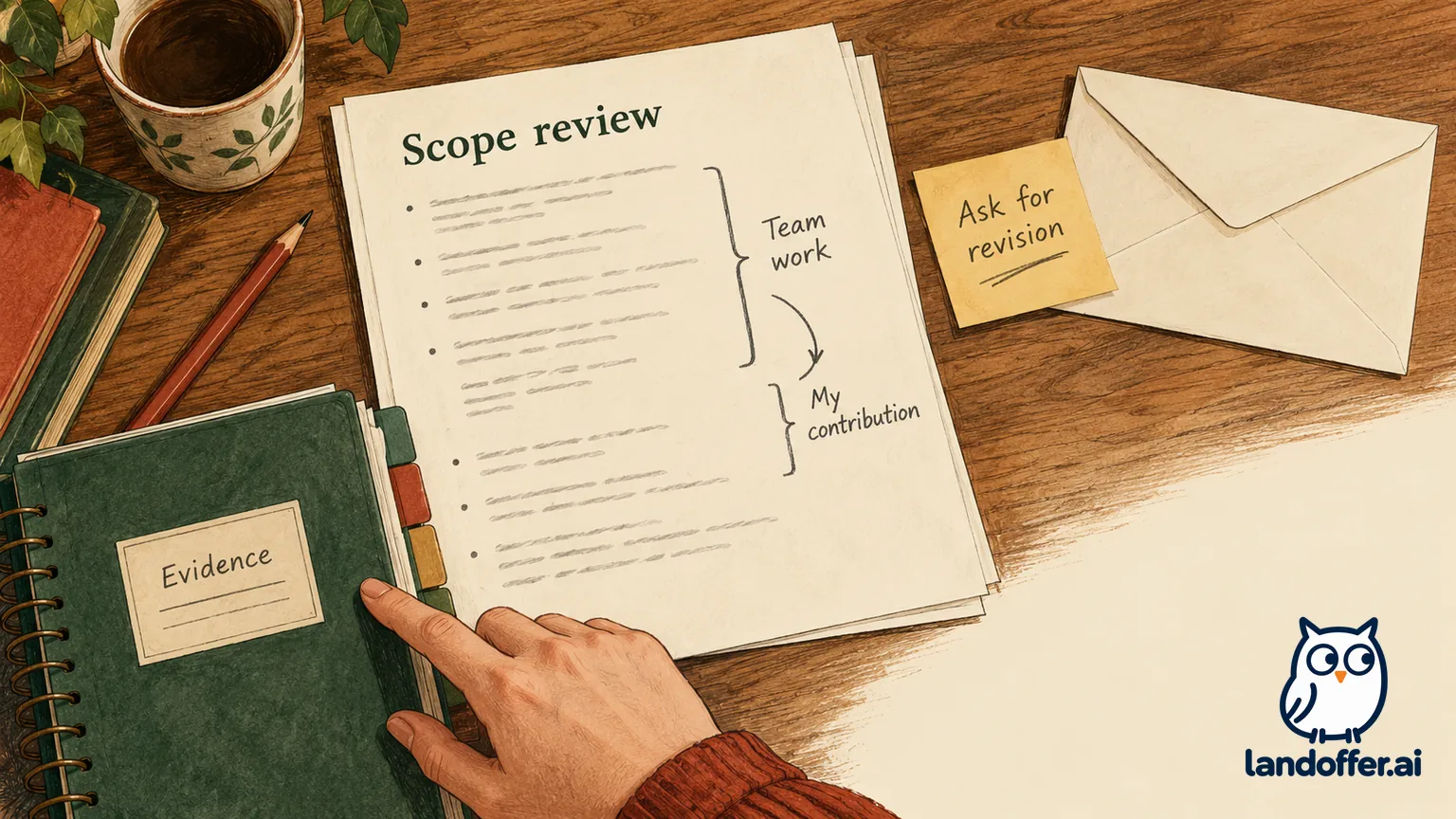
The request for revision should identify the mismatch, not pressure the writer into stronger praise. You can explain which scope is accurate and ask them to revise in their own words. Leave authorship and any revision to the recommender; do not use their account or present your own wording as their independent judgment.
Worked example: Iris reviews scope without manufacturing a testimonial
Fictional data analyst Iris receives a recommendation for a three-month internal reporting cleanup. She organized a field-definition document and reconciled conflicting labels with finance and analytics partners. Her manager approved the priorities, and another analyst owned the reporting pipeline. No revenue effect was measured.
The wording fragments below are invented solely for a review exercise. They are not quotations from a real recommendation or a model endorsement to publish.
| Hypothetical fragment needing review | Iris’s factual boundary | Revision request decision |
|---|---|---|
| “Owned the entire reporting platform” | Iris owned field-definition work; another analyst owned the pipeline | Ask the writer to narrow ownership to the documentation and reconciliation work they saw |
| “Produced a major revenue increase” | No revenue analysis connected this project to an increase | Ask for the unsupported outcome to be removed, without substituting a new metric |
| “Managed the finance team” | Iris collaborated with finance partners; she did not manage them | Ask for the relationship to be corrected |
| “Worked with us throughout the year” | The shared project lasted three months | Ask the writer to use the actual shared period |
Iris’s completed, unsent revision note is: “Thank you for taking the time. Before I display it, could we correct the project scope? My responsibility was the field-definition document and label reconciliation, not ownership of the reporting pipeline or management of finance. The shared project was three months, and we did not measure a revenue effect. Please describe the work you observed in your own words and omit anything you cannot verify.”
She chooses to request a revision rather than add the inaccurate version and hope readers understand its intent. If the revised text accurately describes the shared work, she can consider displaying it. If it still attributes unsupported ownership or results, it remains unsuitable. No real recommendation was accepted, edited or dismissed in this exercise.
Know what accepting, dismissing and hiding mean
LinkedIn documents a Review Recommendation message and controls to Add to profile, Ask for revision or Dismiss recommendation. Its help says acceptance displays the recommendation and sends an update to your network. Do not treat acceptance as a private proofreading step or promise that a job search remains unnoticed.
Dismissal has a separate consequence. LinkedIn says a dismissed recommendation cannot simply be retrieved again; the writer must delete it before you can request a new one. If the issue is a correctable fact, understand the revision option before dismissing. Hiding is another visibility control, not the same action as correcting the writer’s statement.
The visibility guide distinguishes signed-in first-, second- and third-degree viewers from the public profile, which it says displays a count and at most two received recommendations. Recommendations can also appear under the writer’s Given tab. The help page describes those audiences; it does not establish what a particular recruiter sees in their account.
A recommendation on your profile is also different from a separate employment-reference process. Do not assume the writer agrees to recruiter calls, disclosure of contact details or reuse of their words in other materials. Ask for those permissions separately when relevant.
Keep the request independent and the claims authentic
LinkedIn’s Professional Community Policies require accurate, authentic information and prohibit misleading claims about qualifications, experience and achievements. For a recommendation request, that means preserving the actual relationship and contribution instead of using the feature to create an invented employment history or result.
Avoid making your request conditional on a promised recommendation in return. If someone is busy or does not feel able to endorse the work, let the request end without repeated pressure. A recommendation is voluntary; an unanswered request is not evidence of a negative performance judgment.
Finish with an accurate request and a clear review standard: firsthand observation, bounded ownership and supportable outcomes. The other person remains the author of their recommendation. For your next application, use LandOffer and connect the work you claim with evidence you can explain yourself, whether or not a recommendation arrives.