LandOffer
Job search
Application Questions About Relatives at the Company: Disclose the Requested Relationship
Disclose the requested connection and known hiring involvement without treating disclosure as automatic disqualification.
Answer a question about relatives at the company using the relationship definition and organization scope supplied by that application. A first cousin, domestic partner or relative at a subsidiary may be included, excluded or unresolved depending on the wording. Disclose the requested facts accurately; do not assume that every family connection is either irrelevant or an automatic bar to employment.
Separate this disclosure from “Who referred you?” and from a general question about personal conflicts. LandOffer publishes this guide; as you browse recently posted jobs, save each employer’s actual disclosure instructions with the role. The examples below show how to identify a covered relationship, limit the response to relevant information and ask about a definition you cannot confidently apply.
Start with the form’s definition of a relative
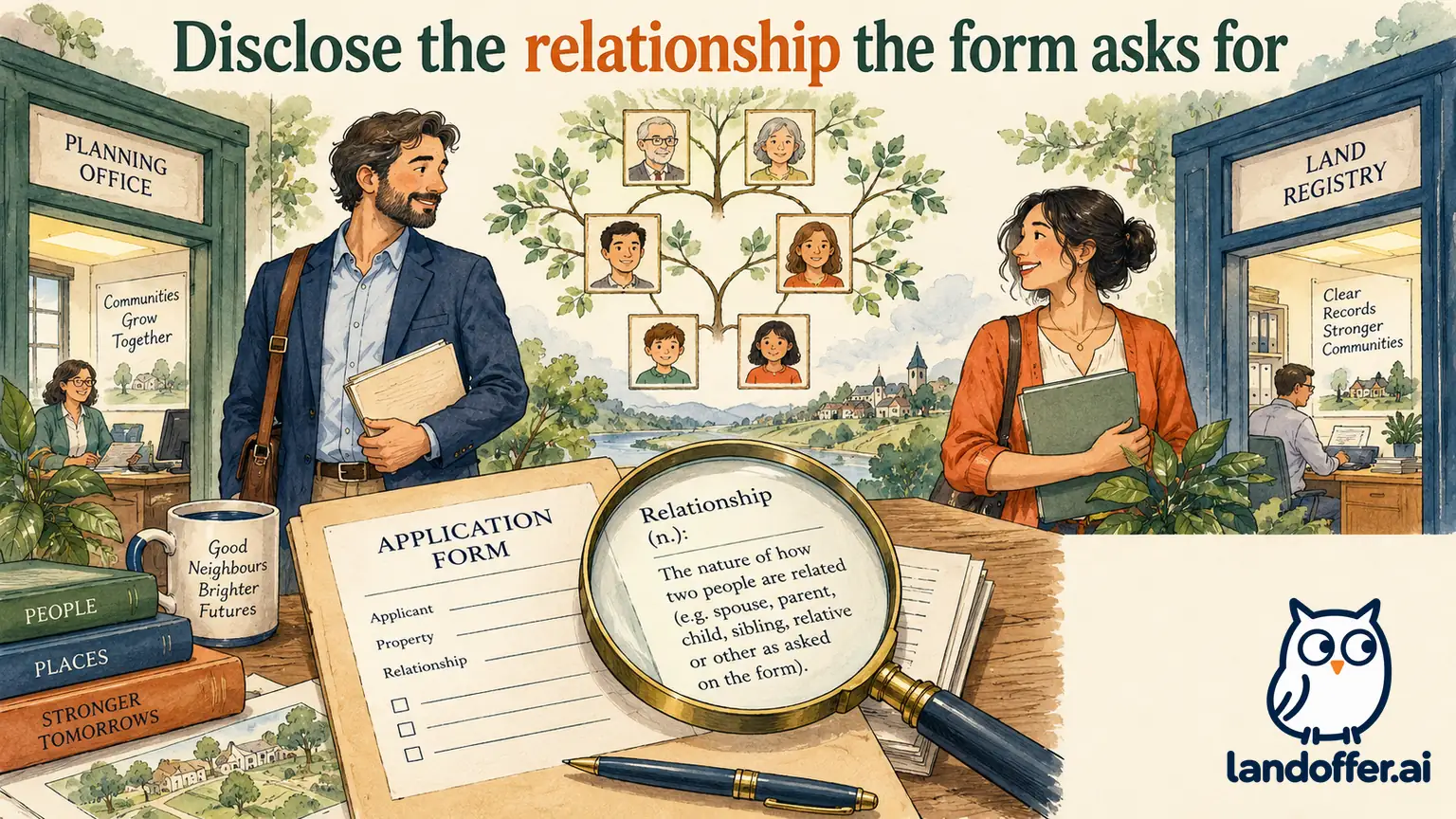
Read the question, help text and linked policy before applying your everyday meaning of family. Some definitions name specific relationships; others include a household member or a close personal relationship. A field about immediate family can cover a different set of people from a field about all relatives. If the form supplies a list, use that list rather than a definition borrowed from another employer.
A public, firsthand example is USGS Form 9-1644, Nepotism Certification. The form’s defined relatives include first cousins, specified in-laws, step relatives and half siblings. It asks about relatives employed in the USGS or the Office of the Secretary of the Interior, and provides fields for their name, relationship and employing office. The publicly hosted form is dated December 2002; it was inspected for this guide on October 12, 2026.
In this particular form, a first cousin is expressly covered, so “only my cousin works there” would not justify a no. It does not mean every employer uses the USGS definition or that you should complete this federal form for a private application. The application in front of you determines the relevant categories.
If a relationship does not fit the supplied labels, describe the relationship plainly through the employer’s clarification route. Do not silently convert a partner to spouse, a cousin to sibling or a household member to a relative. A dropdown mismatch is a reason to ask how to record the fact, not a reason to change the fact itself.
Check the company boundary and the relative’s involvement
“Employed by this company” can mean a named entity or an expressly defined group. Check whether the question includes subsidiaries, affiliates or a parent organization. A shared brand does not settle the boundary. Nor does a different company name establish that a subsidiary is excluded when the instructions explicitly include the group.
Also check the time period. A relative currently employed there, a relative who left years ago and a relative who is also applying are different facts. Answer the period requested. If the question asks only about current employment and you know the person has left, do not describe them as current merely because their profile has not been updated. Where their status is uncertain, verify or state the uncertainty through the available route.
Hiring involvement is a separate issue. A relationship may need disclosure even if the relative has no influence on the hiring decision. Conversely, a policy may ask specifically about supervision, assessment or financial decision-making. Answer those follow-up questions from what you know. Do not infer “no influence” simply because the relative works in another department.
The USGS employment-of-relatives manual distinguishes prohibited advocacy or supervision from situations in which relatives may work in the same organization without those conflicts. Its public manual entry is dated January 21, 2003. This is an agency-specific illustration of the distinction between disclosing a connection and determining whether an arrangement is permitted; it is not a universal hiring policy.
A completed disclosure with a cousin at a subsidiary
The following people, employer, policy, role and answers are entirely fictional. Leo is applying to Bayside Analytics, role BA-730. His first cousin Mei works at Bayside Data Services, a wholly owned subsidiary in this teaching case. The invented application explicitly includes first cousins and employees of wholly owned subsidiaries. It asks for the relative’s name, relationship, employing entity and involvement in recruiting or supervision.
Leo knows Mei’s employer and team. Mei has not referred him or participated in his application. Leo does not know the complete future reporting structure, so he should not make an unlimited claim about every possible supervisory relationship.
| Requested item | Completed entry for the fictional case | Why it belongs |
|---|---|---|
| Relative employed by company or covered subsidiary? | Yes | First cousins and this subsidiary are expressly included |
| Name | Mei Chen | The form requests an identifying name |
| Relationship | First cousin | Specific relationship rather than vague “family” |
| Employing entity and team | Bayside Data Services; data operations | Distinguishes the subsidiary from the hiring entity |
| Referral or selection involvement | No referral or selection involvement known to me | Describes Leo’s knowledge without inventing access to internal decisions |
| Future supervision | Reporting relationship not yet confirmed; please review | Keeps an unresolved organizational fact visible |
A completed explanation could read:
My first cousin, Mei Chen, works in data operations at Bayside Data Services, which the application includes as a subsidiary. She did not refer me and has not participated in my application to my knowledge. Please review any potential reporting relationship for BA-730.
The answer records the connection requested by the form. It also does not claim that the relationship has been approved or that Leo is guaranteed to remain eligible. The employer still needs to apply its policy to the actual position.
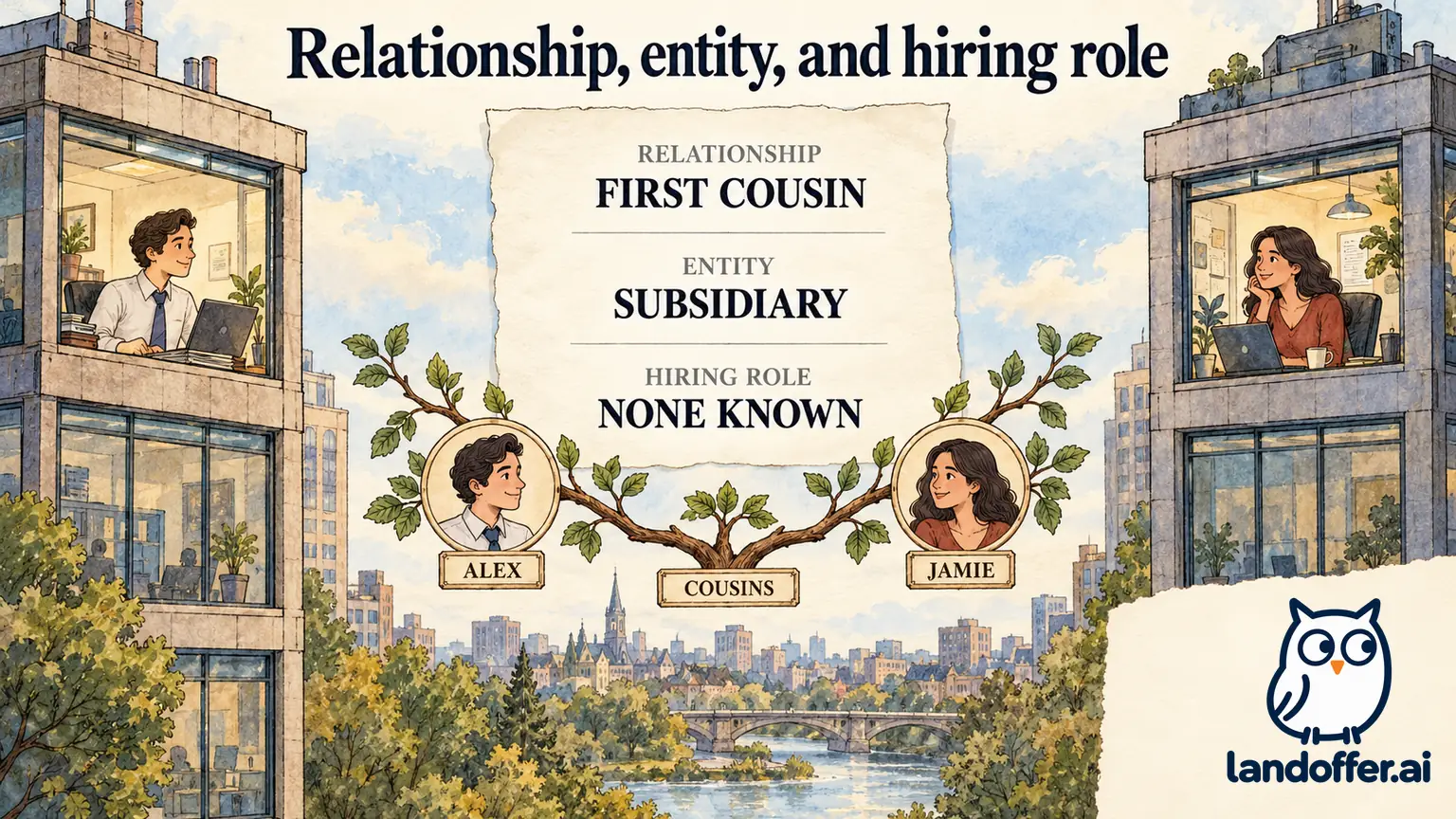
If the same invented form excluded cousins, the yes/no result could differ. If it included cousins but did not define subsidiaries, the entity scope would remain unresolved. Keep those changes attached to the wording. Do not reuse Leo’s answer as a universal rule for every cousin or every corporate group.
Keep a relative disclosure separate from a referral
A relative can work at the company without referring you. A friend can refer you without being a relative. These are independent questions, even when the form places them next to each other. Filling one field does not necessarily satisfy the other.
Consider a second fictional example. Priya found a role on the employer’s public career site. Her brother works there, but he did not send her the role or contact recruiting. A question about relatives that includes siblings requires the appropriate disclosure. A question asking how she found the role should still reflect the public career site, according to its available options. She should not select employee referral simply because she has a brother on the payroll.
If an employee actually referred you, follow the employer’s referral instructions and state the relationship when separately requested. Do not ask a relative to conceal the connection or influence a decision that policy prohibits them from influencing. The public USGS example has particular advocacy restrictions; another employer’s rules may differ. Check the relevant process before assuming family referrals are permitted or prohibited everywhere.
Likewise, an answer about relatives should not become a list of every friend, acquaintance or former colleague at the company. If a separate conflict question includes close personal relationships, answer that separate scope. The point is complete disclosure of the requested category, not indiscriminate disclosure of your social network.
Provide enough information without adding private family details
Use the employer’s requested identifiers and a short description of the relationship. Provide the fields the employer requests so it can locate the relevant relationship; do not add a family history to fill an otherwise concise disclosure. Follow the actual instructions and use an authorized channel for any additional information.
Avoid adding unrelated home addresses, personal phone numbers, compensation, medical information or family circumstances. These details do not automatically help the employer identify a workplace conflict. If a required field asks for information you do not know or cannot appropriately obtain, ask why it is needed and how to proceed. Do not fabricate an employee number for your relative or upload their private employment records.
You also cannot promise who will see the answer without evidence about the employer’s process. If visibility matters, ask whether the disclosure goes to recruiting, HR or an ethics team and how corrections are handled. A small lock icon or a generic privacy statement does not establish the actual review path for that particular field.
Keep your own copy limited too. Save the wording, your answer, the role reference and any instructions, rather than collecting a detailed family dossier. Update the record if the relevant employment status or relationship changes while the application remains active, following the employer’s directions.
When the policy is unclear, ask a narrow question
Suppose Leo’s application instead says only “Do any relatives work for Bayside?” It supplies no family definition and no company-group scope. He knows his cousin works for the subsidiary, but the binary question does not tell him whether that relationship falls within it. His completed clarification request could be:
For BA-730, does the relatives question include a first cousin employed by Bayside Data Services rather than Bayside Analytics? I can provide the requested name, relationship and team through your disclosure process. Please confirm the scope and where to record it before I certify the answer.
The request identifies the first-cousin and subsidiary questions and offers the requested identifying details. It asks recruiting to define the covered relationship and entity. It also avoids attaching private records before the recipient and channel are confirmed.
Use a provided explanation or unknown option when it accurately fits. If the form blocks progress with a required binary choice and no definition, preserve the question and seek instructions promptly. A deadline may make the request urgent, but it does not supply a missing policy definition. Keep the field unresolved rather than disguising an assumption as confirmed knowledge.
Employer policies can handle disclosed conflicts differently. Dartmouth’s employment-of-relatives policy, revised December 1, 2025, restricts hiring, direct supervision and institutional decisions concerning family members unless specified approval and conflict-management conditions are met. That is a bounded institutional example. It does not tell you whether your prospective employer will require reassignment, additional review or some other response.
Correct the answer when the underlying fact changes
Before submitting, check the relationship label, current employment status, company entity and any hiring-role statement. Read the final summary if autofill supplied a saved no from another employer. Company scope can change across applications even when your family facts stay the same.
If you discover an omitted relationship after submission, contact the employer through its correction or disclosure route. Name the existing application, identify the field and provide the corrected requested fact. Ask how the correction will be attached to the record. Do not assume that changing a general profile will update an already certified application.
If a relative joins the employer during an active process, check whether the policy requires an update. Follow its timing rather than assuming only the initial submission matters. The USGS form expressly addresses a new certification when changed circumstances invalidate the old one; that requirement belongs to that form and should not be generalized to every application’s procedure.
Take one posting from LandOffer’s recently posted jobs and read its actual relationship disclosure before reusing an answer. Record the included relatives, covered entities and requested details. Confirm an unclear relationship or entity boundary before certification, then save the limited disclosure and any employer instruction with the application.
Sources and Further Reading
- USGS Form 9-1644: Nepotism Certification — firsthand defined relationships and requested disclosure fields; December 2002 form inspected October 12, 2026.
- USGS: employment of relatives — agency-specific advocacy, supervision and certification context; January 21, 2003 manual entry.
- Dartmouth: employment of relatives — institution-specific conflict-management and approval conditions; revised December 1, 2025.