LandOffer
Job search
Referral Link, Employee Name, or Recruiter Introduction: Which One Does the Form Require?
Interpret referral and source fields using the actual prompt, contact permission and employer process. Includes six completed field examples and a case involving both an employee and a recruiter.
Use the input the application form actually requests. A referral URL is a route into an application, an employee-name field asks for a person, and a recruiter introduction describes a contact event. They can be related, but none automatically substitutes for the others. Read the label and help text, confirm the person's permission, and ask the employer when the required choice does not fit what happened.
LandOffer publishes this guide. If you discover a recent role on LandOffer.ai and later receive help from an employee or recruiter, keep both events in your notes. This guide uses public documentation reviewed October 12, 2026 and fictional form examples. It does not test attribution inside an employer account or promise referral credit.
Read the question before choosing the most impressive source
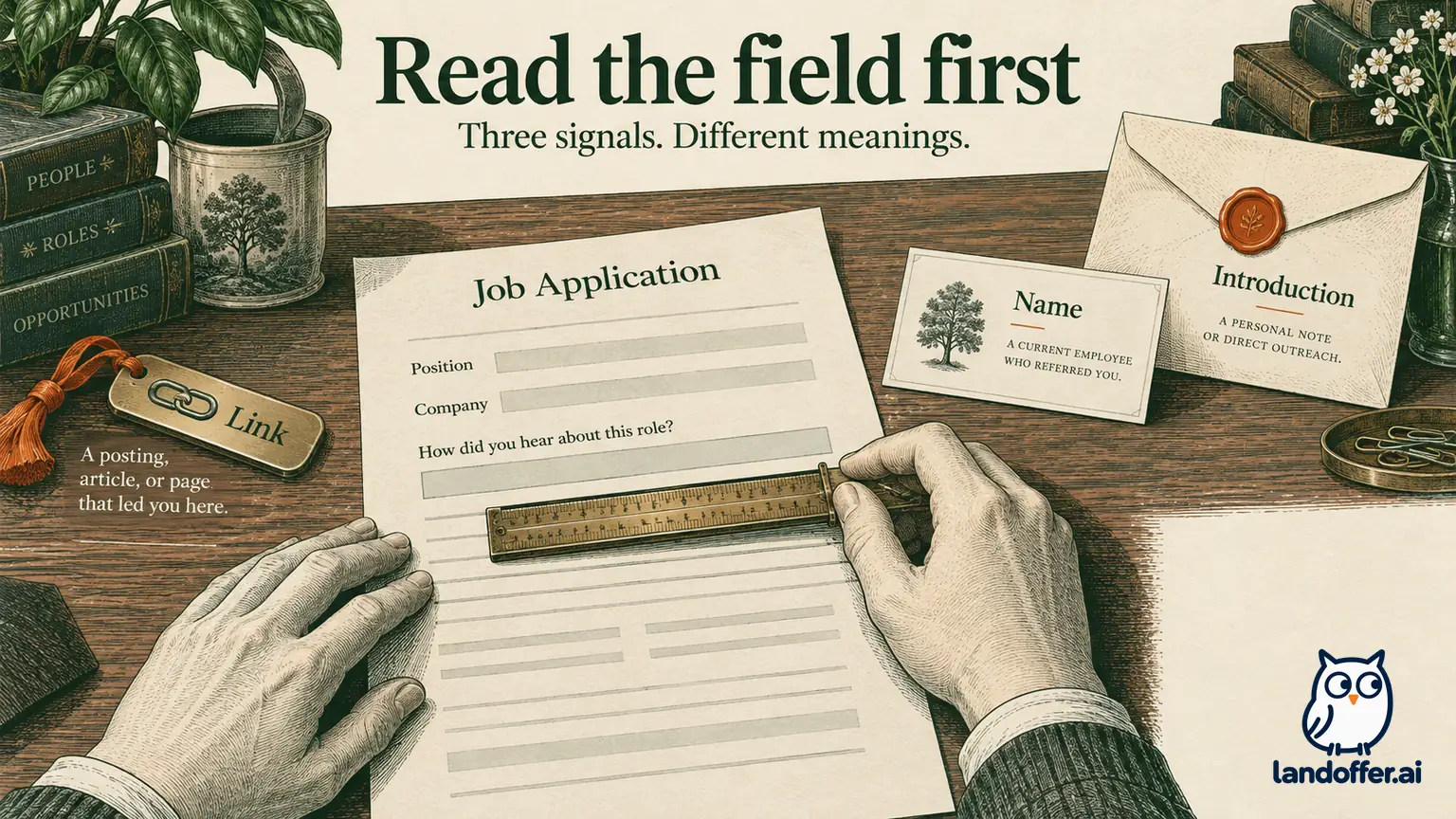
Start with the exact wording. “How did you hear about this opening?” may ask for a discovery source. “Were you referred by a current employee?” asks about a particular relationship or process. “Employee email” requires a specific identifier. A required field does not give you permission to invent the answer it appears to prefer.
Look for help text and the options that appear after a selection. Choosing Employee referral may reveal a name field, email field or code. Those additional controls can clarify what the employer wants, but they do not establish that an internal referral has already been recorded. Answer from what happened and what the instructions say.
Do not list a person you found on a company directory simply because the form accepts the name. If someone shared a public vacancy in a group, that is evidence of a shared vacancy. It is not necessarily permission to describe them as your employee referrer or as a professional reference willing to discuss your work.
Keep the source question separate from the qualifications section. A truthful source answer cannot replace relevant experience, and there is no evidence here that selecting one label gives an application a universal ranking advantage. The useful aim is accurate attribution and a complete application.
Three referral signals can lead to different records
Greenhouse documents unique referrer links associated with a user. When someone applies through one, that user is credited as the applicant's source. The feature must be enabled by the organization, and a link can target a job board or a particular posting. That is a documented mechanism, not proof that every URL sent by an employee is a referral link.
An employee can also submit a referral internally. The candidate may not fill a name field at all during that internal action. Greenhouse's Who Gets Credit guidance describes referrer information maintained in the recruiting system, including administrator changes. A candidate's free-text answer and that internal field should not be treated as automatically synchronized.
A recruiter introduction is different again. A recruiter may invite you to apply, ask for a resume, or connect you to another member of the hiring team. Preserve the instructions in that conversation. A recruiter's employer alone does not settle the source category. Follow the form's definition or ask which option applies.
The distinction also depends on employer policy. GitLab's published referral process distinguishes referrals from endorsements and explicitly excludes someone applying through a unique Greenhouse link shared on a social site from its definition of a referral. This shows why technical source credit and a company's referral-program rules are separate questions.
A field-to-evidence map you can use while applying
The following entries are fictional form examples, not standardized labels used by every employer. Each row gives a completed response for the stated facts. Your form's instructions control the actual answer.
| Form wording | Facts in the example | Appropriate response or next step |
|---|---|---|
| How did you first hear about this job? | Candidate first found it on a job board; employee helped later | Select that job board, if listed; preserve the later help separately |
| Name of employee who referred you | Elena Ortiz agreed to refer the candidate and confirmed the process | Enter Elena Ortiz as requested; do not paste her referral URL into the name field |
| Referring employee's work email | Candidate knows Elena's name but has not confirmed her work email | Ask Elena for the identifier she authorizes; do not guess an email pattern |
| Referral code | A recruiter sent an ordinary invitation URL with no code | Ask whether a code is required or supplied separately; do not extract random URL characters |
| Referred by a current employee? | Candidate only saw a public post by an employee who does not know them | Do not claim a personal referral on that evidence |
| Recruiter or agency contact | A recruiter directly introduced the role and asked to be named | Use the instructed category and approved identifier; confirm if the wording is ambiguous |
The first row is particularly easy to mishandle. A form asking where you first learned about the opening is asking a different question from one asking who later recommended you. Keeping both events lets you answer the discovery question accurately and explain the later referral if recruiting asks. Keep the chronology, answer the stated question, and use an optional explanation only if it serves that field.
If the form says “select all that apply,” more than one truthful category may be appropriate. If it allows only one choice and several events fit, use the help text or ask the employer which event it intends to measure. Do not assume that the first, most recent or most senior contact automatically controls attribution.
Use an authorized link without inventing its meaning
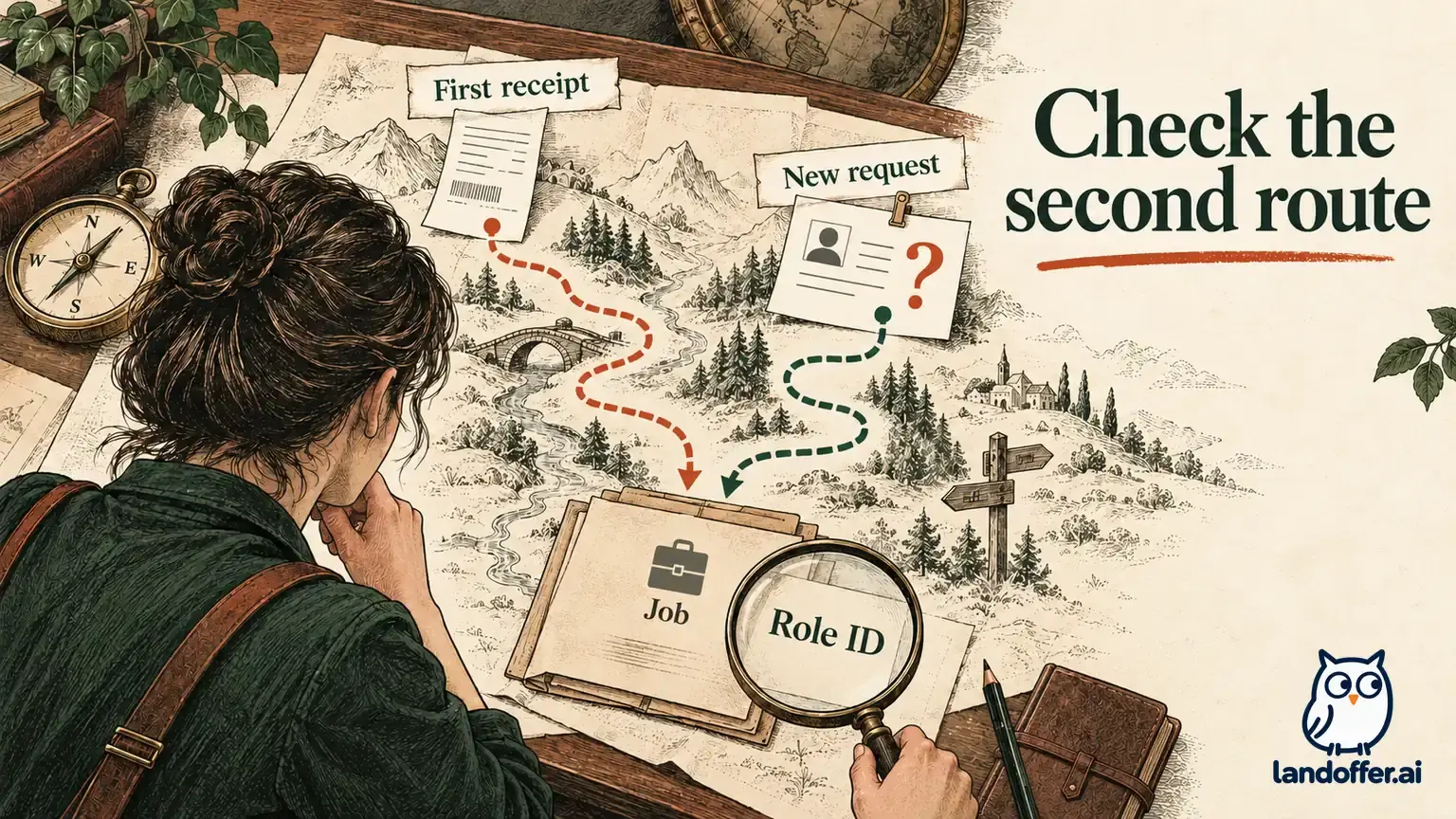
When an employee sends a link intended for your application, ask whether you should apply through it or wait for an invitation. Check the employer, job title and role ID after opening it. A board-wide link may require choosing the intended posting; a role-specific link may become stale if the job closes.
Keep the original link privately and use the provided route as instructed. Avoid shortening it or removing parameters merely to make it look cleaner. At the same time, a long URL is not proof of referral status, and a tracking parameter does not establish that the employee personally endorses you.
Do not edit a URL to insert an employee name, copy a code from someone else's application, or exchange identifiers with another candidate. The employer may have a separate internal record or eligibility rule that you cannot see. Ask the employer or referrer to correct the route; do not construct a replacement link yourself.
If the link fails, report the role and error to the sender through the existing conversation. Ask for a current route. If an ordinary public application is still available, check the employer's instructions before switching; do not promise yourself that the same attribution will survive the change automatically.
A completed case with an employee and a recruiter
Theo, Elena Ortiz, recruiter Sam and Harbor Finch are fictional. Theo first finds Harbor Finch role HF-506 on a job board. Elena, a former teammate now employed there, agrees to refer him and sends a role-specific link. Later, Sam contacts Theo about the same opening and supplies a general careers link.
Theo's form asks both “How did you first hear about this job?” and “Name of employee who referred you.” Those are separate questions. Under the example's stated facts, he selects the job board for the first and enters Elena Ortiz for the second. He does not put Sam's name into the employee-referrer field merely because Sam's message arrived later.
Before submitting, Theo tells Sam that Elena has already provided a referral route. He asks whether to continue through that route or use Sam's invitation. In this fictional case, Sam confirms that Theo should finish the existing referral route and that recruiting will confirm how the employee and recruiter contacts are recorded. Theo submits one application and saves its role-specific acknowledgment.
| Event | Evidence retained in the example | Final treatment |
|---|---|---|
| Job discovered | Job-board listing for HF-506 | Truthful first-discovery answer |
| Employee help | Elena's permission and role-specific link | Elena named in the employee field |
| Recruiter contact | Sam's introduction and clarification | Contact retained; no second application |
| Route decision | Sam confirmed use of existing referral route | One route followed |
| Submission | Acknowledgment for HF-506 | Application recorded once |
The completed result is one submitted application with an accurate chronology. Theo has not independently inspected the employer's internal attribution fields, and the acknowledgment does not prove bonus eligibility or hiring priority. The case resolves what Theo should enter and do, while leaving internal credit to the employer.
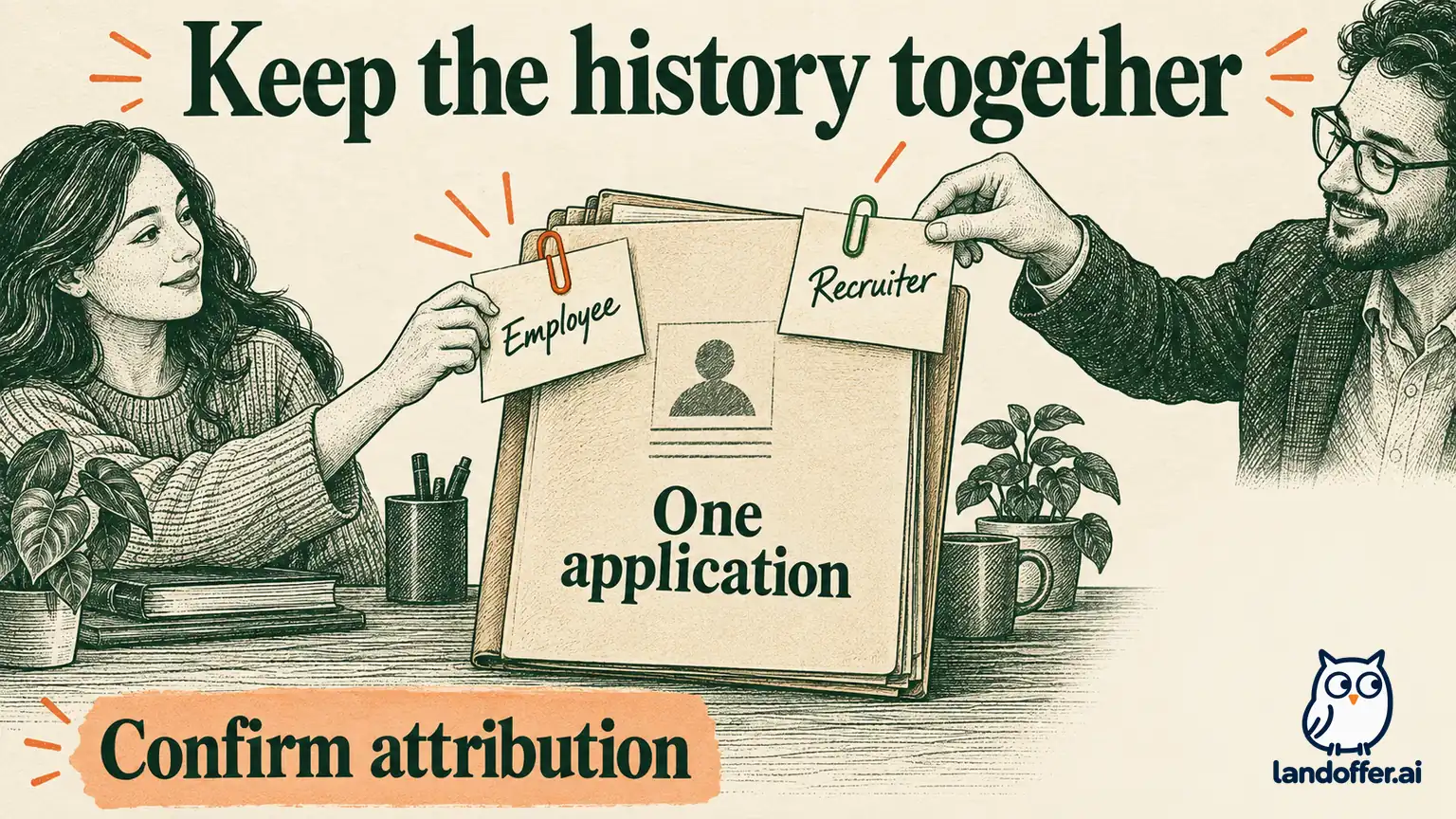
If Sam had instead confirmed that an application already existed and requested a supplemental form, Theo would follow that instruction rather than submit a fresh public application. If the two contacts gave conflicting directions, he would quote the conflict and ask recruiting to resolve it. The latest message is useful evidence, but it does not automatically cancel an existing record.
Handle two employee contacts transparently
Two people may offer help with the same role. Tell each that another contact is involved before asking either to repeat an internal submission. Explain the job ID and what has already happened. You can appreciate both people's help without promising both that they will receive formal credit.
Ask the employer how it handles overlapping referrals. The reviewed sources do not establish a universal first-referrer, last-referrer or multiple-credit rule. Two recommendations also do not establish a doubled hiring advantage. Do not create duplicate applications or alternate candidate emails to try to preserve separate claims.
A concise, unsent example is: “Thank you for offering to help with HF-506. Elena has already sent a referral link, and I have not submitted yet. Before either of you takes another step, could we confirm the employer's preferred route? I want to keep one accurate application record.” Adapt it to your actual submission state.
If one person only shared a public posting and another agreed to a formal referral, preserve that distinction. Do not upgrade the public share into an endorsement to make the two events appear equivalent. Permission and the employer's process matter more than the number of names you can enter.
Repair a mistaken answer without rewriting the history
If the form is still a draft, correct the field from the verified facts and recheck any related fields. Changing a source dropdown can reveal or clear another input. Review the final summary if available; do not assume an earlier employee name remains correctly associated after a category change.
If you already submitted, keep the receipt and ask the employer how to correct the existing record. State the field, the submitted value and the intended correction. Do not withdraw and reapply as a default attribution repair. The separate referral timing guide explains why post-application help may need a different route.
Greenhouse's referral-editing guidance says referrers cannot edit a submitted referral and should contact their site administrator for changes. That illustrates why the person who helped you may need internal assistance. It does not mean every employer allows every requested change or that applicants have the same permissions.
When the employer responds, save exactly what was confirmed. “Recruiter acknowledged correction request” is different from “source changed.” If the employer cannot change attribution, keep its explanation with the application record. Your responsibility is to report the facts accurately; the employer decides whether its record can change.
Submit the facts the form asks for
Before the final action, compare the source answer with the actual question, the employee name or email with the details that person authorized, and the route with the employer's instruction. Keep your application email and role ID consistent. If a required field cannot be answered truthfully, ask for help rather than inserting a convenient name or code.
Referral information is one part of an application, not a replacement for completing it. Save the resulting confirmation, keep contact permission and route instructions privately, and record internal attribution only if the employer confirms it. You do not need to convert every friendly introduction into a formal referral claim.
For your next search, browse recent roles on LandOffer.ai and note where you found each opening. When an employee or recruiter later helps, add that event to the same role history. Use that history to answer each field. Ask the employer to resolve any remaining credit question before creating another application.