LandOffer
Job search
Public Trust vs. Security Clearance: What Federal Tech Job Listings Actually Require
Two real postings with mixed vetting language show how to classify requirements without treating Public Trust as a lower classified-access clearance.
Public Trust is not a security clearance. A federal technology job can require a background investigation, a suitability or fitness determination, facility credentials, or eligibility for classified access. Those requirements answer different questions. Read the actual position's conditions before treating a Public Trust label as a lower level of Secret clearance.
LandOffer publishes this guide and offers a place to browse recent roles. This documentation review uses official guidance and public postings checked on October 12, 2026. Two actual examples contain mixed terminology; the completed annotations below identify what needs clarification. They do not establish anyone's eligibility or predict an investigation outcome.

Start with the kind of decision
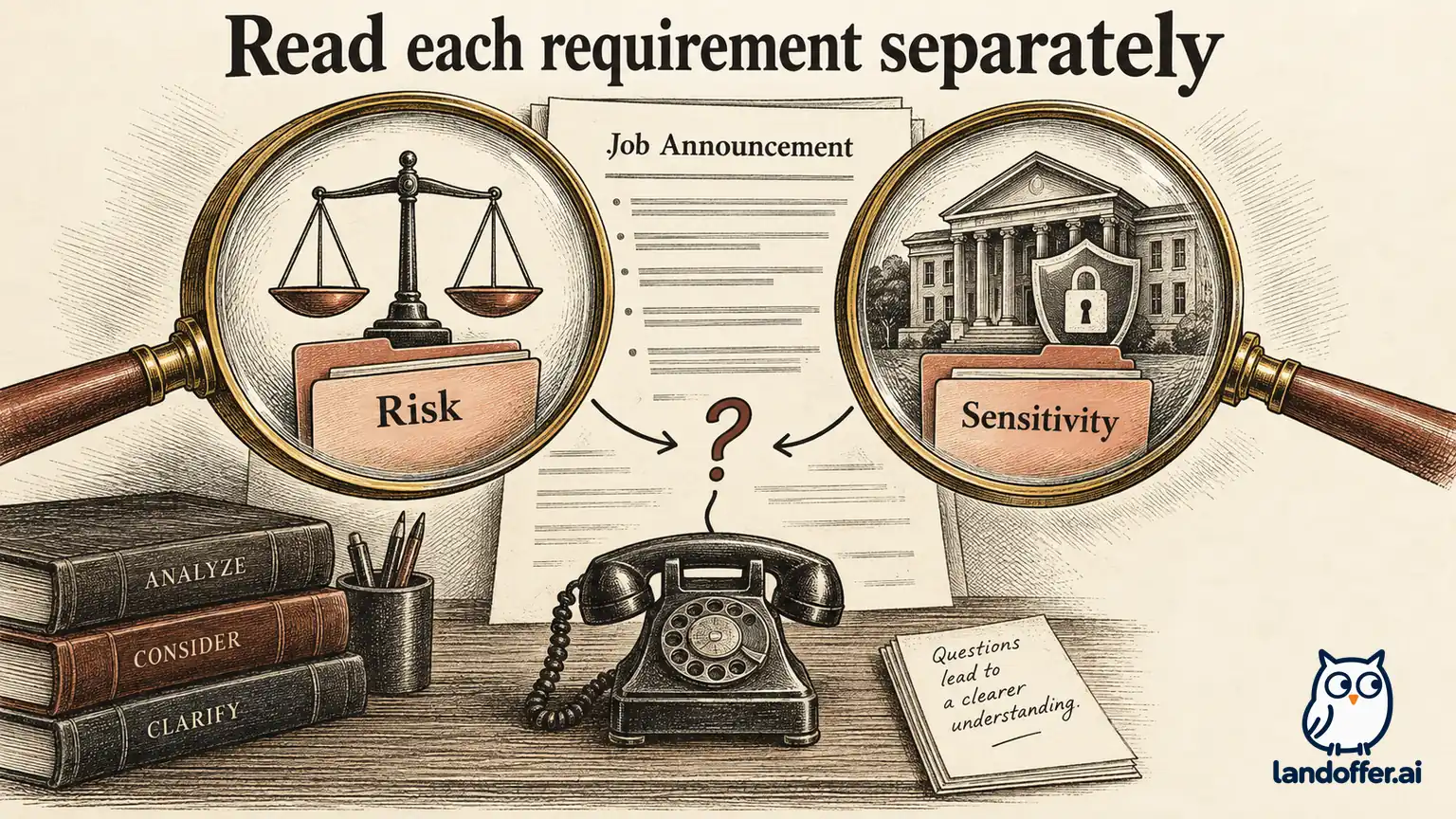
The USAJOBS background-check guide explicitly distinguishes Public Trust investigations from security clearances. It also separates position risk, which concerns possible harm to public trust, from sensitivity, which concerns national security. Its credentialing section concerns access credentials for government facilities and systems.
Those distinctions change how you read a listing. High risk does not mean Top Secret. A reference to systems access does not, by itself, identify classified information. The title Software Engineer cannot settle which determination applies.
DCSA's trust-decision overview distinguishes suitability under 5 CFR Part 731 from agency-specific contractor fitness determinations. It separately describes national-security eligibility for Confidential, Secret and Top Secret access. These are official descriptions of different decisions, not interchangeable qualifications a candidate can claim after completing any background check.
Start a posting annotation with the requested decision and the responsible organization, so you know which question must be resolved before tailoring. Leave the outcome blank unless you have verified information you may accurately represent. A recruiter screening for the customer and the government office making a determination have different roles.
A completed terminology-to-contact map
The following map translates common posting language into a useful next question. The definitions come from the linked official guidance; the suggested questions and contact routing are editorial recommendations. Ask the employer to identify its actual office rather than assuming every agency uses the same arrangement.
| Wording in the posting | What to separate | Useful clarification and starting contact |
|---|---|---|
| Public Trust or SF-85P | An investigation requirement from classified-access clearance | Ask recruiting or agency HR which position designation and determination apply; request the personnel-security contact if needed |
| Moderate or high risk | Position risk from Confidential, Secret or Top Secret | Ask HR or personnel security which risk designation applies to this specific seat |
| Sensitive position | National-security sensitivity from a generic background check | Ask personnel security what designation, investigation and access conditions apply |
| Secret or Top Secret | Classified-access eligibility from Public Trust terminology | Ask recruiting about required timing and the security office about verification |
| Facility or system credential | Credentialing from authority to access classified information | Ask the onboarding or credentialing contact which process is required |
| Other or unspecified | An incomplete label from a complete position requirement | Ask the hiring contact to reconcile the overview with the detailed conditions |
Use the map to identify which requirement the posting leaves unclear.
A software role handling important government data can have serious responsibilities without every dataset being classified. Conversely, a posting with a reassuring background-check label may contain an additional classified-access condition elsewhere. The relevant evidence is the full requirement, including any customer or selected-position qualifier.
Do not select your own questionnaire because a blog mentions a form number. The hiring organization should provide the applicable instructions through its authorized process. Downloading a blank questionnaire does not establish that the organization initiated processing or that you received a favorable determination.
Example one: a contractor posting mixes three descriptions
The Leidos Senior Systems Integration and Test Engineer posting, requisition R-00194366 with a location suffix, was readable during this review. Its original posting date is October 9, 2026. The Ashburn role concerns integration and testing for flight-service software supporting an FAA program.
The public metadata labels its clearance field Public Trust. The narrative describes obtaining and maintaining a favorable Public Trust investigation. A qualification refers to SF-85P while calling the result a clearance. A separate responsibility says selected applicants must meet eligibility requirements for access to classified information.
The complete reading therefore contains an unresolved question: is classified access actually required for this position, and if so, what additional designation and clearance requirement applies? The guide's definition explains why the Public Trust label cannot answer that question. Keep the classified-access sentence in the annotation until the employer explains whether it applies.
Other requirements remain visible. The posting lists U.S. citizenship, integration and automated-testing experience, and degree/experience combinations. It also describes hybrid work and travel. Calling the Public Trust wording imprecise does not waive those independent conditions.
If this is an attractive role, the next useful action is a requisition-specific clarification. Ask about the conflicting requirements before describing yourself as holding the required clearance or assuming the role needs none. The uncertainty belongs in the record even if your technical experience is strong.
Example two: a federal register covers different selected positions
The GSA AI software-engineer announcement, control 883691200, demonstrates another problem. Its overview lists the security-clearance field as Other. The detailed conditions say requirements depend on the selected position and list Top Secret, Secret and several risk designations together.
The same paragraph requires the applicable investigation and says the required approval must be granted before starting. This is a standing register covering potential selections, so the overview does not identify one uniform security condition for every future seat.
Do not translate Other into Public Trust, no clearance, or active clearance required. None of those interpretations follows from the label alone. Ask which specific position is under consideration, its risk and sensitivity designation, and whether it requires classified access.
The completed comparison shows the different clarification each posting needs:
| Reading question | Leidos R-00194366 | GSA 883691200 |
|---|---|---|
| Why is the short label insufficient? | Public Trust appears alongside classified-access language | Other covers selection-dependent conditions |
| What is already stated? | Favorable investigation, SF-85P reference and additional eligibility language | Requirements depend on the selected position; approval precedes start |
| What should be clarified? | Whether classified access applies and what separate requirement follows | Which seat, risk, sensitivity and access conditions are relevant |
| Who starts the question? | Employer recruiting, with customer/security clarification | Agency hiring contact, with personnel-security clarification |
| What cannot be concluded? | That Public Trust is Secret, or that the classified-access sentence can be ignored | That all positions share one clearance or risk designation |
These examples are useful precisely because the public text does not give a clean final classification. The completed outcome is a defined clarification task, not a forced comparison between two supposedly equivalent clearances.
A finished clarification record
Fictional teaching case: Omar is an integration engineer considering the Leidos example. He has relevant software-testing experience but has not established the exact investigation and access requirement for this requisition. This is an invented screening exercise, not a real application or employer response.
Omar records the role as held for clarification. His note contains the requisition, source URL, checked date, the Public Trust/SF-85P references, and the separate classified-access sentence. He leaves the actual clearance level and processing sequence unresolved.
He then prepares this fictional, unsent inquiry:
Subject: Vetting requirement clarification — R-00194366, Ashburn
Hello Recruiting Team,
I am reviewing the Senior Systems Integration and Test Engineer posting. It describes a favorable Public Trust investigation and references SF-85P, while another sentence mentions eligibility for access to classified information.
Could you confirm the investigation and determination required for this specific position? Does the role also require a national-security clearance or classified access? If so, which requirement applies, when must it be met, and which security contact can clarify the process?
Thank you.
The inquiry asks the employer to explain the job. It does not ask a recruiter to evaluate Omar's personal history or promise an approval. No identity documents or investigation records are attached.
For GSA, Omar would change the question rather than reuse the message unchanged: Which selected position is being considered, and what risk, sensitivity and classified-access requirements apply to that seat? The announcement's selection-dependent wording makes the position itself the missing fact.
Omar's completed record has a concrete result: two roles held for different reasons and two targeted questions. He can continue reviewing clear opportunities while those questions remain unanswered.
Interpret the reply without expanding it
Suppose an employer says a role requires only a Public Trust investigation and supplies the applicable process. That answer can resolve the job-description ambiguity. It still does not establish a favorable determination for you, transferable classified access, or completion of every onboarding requirement.
If the reply confirms a separate Secret requirement, record it separately. Then read whether the posting requires current status for consideration or allows a process to obtain it. That is a timing question after the type of requirement has been identified.
A reply such as “standard government background check” may leave the important distinction unresolved. Ask for the position-specific designation or the responsible office. Save the reply's exact wording with the requisition; leave the designation unresolved if the answer does not identify it.
If the employer changes the requirement, retain the dated clarification alongside the posting. Ask whether the updated information applies to your exact requisition and location. A statement about another team or customer does not settle the conditions of this role.
Keep application declarations accurate
A generic application field may offer only clearance levels, even when the description discusses Public Trust. Do not choose Secret to approximate a prior investigation. Likewise, a previous employer's background check is not evidence that you hold the government status this employer requests.
Read the field's help text and available choices. If a truthful answer is unclear, ask the verified recruiting contact how the field should be interpreted. An explanatory note can identify the issue, but it should not accompany a checkbox you know misstates your status.
Separate having completed paperwork from receiving a determination. Also separate an earlier determination from what the new organization must verify or require. This guide cannot inspect your record or establish that a previous result satisfies another position.
Use the authorized security or personnel process for personal information once the organization identifies it. A first recruiting question can usually describe the conflicting public sentences without reproducing Social Security numbers, detailed histories or confidential records.
The goal is an accurate application statement and a clearly understood job condition. Keep an unverified status unresolved, and answer required disclosures accurately through the authorized process.
Decide what to do before tailoring
For a clearly described Public Trust position, review its other conditions and qualifications without adding an invented active-clearance barrier. For an explicit classified-access requirement, check both the level and timing. For conflicting language, hold the role with a specific question and contact.
Hiring-path eligibility remains separate as well. A federal announcement may restrict who can apply regardless of the investigation it requires. Review the announcement’s eligible applicant groups before investing in a role whose hiring path does not fit your circumstances.
LandOffer has an interest in job-search tools. An existing document is enough for this annotation; neither a search filter nor a tracker can issue a government trust determination. Keep the employer source and the unresolved condition together.
For your next search, choose one recent technology role on LandOffer.ai, identify its vetting terms, and classify it as clearly described or needing a position-specific clarification. Review the separate qualifications if the requirement is clear; otherwise, write the position-specific question and identify the office that can answer it.