LandOffer
Workplace Communication
A Project Deadline Is at Risk: Present Options Before Asking for More Time
Compare checked scope, staged-delivery and date options against actual dependencies, then request an authorized decision and record the revised baseline.
When a project deadline is at risk, raise the risk while a useful choice remains. Check the remaining work with its owners, identify which constraints can change, and compare feasible options for scope, delivery sequence, resources, or date. Then ask the authorized person to choose, explaining what each option gives up. Support a proposed date with the remaining work sequence and obtain the required approval.
LandOffer.ai publishes this guide for people handling an active delivery risk. The completed preset-library example is fictional. Its estimates, workdays, owner confirmations, and messages are invented teaching inputs; no software was tested, stakeholder contacted, or revised commitment made in a real project.

Raise the risk before the options disappear
You do not need a perfect recovery plan before saying that the current commitment is threatened. Explain what changed, which commitment is affected, and when you will return with checked options. Waiting for certainty can leave the decision owner with fewer choices. Keep uncertainty explicit rather than presenting an unsupported revised date as established fact.
Identify the agreed baseline first: the deliverable, intended audience, acceptance requirements, date, and approving authority. Separate the project's target from the reason behind it. A delivery date chosen to leave preparation time before an event may have different flexibility from the event itself. Ask which constraint is actually fixed rather than assuming both can move.
Atlassian's trade-off analysis play asks teams to discuss flexibility in cost, scope, quality, time, and risk, and revisit the discussion when information changes. That is a method for examining priorities. It does not mean a project team may independently relax a contractual requirement, safety control, or employer approval rule.
Be specific about the decision window. If an option requires changing tomorrow's staffing or informing a partner today, explain that timing. “Please decide soon” gives the recipient no basis for prioritizing the request. “We need the scope decision before preparation begins on Day 3” connects the request to work that will otherwise proceed on the wrong assumption.
Rebuild the remaining sequence with the people doing it
Ask owners about the work still required, dependencies, available capacity, review needs, and release steps. Use remaining effort rather than the original estimate minus time elapsed. A task can be mostly implemented while its hardest uncertainty remains unresolved. A high completion percentage does not establish a plausible finish date.
Identify which activities depend on a completed predecessor and which can genuinely overlap. Check who would perform any parallel work and what review or rework it could create. “Add someone” is an option to investigate, not a valid estimate until an appropriate person is available and the work can benefit from their help.
Asana's discussion of fast tracking and crashing distinguishes overlapping activities from adding resources and discusses dependency, capacity, cost, and quality risks. Those categories help formulate questions. They do not establish that either technique will shorten your particular software project or that overtime is available.
Preserve necessary acceptance checks in every option. If a proposed smaller release has different checks, explain why its scope and audience justify that difference and who can approve it. Calling an unverified full release a “pilot” does not resolve the underlying risk. A staged option needs a real boundary and a plan for the remaining work.
Worked example: three checked scope-and-date options
The fictional Cadence audio editor is adding a preset library with browsing, tag filtering, and shared presets. The agreed release target is the end of working Day 5. A partner training session on Day 7 needs the shared-preset capability. The example assumes that the product sponsor, Ren, can approve a changed release target; the training date is fixed.
On the morning of Day 3, the team finds an unresolved shared-preset validation problem. Browsing and tag filtering are implemented. Engineer Kai estimates two full working days for the shared-preset work. QA owner Morgan needs the completed change before one day of its acceptance checks. Release owner Devon then needs one day for packaging and the release process. These are supplied fictional estimates, not a benchmark.
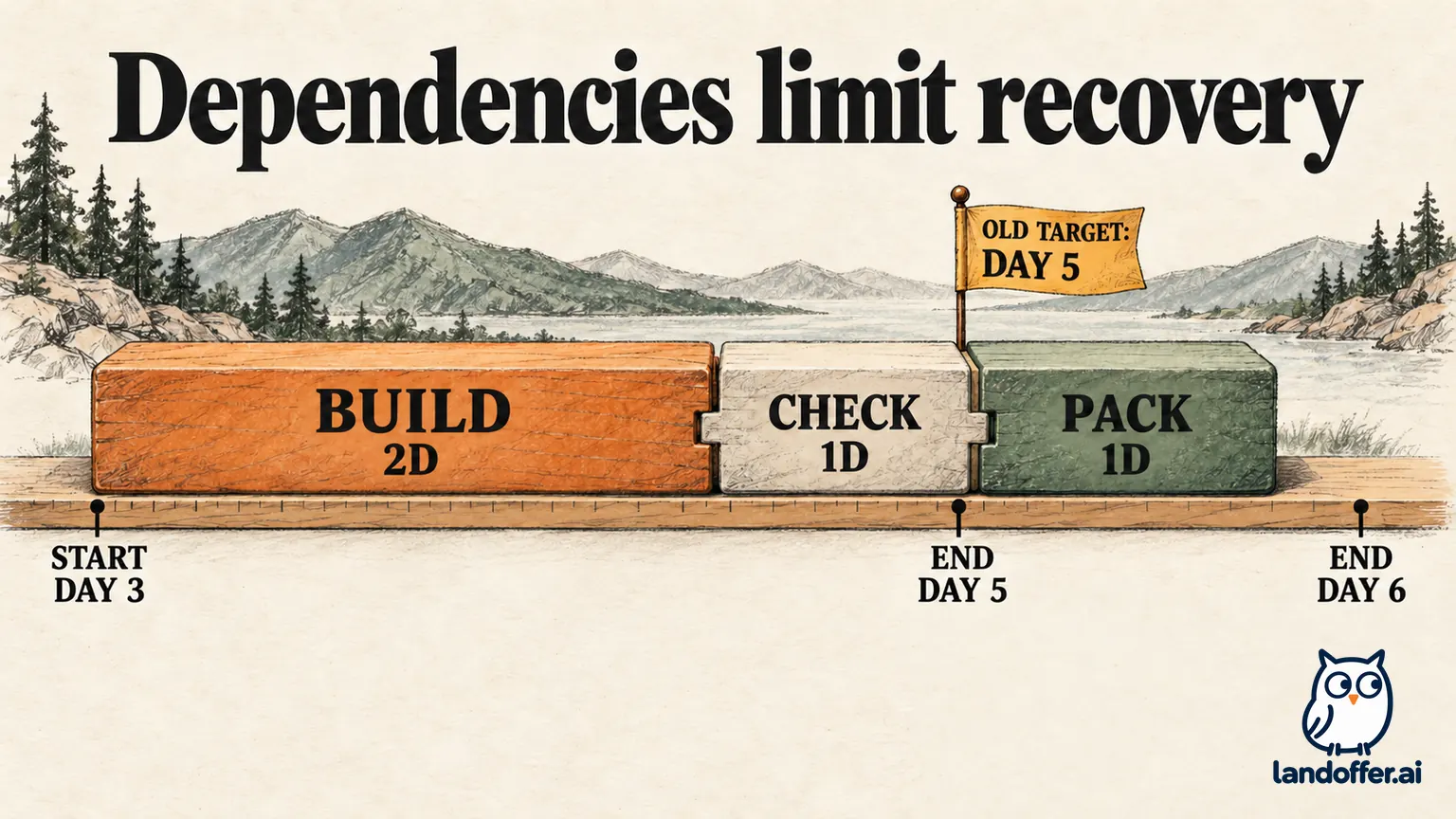
For this example, each Day label means a full available working day. The full-scope sequence is work on Days 3–4, acceptance checks on Day 5, and packaging/release on Day 6. Three days remain through the current Day 5 target, but this sequence takes four. Within the fictional case, the owners find no justified overlap and no available additional engineer who could remove that dependency in time.
They also assess two alternatives. A broad release without shared presets needs two days of preparation and checks, followed by one release day. A five-person internal pilot has a separately defined, approved test scope; preparing and launching it would use Days 3–4 and delay the full-scope sequence until Days 5–8. The pilot would provide early feedback but would not meet the training need.
| Option | Scope and checked forecast | Main sacrifice and dependency | Approval required |
|---|---|---|---|
| A — reduce the broad release | Browsing and tag filtering by Day 5; shared presets excluded, with a separate later estimate needed | Keeps the current release date but omits a capability required for Day 7 training | Ren approves scope reduction and a training response |
| B — retain full scope | Full preset library by Day 6, assuming Kai's work finishes Day 4 and checks find no new blocker | Moves the release one working day; leaves less preparation time before training | Ren approves the changed target; owners confirm the sequence |
| C — stage an internal pilot first | Five-person core-only pilot Day 4; broad full-scope release forecast Day 8 | Adds a release stage and consumes the same team's capacity; misses the training need | Ren approves staging and the missed training requirement; pilot criteria remain required |
The comparison does not assume that staging is always faster. In this case it delays the shared capability because the same people must prepare and release the pilot first. It might be useful if early internal feedback were the priority, but that is different from delivering the training requirement on time.
The team recommends B because it preserves the capability needed for Day 7 under the supplied estimates. It also identifies the narrow margin: an unresolved issue after Day 4 would threaten that plan. If Ren says Day 5 is immovable, the team must revisit scope or the underlying need; it cannot make B finish a day earlier by changing the wording.
Explain why the alternatives are feasible or rejected
Give each option its scope, audience, forecast, resources, and acceptance conditions so the decision owner can compare the actual sacrifices. Otherwise, a “fast” option may appear attractive only because its missing work or risk is hidden. Do not compare a fully checked release estimate with an unexamined idea as if they had equal evidential support.
Separate feasibility from preference. Kai's estimate supports a sequence; it does not decide whether the partner training is worth moving another commitment. Ren's preference for a date does not establish that the engineering work fits it. Bring those responsibilities together without letting either substitute for the other.
Microsoft's project-triangle guidance illustrates how changes to schedule, resources, and scope affect one another and emphasizes knowing what cannot change. Use that relationship to expose a trade-off. It is not a formula that automatically converts another person or additional budget into a shorter duration.
Record a rejected option's limiting fact. “More people will not help” is too broad. “No suitably available engineer can take an independent part of this remaining change before Day 4” is a narrower assessment for this case. If a suitable engineer becomes available for an independent part of the work, ask the owners to reassess the sequence before revising the forecast. This avoids turning a current constraint into a universal management rule.
Completed request: ask for a bounded decision
The following message is original fictional copy prepared after the option review. It was not sent. Sabine is the project coordinator; she can recommend but cannot approve the changed target.
“Ren — decision requested before work starts on Day 3. The Day 5 full-scope Cadence release is at risk. The remaining shared-preset work needs two working days, followed by one day of acceptance checks and one release day. Kai, Morgan, and Devon have reviewed that sequence; it forecasts Day 6, subject to the work finishing Day 4 and the checks finding no new blocker.”
“We have three checked choices: A, release browsing and filtering on Day 5 without shared presets, which does not satisfy the Day 7 training need; B, preserve full scope and change the release target to Day 6; or C, run the five-person core pilot on Day 4 and forecast the broad full-scope release on Day 8. C uses the same team's capacity and also misses the training need.”
“I recommend B. Please approve the Day 6 target or choose a different scope/training response. We will retain the acceptance requirements and review the shared-preset result at the end of Day 4. If that checkpoint fails, I will bring a revised forecast and the training impact immediately. Until a decision is recorded, Day 5 remains the approved baseline; this recommendation is not authorization to change it.”
This request explains the reason for more time rather than asking the sponsor to choose a number of extra days. It identifies the decision owner, dependencies, recommendation, approval boundary, and next risk trigger. The underlying work and acceptance requirements remain available in the option record instead of being hidden inside the message.
After confirmation, update the baseline without erasing history
Suppose Ren confirms B in writing before Day 3 work begins. That approval is another fictional input, not a real action. Sabine's completed follow-up is:
“Decision recorded: Ren approved the Day 6 full-scope release target before Day 3 work began. Scope remains browsing, tag filtering, and shared presets. The earlier Day 5 target is retained in the decision history. Kai owns the Days 3–4 change; Morgan owns Day 5 acceptance checks; Devon owns the Day 6 release process. The Day 7 training remains scheduled, with less preparation time.”
“Next checkpoint: end of Day 4. If the change is not ready for the required checks, we will reassess the Day 6 forecast and raise the training consequence. Approval of the target does not mean the work or release checks have passed. Options A and C were considered and not selected.”
Now the team can plan against the approved target while retaining the reason for the change. Update dependent plans, communications, and ownership through the agreed process. Do not leave one audience using Day 5 while another believes Day 6 was always the commitment. Keep an estimate, an approval, and actual completion as distinct events.
Make the next commitment from checked assumptions
If none of the options is feasible within the fixed constraints, say that clearly and escalate to the appropriate decision owner. You can provide the evidence and describe what would need to change without pretending an impossible combination is achievable. Keep the unresolved constraint visible and ask for the decision needed to change it.
Before requesting more time, check the baseline, remaining sequence, resource assumptions, and acceptance requirements. Present comparable choices and their sacrifices, then state who must decide and when. After approval, record the changed baseline and the checkpoint that would trigger a new estimate.
Use that process on the next material risk rather than waiting for a routine status report. Return to this LandOffer.ai guide when a constraint changes, keeping the decision tied to the work owners' current evidence and the authorized commitment.