LandOffer
Job search
Process Mining Jobs: Distinguish Event-Log Modeling, Implementation, and Value Consulting
Read process mining roles through deliverables and authority, then match event-data, implementation, architecture, and value work to evidence you can show.
Process mining jobs can involve building trustworthy event data, implementing a customer solution, or proving that a process change creates business value. Identify what the person must deliver and which decisions they own before relying on the title. SQL, Python, PQL, and dashboards may appear across these roles, but familiarity with one tool does not establish ownership of the whole project.
This guide uses Celonis’s official team descriptions and three accessible US job descriptions checked October 23, 2026. It distinguishes those employer requirements from our fictional examples and a small local Python exercise. We did not access a customer system, run Celonis or PQL, or apply for a role. LandOffer publishes this guide; use recent software and data roles on LandOffer.ai to compare duties, then verify each opportunity with its employer.

Separate the work without assuming the teams never overlap
Celonis’s Services team page distinguishes implementation consulting, engagement management, and solution architecture. Consultants implement solutions; engagement managers coordinate strategic delivery; solution architects support technical onboarding and reliable data pipelines. This is one employer’s organization, not an industry-wide rule for every “process mining consultant” title.
Use three questions when reading an opening. Who creates and validates the process data? Who turns that data into a supported solution? Who agrees with the customer on what improvement is worth pursuing and measures whether it happened? One person may contribute to all three. Your application should still show which responsibilities you owned and which belonged to colleagues or the customer.
A data engineer’s successful pipeline can be necessary without being sufficient. A consultant may need to gather requirements, demonstrate a configured solution, and support adoption. A value engineer may prototype technically while also leading executive discussions and business cases. Look for the result the employee owns, alongside the technical work they perform.
That distinction also prevents a misleading career move. An engineer seeking a mostly internal build role should inspect customer-facing duties before applying to consulting. A consultant who enjoys workshops should check how much hands-on data transformation the position expects. Neither preference is a deficit; a title alone cannot reveal the working week.
Event-log modeling begins before the dashboard
The official process-mining explainer describes a basic event log through case ID, activity, and timestamp. These fields connect separate actions into the history of a business object. Counting invoices by supplier is different from reconstructing how each invoice moved from creation to approval and payment.
The difficult work is often deciding what those fields mean. Does a case represent an invoice, invoice line, purchase order, or something else? Which source record establishes that approval occurred? Is the timestamp the business event’s time or merely the warehouse ingestion time? Can two systems use the same identifier for different objects? Explain these choices before showing a process map, so a reader can judge whether it represents the intended business object.
A useful portfolio artifact includes a field mapping, source lineage, rejected-row policy, duplicate policy, and an explanation of event order. An ordering rule should have a defensible source. Sorting activity names alphabetically can produce a neat sequence that never occurred. If timestamps and source sequencing cannot establish which event came first, retain that uncertainty in the model and its documentation.
Celonis also supports broader process models; this article’s simple invoice example is deliberately case-based. It does not demonstrate every object relationship or a complete enterprise model. A job involving interconnected orders, deliveries, and invoices may need a more complex model than the one below.
Worked event example: one supplier is not one case
We created ten fictional input rows and ran an original Python script locally; the saved input, cleaned rows, and result reconcile the counts below. It removes one exact repeated event ID and quarantines one row missing an event timestamp. Eight accepted events remain, forming these invoice histories:
| Invoice case | Ordered accepted activities | Result under this example’s rule |
|---|---|---|
| P01, supplier V7 | Create → Approve → Pay | Approval precedes payment. |
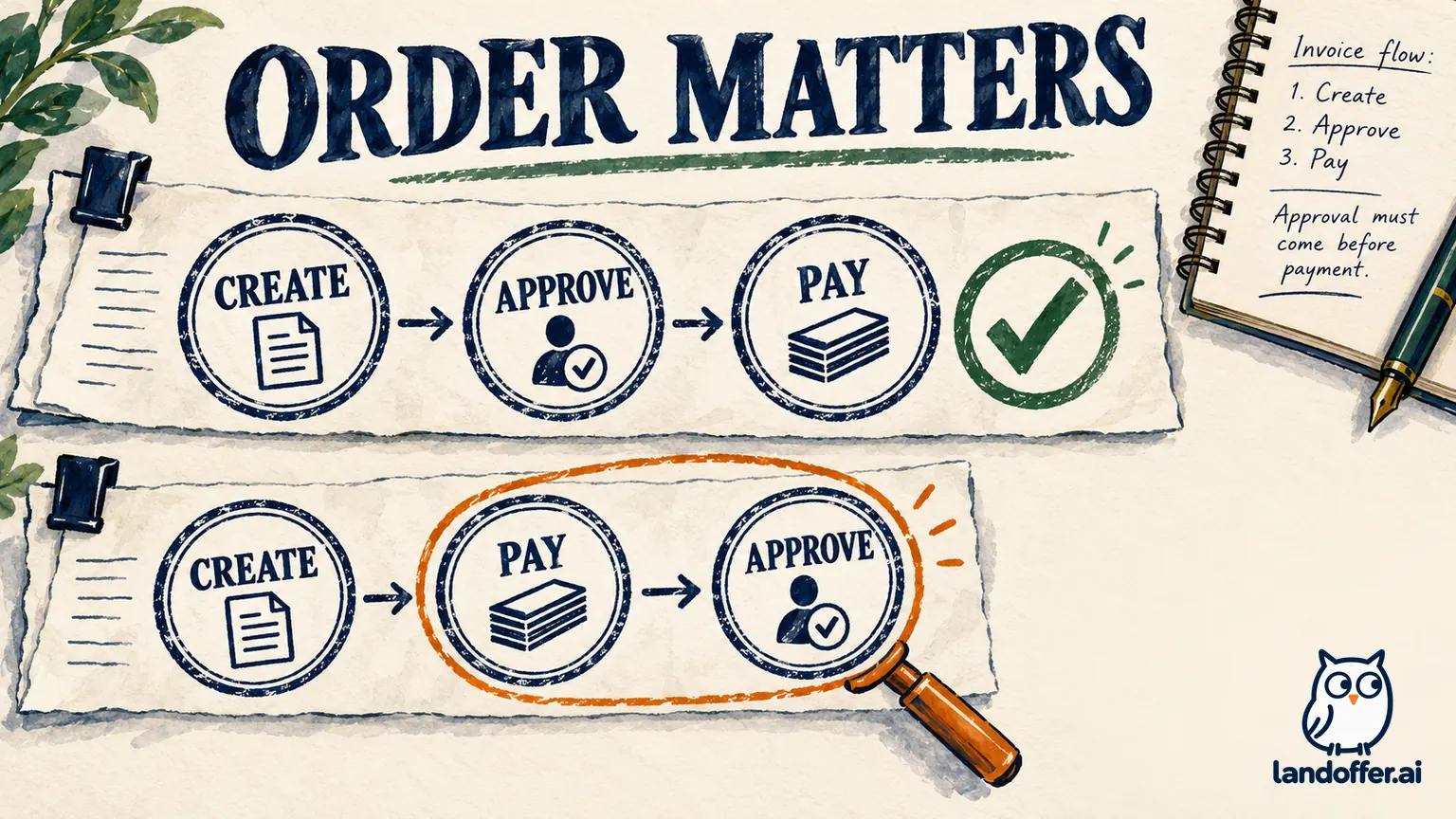
| P02, supplier V7 | Create → Pay → Approve | Payment precedes approval; flag for review. |
| P03, supplier V8 | Create → Approve | No payment observed; retain as an open case. |
P01 and P02 share a supplier but remain separate cases. Grouping on V7 would merge their events into one artificial history. A chart showing two invoices for that supplier could be numerically correct while a process model built on the wrong case key remained misleading.
The fictional process owner’s rule is “approval must precede payment.” One of the two paid cases violates that rule, so the result is 1/2 paid cases, not one out of all three invoices. P03 is open at the observation cutoff. Treating it as a paid compliant case would change the denominator without evidence.
The script orders accepted records by invoice, UTC event time, and source sequence. In this fixture the timestamps already distinguish each invoice’s steps; the sequence field does not manufacture an otherwise unknown order. Its duplicate rule removes an identical repeated event, not every repeated activity. Two genuine approval events could represent rework and should not disappear merely because their labels match.
This exercise verifies only our synthetic cleaning and simple precedence calculation. It is not a Celonis import, PQL execution, BPMN replay, or full conformance-engine test. The professional evidence is the reasoning: case grain, event identity, missing-data handling, open-case treatment, and the limits of the result.
Implementation turns the finding into an accepted deliverable
For the fictional invoice project, divide ownership explicitly:
| Deliverable | Proposed owner | Completed handoff or acceptance condition |
|---|---|---|
| Event mapping and extraction | Data engineer | Invoice key documented; ten raw rows reconcile to eight accepted, one duplicate, and one quarantined row. |
| Configured analysis and rollout | Implementation consultant | Show P02’s sequence, label P03 open, and obtain agreement on the paid-case denominator. |
| Technical design and operation | Solution architect | Review access boundaries, refresh behavior, and how rejected or corrected records reach the analysis. |
| Value hypothesis and follow-through | Value consultant with process owner | Identify what P02 means operationally before assigning a financial benefit or recommending a change. |
This ownership map is an illustrative project design, not a claim about Celonis’s staffing on an actual engagement. The customer’s process owner approves the intended rule. The technical team should not silently turn a local convention into an organization-wide policy.
Before calling the example ready for use, the proposed implementation handoff also records a correction path. A rejected timestamp stays in a separate queue with its source event ID. If the source is corrected, the pipeline must reconcile the repaired event without introducing another copy of an existing event. The consultant then checks whether the affected case and KPI changed as expected. That is a useful acceptance discussion even though this small fixture does not implement a production replay or refresh service.
A credible implementation example continues beyond a screenshot. Describe the source mapping you received, what you configured, what failed validation, who accepted the correction, and how the receiving team knew when a refresh was unhealthy. If you only built the visual layer, say so. That experience can still be useful without claiming responsibility for ingestion or customer sign-off.
The Associate Deployment Engineer—Galaxy description in New York illustrates this mixed work: SQL/Python transformations, platform implementation, customer requirements, deliverable demonstrations, and critical KPIs. It lists a relevant degree and 0–2 years of experience. A dashboard example can demonstrate presentation skills; add separate evidence for transformations, configuration, and requirements if you performed those tasks.
PQL and conformance require more precise evidence
PQL is Celonis’s process-oriented query language. The company’s PQL learning article, updated in April 2023, explains its relationship to SQL and the importance of the underlying data model. Use it as background, not proof that every historical course or platform behavior remains unchanged.
For a job requiring PQL, be prepared to explain which business question a query answers, the model it assumes, and how filtering or aggregation affects the result. SQL experience provides relevant foundations, but it is not evidence that you have already delivered advanced PQL. State your actual experience level and use the reference appropriate to the employer’s platform version.
Conformance adds a different responsibility: compare observed execution with an agreed intended model or rule. Celonis’s process-adherence explanation warns that actual behavior may contain valid variations and that models and logged events can differ in granularity. A deviation needs interpretation; it does not by itself prove misconduct, a legal violation, or avoidable cost.
In the invoice example, investigate P02 before declaring the approval process broken. A late source-system update, a wrong timestamp mapping, or an approved exception could change the interpretation. The synthetic fixture establishes the sequence in its input, not the cause or business consequence. This is why modeling, implementation, and value discussions need a shared definition.
Worked application choice: one data candidate, three descriptions
Fictional candidate: Nina has a computer-science degree, one year in a data-engineering position, and experience with SQL transformations, Python validation, and internal requirements discussions. She has no production Celonis/PQL delivery, senior architecture ownership, or banking pre-sales experience. Her completed comparison is:
| Official US description | Evidence Nina can show | Decision and gap |
|---|---|---|
| Associate Deployment Engineer—Galaxy, New York | Relevant degree, early-career experience, synthetic log validation, and internal demos | Closest responsibility/level match, but hold this specific cohort inquiry pending timing confirmation. Build customer-facing and platform evidence honestly. |
| Lead Deployment Architect, New York | Some relevant data-engineering foundations | Deprioritize. The description asks for 8+ years, senior technical leadership, platform mastery including advanced PQL, and architecture across engagements. |
| Senior Value Engineer—Banking, New York | SQL/Python overlap | Deprioritize. It asks for 5+ years leading banking/financial-services pre- and post-sales, domain knowledge, ROI cases, and executive communication. |
Timing changes Nina’s next action. The accessible Galaxy application still asks candidates to confirm a September 2026 full-time start, already past when we checked in October. Its readable description remains useful for understanding responsibilities; its presence does not establish an available future cohort. Nina records “ask about the next intake,” not “currently eligible and ready to submit.”
She also records that the Galaxy and Banking descriptions state no visa sponsorship. Work authorization, location, and any office requirements need separate checks for each real applicant. These observations concern the named postings; they do not establish a company-wide sponsorship policy or an eligibility decision about a reader.
Nina’s preparation note now says: “Demonstrated invoice-event cleaning and a simple approval-before-payment check on synthetic data; production work involved SQL/Python pipelines, not Celonis delivery.” This preserves a relevant transferable skill without converting a teaching exercise into customer implementation experience. It leaves the employer able to assess her actual background.
Apply to the responsibility you can substantiate
Current Celonis descriptions show overlap between technical work and customer value. The Lead Deployment Architect role combines design standards, delivery reviews, and customer strategy; the Banking value role includes technical prototypes as well as business cases. Avoid a rigid “engineers code, consultants talk” split. Read the level, domain, and scope of authority together.
For a data-focused opening, lead with lineage, event semantics, reconciliation, and a validated model. For implementation, add requirements, acceptance, rollout, and operational handoff. For value consulting, explain the baseline, proposed intervention, accountable business owner, adoption, and how benefits would be measured. Potential savings, realized savings, and a visually convincing demo are different claims.
Use recent roles on LandOffer.ai to build a small shortlist, then save each employer’s current duties and constraints. Save one relevant work example beside each shortlisted role, label the learning gaps, and confirm the employer’s current opening before you apply.
Sources and Further Reading
- Celonis Services team responsibilities
- How process mining works and basic event-log fields
- Associate Deployment Engineer—Galaxy, New York; accessible description with past cohort prompt
- Lead Deployment Architect, New York
- Senior Value Engineer—Banking, New York
- PQL background article, updated April 2023
- Process adherence, model granularity, and interpreting deviations