LandOffer
Job search
Have You Worked Here Before? Distinguish Employees, Contractors, and Acquired Companies
Map your actual prior relationship to the precise company and relationship scope of the application.
Answer “Have you worked here before?” by matching your actual relationship to the employer’s definition of “here” and “worked.” Direct employment, an agency assignment and work for a company later acquired by the employer are different histories. Recognizing the brand on your old badge does not, by itself, tell you which answer the application requires.
Gather the employer name, relationship type and relevant dates before choosing an option. LandOffer publishes this guide; when you browse recently posted jobs, save the hiring entity and job reference alongside the posting. The completed examples below show how to distinguish employee history from client work and how to ask about an acquired company without inventing a classification.

Read the exact relationship and company scope
“Previously employed by this company” is narrower than “previously worked for this company, including as a contractor.” Another form might include affiliates, subsidiaries, predecessors, interns or temporary assignments. Read the help text as well as the visible question. An explanatory sentence can change the scope of a required yes/no answer.
Next, identify the employer named in the application. A consumer brand, a parent organization and a local legal entity can have different names. Check the posting and recruiting instructions for the entity and any expressly included company group. If a question names a group but does not explain whether it includes former subsidiaries, ask about the specific relationship rather than supplying your own corporate-history rule.
Your answer should describe the relationship your records support. You do not need to become a corporate historian before applying. Record the name on your employment documents, the client or worksite if different, the period involved and the name used by the application. Those facts let recruiting clarify the company boundary without guessing which former organization you mean.
Avoid assuming that a system’s internal/external applicant route answers the employment-history question. At the University of Texas at Austin, current employees and contingent workers are directed to apply through the internal Workday route, while former employees and former contingent workers use the external route. Those are that institution’s instructions. That shared application route does not establish that a contingent worker was a direct employee.
Reconstruct the relationship before the answer
Begin with documents you are entitled to retain and use: an offer or employment agreement, an agency assignment notice, a separation record, or your own payroll records. Note what each document actually establishes. A client-issued access badge shows access or affiliation; it may not identify the employer. A project email address likewise does not settle whether you were an employee of the client.
Payment documents are useful clues, but avoid treating a single tax form or payment method as a complete legal classification. The IRS common-law employee guidance explains that, for its tax framework, the substance of the relationship matters rather than a label alone. This article is not assessing anyone’s tax status or employment rights. For the application, separate the records you possess from a classification you still need clarified.
An internship also needs its own check. A paid employee internship, a school placement and an agency-supported assignment should not all become “employee” merely because the title contains intern. Record the arrangement described in the relevant documents and check whether the question expressly includes internships. If you lack the documents, ask the former HR contact or agency for the specific relationship and period.
Record each distinct relationship period separately, including a later direct hire after an agency assignment. Do not merge an agency assignment and a later direct hire into one uninterrupted employee record. If dates are uncertain, reconstruct them before entering precise days. A month-level record can still be useful for a preliminary clarification request; it does not justify inventing an exact start day for the final application.
A completed history with an acquisition and an agency assignment
The following person, organizations, dates, documents and form language are fictional. Theo was directly employed by Cedar Labs from March 2019 through August 2021. Atlas acquired Cedar Labs in July 2023, after Theo had left. From February through June 2025, Theo worked on an Atlas project through Harbor Staffing. In this teaching case, the agency records identify Harbor Staffing as Theo’s employer during that assignment.
| Period or event | Record in the fictional case | What Theo can state | What remains separate |
|---|---|---|---|
| March 2019–August 2021 | Cedar Labs employment and separation records | Former Cedar Labs employee | Whether Atlas’s question includes predecessors |
| July 2023 acquisition | Public acquisition notice in the example | Atlas acquired Cedar after Theo left | Acquisition does not rewrite the original employer name |
| February–June 2025 | Harbor Staffing employment and Atlas assignment records | Agency worker assigned to Atlas | Not a stipulated direct Atlas employment period |
| 2026 application | Atlas recruiting form | Two prior relationships need review against its wording | Rehire eligibility has not been established |
Now consider three different questions. Each is invented to demonstrate the decision, not quoted from an Atlas form.
| Exact fictional question | Completed response based on the stipulated facts | Explanation |
|---|---|---|
| “Have you ever been directly employed by Atlas? Exclude agency assignments and employment with companies before acquisition.” | No | Neither period falls within this expressly narrow definition |
| “Have you worked for Atlas as an employee, agency worker or contractor?” | Yes; agency assignment February–June 2025 | The question expressly includes the assignment |
| “Have you worked for Atlas or an acquired company?” with no timing definition | Clarification required | Theo should identify Cedar and the pre-acquisition period before certifying the binary answer |
The first no is supported by the hypothetical definition; it is not a rule that all former contractors should select no. The second yes does not transform Theo into a former direct employee. The third remains unresolved because the question does not tell him how to treat employment that ended before acquisition.
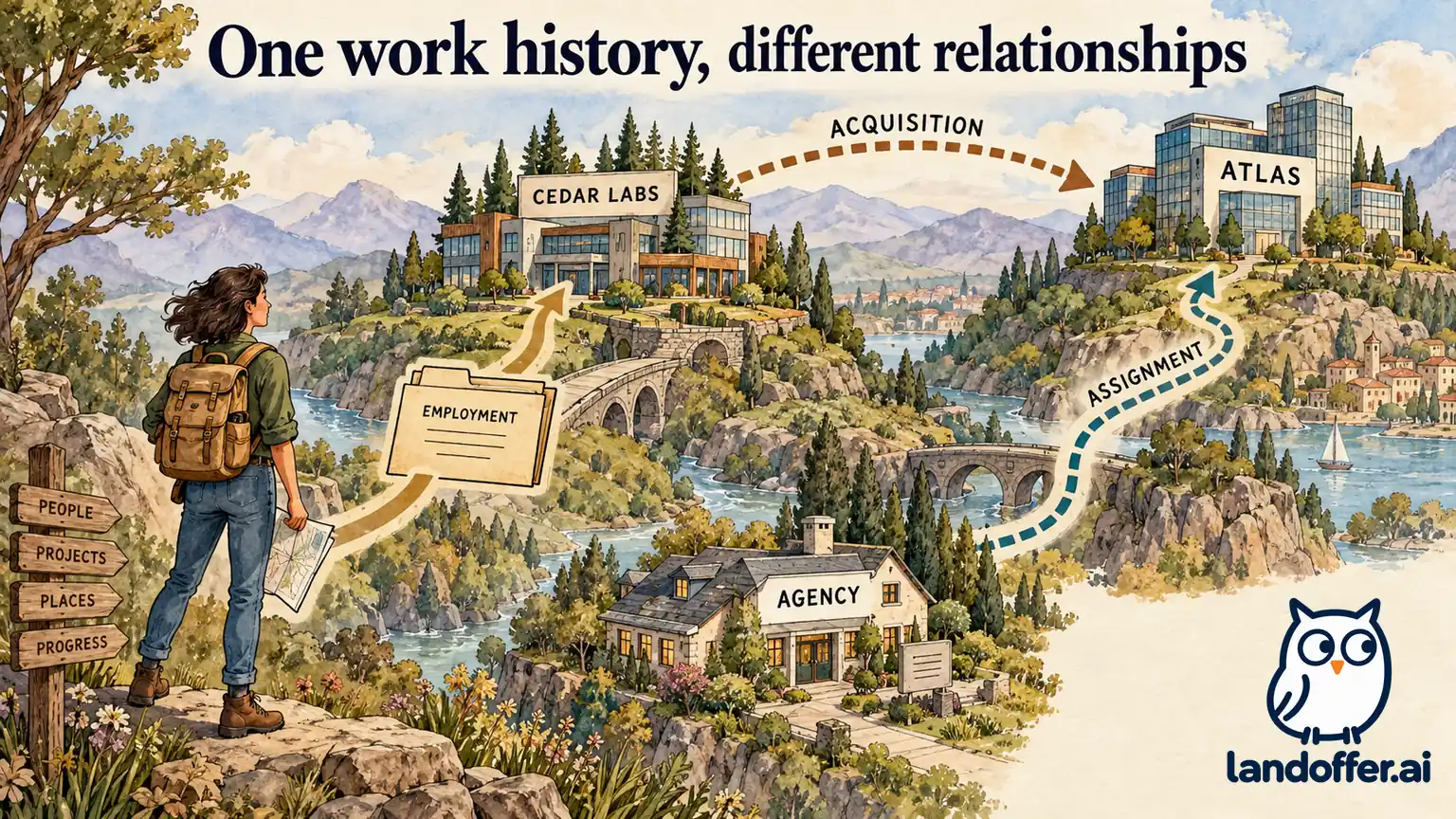
Theo’s concise explanation for the broad second question could read: “Yes. I was assigned to Atlas through Harbor Staffing from February to June 2025. Separately, I was employed by Cedar Labs from March 2019 to August 2021, before Atlas acquired it.” That preserves both histories and their order without asserting that Atlas has classified him as eligible for rehire.
Keep contractor, subsidiary and predecessor facts visible
For an agency placement, identify the agency and client separately when the form permits it. A useful entry might name the agency in the employer field and the client in an assignment description, provided that follows the actual field instructions and records. If the form explicitly requests client organizations, answer that request too. Do not hide the client relationship merely because the agency issued the paycheck.
For consulting through your own business, distinguish your business, the contracting counterparty and any end client. Check which category the question includes. You may know you delivered work on the company’s project while still needing help with a field that only offers employee categories. State the arrangement; do not select a payroll employee title to make the dropdown convenient.
For subsidiary employment, preserve the subsidiary’s name and dates. A parent-company logo on a career page does not prove that the question excludes the subsidiary, and a different legal name does not prove it is outside the requested group. The employer’s definition determines the scope of the application response. Ask if the named group and the record do not line up clearly.
For a merger or acquisition, keep the chronology. Employment before a transaction, employment continuing through it, and employment beginning afterward may be handled differently by the receiving employer. Do not change an old employer name to the new parent name without qualification. A note such as “Cedar Labs, later acquired by Atlas; employment ended before acquisition” conveys the history more accurately than silently replacing Cedar with Atlas.
These distinctions matter even when your resume uses a recognizable brand for readability. The resume and application should describe the same history at their respective levels of detail. Use a short parenthetical to connect a recognizable brand with the actual employer. It should not create a longer employment period or claim direct employment that your underlying records do not support.
Ask recruiting a question they can resolve
When the definition is unclear, give the employer a small factual packet: the job reference, exact question, original entity, relationship and dates. Avoid a long narrative about every project. The recruiter needs to know the ambiguous boundary, not the confidential work you performed.
For Theo’s third question, the completed request could be:
For Atlas role AT-612, the application asks whether I have worked for Atlas or an acquired company. I was employed by Cedar Labs from March 2019 to August 2021; Atlas acquired Cedar in July 2023. I also had an Atlas agency assignment through Harbor Staffing in 2025. Does the question include pre-acquisition employment, and where should I record the two relationships?
The role reference and dates are also fictional. No reply is assumed. Theo should save any actual instruction with the application and check whether it concerns the particular field or only the applicant login route. “Use the external portal” does not necessarily mean “answer no to every former-affiliation question.”
A second employer example makes that distinction concrete. Penn State’s recruiting instructions include former employees in the external applicant group. That is a routing instruction, not a declaration that they have never worked there. Follow your own employer’s current route while separately answering its prior-work question.
If you are asked for a former employee number and do not know it, say so through the available route. Check your own permissible records or request help from HR. Do not use a building-access number, vendor number or another person’s identifier as a substitute. If the field is required and offers no unknown option, ask how to continue accurately.
What if you do not know rehire eligibility?
Prior work and rehire eligibility are separate facts. Knowing that you left voluntarily does not establish the organization’s current eligibility record. Nor does a successful application login prove that you are eligible for rehire. If the form asks whether you are eligible and you lack confirmation, use an available unknown option or ask the relevant HR team how to record that uncertainty.
Keep the request factual: “I worked for this entity during these dates. Can you confirm the process for determining or recording rehire eligibility?” Avoid asserting that a former manager’s positive farewell message is an official eligibility decision. It may be useful context, but it answers a different question.
Describe the missing fact without assuming why the former employer’s record is unclear. Records may be incomplete, names may have changed, or recruiting may need to route the question internally. Describe the missing fact and the record you have. If the employer requests documents, use its authorized channel and provide only the relevant material you are permitted to share.
Check the final entry against the question you answered
Before submitting, read the exact wording again. Confirm that your answer covers all included relationship types and entities, and that a saved answer from another application did not narrow the scope. Check any follow-up dates, former titles and identifiers. A broad yes with an accurate explanation is more informative than a yes followed by a mistaken direct-employment record.
If you discover an error after submission, use the employer’s correction route with the existing job reference. Identify the field, the prior entry and the corrected relationship. Do not assume that withdrawing and creating a duplicate application is permitted or that a profile update will automatically change an already submitted record. Ask how the employer wants the correction connected.
Choose a role from LandOffer’s recently posted jobs and make a short prior-affiliation record before completing its form. Keep employer, client, relationship and dates separate. Ask recruiting about an unclear company scope before certification, then save the final answer and the field-specific instruction with the application.
Sources and Further Reading
- University of Texas at Austin: application process — institution-specific routes for current and former employees and contingent workers.
- IRS: common-law employee — why a relationship label alone does not determine status within this tax framework.
- Penn State: recruiting and hiring process — former employees included in an external applicant route.