LandOffer
Workplace Rights
Pregnancy-Related Work Changes: Describe the Limitation and Discuss Available Adjustments
A completed fictional engineering case turns lifting and standing limitations into a specific adjustment request. Its follow-up record distinguishes an accepted bench and transport arrangement, a corrected coverage gap, a promised reply, and an unresolved event assignment without assuming medical clearance or legal eligibility.
Describe the pregnancy-related limitation, the task it affects, and the change you need. Ask who will decide and implement the change, what interim arrangement is available, and when you will review whether it works. Under the U.S. Pregnant Workers Fairness Act (PWFA), a limitation need not meet the ADA definition of disability. A request starts a discussion; it does not establish that your preferred arrangement has been approved.
This LandOffer.ai guide uses a fictional engineering employee’s temporary lifting and standing limitations to show a complete request and follow-up record. The dates, restrictions, employer, and responses are invented teaching examples, not medical recommendations or findings about anyone’s legal eligibility.

Understand the request you are making
The EEOC’s current PWFA overview describes accommodations for qualified workers’ known pregnancy-related limitations, absent undue hardship. Private employers and state or local government employers generally come within its coverage at 15 employees; other covered entities and federal employment have their own contexts. State or local protections may also matter. Check the employer and jurisdiction rather than deciding coverage from a job title.
Pregnancy itself is not an ADA disability, although related impairments may qualify. The EEOC’s pregnancy discrimination page distinguishes the PWFA, ADA, and Title VII. Consequently, “I do not have an ADA disability” does not by itself answer a pregnancy-related adjustment request. Parental leave approval, disability benefits, and a work adjustment are also separate questions.
A temporary inability to perform a fundamental duty does not automatically end the PWFA discussion. The EEOC’s rule summary describes a second qualification route involving temporary inability, performance in the near future, and reasonable accommodation. It does not create an unconditional entitlement to remove any duty for any duration.
These sources were checked October 27, 2026. The EEOC summary contains court-order qualifications, and the 2026 regulatory agenda lists proposed revisions. A planned proposal is not an enacted replacement. This article addresses an ordinary lifting-and-standing discussion, not disputed coverage categories or the application of a particular court order.
Turn the limitation into a usable work description
Start with your actual difficulty rather than an accommodation borrowed from someone else. Identify the work involved, when the problem arises, and the change needed. Do not invent a weight limit or recovery date to make the request look complete; obtain appropriate clinical clarification when needed.
Describe inspecting equipment and moving it as separate tasks when the limitation affects them differently. “I cannot do my job” conceals that difference. “I need to avoid lifting the transit cases, but I can perform the bench inspection once equipment is positioned” gives the discussion a practical starting point without deciding which duties are legally essential.
The EEOC’s small-business guidance says requests do not require a special form, legal terminology, or writing. An oral explanation can count. A written recap helps the next shift act on the discussion: it names who moves a case, where the seated station is, and who handles an absence.
Do not wait for a perfectly polished packet before communicating a current need. Equally, do not treat silence as permission to implement a different schedule or abandon assigned work. Ask for an immediate discussion of the affected task and any interim arrangement, especially before the next task is due.
Worked request: keep inspection work, change lifting and standing
Asha is a quality engineer at the fictional company Northmere Devices. She normally performs bench inspections, records measurements, attends defect reviews, and carries transit cases between storage and the inspection area. The example assumes her described limitations have been communicated accurately; it does not establish anyone else’s safe activity level.
On Monday, November 2, 2026, Asha tells manager Luis that pregnancy-related limitations mean she needs to avoid lifting the transit cases and needs a seated option during inspection work. Her current information identifies November 20 as the initial period to discuss. It is not a guaranteed recovery date.
Her preparation separates the tasks instead of requesting an undefined “light duty” assignment:
| Actual task | Limitation and proposed change | Information still needed |
|---|---|---|
| Carry transit cases from storage | Asha requests no case lifting during the initial period; another assigned worker positions them | Who accepts the transport duty, including absences? |
| Inspect components at a standing bench | Request an adjustable-height seated station, with standing available when useful | Can the layout support the inspection without reaching around stored equipment? |
| Record measurements and review defects | Asha expects to continue these tasks | Confirm that meetings and documentation remain in her assigned work |
| Attend an off-site demonstration on November 12 | Transport and prolonged standing have not been assessed | Discuss a separate arrangement before assigning travel or assuming she will attend |
The table is a discussion aid. Asha has not volunteered a coworker, certified a workstation, or declared the demonstration safe. Luis needs confirmation from the transport coordinator and must check the bench arrangement before presenting either as available.
Her written recap reads:
Luis, as we discussed today, I need changes to my work because of pregnancy-related limitations. For the initial period through November 20, I need to avoid lifting the transit cases and have a seated option for bench inspections. I can continue measurement recording and defect reviews.
Could we discuss assigning case transport and setting up the adjustable bench? I would like to continue the inspection work with those changes. Please confirm what applies before tomorrow’s inspection and who I should contact if transport coverage is unavailable.
The November 12 demonstration needs a separate discussion because its transport and standing requirements are unresolved. Can we review the initial arrangement on November 16, or earlier if it is ineffective? Please tell me the appropriate HR contact for any necessary supporting information.
This request names the work change without prescribing the employer’s legal conclusion. It also avoids promising that symptoms, medical information, or the assignment will remain unchanged until a calendar date.
Discuss alternatives without losing the original need
Luis should not answer the transport question by simply telling Asha to “ask around.” An operational plan needs an owner. In the fictional discussion, he checks coverage with operations lead Erin, who accepts responsibility for arranging transport. Luis also confirms that the adjustable bench is available for Asha’s inspections.
A different proposal should be evaluated against the actual limitation. For instance, a cart alone would not answer Asha’s request if she still had to lift cases onto it. Temporarily assigning her only documentation might remove lifting, but it would also change the work she asked to continue. The discussion should address whether a proposed alternative works, not merely whether it has a reassuring name.
The EEOC’s small-business guidance recommends considering effective alternatives and individual circumstances. It also explains that leave should not be the default when another reasonable accommodation allows continued work without undue hardship. Leave may still be requested or appropriate in a particular situation; this example does not decide that question for another employee.
If someone says “company policy never permits that,” ask which part of the task cannot be adjusted and whether the appropriate accommodation contact has reviewed alternatives. Record the answer accurately. Keep the discussion on the affected task and ask for clarification if the response leaves tomorrow’s assignment unclear.
Record what was agreed, then check the implementation
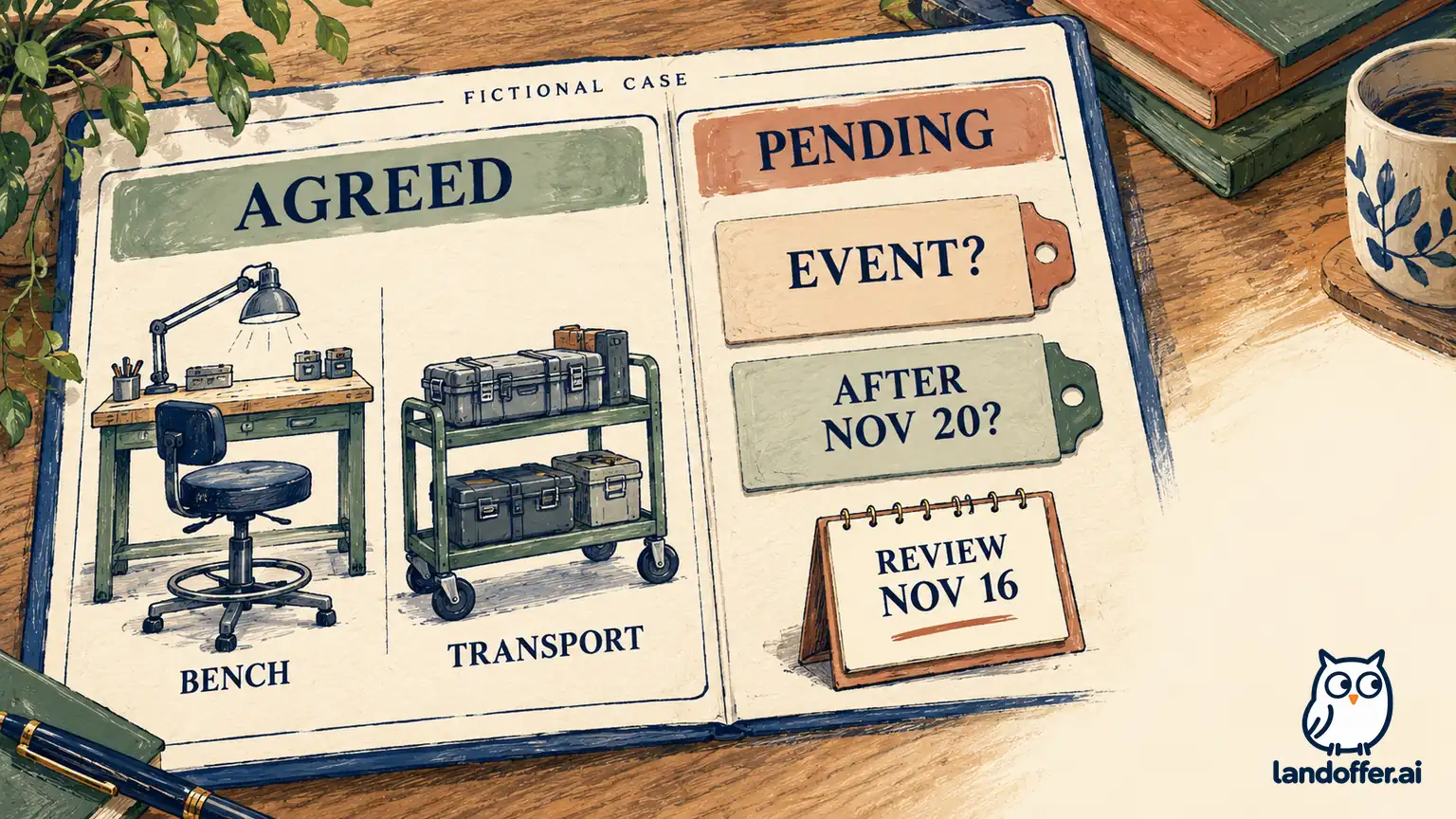
The second completed asset is Asha’s record of the fictional discussion and its first correction. It deliberately keeps the demonstration and later continuation open.
| Date and stage | Recorded response or event | Confirmed scope and remaining work |
|---|---|---|
| November 2: request and discussion | Luis agrees to no transit-case lifting and use of the adjustable seated bench through November 20; Erin accepts transport coordination | Measurement records and defect reviews remain assigned; review scheduled November 16 |
| November 3: first inspection | Operations worker Mei positions the cases; Asha uses the seated station | First setup occurred; this is not proof the arrangement will always work |
| November 5: coverage gap | Mei is absent; Asha reports that no replacement has arrived rather than lifting the cases herself | Inspection start is delayed; the accepted transport responsibility remains unresolved for that session |
| November 6: correction | Erin assigns Dev as backup, and Dev accepts; Luis confirms Asha should contact Erin directly when transport is missing | Coverage route revised; no claim that every future absence is covered |
| November 9: status recap | Luis confirms the revised transport route and November 16 review | November 12 demonstration arrangement still pending; no continuation beyond November 20 agreed |
Asha’s November 9 recap is specific enough to expose a disagreement:
My understanding is that the initial arrangement remains in place through November 20: I will not lift the transit cases, will use the adjustable bench, and will continue inspection records and defect reviews. Erin coordinates transport; Dev has accepted backup coverage following the November 5 gap. I will contact Erin if transport is missing.
We are scheduled to review effectiveness on November 16. The November 12 demonstration remains unresolved, so please confirm its assignment and any effective adjustment before that event. I am not treating the review date as approval to extend or end the arrangement automatically.
Luis replies that the recap matches the agreed bench and transport arrangement. He says he is still checking the demonstration with its owner and will return to that question on November 10. His reply establishes a November 10 follow-up commitment, while leaving the event assignment and any adjustment undecided. At the record’s stopping point on November 9, the answer remains pending.
Keep supporting information and review dates proportionate
A review date asks whether the arrangement is effective and whether circumstances have changed. It is not a medical clearance, a mandatory end date for every accommodation, or permission to resume a restricted task. Asha’s November 16 conversation should address actual coverage gaps, the bench setup, updated information if relevant, and the unresolved period after November 20.
Use the right channel for any supporting information. The EEOC’s overview explains that medical documentation is limited and is not always appropriate; certain straightforward pregnancy-related requests, including specified sitting, standing, water, and break needs, do not justify requiring it. Ask what information is reasonably needed for the particular request, why, and where it should go. Avoid sending a complete medical history to a broad project thread.
Asha’s team only needs the operational instruction necessary to perform its work. Her example does not require a coworker to evaluate a diagnosis, negotiate her restrictions, or determine her eligibility. Detailed medical-information requests are a separate issue from agreeing who will position equipment tomorrow.
If the response is delayed, rejected, or ineffective, retain your request, the employer’s explanation, and the next task affected. Ask the designated accommodation or HR contact for a concrete next step and an interim discussion. Internal review is not a substitute for checking any external rights or deadlines that may apply; obtain current, situation-specific guidance rather than assuming a pending internal conversation preserves them.
The practical endpoint is a record of the limitation communicated, changes actually agreed, implementation problems, and questions still open. Bring the open questions to the responsible contact at the next discussion; related workplace guides are available from LandOffer.ai. No request template can promise approval or replace medical advice about your own limitations.
Sources and Further Reading
- EEOC: What You Should Know About the Pregnant Workers Fairness Act
- EEOC: Pregnancy, Childbirth, or Related Medical Conditions Accommodations
- EEOC: Pregnancy Discrimination and Pregnancy-Related Disability Discrimination
- EEOC: Summary of Key Provisions of the PWFA Final Rule, including court-order notes
- Reginfo.gov: 2026 agenda entry for proposed PWFA regulation revisions