LandOffer
Pay & Benefits
A Personal Charge Landed on Your Corporate Card: Reconcile It Through the Approved Process
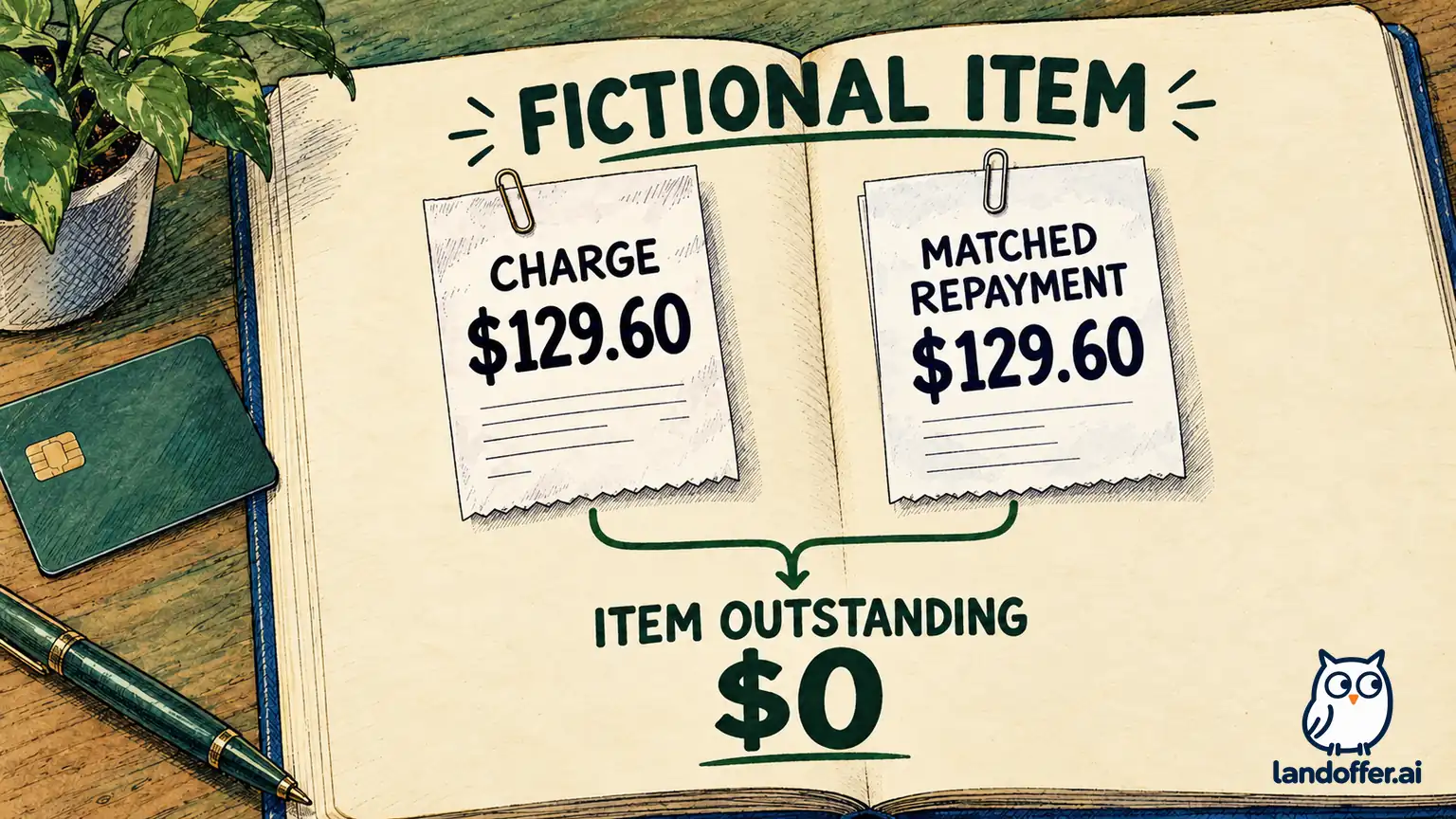
A completed fictional $129.60 correction follows notification, personal classification, repayment, receipt, and matching to a zero outstanding item. The administrator notice and readback keep a separate business reimbursement and a hypothetical later credit out of unauthorized offsets or duplicate corrections.
If a personal purchase lands on your corporate card, report it promptly, preserve the transaction and receipt, and ask your card administrator how to classify and repay it. Confirm the correct recipient before moving money: some programs collect repayment through the employer, while others require payment to the card issuer. Keep evidence linking the original charge, approved correction method, payment receipt, and final reconciliation. A personal classification records the expense type; separate payment and matching evidence establish whether the amount is settled.
This LandOffer.ai guide uses public policies checked October 27, 2026 and a completed fictional audit trail. No card account, employer system, repayment, refund, or message was accessed or changed. Your employer's policy and card agreement control. The goal is a documented correction, not advice to conceal a charge, manufacture a business purpose, or assume that repayment decides every policy consequence.

Record what happened before choosing the correction
Confirm which transaction you are looking at: merchant, purchase and posting dates, currency, total, and the card identifier permitted by your employer's process. Check whether it is posted, still pending, or already accompanied by a credit. Recording pending and posted statuses separately helps finance avoid treating a temporary authorization or an actual debit as the same event.
Save the itemized receipt and write a short factual explanation. “I selected the corporate card for my personal order by mistake” is clearer than an invented client-meeting justification. Do not delete the imported transaction, alter the receipt, or assign it to an unrelated project to clear an exception queue.
If you do not recognize the transaction or suspect unauthorized use, identify it as that different problem and use the applicable card-security process. Describe an accidental personal purchase truthfully, rather than reporting it as an unrecognized or fraudulent transaction. The correction route depends on the facts.
Contact the card administrator or designated finance team using the established internal channel. Provide the information needed to locate the charge, not the full card number, security code, banking credentials, or a payment image in an ordinary team message. Ask whether any manager notification or additional record is required under your policy.
Confirm who receives repayment and how it is recorded
Three current employer examples show why a generic “just pay it back” instruction is incomplete.
Indiana University's P-Card procedure, revised December 5, 2023, requires repayment of the total personal transaction. A fiscal officer processes the repayment using an Advance Deposit form; reconciliation uses its Personal Accidental Usage category, with an explanatory note and document reference completing the audit record. These are IU's named processes, not account codes to create at another employer.
Harvard's University-Issued Card Policy, effective January 1, 2024, says inadvertent personal use requires prompt identification and payment. For charges marked personal in Concur, its instructions describe paying Citibank directly. An expense classification therefore does not prove the issuer has received payment. Different card types and local procedures also matter.
Stanford's Travel Card repayment instructions, updated October 22, 2026, instead describe payment to Stanford with the related Expense Request reference. Payment Services records the reference and creates a reconciling transaction. Its published process also permits certain cash expenses in the same transaction to affect the amount due. That is a documented institutional method, not permission to subtract an unrelated reimbursement privately.
Ask your administrator to specify the recipient, approved channel, amount, reference, and evidence needed for closure. If someone proposes an offset or payroll deduction, have the appropriate team explain the authorized process and any necessary agreement. Ask the designated finance or payroll team to confirm the applicable policy and requirements; another institution’s offset instructions do not authorize a deduction at your employer.
Worked asset: a complete correction and audit chain
All people, companies, amounts, references, dates, and responses below are fictional. Morgan works at Bayhaven Analytics and mistakenly selects the corporate card for a personal household order. This is not an IU, Harvard, or Stanford employee case or a live expense-system test.
The receipt shows $112.00 for goods, $8.00 shipping, and $9.60 tax: a $129.60 total in USD. These are stipulated receipt lines, not a calculation of any jurisdiction's sales-tax rule. The charge posts November 3, 2026. No merchant credit or reversal appears when Morgan checks it the next morning.
| Event and evidence | Owner and recorded result | What that result does not establish |
|---|---|---|
| November 4 — receipt and posted charge | Morgan notifies card administrator Drew, identifies the $129.60 personal transaction, and retains teaching reference CARD-P08 | Notification is not repayment or approval of personal card use. |
| November 4 — written correction instructions | Drew confirms Bayhaven's employer-repayment route, the full amount, required transaction reference, and existing personal-charge classification | Morgan does not substitute a bank payment, create a new category, or decide the accounting entry. |
| November 5 — expense-system record | The preparer links the original receipt, factual explanation, and Drew's instructions to CARD-P08, using the designated classification | The record is classified; the amount remains outstanding. |
| November 5 — repayment initiated | Morgan uses Bayhaven's verified repayment channel for $129.60 and retains its confirmation reference | Initiation does not prove finance received or matched the money. |
| November 6 — repayment receipt | Finance confirms receiving $129.60 and records the receipt reference | Receipt alone does not prove the card transaction has been reconciled. |
| November 9 — matching and closure | Finance links the receipt to CARD-P08 and confirms $0 outstanding for this personal-charge item | This is not a statement that the entire card account is paid or that every policy review is complete. |
The initial amount due is $129.60. Classification changes how the charge is handled; it does not reduce that debt. Payment initiation also leaves the financial outcome unconfirmed. Only the later matched receipt and reconciliation confirmation establish the isolated item's zero outstanding amount in this case.
Morgan separately has a $42.00 business expense paid from personal funds awaiting review. Morgan does not send $87.60 as a self-selected net payment. Drew's instructions require the full personal-charge repayment, and the business reimbursement remains its own pending request. The case does not assert that the $42.00 will be approved or paid.
Morgan's final annotation reads: “Personal purchase selected on corporate card in error; administrator instructions retained November 4. Full $129.60 repayment received November 6 and matched to CARD-P08 November 9; finance confirms $0 outstanding on this item. Separate $42.00 reimbursement remains pending. No merchant credit recorded through November 9.” This preserves the history without disguising a personal expense as company spending.
Worked asset: a factual notice and an administrator's reply
Morgan's initial message is designed to obtain a usable process, not merely confess an error and wait. It uses the established card-administration channel; nothing was actually sent.
Subject: Accidental personal charge — repayment and reconciliation instructions
I accidentally used my corporate card for a personal household order that posted November 3. The posted total is $129.60 USD, comprising $112.00 goods, $8.00 shipping, and $9.60 tax. The transaction and itemized receipt are available in the approved expense record under CARD-P08.
I am reporting this as personal and am not requesting business reimbursement for it. No merchant credit or reversal appears in the record I checked this morning.
Please confirm the correct repayment recipient and verified payment method, the amount due, the reference to include, and the existing classification and explanation required in our expense process. Please also confirm whether I must notify another approver or meet a specific reporting or payment deadline.
I have a separate $42.00 out-of-pocket business expense awaiting review. I will not offset it against this charge unless the designated team explicitly instructs me to use an approved process.
Once I repay, which team confirms receipt and matches it to the original transaction? Please let me know what evidence will establish that this personal-charge item is reconciled. I have not included card or banking credentials in this message.
Drew's fictional reply confirms employer repayment of $129.60 through Bayhaven's verified internal route, identifies the existing classification, and asks Morgan to include CARD-P08. Drew says the finance team, not Morgan's manager, will confirm receipt and matching. A separate manager notification is required by Bayhaven's fictional policy, so Morgan makes that notification without attaching financial credentials.
Morgan reads back the instructions: “I will repay the full $129.60 through the specified route and keep the $42.00 request separate. I will attach the payment confirmation to the approved record, then wait for finance's receipt and matching confirmation before marking the item settled.” The readback identifies the full repayment, its reference, the separate reimbursement, and the finance confirmation still needed to close the item.
After November 6's receipt confirmation, Morgan asks finance one final question: “Has this receipt been applied to CARD-P08, and is any amount still outstanding on that item?” The November 9 response supplies the missing link. A manager saying “thanks for handling it” would not answer that accounting question.
Handle a refund or changed amount without creating a second error
A pending refund needs its own evidence. If the merchant says it reversed the charge, retain that communication and ask the administrator how to treat the original transaction while the credit is pending. Do not delete the charge or invent a credit to force the numbers to match. Confirm the actual posted credit and its relationship to the original amount.
If a credit arrives after repayment, tell finance promptly and connect it to the existing record. For example, if a later $20.00 credit posted against Morgan's $129.60 charge, the net card cost would be $109.60 while the employee repayment would still be $129.60. The $20.00 difference would require an authorized reconciliation; it would not give Morgan permission to make a compensating personal purchase on the corporate card.
That later-credit example is a separate hypothetical branch. No such credit has occurred in the completed November 9 case. Finance would need to establish the appropriate adjustment and recipient under the actual program before anyone could claim an employee refund was approved or paid.
For a partially personal transaction, preserve the full receipt and have the preparer follow the institution's permitted itemization method. Stanford's instructions distinguish fully personal lines from itemized personal portions. Do not turn a wholly personal purchase into a mixed business expense simply because an expense tool provides an itemization screen.
Close the financial item and prevent the same selection mistake
Keep a compact record linking the original charge, explanation, administrator's instructions, classification, repayment reference, receipt, and matching confirmation. If a statement due date or reconciliation deadline is approaching, ask the responsible team what action is required while the correction is pending. A repayment inquiry should not silently replace the card program's ordinary reporting obligations.
Check the exact wording of closure. “Personal line reconciled” is narrower than “entire account paid in full.” It also does not promise that an employer will disregard a policy breach. The cited institutions have their own rules; this guide cannot predict a disciplinary outcome, tax treatment, or card-privilege decision.
Finally, identify the selection error that occurred. In Morgan's case, the wrong card was stored as the checkout default. The prevention action is to remove that personal-shopping default in accordance with the card program's security rules and check the payment method before the next purchase. This is a fictional corrective action, not an account setting changed during production of this article.
Start with the posted transaction and send the administrator a factual notice that asks for the recipient, reference, and closure evidence. Follow the confirmed route, retain the payment reference, and ask finance to confirm that it is matched to the original charge and what amount remains outstanding. LandOffer.ai publishes this guide; it does not collect repayments, administer corporate cards, or determine your employer's accounting policy.
Sources and Further Reading
- Indiana University: SOP-CARD-05, Personal Purchase Reimbursement — revised December 5, 2023; public repayment, classification, and audit-reference procedure checked October 27, 2026.
- Harvard: University-Issued Card Policy — effective January 1, 2024; card-specific personal-charge and payment requirements, checked October 27, 2026.
- Stanford: Return Personal Expenses Charged to Travel Card — updated October 22, 2026; employer-payment matching and itemization instructions. No institution's instructions are applied as another employer's policy.