LandOffer
Career Growth
Passed Over for Promotion: Build a Specific Plan for the Next Cycle
Separate readiness, evidence, process and organizational opportunity after a promotion decision. Use a completed reason-to-plan example and manager follow-up.
After being passed over for promotion, ask for a specific account of the decision before agreeing to more work. Separate missing capability, missing evidence, and an unavailable role or budget. Then agree on a limited set of actions, the opportunities and support your manager will provide, and when each unresolved question will be reviewed. Completing that plan can strengthen a future case; it cannot guarantee promotion next cycle.
You may leave the initial conversation disappointed and unable to think of every question. Capture what was decided and what remains unclear; the follow-up can do the planning. This guide from LandOffer.ai develops a fictional software-engineering example into a concrete follow-up plan. It concerns development within your current employer, rather than preparing a job application or disputing a performance-review error.

Establish what “not this time” actually means
A disappointing result can conceal different decisions. Perhaps your manager never nominated you. Perhaps reviewers evaluated the case and found a specific responsibility insufficiently demonstrated. Perhaps they considered you ready but could not authorize the role. These are not interchangeable explanations, and the same response will not solve them all.
Ask whether a nomination was submitted, what stage it reached, and what feedback can be shared with you. Identify the criterion or constraint that determined the result. If your manager says “not enough leadership,” request an example of the expected behavior and an example of where your evidence fell short. You need an explanation of your own case; confidential comparisons with colleagues are unnecessary.
Keep an uncertainty visible when your manager does not know the answer. “Budget was the reason” and “the manager will confirm whether budget was a reason” create different next steps. A guessed explanation can send you into months of unnecessary skill-building or leave an actual gap untouched.
Will Larson's Staff Engineer guide describes how opportunity and organizational conditions can affect access to Staff roles. It is practitioner guidance focused on senior technical progression, not a diagnostic account of your employer. Use it to resist assuming that every unsuccessful promotion must reflect a personal deficiency.
Separate the questions you can act on
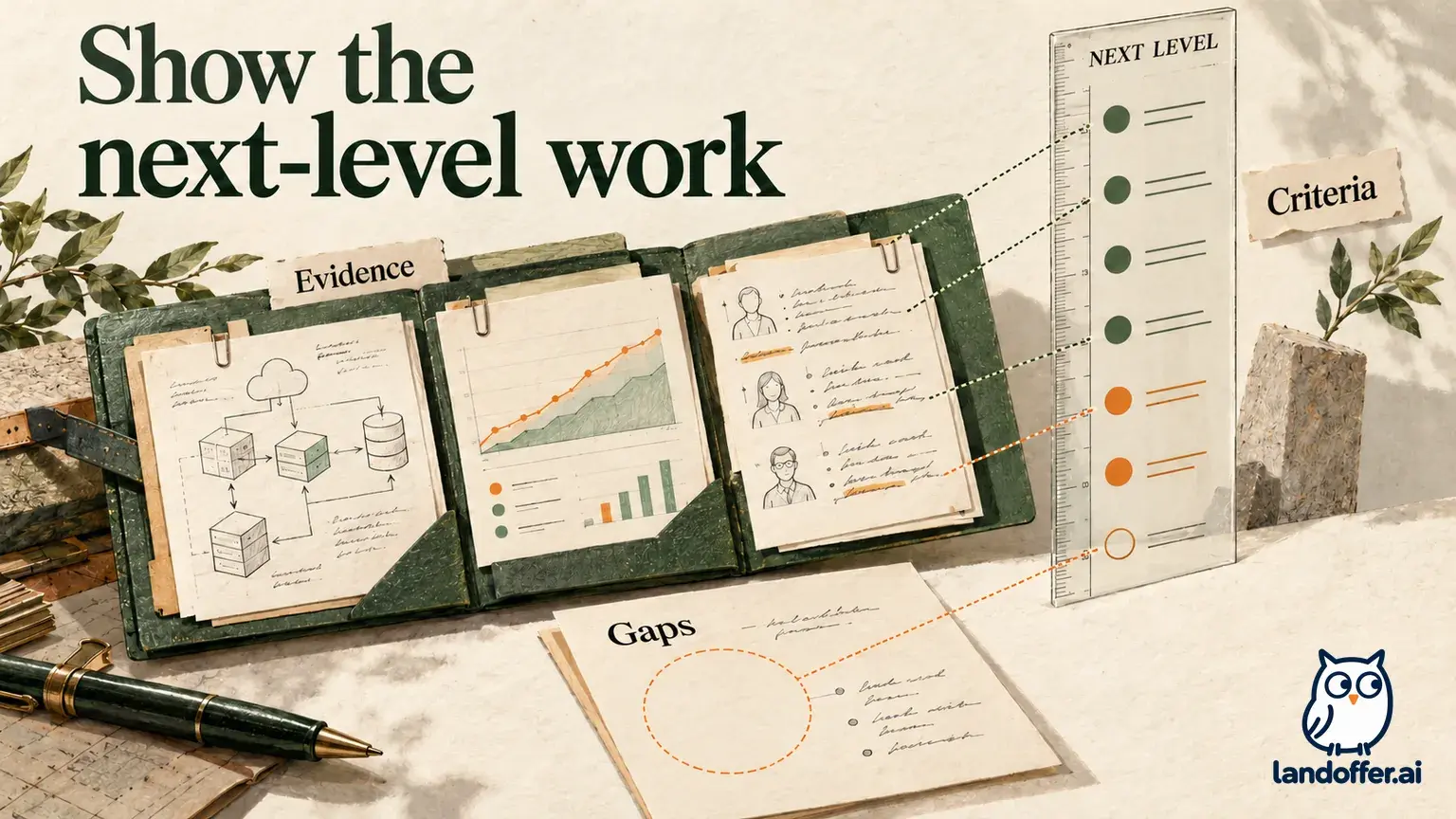
Treat the explanation as several questions rather than one verdict on your ability. Can you perform the responsibility? Did reviewers see enough supported examples? Is a suitable role or scope available? Did the case reach the right decision-makers in time? These capability, evidence, opportunity, and process questions need different answers.
For a capability gap, identify a responsibility to practice with feedback. For an evidence gap, recover an existing authorized record or arrange a fair observation of the work. For an unavailable role, ask who can clarify the future opportunity and when. For a missed process step, establish the owner and deadline. Rewriting your accomplishments would not, by itself, create headcount or repair a missed nomination.
GitLab's Engineering Career Development guidance distinguishes coaching toward a role from documenting work already performed for promotion. It also describes organizational need for some moves beyond Senior Engineer. Those are GitLab-specific examples; your employer's current framework and process control your situation.
You may have more than one issue. A manager could support your readiness for most criteria while identifying one weak area and an uncertain opening. Preserve both. Labeling the entire result “budget” can hide useful feedback; labeling it entirely “performance” can make you responsible for a decision you cannot control.
Completed example: turn mixed feedback into a bounded plan
Sofia Chen is a fictional Senior Frontend Engineer who hoped to be considered for Staff Engineer. Her company, criteria, meetings, dates, and records below are invented. No actual employee or promotion system was inspected. The example shows how to organize a conversation, not what every Staff Engineer must demonstrate.
In the teaching case, Sofia's manager says she produces strong implementation work but needs to demonstrate how she helps several product teams agree on an engineering direction. Her accessibility-filter prototype is useful, yet the existing record does not show how she resolved competing requirements. The manager also says the department has not approved continuing Staff-level scope for this work.
The completed response separates three issues instead of translating all of them into “lead more projects.”
| Decision explanation | Agreed next step and evidence | Owner and boundary |
|---|---|---|
| Cross-team technical direction is insufficiently demonstrated | Sofia will facilitate the catalog-filter planning discussion, document two competing requirements, and record the decision and unresolved risks. The product and accessibility leads will review her explanation. | Sofia prepares and facilitates; manager secures participation. Attending a meeting alone will not establish the behavior. |
| Prototype work was described without its decision context | Sofia will add the existing design alternatives and her contribution to the authorized internal work record, identifying which decisions belonged to others. | Sofia supplies the record; manager checks whether it answers the stated evidence gap. No invented adoption or customer impact. |
| Continuing Staff-level scope is unapproved | Manager will ask the department lead whether this responsibility is expected to continue and report back on November 17. | Manager owns the inquiry. No role, budget, or nomination is promised; Sofia does not need to prove that an opening exists. |
This is a completed plan, including an unresolved organizational condition. It makes the employee's work inspectable without pretending that she controls staffing. Naming the manager's commitments also shows whether the promised development opportunity was provided. If the leads cannot participate, revisit the arrangement before judging Sofia's ability to collaborate.
The evidence-gap action is intentionally smaller than a new project. If an existing record can answer a specific question, repeating the entire assignment may waste time. However, reconstructing a decision after the fact cannot establish behavior that never occurred. The manager must still judge whether the recovered record is sufficient.
Choose an assignment that can demonstrate the missing behavior
Agree on the intended observation before starting. “Lead the catalog discussion” is too broad unless you know what the observer will evaluate. In Sofia's example, the relevant behavior is identifying competing needs, explaining trade-offs, and helping accountable owners reach an explicit decision. The plan does not require her to overrule the product lead or claim final authority she lacks.
MIT Human Resources' Development & Career Planning guidance includes work assignments, practice, and feedback among development activities. It connects planning with employee interests and organizational needs. This supports considering a range of learning opportunities; it does not make any particular assignment a promotion requirement.
Choose work that serves a legitimate team need and gives you a fair chance to practice. Confirm the sponsor, participating stakeholders, time allocation, and which current deliverable will be reduced or delayed. Extra responsibility without time or access may produce an overloaded schedule rather than useful evidence. A course can support a skill, but completing a course is different from demonstrating that skill in the target responsibility.
Keep your present-role commitments explicit. If the development assignment conflicts with delivery work, ask the manager to prioritize. Avoid silently assuming that advancement preparation must happen outside working hours. The useful agreement describes what you will do and what the organization will enable.
Write the follow-up while the conversation is still specific
A short written recap can expose disagreement before it becomes another disappointing review. Label your understanding, distinguish confirmed points from questions, and ask for corrections. Sending a recap does not make it an agreement. If there is no response, follow up through your normal channel rather than treating silence as approval.
Here is a completed fictional message Sofia could adapt. The dates and commitments are examples, not a recommended company timetable:
Thanks for discussing the Staff decision with me. My understanding is that the current case did not sufficiently show cross-team technical direction. The department has also not confirmed continuing Staff-level scope for the catalog work. These are separate questions; please correct me if I have misunderstood either.
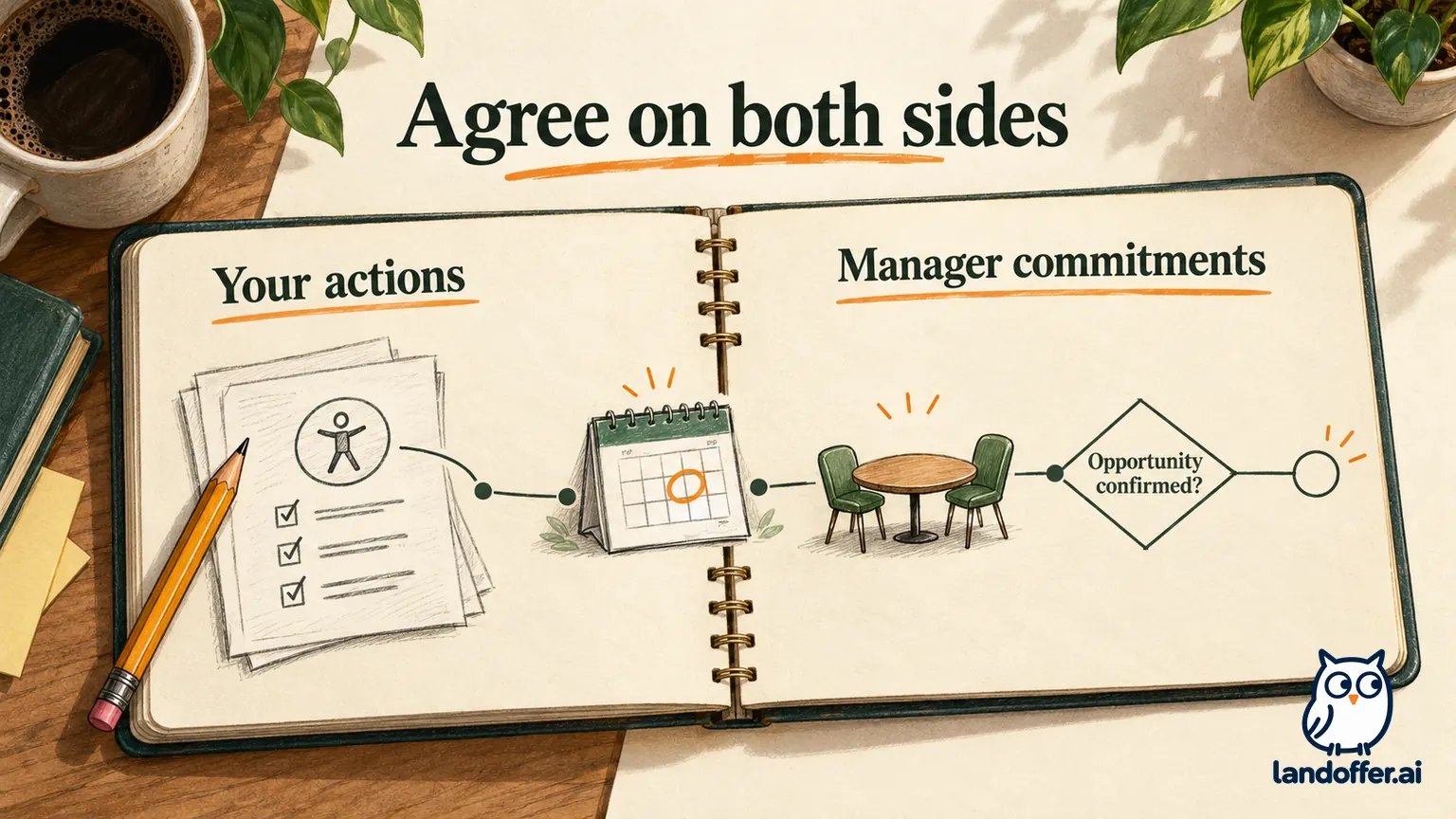
I will prepare a two-option catalog-filter discussion brief by November 5 and facilitate the November 10 planning session. I will record the trade-offs, the accountable decision-makers, and the risks left open. You will invite the product and accessibility leads, confirm that this session can be used for developmental feedback, and reduce my implementation queue by one agreed item that week.
At our November 12 check-in, we will review whether my brief and facilitation demonstrate the behavior we discussed. You will confirm the department's expected scope by November 17. At our November 24 review, we will decide whether to continue this plan, change the opportunity, or pause promotion preparation. We have not agreed on nomination or a promotion outcome.
The recap contains employee actions, manager commitments, observers, and decisions. It does not say that three weeks of work will qualify Sofia for Staff. The first check-in examines behavior; the second resolves an opportunity question; the final meeting decides what to do next. Separating them prevents “review later” from becoming an indefinite promise.
Use checkpoints to change the plan, not just report activity
At the first check-in, compare the work with the agreed behavior. In this hypothetical continuation, Sofia presented two options but closed the discussion before the accessibility lead explained a concern. This is an invented observation, not a reported employee outcome. It illustrates specific feedback she could use: circulate the unresolved questions and facilitate a follow-up decision with the owners, rather than add unrelated features to appear more productive.
Record disagreement about the observation. If the manager expected consensus while the stakeholders expected a recommendation, clarify the responsibility before evaluating another attempt. An unexplained moving standard makes it difficult to know what to practice. A changed standard should have a stated reason and a revised agreement.
At the opportunity checkpoint, suppose the department confirms that it has no continuing cross-team role planned. Keep the development result separate from that constraint. Sofia can still have learned something useful, while deciding that further promotion-specific work is not justified under the current conditions. The next action could be maintaining her current scope, exploring an authorized internal opportunity, or asking when the organizational question can realistically be revisited.
There is no obligation to turn every skill into another unpaid stretch assignment. Decide how much time and uncertainty you are willing to accept. A plan earns continued effort by becoming more informative, not merely by accumulating more tasks.
Decide what would justify another cycle
Before the next nomination window, revisit the evidence and the process separately. Ask which original concern has been addressed, which remains open, and whether a nomination is actually planned. Confirm who owns it and what the current deadline is. Your company's next cycle may not match a calendar quarter or the dates used here.
If the reason changes, ask whether new information emerged, priorities shifted, or the original explanation was incomplete. Document the answer without assuming either bad faith or guaranteed fairness. Concerns about discrimination, retaliation, or a breached policy may need your employer's designated reporting or advice route; a development plan is not a substitute for resolving those concerns.
Your next action is to write three lines: the decision as you understand it, the most important unresolved question, and the person who can answer it. Mark the first line as your understanding and invite correction. Take those notes into a follow-up conversation before accepting a broad promise to “keep doing great work.” This guide is from LandOffer.ai; its purpose is to help you make the next discussion concrete, without promising what that discussion will decide.
Sources and Further Reading
- Will Larson: Getting the title where you are — practitioner discussion of Staff-level opportunity and organizational conditions.
- GitLab: Engineering Career Development — an employer example separating coaching, promotion evidence, and opportunity.
- MIT Human Resources: Development & Career Planning — development activities, feedback, interests, and organizational needs.