LandOffer
Pay & Benefits
Paid Parental Leave, Disability Pay, and PTO: Build One Timeline from Separate Policies
A fictional employee’s conflicting leave draft is reconciled into one continuous absence with changing pay sources and concurrent protection. The completed timeline and administrator-response record distinguish a waiting period from payable disability weeks, preserve the remaining PTO balance, and leave an unanswered deposit-date question open.
Build one leave timeline with separate rows for approved time away, the source of pay, paid-leave balances, and any job-protection designation. Check waiting periods, overlap rules, eligibility, and the authority for each approval. Disability pay, employer parental pay, and PTO may cover different portions of the same absence; do not add their published maximums together without checking which periods overlap and which payments can be combined.
This LandOffer.ai guide uses an explicitly fictional employer policy and employee case to reconcile a conflicting draft. It is an organizational planning method, not a determination of your medical recovery, benefit entitlement, tax liability, or legal rights. Use your actual plan documents and written administrator responses for your own dates.

Separate absence, pay, and protection before counting weeks
An approved absence answers when you may be away and what return process applies. A benefit decision answers whether a payment is payable, its amount, and for which period. A job-protection designation addresses a different question. A favorable decision in one system is not necessarily an approval in the others.
The US Department of Labor’s March 2025 FMLA protections fact sheet explains that eligible employees of covered employers may have unpaid, job-protected leave and may use employer-provided paid leave at the same time. It describes up to 12 workweeks for qualifying family and medical reasons in the applicable 12-month period. Eligibility, available entitlement, and the specific designation still need checking; a benefits brochure does not establish them.
Do not treat “12 weeks of FMLA” as a second payment source or a block that necessarily starts after paid leave finishes. Equally, do not infer that a disability payment by itself establishes the whole duration of job protection. Other applicable laws, agreements, or employer provisions may matter; this article does not calculate every jurisdiction’s entitlements.
Get the governing versions of the parental-leave policy, disability plan, sick-leave/PTO rules, and leave-administration instructions. Record the employee group, work location, effective date, and whether the document applies to you. A faculty policy, hourly policy, or collective agreement may differ from a general staff page.
Read how the policies coordinate
As a real employer example, Penn’s paid parental leave policy, reviewed July 30, 2025, provides eligible employees up to four weeks and describes concurrent FMLA. It says disability benefits and parental benefits cannot be received simultaneously, and parental leave cannot fill the disability waiting period. Its policy instead directs available sick time and PTO into that waiting period in the stated order.
Penn’s separate short-term disability policy describes a 14-consecutive-calendar-day waiting period, administrator approval, and its own pay percentages and limits. These are Penn’s provisions for the employee groups covered by that policy. They are not a national standard or the fictional pay formula used below. A medical period is not established by copying a policy’s maximum.
For your plan, ask whether a waiting period consumes calendar days or workdays, whether paid balances must or may cover it, and whether disability and parental pay run together or in sequence. Check how supplemental pay and offsets work before assuming that PTO can be added to disability benefits. Obtain the relevant administrator’s answer rather than asking payroll to invent an interpretation.
Also distinguish the benefit-covered dates from the date money arrives. A claim can cover a period while its payment is still being processed. A payroll cycle or missing document can create a cash-timing question without creating an extra benefit week.
Worked case: identify the assumptions before drawing the line
All people, documents, approvals, amounts, dates, and results in this case are fictional. Rae works a regular Monday–Friday, eight-hour schedule at Harborline. The illustration assumes the leave administrator has confirmed that Rae is eligible for FMLA, has 12 workweeks available, and has designated the continuous November 2, 2026–January 24, 2027 absence accordingly. This is a stipulated example, not a calculation of your eligibility or leave-year method.
The fictional disability administrator has approved Rae’s medically supported disability period through December 27. That is an eight-week absence in this example, including the waiting period. It is not a typical recovery prediction, a recommendation, or a rule that every birth results in eight weeks of disability.
Harborline’s written example rules are:
- Disability has a 14-calendar-day waiting period. Available sick leave is used first, then PTO for scheduled workdays in that period. Afterward, approved disability pays 60% of a hypothetical $2,000 regular gross weekly base, with no additional pay supplement assumed here.
- Employer parental leave pays four continuous weeks at the hypothetical base rate after disability ends. The example policy does not allow parental pay and disability pay for the same period.
- Rae starts with 40 sick hours and 80 PTO hours available. No additional accrual is assumed. Other offsets, state wage-replacement programs, taxes, and deductions are outside this arithmetic illustration and must be checked separately if applicable.
- The leave administrator’s confirmed protection designation runs alongside the paid periods. The year boundary does not create an assumed extra entitlement in this stipulated case.
Rae’s first draft lists eight disability weeks, four parental weeks, and two PTO weeks as 14 paid weeks, then adds another 12 weeks for FMLA. It also puts parental pay into the first two weeks to “bridge” the disability waiting period. The draft both overlaps pay sources and assumes extra protected time; it needs reconciliation before Rae relies on it.
Revised timeline: one absence, changing sources of pay
Rae asks the leave administrator, benefits administrator, and payroll to reconcile the draft. In this fictional response, the leave administrator confirms the 12-week designation; the disability administrator confirms the approved benefit period and waiting rule; HR confirms parental sequencing; payroll confirms the sick/PTO entries. A manager’s agreement to cover work is not substituted for these decisions.
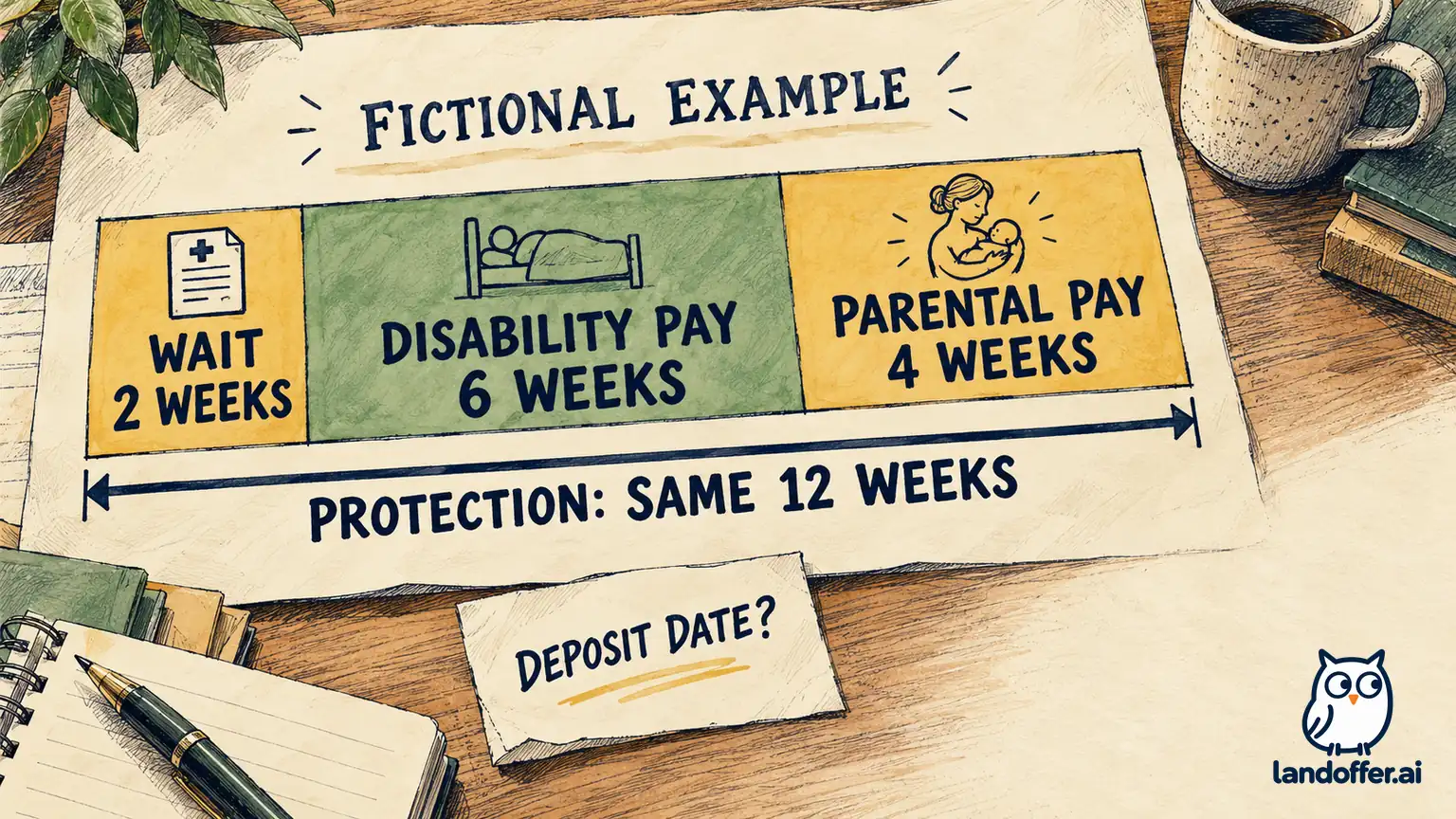
| Continuous absence | Pay source under the fictional confirmed rules | Balance or payment treatment | Concurrent protection in this case |
|---|---|---|---|
| November 2–8, week 1 | Sick leave for five scheduled workdays | Use 40 sick hours; hypothetical gross pay $2,000 | Part of the same designated FMLA absence |
| November 9–15, week 2 | PTO for five scheduled workdays | Use 40 PTO hours; hypothetical gross pay $2,000; parental pay not used in waiting period | Part of the same designation |
| November 16–December 27, weeks 3–8 | Approved disability benefit | Six payable weeks at $1,200 gross per week; no PTO top-up assumed | Part of the same designation, not six added protected weeks |
| December 28–January 24, weeks 9–12 | Employer paid parental leave | Four weeks at $2,000 gross per week under this example | Remaining portion of the same designation |
| January 25 | Planned return date | Check required return documentation and payroll status before the transition | No extra protection inferred from an unused PTO balance |
The table uses whole continuous weeks and the example’s written designation; it does not attempt to calculate different holiday, intermittent-leave, or reduced-schedule rules. Payroll must apply the actual employer’s rules to dates and balances. Dates may need revision if the event, approved medical period, or return circumstances change.
Under the stated starting balance and no-accrual assumption, Rae has 40 PTO hours left: 80 minus the 40 used during the waiting period. The draft’s proposed two PTO weeks at the end are therefore unsupported even as a balance calculation. One unused PTO week also does not automatically extend the approved absence beyond January 24. Any additional time needs the applicable approval and a separate determination of protection or other rights.
The illustrative gross total is $19,200: $4,000 during the waiting period, $7,200 from six disability weeks, and $8,000 from four parental weeks. Twelve hypothetical regular-pay weeks would total $24,000, so the gross difference is $4,800. These are arithmetic comparisons before taxes, deductions, offsets, and actual payment timing—not a take-home estimate or an amount promised by any insurer.
Keep an approval and payment record beside the timeline
Keep the approval record beside the calendar so that a change in one system does not quietly rewrite the others. Rae keeps the following reconciliation record with the policy versions and administrator responses in the approved private location. Medical documentation goes through the designated secure route; it is not attached to a general team coverage message.
| Conflict in the first draft | Fictional confirmed revision | What still needs a separate check |
|---|---|---|
| Parental pay fills weeks 1–2 | Remove it; use 40 sick hours and 40 PTO hours in the waiting period | Verify the first payroll entries and actual remaining balances |
| “Eight weeks STD pay” | Relabel as eight weeks of disability absence including two waiting weeks; only six weeks payable in this illustration | Reconcile benefit-covered dates and any actual payment notice |
| Paid periods followed by 12 FMLA weeks | Show protection concurrently across the same 12-week absence | Keep the actual designation and available-entitlement record; do not infer a fresh annual bank |
| Two PTO weeks appended automatically | Remove the extension; only 40 PTO hours remain | Additional absence and protection have not been approved |
| Payment-covered dates equal deposit dates | Record covered dates separately from deposit dates | Disability administrator has not confirmed the first deposit date; payroll timing remains open |
Rae’s completed follow-up question is: “Please confirm that my revised source-of-pay sequence matches the written approvals for November 2 through January 24. I understand the first 14 calendar days use available sick leave and PTO for scheduled workdays, followed by six approved disability-pay weeks and four parental-pay weeks. Please identify any offsets or coordination provisions missing from this example record, confirm how I will see the sick/PTO deductions, and provide the expected first disability payment date when available.”
Within the fiction, HR confirms the corrected parental sequence and payroll confirms the intended waiting-period coding. The disability administrator has not answered the deposit-date question. The record therefore says “sequence reconciled; first payment timing unconfirmed,” not “all pay received.” No real claim, medical record, leave request, payroll instruction, or message was submitted for this article.
Revisit the plan when an assumption changes
If the approved disability period changes, obtain the revised administrator decision and ask how it affects parental leave, protection, and return requirements before changing the timeline. Do not simply slide every later date yourself or assume an extension is payable. Ask which administrator can revise which part of the record, and retain the new decision beside the old version.
If adoption, a non-birth parent’s bonding leave, or another family circumstance applies, the disability row may not apply at all. Use the policies applicable to that employee and event rather than copying Rae’s medical timeline. Where a state program or collective agreement applies, add its actual coordination rule; do not assume Harborline’s fictional formula resolves it.
Keep benefits continuation and employee premium contributions on the checklist as separate administration questions. DOL’s fact sheet explains that group health coverage during FMLA continues on the same terms, including the employee’s normal contributions. A payroll or unpaid period can require a different collection arrangement; confirm it rather than interpreting a smaller deposit as proof that coverage ended.
Start with your actual documents and draft one row for every changing pay source, with protection alongside it. Ask the authorized owners to reconcile overlaps, balances, and unanswered payment questions before relying on the result. More current-work guides are available from LandOffer.ai.
Sources and Further Reading
- US Department of Labor: Fact Sheet #28A, FMLA employee protections — March 2025; eligibility and covered employers, concurrent paid leave, protection, and group-health contributions. This article does not determine an individual’s rights or entitlement.
- University of Pennsylvania: Paid Parental Leave, Policy 635 — last reviewed July 30, 2025; Penn-specific eligibility, four-week limit, sequencing, waiting-period treatment, and jurisdiction caveat, not Harborline’s fictional policy.
- University of Pennsylvania: Short-Term Disability — current public body checked October 27, 2026; Penn-specific waiting period, administrator approval, pay rules, and concurrent leave. Its pay percentages differ from the explicitly fictional 60% illustration.