LandOffer
Job search
OnlyDust Review: Contribution History, Fellowships, and the Reward-Availability Boundary
Read OnlyDust’s current closure notice alongside older grant documentation, then distinguish contribution evidence, historical selection and payment records.
OnlyDust’s current homepage says its chapter has closed. That changes the answer to an OnlyDust review: do not plan new paid work around an old fellowship page, a project listing or a merged pull request. Preserve the work you can document, then ask separately whether a grant was awarded, which conditions applied and whether money was received.
We checked public OnlyDust pages on October 22, 2026. The closure notice was undated; this is the date we observed it, not an established shutdown date. Older documentation remained accessible. We did not create an account, connect GitHub, contribute code, apply for funding or inspect a wallet. LandOffer publishes this guide. For a separate employment search, browse recent roles on LandOffer.ai and verify the employer’s actual work arrangement.

Start with the closure notice, not the old reward description
The OnlyDust homepage displayed “The OnlyDust chapter closes here. Thank you for an incredible ride.” Its founder message describes a change in focus and points to another project, ctrlg.com. That is a current public statement about OnlyDust’s direction, not evidence that an old fellowship remains open or that contributor accounts, balances or obligations moved to the linked service.
A readable documentation page cannot settle present availability. Old program descriptions can explain how a past contribution or award was organized; they do not establish an upcoming selection round, current sponsor budget or functioning funding application. This review found no basis to describe OnlyDust as a currently available fixed-pay job route.
If you previously received an award notice, assess that individual record separately. The homepage alone does not establish the status of that particular award or any transfer. Preserve the individual documents and communications that identify it. This article does not determine outstanding amounts, withdrawal availability or a person’s legal rights from a general closure message.
The documented funding model had already changed
OnlyDust’s funding explanation contrasts direct distributions to contributors and maintainers in 2024 with a three-month grant program in 2025. That dated distinction helps explain why older descriptions of rewards should not be treated as a continuing per-PR rate card. On October 22, the page still described its 2025 grant model in ongoing language; the homepage closure statement prevents treating that wording as verified current availability.
The May 26, 2025 terms described discretionary Fellowship Grants for contributors and Project Grants for projects. They distinguished those grants from compensation tied to a specific task or deliverable and did not describe OnlyDust contributors as employees of the platform. This is the document’s stated model, not a legal classification of every relationship a contributor might have elsewhere.
For job-search planning, the consequence is practical. An issue can define engineering work without defining pay. A project can have support without promising an individual contributor funding. A history of accepted contributions can demonstrate work without establishing a new award. Keep the contribution record separate from the funding record, so time spent on an issue does not become income you have only assumed.
The same terms described conditions around grant transfers, including verification and applicable administrative requirements. Reading those conditions does not establish that a transfer facility is currently operating. We did not accept terms, provide identity information or test payment access. No old support amount is presented here as an available offer.
Fellowship selection was different from contribution acceptance
The remaining OnlyDust Fellowship documentation described manual review of contribution history, consistency, quality, collaboration and context. It described selected contributors receiving support for up to three months, with monthly review and capacity depending on sponsor support. A merged PR mattered as contribution evidence; it was not itself a selection notice.
The page also described possible mentorship, merchandise and some event-related support. Those descriptions explain the former support model, not current entitlements. Neither the number of PRs nor an old mention of a monthly review cycle establishes that somebody is evaluating new applicants today. The closure notice is why this guide does not offer those pages as an application plan.
The separate project-grant documentation considered project activity, roadmap, onboarding and community engagement. It also described matching selected fellows with projects. Project funding and contributor fellowship support therefore had different subjects and selection evidence. A repository being listed, or a project describing itself as sponsor-backed, did not automatically make every issue a paid assignment.
When looking back at your records, ask what the document actually names: the repository, a project grant, a contributor invitation or an individual award. Do not treat a maintainer’s encouraging review comment as a funding decision made by the grant operator. The people accepting code and allocating support may have different responsibilities.
The issue workflow was not a job application
OnlyDust’s Find your first issue guide described applying to work on an issue, obtaining maintainer assignment, submitting work and tracking review states. It said an issue application could create a comment on GitHub. That was a public contribution workflow, not a private employment application or a fellowship award request.
The OSS Wave guide described a roughly ten-day contribution event with further maintainer review time. Event participation could contribute to a developer’s history. It did not establish an hourly wage, a guaranteed merge or a personal grant. No future Wave date or currently open registration was verified in this review.
These older instructions remain useful for interpreting archived records, but they should not be followed as proof of a live service. Check a repository’s own current contribution instructions if you independently choose to work on it. A platform’s status does not determine whether every underlying open-source repository is active, abandoned or accepting help.
Also distinguish work being visible from work being credited accurately. A submitted PR can show a proposed change. A merged PR can show that the change entered the target branch. Review discussions can explain revisions and collaboration. None should be expanded into authorship of an entire project, production adoption or measured impact that the record does not establish.
Worked example: preserve contribution history without inventing pay
Jae is fictional. Their stipulated archive contains work on an invented open-source command-line project called Cedar Pack. Two contributions were merged before the current review date, while a third remained under review. The project, records and outcomes are invented teaching material, not real OnlyDust or GitHub activity. No repository was accessed or changed for this example.
Jae’s first resume note says, “Paid OnlyDust engineer delivering production releases.” The stipulated record establishes neither platform employment, payment nor release ownership. Their completed evidence record separates what the contribution history supports:
| Invented archived record | What it establishes within this example | Claim Jae retains |
|---|---|---|
| A documentation PR with a recorded merge | Accepted update to installation instructions | Contributed installation documentation |
| A parser-test PR with review comments and a merge | Accepted test additions and a revision after feedback | Added parser test cases and incorporated maintainer feedback |
| A proposed packaging change still under review | Work submitted; acceptance unresolved | Discuss as a proposal, not a shipped change |
| No individual grant-selection notice | No selection established by this record | Do not list a fellowship award |
| No payment receipt | No payment established by this record | Do not describe the work as paid employment |
The completed portfolio paragraph reads: “Contributed installation documentation and parser test cases to the Cedar Pack open-source project. Revised the test contribution following maintainer feedback. A separate packaging proposal remained under review when I prepared this summary. These were independent open-source contributions; this record does not establish a fellowship award or payment.”
Jae’s supporting note retains each repository and PR identifier, the scope of the change, the review discussion, the recorded merge state and the date checked. In a real record, those details should point to the person’s actual work. They should not expose private maintainer messages, credentials, unreleased customer code or information unrelated to the contribution.
Their completed decision is to keep the accepted work as technical evidence and remove the employment, pay and production-release claims. The third proposal stays separate from the two accepted contributions. The closure notice does not erase the stipulated contribution history, but neither does that history establish money received.
For an interview, Jae prepares to explain the parser test and the revision requested by the maintainer. Performance improvements and prevented production incidents remain outside the account because the stipulated record supplies no evidence for them.
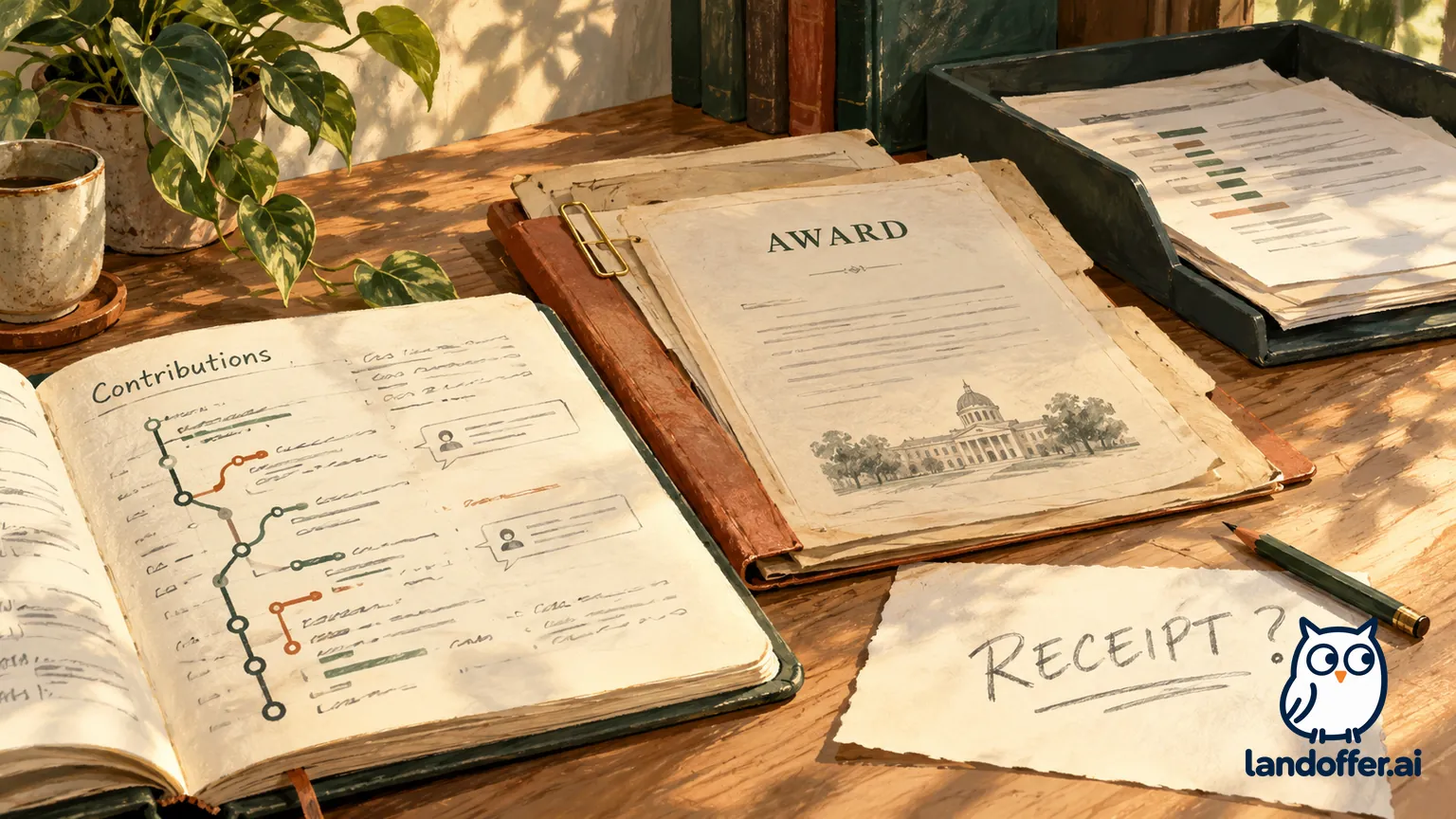
Worked example: an award document and a transfer need separate records
Marin is fictional and is reviewing an invented historical support file. This exercise does not describe a real OnlyDust recipient, available grant, wallet balance or unpaid debt. The supplied facts are limited: an invitation to discuss a fellowship, a later selection notice identifying a support period, and one transfer confirmation for one installment. There is no evidence of later transfers in the supplied file.
The purpose is to classify documents, not infer contractual rights. No payment amount, token price or expected return is needed to complete the record:
| Item in the invented file | Completed status | What remains unestablished |
|---|---|---|
| Invitation to discuss goals | Invitation received in the fictional history | Selection or funding at that stage |
| Later selection notice naming a support period | Historical selection documented | A new current fellowship opening |
| Terms attached to that notice | Conditions available for review | Whether every condition was satisfied |
| One installment’s transfer confirmation | One transfer documented in this example | Receipt of other installments |
| No later transfer confirmations | Later receipts unverified | Whether anything is due, pending, canceled or already paid elsewhere |
| Current homepage closure notice | Current platform-status information | Resolution of Marin’s particular historical file |
Marin’s completed record summary reads: “My archive documents an invitation, a later historical selection and one confirmed transfer. I have not established later receipts from the records available here. I will keep the award notice, its conditions and each transfer record separate from the current closure announcement.”
Their unsent clarification request reads: “Could you clarify the status of the support period identified in my original notice and the records for each installment? My archive contains the selection notice and one transfer confirmation. I am seeking the relevant record, rather than assuming that a contribution merge or the homepage message settles the remaining status.”
The exercise deliberately leaves the missing information unresolved. It does not turn an award into a bank receipt, a missing receipt into a debt conclusion, or a closure notice into evidence that every historical grant has the same outcome. In a real situation, use the original award’s established contact route and avoid posting financial or identity documents publicly.
Marin’s archive is separate from Jae’s portfolio. One records contribution work; the other records selection and transfers. A contributor may have both kinds of history, but they answer different questions. Keep the language of each record proportionate to the documents it contains.
Decide what to preserve and where to search next
For a new visitor seeking predictable income, the current closure notice rules out treating old OnlyDust program documentation as a reliable paid-work plan. For someone with previous contributions, preserve the original technical evidence and describe the work accurately. For a previous award recipient, review the individual support documents without inferring their resolution from the homepage alone.
Start with the record that needs a decision: correct an overstated portfolio sentence, reconcile a historical support file or verify a current employer requisition. Browse recent roles on LandOffer.ai for the last task. Keep the discovery of work, acceptance of a contribution, grant selection and receipt of money as distinct states in your search record.
Sources and Further Reading
- OnlyDust current homepage, closure message observed October 22, 2026; exact announcement date not established.
- OnlyDust funding explanation, accessible older documentation distinguishing 2024 direct distributions and the 2025 grant model.
- OnlyDust terms, last updated May 26, 2025, documented discretionary-grant model, not proof of currently operating services or a personal legal determination.
- OnlyDust Fellowship documentation, former selection and support description, not a verified open cycle.
- Project-grant eligibility documentation, project-level criteria and fellow support distinguished.
- Find your first issue, older contribution workflow and GitHub-comment boundary.
- OSS Wave documentation, older event mechanism; no future event availability verified.