LandOffer
Job search
Non-Compete and Confidentiality Questions on Applications: Gather Facts Before You Answer
Inventory the actual agreements and distinguish their existence from relevance and enforceability.
Before answering a non-compete or confidentiality question, find the agreements you actually signed and read what the application asks about them. “Have you entered into an agreement?” asks about a document or obligation. “Would an agreement prevent you from performing this role?” requires a different assessment. Do not turn a remembered document title, a news headline or a required checkbox into a legal conclusion.
Gather the facts, identify the uncertainty and use the employer’s appropriate review route when the answer depends on interpretation. LandOffer publishes this guide; when you browse recently posted jobs, save enough of the role’s public duties to explain what needs review. The worked examples below separate document existence, possible relevance and unresolved enforceability without sharing a former employer’s confidential material.

Separate the question about existence from the question about impact
Read the whole sentence, including any list of agreement types. An application may ask only about non-competes, or it may also include confidentiality, non-solicitation, intellectual-property and other obligations. Do not answer a broad question as though it named only the document you consider most important.
For an existence question, start with the executed documents and any later amendments or releases. Did you sign the agreement named by the question? Was it amended, replaced or released? Is the question asking about any agreement ever signed or an obligation to which you remain subject? Those are distinct scopes. A signature is a fact you can locate; whether an obligation remains operative may require interpretation.
An impact question asks how an obligation relates to the proposed work. The new role’s title may not supply enough detail. Customer contact, territory, products, duties and timing could be relevant facts for an appropriate reviewer. Do not claim that an agreement cannot affect the role merely because the two employers use different job titles.
Enforceability is a further question. This guide does not decide whether a clause is valid, enforceable, expired or waived for you. State and other applicable law, the document and the circumstances can matter. If answering accurately requires that assessment, bring the relevant facts to a qualified lawyer rather than guessing from a general article.
Do not use the old FTC announcement as a blanket answer
As checked October 12, 2026, the FTC’s noncompete rule status page says the rule is not in effect and is not enforceable. The FTC subsequently published a February 12, 2026 final action removing the rule from the Code of Federal Regulations. The 2024 announcement of a nationwide ban does not establish that your particular agreement is irrelevant in October 2026.
This status does not establish the opposite conclusion either. It does not mean every non-compete is enforceable, nor does it resolve a confidentiality or non-solicitation clause. Keep the federal rule’s status separate from the question about your documents and the law applicable to them.
If a saved answer was based on “the FTC banned all non-competes,” reopen it before using it. Record the source and date of any legal information you rely on, and seek current advice for an individual assessment. A prefilled no should not survive solely because it worked on an older application.
The practical task at this stage is narrower: locate what you signed, establish the exact application scope and identify what still needs review. You can do useful preparation without claiming that you have settled the law. An inventory helps a reviewer focus on the actual provision, the proposed duties and the missing facts.
Build an inventory from the documents you may access
Use your own retained copies or request copies through a legitimate HR or legal route. Look for executed agreements, offer attachments, amendments, equity-related agreements, separation documents and written releases where relevant. A later document may affect an earlier one, so do not stop after finding the first familiar title.
Record the document date, parties, signature status and relevant section references. Record the execution date, employment separation date and any stated obligation start or end separately. If the text measures a period from termination, you need the correct termination event before treating a calendar calculation as meaningful. Even then, interpretation may remain unresolved.
Use document titles as navigation aids, not as the sole classification. An agreement called “Confidentiality and Inventions” might contain additional provisions. A separation agreement might refer back to continuing obligations rather than repeat them. Read the relevant text and cross-references. If an attachment is missing, identify it as missing rather than assuming it adds nothing.
Do not retrieve files you are no longer authorized to access or take business records to prove that you worked on a project. This inventory concerns your own agreements and permissible personal records. Customer lists, source code, internal forecasts and unreleased product information are not necessary attachments to an ordinary application explanation.
A completed document inventory with a missing assessment
The following candidate, employers, dates, document contents and role are fictional teaching inputs. Ravi signed a 2022 agreement with Stonepath Software containing confidentiality and intellectual-property provisions. A signed 2024 amendment contains a stated twelve-month customer non-solicitation provision following separation. He left in August 2026 and is considering a public-facing solutions role at another invented employer, Harborline Tools. No legal interpretation or release is stipulated.
| Document or fact | What the fictional record establishes | What it does not establish |
|---|---|---|
| Executed 2022 agreement | Ravi signed confidentiality and IP provisions | That it is a non-compete or prevents every new role |
| Executed 2024 amendment | A customer non-solicitation provision is present | Its enforceability, precise coverage or effect on Harborline duties |
| August 2026 separation record | A recorded separation month | A legal conclusion about when every obligation ends |
| Public Harborline role description | Customer-facing solutions work is contemplated | Which customers, accounts or duties Ravi would actually receive |
| No release located in Ravi’s copies | Ravi has not found a release | Proof that none exists or that no later change occurred |
The inventory records known documents and specific unknowns; the role-impact assessment remains unresolved. Ravi can accurately identify the signed documents and the missing information. He cannot infer that “no document titled Non-Compete” means “no relevant agreement.” The application might expressly include the amendment’s category.
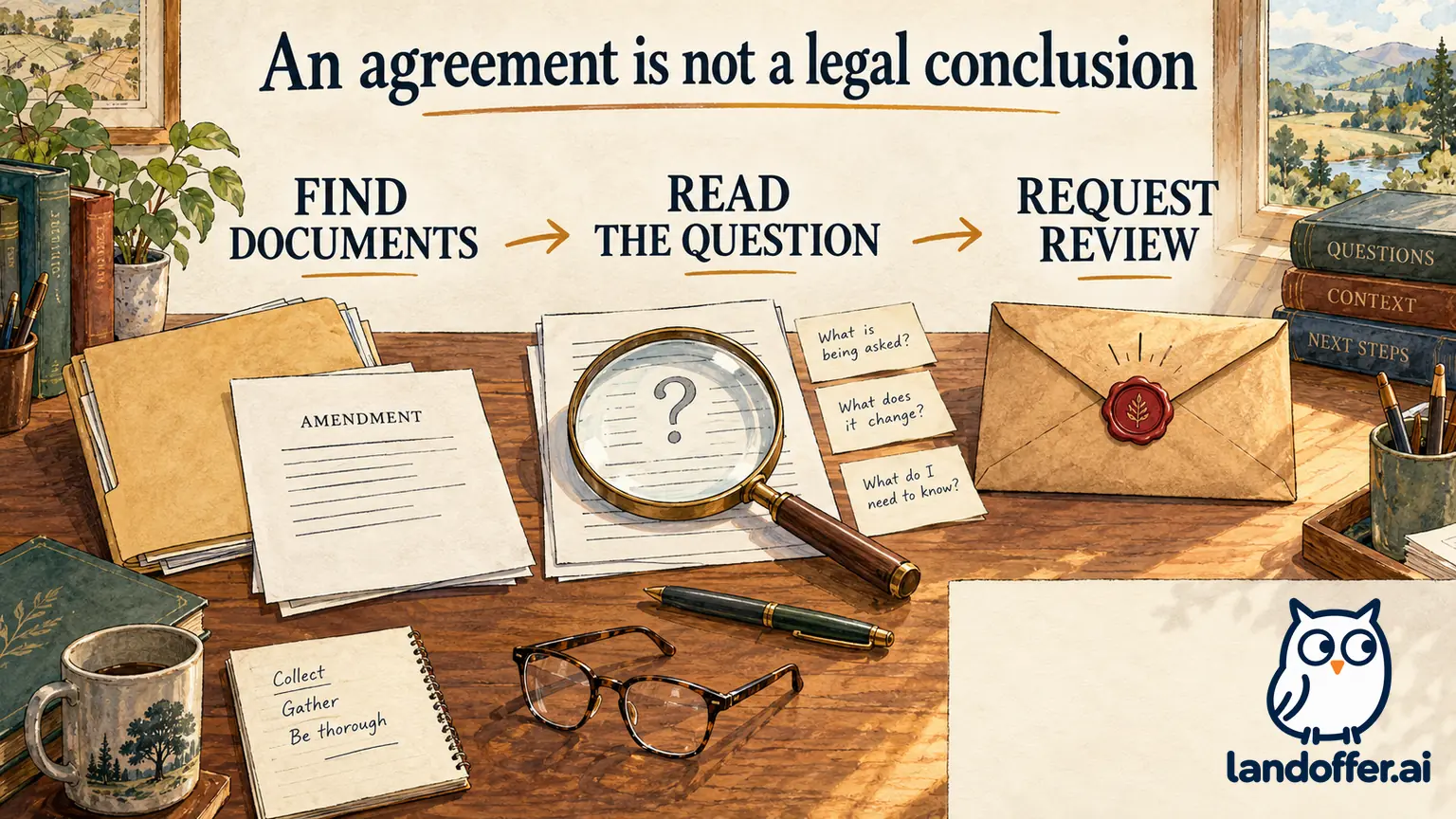
His next steps are specific: confirm that he has the complete executed set, obtain a nonconfidential description of the prospective customer-facing duties, and arrange appropriate review. He should not replace those steps with a personal estimate that the old and new employers probably serve different customers.
Three different fields produce three different responses
The questions in this table are invented. They show why one universal yes/no answer is unreliable. The responses apply only to Ravi’s stipulated facts and preserve the unresolved legal assessment.
| Fictional application wording | Supported response or next step | Reason |
|---|---|---|
| “Have you signed any confidentiality agreement with a current or former employer?” | Yes; identify the agreement briefly if requested | The executed 2022 record establishes that fact |
| “Have you signed a non-compete or customer non-solicitation agreement?” | Yes; identify the 2024 customer non-solicitation amendment | The question expressly includes that category |
| “Are you subject to an agreement that would prevent you from performing this position?” | Review required; do not certify an unsupported yes or no | Document effect and proposed duties have not been assessed |
For an explanation field tied to the broad second question, Ravi could write:
I signed confidentiality and intellectual-property provisions in 2022 and a customer non-solicitation amendment in 2024. I am gathering the complete documents and would like the appropriate review process for any potential relevance to this role. I have not concluded that these provisions prevent me from accepting it.
That is a factual summary, not a legal opinion or a promise that the employer will accommodate an obligation. Whether the form accepts such an explanation still depends on its instructions. If it requires a certification about impact, Ravi needs the unresolved assessment addressed before making that certification.
Avoid adding “standard NDA, nothing to worry about.” Calling a document standard does not explain what its text requires. Also avoid saying that every signed agreement prevents you from working elsewhere. Confidentiality obligations and a restriction on taking particular work are different concepts; the relevant text and its application need review.
Use a limited, appropriate review route
Ask recruiting who handles these questions and what information is needed. A recruiter may be able to clarify the form’s intended scope or connect you with the employer’s review process. That is different from independent advice about your own rights and obligations. If your answer requires legal interpretation, consider qualified counsel for your situation.
A completed process question for the fictional role could read: “For HT-506, the form asks whether an agreement would prevent the proposed work. I have signed confidentiality/IP and customer non-solicitation provisions and have not yet assessed their relevance. Who should receive a limited summary, and what nonconfidential role details are available for review?” No recipient reply or approval is assumed here.
Before sending a contract, check whether you are permitted to disclose it and whether the recipient and channel are appropriate. Some documents themselves contain confidential information. Do not paste the full agreement into a general application box or upload it to an unverified tool just because a field asks for an explanation. Get guidance on what may be shared and with whom.
Keep the summary factual and limited. Document category, execution date, relevant section reference and an identified review question may be enough to start. Do not attach customer names, secret project details or source code to demonstrate why the agreement might matter. Ask for a way to review the issue without unnecessary exposure of another organization’s information.
Confidentiality also has legal boundaries. The SEC’s whistleblower protections guidance explains that Rule 21F-17 prohibits impeding direct communications with the SEC about possible securities-law violations, including through confidentiality agreements. That narrow protection is not a general permission to publish employer information or send it to a prospective employer. Do not conflate an ordinary application disclosure with a protected regulatory communication.
Handle a mandatory checkbox and keep the record current
If the form offers only yes or no, read the certification and any instructions for uncertain answers. An optional explanation box may not cure an inaccurate binary certification. Ask how an unresolved assessment should be handled before submitting. Identify the exact field and role so the response can address your situation rather than offer a generic reassurance.
A deadline is a reason to start this process early. Save the clarification request and any reply, but do not assume a message changes the application or suspends the deadline. If no supported route is available, keep the question unresolved rather than selecting a false answer to advance the screen.
When review is completed, record the conclusion and its scope without generalizing it to every future job. A conclusion about one set of duties, one start date and one agreement set may need reconsideration for another role. Save an authorized record of the relevant advice or employer instruction appropriately; do not circulate privileged or confidential communications as reusable application text.
Before final submission, compare the answer with the latest executed documents, the role’s current duties and any material changes. If an earlier answer was inaccurate, use the employer’s correction route with the existing job reference and a limited factual correction. Do not claim that this automatically resolves any contractual issue.
Use LandOffer’s recently posted jobs to choose a role, then pair its public duties with your document inventory. Answer existence questions from the actual records. If a certification depends on an unresolved impact or enforceability assessment, obtain appropriate review first; share only permitted information through the agreed route.
Sources and Further Reading
- FTC: noncompete rule status — rule not in effect or enforceable; checked October 12, 2026.
- Federal Register: February 12, 2026 removal of the non-compete rule — published removal from the CFR following court decisions.
- SEC: whistleblower protections — the specific protection for direct SEC communications about possible securities-law violations.