 LandOffer
Job search
New-Grad Software Engineer Resume: Coursework, Internships, and Project Evidence
Allocate a page by evidence strength, then order education, experience and projects for the role.

A new-grad software engineer resume should put the strongest relevant evidence where a reader can find it: degree and graduation context, internship contributions, selected projects and a concise skills section. Coursework helps when it explains preparation the work does not already show. Choose content for the target role, preserve your individual contribution and cut repetition before shrinking the type to fit a page.
Choose a suitable opening from LandOffer's recent jobs before arranging the document. LandOffer publishes this guide. Career guidance was reviewed October 8, 2026. Celia Ahmed, Pinecrest Institute, Seabright Labs and the complete resume example are fictional teaching inputs. No application, project result or hiring outcome is reported.
Start with a content inventory
List the facts you can support before choosing a template. Include the degree and graduation date, technical tools you actually used, internships, research, personal or team projects, and other work that demonstrates relevant responsibility. Keep notes about the source of a metric or your part of a shared result.
Celia's fictional inventory contains a computer science degree completed in May 2026, an application-service internship, a network signal simulator, a database course project and campus library work. Her target role asks for backend application development, tests and collaboration. She has no production on-call ownership or independently designed company architecture.
The inventory prevents the resume from becoming a sequence of whichever entries the template offers. A template's Skills block with many blank categories does not mean you need to fill them with tools you briefly encountered. A Summary slot does not mean you need an introduction that repeats your degree and goal.
Choose the relevant facts you already have before adding new wording. An internship may be the strongest evidence even if it used a different language from the target role. A project may provide the clearest testing example. The document should make your relevant work easy to find, while allowing you to answer questions about gaps without defending an invented skill.
Choose an order that makes the evidence easy to follow
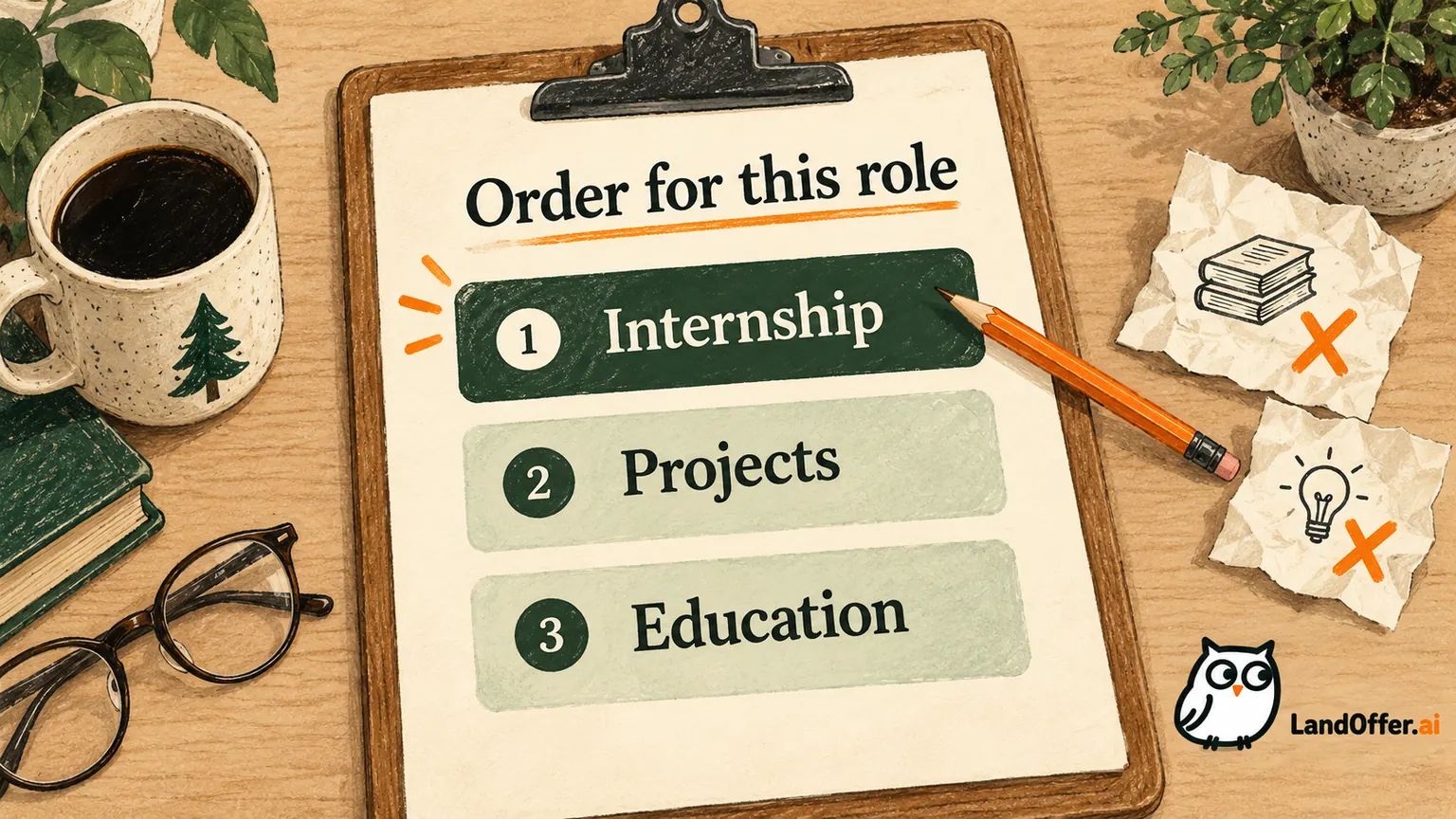
For Celia's first backend application, Education comes first because her graduation context is current and relevant. Technical Skills supplies a short vocabulary. Internship Experience follows with her strongest work evidence, then Selected Projects and a brief Additional Experience line.
That is an editorial choice for this case. CareerOneStop's recent-graduate guidance describes bringing education and relevant qualifications forward. Harvard's resume guidance recommends ordering headings by importance. Neither source makes Celia's exact sequence mandatory for every graduate.
If you have a highly relevant internship, you may put it before a longer skills section. If you lack an internship, projects can carry the main evidence. If a research role closely matches the work, it can earn its own prominent section. Decide from the content rather than applying a fixed prestige hierarchy.
Within a section, keep dates and entries consistent. Use reverse chronological order unless a clear purpose justifies another arrangement. The reader should be able to distinguish your internship, course project and personal work without decoding a different format for each entry.
Complete the keep, cut and compress decisions
Celia has more material than she needs for the selected page. She makes the following fictional decisions before changing margins or font size.
| Inventory item | Decision for backend application | Why |
|---|---|---|
| Seabright application-service internship | Keep three contribution bullets | Direct evidence of API work, tests and review |
| Signal simulator | Keep two bullets | Shows original behavior and controlled fixture checks |
| Database course project | Keep one concise bullet | Demonstrates transaction behavior relevant to role |
| Six introductory course names | Cut most; keep three relevant advanced courses | Degree already conveys basic study; specific preparation is enough |
| Long tools list with classroom-only libraries | Compress to tools she can explain using | Avoid implying equal depth across every dependency |
| Campus library work | Keep one short responsibility line | Adds real collaboration and work context without crowding technical evidence |
| Generic motivation summary | Remove | Repeats degree, direction and unsupported adjectives |
This is a completed allocation decision. Celia keeps the internship and two different projects, compresses supporting context and removes an interchangeable introduction. She does not turn a course grade into production expertise or borrow a teammate's result to make the page fuller.
The choices give Celia a stopping point: preserve the strongest technical contributions. If the export overruns the intended page, shorten duplicate project context or reduce the unrelated work line. She should not remove employment dates, hide contribution boundaries or make the text unreadably small just to preserve every entry.
Read the complete fictional resume content
The following is a finished content example intended for a simple one-page layout. It is not a rendered pagination test or a real person's resume. The complete text is a proposed one-page content set; the chosen editor and actual export determine pagination. Dates, institutions, contributions and test counts are invented teaching inputs.
Celia Ahmed
Seattle, WA · celia@example.com · Portfolio and repository links supplied in the working document
Education
Pinecrest Institute — B.S. Computer Science, May 2026
Relevant coursework: Operating Systems, Computer Networks, Database Systems
Technical Skills
Languages: Java, TypeScript, SQL. Tools: Git, Linux, PostgreSQL. Testing: unit and integration tests in the projects below.
Internship Experience
Software Engineering Intern — Seabright Labs | June–August 2025
- Implemented Java API handlers for a document-review queue, using the team's existing service architecture and shared design reviews.
- Added tests for empty queues, unauthorized access and document-state transitions; documented expected outcomes for reviewer feedback.
- Investigated a stale queue-view defect and submitted a corrected query with reproduction notes; a staff engineer owned deployment.
Selected Projects
Signal Studio — personal network simulator | February–April 2026
- Built a local simulator that displays delayed and dropped synthetic messages, allowing the user to compare delivery order with the original sequence.
- Wrote 14 illustrative fixture tests for duplicate messages, queue limits and missing acknowledgments; no production network or user adoption claimed.
Reservation Desk — three-person Database Systems project | September–December 2025
- Implemented the PostgreSQL transaction and rollback path for reservation cancellation; teammates owned the interface and deployment configuration.
Additional Experience
Campus Library Assistant — Pinecrest Institute | September 2023–May 2026
- Coordinated shift handoffs and documented unresolved equipment requests for the next assistant.
The content gives the reader an identifiable contribution in each technical entry. It also preserves shared architecture, deployment ownership, synthetic fixtures and team boundaries. Those qualifiers are part of the facts, not weaknesses to edit away.
Make coursework earn its line
Coursework is useful when it signals preparation relevant to the role and is not already obvious from the strongest work. Celia keeps Operating Systems, Computer Networks and Database Systems because they connect to the backend and simulator evidence. She does not list every introductory class or repeat several names that communicate the same preparation.
Describe a course project as a course project. A substantial implementation can demonstrate useful skills without becoming paid professional experience. If the work was shared, identify your component. If the professor supplied a framework, distinguish your implementation from that baseline when it affects the claim.
Do not treat a course name as proof of proficiency with every tool in the syllabus. A database course can support academic preparation, while a project contribution shows the particular transaction behavior you implemented. Keeping both statements precise helps the reader understand the depth of the evidence.
Only include academic details you can report accurately. Use the actual degree status and graduation date, and follow the application's requested academic fields separately. An expected degree is different from a completed degree; a resume should not resolve that distinction through optimistic formatting.
Use internships as evidence of your contribution
An internship's company name does not describe the work. Celia's entry identifies her API handlers, tests and investigated defect. It also states that the service architecture already existed and a staff engineer owned deployment. That prevents the work from becoming an invented end-to-end system ownership claim.
You can show collaboration through a review, handoff, paired investigation or documented feedback. “Worked with a team” is broad. “Documented expected test outcomes for reviewer feedback” describes an activity the reader can ask about. Keep the result bounded to what the record supports.
If the internship involved confidential material, describe the technical problem at an approved level of detail. Avoid customer names, internal identifiers or protected data. A clear component and decision can be useful without reproducing a private design document or a proprietary metric.
MIT's writing-about-skills guidance connects action, context and outcome. For an internship, that can mean a corrected behavior or completed artifact. You do not need an invented revenue figure to show relevant work.
Change the order for a second role without changing facts
Celia next considers a fictional junior role focused on network tooling. Its duties emphasize message behavior, reproducible experiments and debugging. She moves Signal Studio above Reservation Desk and places Selected Projects immediately after Education and Skills. The internship remains visible, but the strongest directly relevant project now appears earlier.
She keeps the same 14-test teaching input and the synthetic environment. She does not rewrite the simulator as a production distributed system or claim network operation for real customers. The new role changes the order and emphasis, not the underlying work history.
For the network-tooling version, she first shortens the database project if space requires it; Signal Studio's delivery-order behavior remains prominent. She does not remove the internship's deployment boundary or expand the campus work into unrelated technical experience. The second version answers a different work request with the same supported facts.
This is a completed tailoring decision across two role types. It differs from planning an entire new-grad job search: the task here is allocating and ordering evidence inside a resume. Eligibility, graduation windows and application deadlines still belong in the separate opportunity decision.
Celia also reviews the skills section against the selected entries. Java appears in the internship, SQL and PostgreSQL in the course project, and TypeScript in supported project notes. If a listed tool has no contribution she can explain, she removes it or labels a genuinely limited academic context where useful. She does not infer Kubernetes experience from the fact that another engineer deployed her internship service. This final check ties the compact vocabulary to the work and prevents the skills section from expanding beyond the rest of the page.
Review the export as a whole document
After arranging the content, inspect the actual requested-format export. Check the name and contact route, degree status, dates, headings and final lines. A page that fits in an editor can wrap differently after export. Follow the employer's file requirements instead of assuming one extension always works.
Read the resume from the top without your private notes. Can someone find graduation context, understand the internship contribution and distinguish personal work from the course team? If a phrase requires an explanation you have not supplied, add the minimum useful context or narrow it.
Do not use an ATS score as permission to add unsupported tools. Compare suggested terms with the inventory. When a requirement is a genuine gap, decide whether the role is still suitable rather than hiding the gap through a longer skills list.
For your next version, choose one role from LandOffer's recent jobs, complete a keep/cut/compress table and arrange a full resume from the remaining facts. Preserve one clear contribution in each selected entry. After the content decision, inspect the requested-format export and its dates before using it in an application. The example does not promise an ATS pass or interview.
Sources and Further Reading
- Harvard MCS: Strong resume guidance: section importance, readable formatting and factual language.
- MIT CAPD: Writing about skills: contribution, context and result.
- CareerOneStop: Special resume tips: recent-graduate education and qualification options.