LandOffer
Job search
Monica Review for Job Seekers: Hosted Contact Notes or a Self-Hosted Networking Record?
Current public hosted offer and repository version discrepancies support completed fictional networking-record and hosting-readiness decisions, without account or installation tests.
Monica can help a job seeker remember conversations, commitments, and reasons to reconnect. Choose its hosted service when you want that record without operating a server. Consider self-hosting only when you are prepared to maintain the application and protect other people’s information. Neither option turns a contact note into permission to request a referral or evidence that someone supports your application.
This review examines current public documentation and pricing, not an authenticated account or installation. LandOffer publishes it. You can browse recent roles on LandOffer.ai to keep vacancy research separate from relationship notes; Monica’s usefulness here is remembering context, not supplying verified openings or hiring outcomes.

What Monica adds to a job-search record
Monica’s contact-management page describes notes, contact details, calls, reminders, and interaction history. Those are useful building blocks for remembering how you met someone and what you promised to do. They do not require you to populate every available personal field. For professional networking, a small, accurate record is often more useful than a detailed dossier.
A vacancy tracker answers questions such as which role you applied for and what happened next. A relationship record answers what you discussed with a particular person, which advice they actually offered, and whether another conversation would be appropriate. Keep these records connected through a short reference if helpful, while preserving their different meanings. That distinction prevents a useful conversation from being misread as progress on a specific application.
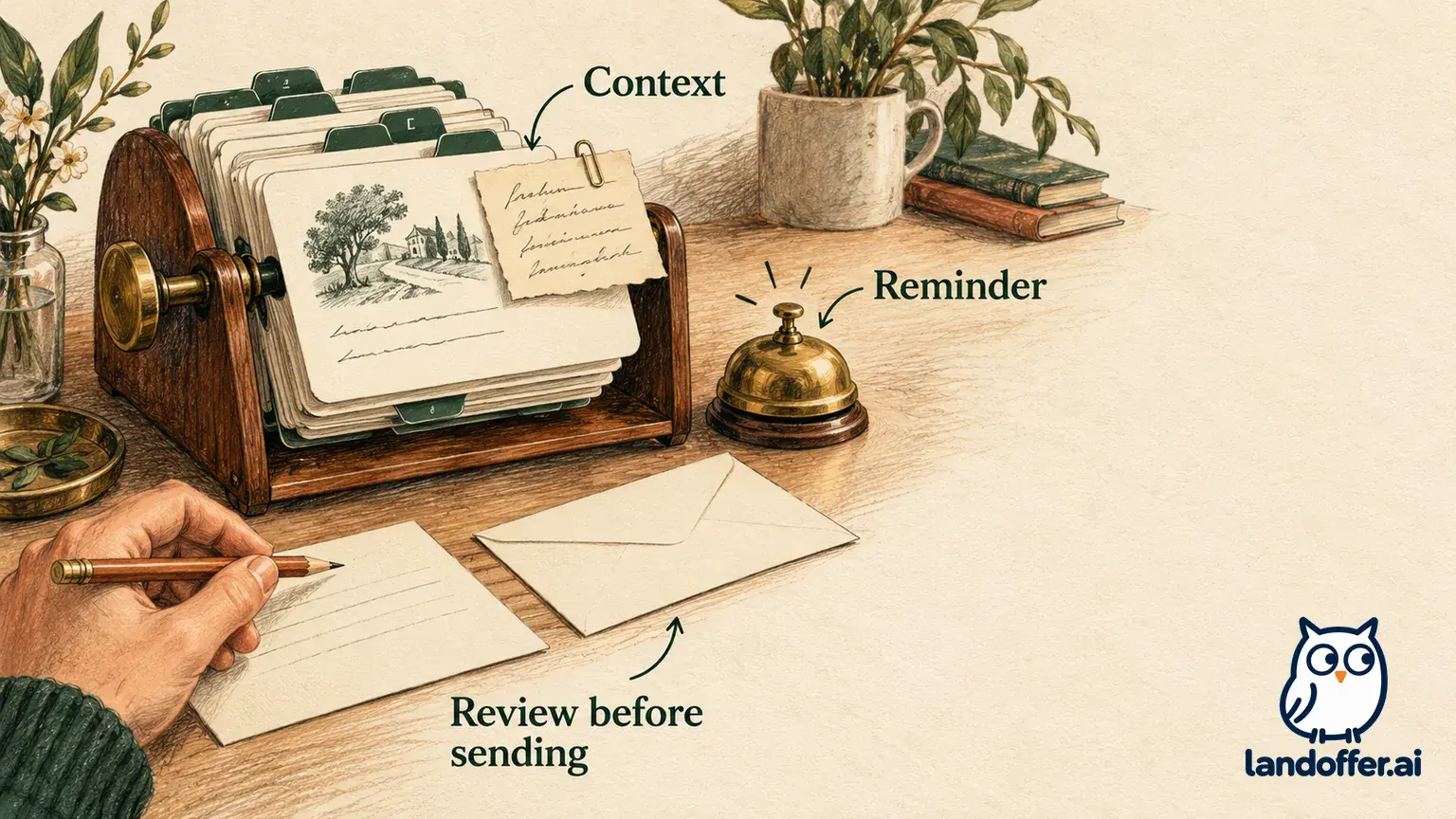
For example, “Jordan suggested comparing incident-review practices across teams” is a useful note. “Jordan will refer me” is a different claim that requires explicit supporting context. Monica can store either sentence; entering it does not supply the missing agreement. Review your wording before a reminder brings an old assumption back into focus.
Monica’s public product page positions it as a personal relationship manager rather than a social network. Treat it as a memory aid that you maintain. Do not assume it knows whether a contact changed jobs, wants another message, or has already responded elsewhere. This review did not verify inbox synchronization, automatic deduplication, or reminder delivery.
Hosted pricing buys operation, not better relationships
On October 20, 2026, the public pricing selector displayed $9 USD per month or $90 USD per year, with a 30-day trial requiring no credit card during the trial. Taxes may apply. The hosted plan lists unlimited contacts, notes, and reminders, along with managed updates, backups, and email support. These are documented offers, not checkout or reliability tests. Current Monica pricing
The same page describes self-hosted software as $0 from Monica, with infrastructure and operation supplied by the user. Some integrations dependent on Monica-operated infrastructure may remain hosted-only. “Same core application” therefore does not establish identical operational behavior in every installation.
An annual subscription is a longer commitment than a monthly choice. Avoid buying it simply because the displayed annual amount is lower than twelve monthly payments. First determine whether you will maintain useful notes and whether the actual export and reminder behavior meet your needs. No subscription was started for this review.
A lightweight existing document may remain the better choice if you have only a few active conversations and can already retrieve their context. Monica becomes more compelling when notes and follow-up intentions are scattered, not merely because a contact list is large.
Check the version before relying on a feature
The public website announces a rebuilt Monica v3 as in development, expected before the end of 2026. Its roadmap includes new record structures and later native mobile applications. A stated migration goal is not an observed completed migration, and a future capability should not decide a purchase that depends on it today. Monica v3 announcement
Meanwhile, the GitHub repository warns that its default branch is a development beta and points readers to 4.x for the stable current version. The official Docker image page lists 4.1.2 tags and separate 5.0.0-beta.5 tags. These public naming schemes do not line up neatly. The observed repository warning identifies a branch choice; it does not establish which code the hosted service currently runs. This review does not infer that website “v3” and repository “v5” are the same release or that either describes the authenticated hosted deployment.
Before installation or migration, record the exact branch, image tag, documentation version, and required capability. Read the matching release and upgrade instructions. A screenshot from one branch or a marketing roadmap is insufficient evidence that the same field, importer, or export path exists in another. No container was downloaded or started for this review.
Worked record: turn a conversation into accurate next steps
The following people, event, conversation, and dates are fictional. Elena is exploring site-reliability engineering roles. At a community discussion on October 15, she meets Jordan, an engineer who describes how their team writes incident reviews. Jordan agrees that Elena may send a short question about a public reading recommendation. No referral, introduction, or hiring commitment is offered.
Elena prepares this completed record for eventual entry into whichever tool she chooses. It is a proposed content structure, not a screenshot or a claim about exact Monica field names.
| Record element | Finished entry | Why it stays |
|---|---|---|
| Identity and context | Jordan; met at the October 15 community incident-review discussion | Distinguishes the person from another Jordan without collecting unrelated details |
| Topic | Separating corrective actions from explanations of an incident | Preserves the substance of the conversation |
| Attributed advice | Jordan suggested reading the public incident-review chapter Elena mentioned | Records a specific suggestion without inventing endorsement |
| Elena’s commitment | Read the chapter and prepare one question about assigning action owners | States what Elena controls |
| Permission boundary | One short reading-related question was welcomed; no referral or resume review was discussed | Prevents a later reminder from expanding the agreement |
| Review date | October 22: check whether the question is still useful before deciding to write | A reminder to review, not an automated instruction to send |
| Excluded material | No personal phone number, family details, speculative hiring influence, or copied private messages | Keeps the record proportionate to the professional purpose |
Her prepared question is: “The chapter separates the incident timeline from follow-up actions. In your experience, what helps a team assign an owner when an action spans two services?” It is unsent. It follows the agreed topic and asks for practical learning rather than introducing an unexpected request for job-search help.
Now add a fictional update: on October 21, Jordan says they are unavailable for further conversations until November. Elena changes the review date to November 5, adds the new availability note, and marks the earlier question as deferred. She retains the original context instead of rewriting it as a missed response.
The completed decision is to defer the reading question until the November 5 review, rather than send it on October 22. Elena uses the reminder to honor Jordan’s stated availability and avoids repeated nudges while Jordan is unavailable. The example demonstrates record quality and a changed next step; it does not claim Monica received a message, rescheduled anything, or improved a relationship.
Privacy depends on what you store and who operates it
Monica’s privacy policy, dated August 6, 2026, says contact information is private to the account and is not cross-linked to populate another account. It also states that, apart from its described password mechanisms, data is not encrypted in the database and could be read by someone with database access. That is a material qualification to broad privacy language; this review is not a security audit. Monica privacy policy
Self-hosting changes the operator, not the sensitivity of the notes. Your server, database, backups, and administration access become part of the data path. A copy on a personal machine can still be exposed through a poorly protected service or backup destination. Open source permits inspection; it does not prove that your installation is correctly configured.
For a job seeker, avoid storing private interview content, access credentials, confidential employer documents, or unneeded sensitive information about contacts. Prefer concise factual summaries over copied conversations. If a record becomes inaccurate, correct it; if it no longer serves a useful purpose, review whether to retain it. These are editorial data-minimization recommendations, not a legal ruling about a particular contact database.
Worked hosting decision: a record without an available operator
Consider a second fictional person, Dev, who has an existing small server but is about to start interviews. Dev wants control over the record’s location and assumes that an already-paid server makes self-hosting the obvious choice. The completed readiness review below tests that assumption without pretending to install Monica.
The official Docker image documentation requires attention to the external database, persistent storage, application configuration, and deployment mode. Its example warns that it provides no SSL encryption and is intended to sit behind a proxy. This is not a complete security design or an instruction to expose the sample directly to the internet.

| Decision area | Dev’s stipulated current evidence | Completed disposition |
|---|---|---|
| Release selection | A saved deployment note points at the beta default branch, while Dev wants a stable daily record | Reject that note as the installation basis; identify the intended stable release first |
| Persistent records | Existing server backups cover a static website, not a Monica database and application storage | Readiness gap; do not assume the existing backup job covers the new data |
| Recovery | No restore procedure has been rehearsed for the proposed application | Readiness gap; a backup file alone is insufficient evidence of recoverability |
| External access | Dev’s draft assumes the sample port mapping is the entire deployment | Readiness gap; resolve the documented proxy/HTTPS boundary before exposure |
| Maintenance ownership | Dev will be away for three weeks and has no agreed replacement operator | No available maintenance owner during the period of use |
| Immediate networking need | Six concise professional conversation records can remain in Dev’s existing protected notes | Keep the current method while evaluating a later deployment |
Dev’s completed decision is defer self-hosting. The free software is attractive, but the proposed installation has unresolved version, recovery, exposure, and ownership gaps. Existing server capacity does not answer those questions. This is a decision about the stipulated situation, not a claim that self-hosted Monica is inherently unsafe.
Elena has a different constraint: she wants a maintained interface for her growing collection of notes and has no interest in operating a service. She selects the hosted trial as the route to evaluate, using fictional or minimal nonsensitive sample records first. Trial account creation, import, reminders, exports, and cancellation remain unperformed in this article.
Her acceptance condition is concrete: she must be able to retrieve Jordan’s current availability without losing the original context, review the pending question without sending it automatically, and understand how her chosen version exports the record. If her existing notes already do those things reliably, keeping them is a valid outcome.
Export and cancellation need a version-specific check
The pricing page says cancellation leaves access through the paid period and then a defined grace period, but does not give its duration there. The privacy policy describes SQL export and backup retention after account closure. Cancellation, account closure, production deletion, and backup expiry are distinct events; do not use one as a substitute for the others.
There is also older wording to reconcile. The terms page dated April 12, 2018 describes SQL export, while the current marketing pages discuss broader supported data and compatible imports. Confirm the actual export format and destination compatibility for your account before relying on a future move. The old privacy-page reference to a free-plan downgrade does not establish a currently offered hosted free tier.
Who should use Monica for a job search?
Choose hosted Monica for its documented relationship-record tools when maintaining context is a real problem and you prefer to outsource server operation. Choose self-hosting when control over infrastructure matters enough to justify explicit version, recovery, and maintenance work. Keep a simpler existing record when the additional system would create more upkeep than value.
Start with one accurate conversation record and one next-step review. You can complete that exercise in your existing notes before committing money or importing contacts. Use recent roles on LandOffer.ai for vacancy research, and let your networking record preserve what people actually said, what you promised, and when waiting is the appropriate decision.