LandOffer
Job search
Mock Interview Credit Packs vs. Single Sessions: Check Expiry and Coach Flexibility
Choose a mock interview purchase by useful hours, coach rates, calendar fit, and the cost of unused balances.
Buy a mock interview pack when you can name the sessions you need, find suitable coaches, and leave time to apply their feedback. Start with a single session when the gap or coach fit is uncertain. A lower advertised unit price can become expensive if you use only part of the balance, miss a refund window, or discover that your preferred coach consumes more credits than expected.
This LandOffer comparison reviews public Aced and IGotAnOffer offers checked October 14, 2026. We inspected logged-out pricing controls and current policies; we did not buy coaching, reserve slots, or request refunds. If you are still identifying target roles, browse recent roles on LandOffer and establish the interview round before budgeting for feedback. The worked cases below are fictional calculations, not customer results.

Convert the purchase into actual interview time
Aced sells ordinary coaching in sessions. One public software engineering coach profile, Camilla Smith, displayed $249 for one mock, $675 for three, and $999 for five. Its offer specifies a one-hour video session and written feedback. These are profile-specific quotes, not a platform-wide promise that every service costs the same. Aced coach offer.
IGotAnOffer uses a balance consumed at the selected coach's rate. Its credit documentation gives a $50–$40 range per credit, with lower prices for larger purchases. During our public pricing-dialog inspection, one credit cost $50 and the default 17-credit selection cost $799. The displayed $47 unit price matches $799 divided by 17. Neither amount establishes the price of your interview. Credit pricing.
The dialog said coaches charge two, three, four, or five credits per one-hour session. At five credits each, 17 credits cover three sessions and leave two credits. At three credits each, they cover five sessions and leave two. The same balance buys different amounts of coaching time. The dialog's estimate of five sessions on average should therefore remain an estimate, even if it appears beside a purchase button. Current coaching offer.
Use the actual selected rates when mixing coaches: add each booking's credit requirement before choosing a balance. Two five-credit sessions and one four-credit session require 14 credits. A remaining balance of three would support a three-credit appointment, but not another five-credit appointment without a top-up. Flexibility does not remove this arithmetic.
Define what the hour must produce: a critique of your attempted coding solution, architecture explanation, or behavioral answer. A mock with a debrief, a résumé review, and a career discussion consume time differently. Do not count all three as three practice interviews just because they use the same payment system. Ask which part of the session will be spent performing the target round and which part reviewing it.
Compare the purchase rules on the same basis
Compare three quantities separately: cash paid, useful sessions completed, and the balance still available. This matrix summarizes documented ordinary coaching rules, not negotiated exceptions or special programs.
| Question | IGotAnOffer one-time credits | Aced ordinary coaching sessions |
|---|---|---|
| What is consumed? | Selected coach's credits per hour | One 60-minute session |
| Can you change coaches? | Credits usable with any coach | Purchase not tied to one coach |
| Does unused access expire? | 12 months from purchase | Unused sessions never expire |
| When can unused purchases be refunded? | Within 30 days | Within six months |
| Is a partial refund simply unused units times discounted price? | No; used credits are repriced | No; discount removed or closest pricing option applies |
| Is course membership automatically included? | Do not infer it from credits | Ordinary coaching excludes membership |
The IGotAnOffer refund policy and Aced coaching FAQ support these distinctions. Aced's no-expiry rule gives a longer documented use horizon, while IGotAnOffer's variable rates allow a balance to serve different coach choices. Neither rule establishes availability for your particular deadline.
Keep special programs outside this comparison. A course-inclusive program, ongoing negotiation engagement, or monthly credit arrangement can have different deliverables and billing. If a page promotes a monthly saving, determine whether you are selecting recurring billing or the one-time balance used here. The public banner alone does not establish the terms of a subscription.
Worked purchase: three useful sessions or five discounted ones?
Avery is a fictional backend candidate with a $700 coaching budget. Their preparation plan has three specific feedback needs: a coding mock, a system design mock, and a second attempt at the weaker round after independent practice. Assume the coach and timing fit are confirmed separately. Using the observed Aced profile quotes, the choices are:
| Purchase | Upfront price | Planned use | Decision |
|---|---|---|---|
| Three single sessions | $747 | Three hours | $47 over budget |
| Three-session pack | $675 | Three hours | Fits; saves $72 against three singles |
| Five-session pack | $999 | Only three hours identified | $299 over budget; two uses unplanned |
For Avery’s stated plan, the three-pack fits the budget and covers every identified round. It funds the three identified rounds while leaving $25 uncommitted. The five-pack's larger discount does not help Avery pay for the work they actually intend to complete. Buying extra sessions for a vaguely defined future search would change the plan and the cash commitment.
Now change one assumption: after two sessions Avery decides further independent practice is sufficient. The $675 already paid divided by two completed hours is $337.50 per used hour. Two singles would have cost $498. Until an eligible refund is processed, $177 more cash is committed than the two-single route required. This is an effective-use calculation, not a revised vendor rate.
A partial refund may change that result. Under the documented face-value approach, if two used sessions are valued at the observed $249 single-session price, an eligible refund would be $675 minus $498, or $177. It would not automatically be $225, the advertised three-pack average for one unused hour. This $177 figure is our conditional illustration of the documented face-value method, not an approved refund. Aced must confirm the applicable promotion and closest pricing option for the actual request.
The distinction matters because Avery could otherwise budget a $225 return, spend it elsewhere, and discover a $48 difference. The pack still gave access to three sessions, but the discount depended on how the purchase was used. Save the original quote and request the precise unused-balance calculation while still inside the refund window.
This example does not prove that starting with singles is always better. Had Avery completed all three planned sessions, the pack would have delivered the stated $72 saving. It shows why confident session needs support a pack, while an exploratory first appointment supports a smaller commitment.
Worked balance: 17 credits, two clocks, and a short interview deadline
Ellis is a fictional engineering candidate considering the observed $799, 17-credit purchase. Three desired coaches or appointments each cost five credits. The complete plan consumes 15 credits for three hours and leaves two credits. It does not buy five hours with those selections. The unused two-credit remainder cannot fund a further five-credit appointment by itself.
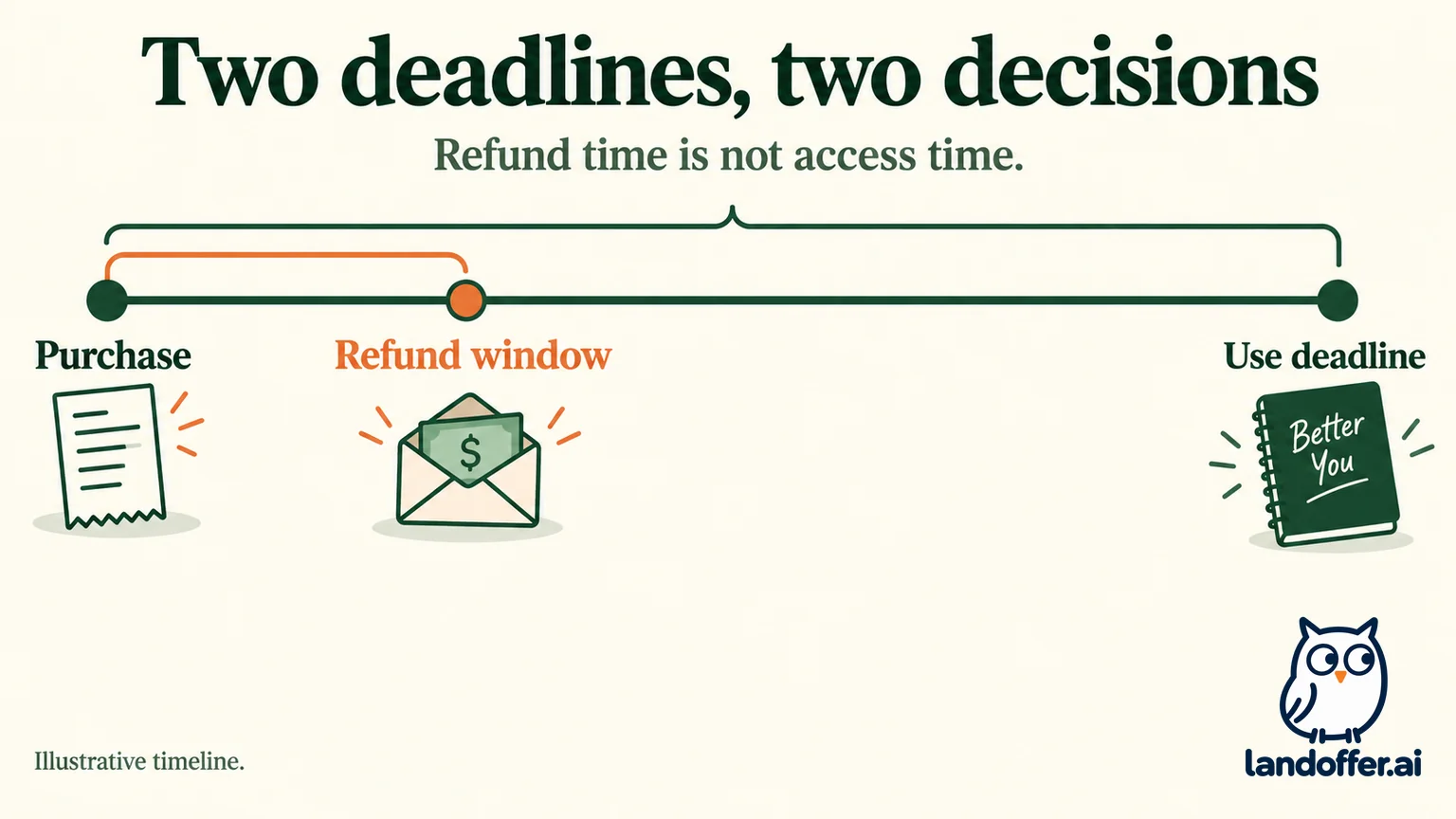
Suppose Ellis purchases on October 14, 2026, and intends to practice on October 20, October 27, and November 3. These are illustrative dates, not verified coach openings. A November 4 review of the remaining balance creates an opportunity to decide whether to retain it or request an eligible unused-credit refund well before the 30-day window ends. Waiting until the next year's usage deadline would lose the ordinary cash-refund opportunity.
The refund cannot be calculated by multiplying two unused credits by the discounted $47. That would suggest $94. If the applicable standard price for the 15 used credits is $50 each, the policy's repricing method instead gives $799 minus $750, or $49. This is a conditional calculation: confirm the rate applicable to the used quantity rather than assuming every quantity has the smallest-purchase price.
That conditional $49 return would leave a $750 net cost for three completed hours, or $250 per hour. Keeping the entire purchase with only three hours used makes the current effective cost about $266.33 per hour. The difference is cash recovered, not a difference in the feedback already delivered. If Ellis later uses the remaining credits on a suitable service, the effective-use calculation changes again.
A missed appointment also changes the plan. If one five-credit session is counted as used and Ellis still needs three completed mocks, the total requirement becomes 20 credits. The 17-credit balance is insufficient. A missed appointment can consume the balance while leaving the original feedback need unresolved.
IGotAnOffer's current expiry FAQ, updated September 23, 2026, says credits last 12 months from purchase. We saw an older search summary claiming they never expire; the current page and main policy agree on 12 months. Existing balances may raise separate historical questions, so obtain account-specific confirmation rather than applying the old summary to a new purchase.
For Ellis, the practical calendar has three checkpoints: verify usable appointment times before committing, review unused money after the final planned mock, and track any retained balance's use deadline. The refund date and the access expiry date serve different decisions. Set reminders early enough to act without relying on support answering at the last minute.
Coach flexibility should preserve the work you are buying
Both services document cross-coach use. IGotAnOffer's credit-system explanation also allows credits across services. That can help a candidate move from technical practice to another defined need, but it should not turn a leftover balance into an excuse to purchase unrelated advice.
Switching coaches can make a pack useful across coding and system design rounds, provided each appointment covers the required specialty. Repeating with the same coach can help when you want them to inspect a correction against their previous feedback. Decide which benefit matters before treating maximum coach choice as inherently better.
For example, after a system design mock, bring the first coach's specific finding to the next appointment: “I selected the database before estimating write volume. Please watch whether I clarify the workload first on a different prompt.” A second coach can test the change, provided the new session actually covers system design and leaves time for that debrief. The purchase unit alone does not specify this handoff.
Prepare a brief for each booking with the role level, round type, one attempted answer or diagram, and the feedback you want. Ask for the most important correction and an exercise that exposes whether you have applied it. That produces a reason to use the next session rather than merely spending down credits.
Protect the sessions you have already planned
IGotAnOffer permits free cancellation or rescheduling more than 24 hours before a session; inside 24 hours it says changes are unavailable. No-shows and arrivals more than 15 minutes late count as used. Schedule any decision to change an appointment earlier than the boundary. Cancellation policy.
Aced documents that missed sessions and cancellations or rescheduling within 24 hours count as used. Its cross-coach flexibility should not be read as permission to move a late appointment without cost. Confirm the timezone displayed in the calendar and the meeting format before adding the session to your own schedule.
Finally, leave practice time between appointments. If a debrief reveals that you cannot explain a trade-off, the next paid hour should follow an independent attempt to correct it. Consecutive sessions with no revision time may provide repeated observations of the same gap. A realistic calendar includes preparation, the interview, review, and a changed attempt.
Choose the smallest purchase that supports a credible sequence of useful feedback. Avery's three confirmed rounds justify the three-pack; Ellis's five-credit selections require a three-hour calculation and an early refund decision. Before buying, write down the intended bookings, exact credit consumption, unused-balance calculation, and both deadlines. Choose the pack only if those bookings fit your budget and calendar; otherwise begin with enough credits or one session for the first defined round.
Use LandOffer.ai to keep target roles and interview requirements in view when deciding which feedback to buy.