LandOffer
Job search
Military Spouse Career Accelerator: Check Fellowship Eligibility and Tech Role Fit
Check the Military Spouse Career Accelerator's current SpouseWorks name, eligibility, technical host fit, paid fellowship terms, location, and full schedule.
The Military Spouse Career Accelerator now appears on the official government portal as the SpouseWorks Fellowship. It offers paid, full-time twelve-week placements, with matching based on a spouse's education, experience and host needs. Start with the current spouse eligibility and application route, then check the actual technical assignment, location and schedule. Check the spouse's own eligibility instead of applying a service member's transition timetable to them.
LandOffer publishes this guide and offers recent tech roles. We checked current government and Hiring Our Heroes pages on October 13, 2026, without logging in, registering or applying. No named current software placement was verified in this public check. Iona and Soren are fictional planning cases, not candidates assessed by the program or promised a host.

Follow the current name and official application route
The current government overview identifies SpouseWorks Fellowship as the former Career Accelerator. It describes twelve weeks of full-time weekday work, paid experience, mentorship and personalized coaching. The older Career Accelerator link redirected to the current SpouseWorks route during our browser check.
The application landing page asks applicants to log in, complete their profile and begin the application. We stopped at that public boundary. A readable landing page does not establish that a profile is complete, eligibility has been approved or a technical placement is available to you.
Hiring Our Heroes still uses Career Accelerator and MySECO wording on its military spouse fellowship page. It describes rolling applications through that government system and HOH support with preparation, employer matching and the placement. It also says eligibility determination and enrollment belong to the government program.
Keep the old and current names together in your search notes so a legitimate redirect does not look like an unrelated opportunity. Follow links from official pages and read the destination's purpose. An HOH contact form, a general job-board account and the government fellowship application are different records.
Check the spouse category without borrowing service-member rules
The current government pages include career-ready spouses of Army, Marine Corps, Navy, Air Force, Space Force and Coast Guard members, including active, reserve and National Guard components. They describe availability to spouses in the United States and abroad, subject to host participation, with potentially fewer overseas opportunities.
The HOH page inspected on October 13 omitted Coast Guard from its branch list. That omission should not be turned into an exclusion when the current government eligibility description expressly includes it. Use the live program process for the actual determination and retain the dated source you relied on.
Do not import a last-180-days military transition condition or a returnship career-gap threshold from another program. Those conditions can matter to different opportunities without defining this spouse route. Similarly, being a military spouse does not resolve a host's required experience or ability to attend.
Explain career readiness through the work you can perform and show. Identify what you can contribute, which skills are current and what support you need. The official process, not this article, evaluates your actual circumstances and available matches.
Separate program eligibility from technical role fit
A host needs work performed in a particular environment. “Technology” might mean testing, application development, customer support, infrastructure, data analysis or another function. A short fellowship can provide experience while still expecting a substantial starting skill set.
Read the actual duties before assembling a long technology list. For testing, ask whether the work concerns manual exploration, automated suites, production support or a combination. For development, identify the language, system responsibility and expected independence. For data work, identify the source data, quality checks and decision the analysis supports.
We did not verify a named public SpouseWorks software assignment. The official pages establish the program and matching model, not an inventory of current technical vacancies. An ordinary job advertised by a partner company should not be labeled a fellowship unless the program or employer confirms that connection.
This boundary is useful when a general employer directory looks promising. Keep the company as a lead and the proposed assignment as unconfirmed. Ask for the actual title, team, duties and placement route before treating it as a ready application opportunity.
Iona completes a technical-readiness record
Fictional case: Iona is a Coast Guard spouse with four years of professional QA experience. She is interested in testing work and can explain previous bug investigation, test planning and collaboration with developers. She has also practiced a small PowerShell utility independently. These are stipulated teaching facts, not a real eligibility record.
Her completed preparation map keeps the questions distinct:
| Decision field | Iona's fictional record | What she records now |
|---|---|---|
| Program identity | Searching the former Career Accelerator | Use the current SpouseWorks route |
| Spouse category | Coast Guard spouse | Current government description includes the category; individual determination pending |
| Prior work | Four years of QA responsibilities | Retain actual employment dates and personal duties |
| Current practice | Local process-exit and log-handling utility | Label independent practice separately |
| Target contribution | Testing and diagnosing application behavior | Request a concrete host duty description |
| Placement state | No named host, date or offer | Preparation only; no placement confirmed |
Iona's local exercise launches a test process and writes a result log. The initial script treats every completed process as a successful test. She changes the utility to retain the process exit code and flag a nonzero code as a result requiring review. She then checks a simulated failure and a path containing spaces, preserving the input commands and local output.
The completed result demonstrates a limited scripting decision. It does not establish ownership of an enterprise test framework or experience with every tool a future host might use. She keeps the experiment available for discussion without extending her former employment or inventing a client result.
Her work-history note originally combines “QA and automation expertise” without explaining the boundary. She revises her private record to separate prior professional testing from recent independent process-handling practice. That lets her ask which starting skills the actual assignment requires.
Iona prepares questions about the host's test environment, review support, location, full schedule and anticipated start. The questions remain unanswered in the example. No recruiter reply, approved eligibility finding or acceptance is fabricated to make the case look finished.
Iona can now investigate the current spouse route and ask for a testing assignment whose starting tasks she can assess. It is not a promise to accept whichever technical title becomes available. If the assignment expects skills she cannot support, she reassesses that particular match.
Check what a host commitment actually contains
The government host guidance describes a twelve-week full-time model and a separate process for employers to participate. It says matching is organized around an employer's needs. A company's willingness to join the program does not identify the technical work a particular spouse would perform.
Before committing, obtain the assignment's expected outputs, supervisor, work environment and feedback arrangements. Ask what you should know at arrival and what will be learned during the placement. “Training provided” leaves too much unclear if it does not explain the starting task and support.
Confirm whether the placement is virtual or in person and where you are permitted to work. A virtual role can still have geographic or time-zone conditions. Overseas program eligibility does not mean every U.S. employer can host someone in every country.
The host's potential ongoing job also needs its own review. The location, schedule or role may change after the fellowship. Do not assume the initial placement terms describe a later offer that has not been made.
Soren completes a weekly availability check
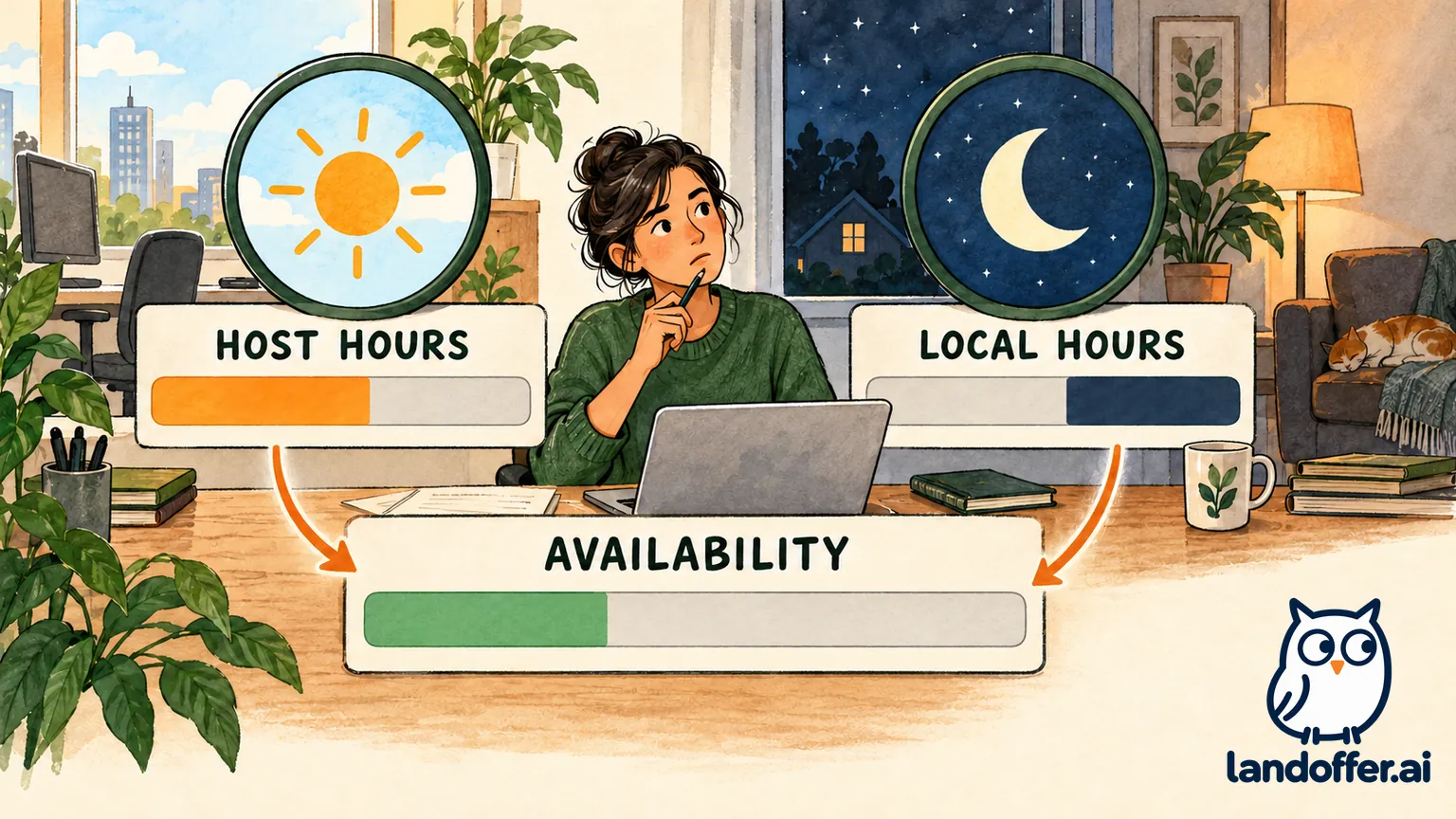
Separate fictional case: Soren is a military spouse living overseas, with prior application-development experience. He wants a virtual placement and is available locally from 8 a.m. to 6 p.m. He has not been matched with an employer.
For an original planning exercise, suppose a possible host requires 8 a.m.–5 p.m. U.S. Eastern attendance and the local offset for the proposed dates is thirteen hours ahead. This is an invented schedule and offset, not a verified current employer offer or a universal time-zone rule.
| Availability field | Stipulated calculation | Completed decision |
|---|---|---|
| Host working day | 08:00–17:00 Eastern | Keep the complete interval |
| Local offset for the example | Add thirteen hours | Recheck real dates and daylight-saving changes if a host is identified |
| Corresponding local attendance | 21:00–06:00 the next day | Overnight work would be required |
| Soren's available local interval | 08:00–18:00 | Does not cover the stipulated host day |
| Current response | Cannot confirm this proposed schedule | Ask about an actual compatible assignment; no exception assumed |
Soren's initial note says “remote, so location works.” The completed calculation reveals a different issue: the proposed working hours do not fit his availability. Soren records the overnight attendance conflict alongside his technical experience before considering the proposed arrangement.
He keeps the next-day boundary visible. Converting only the start time could conceal that the working period runs into the following morning. If the actual placement crosses a daylight-saving change, he recalculates using the real dates and locations rather than applying the example's offset throughout.
The decision concerns a hypothetical schedule, not every virtual fellowship. A host with compatible hours could produce another result. Soren's next question is specific: what hours and geographic arrangements does the proposed assignment actually require?
Confirm the full twelve weeks and paid terms
The HOH spouse page describes weekday daytime participation. Check the full placement interval, orientation and any required meetings against your real availability. A known move, existing work commitment or recurring appointment needs resolution before you confirm attendance.
Paid fellowship language does not by itself supply your payment amount, administrator, timing, benefits or accepted employment terms. Obtain those details through the official process and written placement information. We did not inspect an offer, receive payment or calculate a personal financial plan.
Keep eligibility, host matching and payment setup separate. An approved profile does not mean a match exists, and a possible employer conversation does not mean paid work has begun. Do not count application preparation or an unconfirmed waiting period as fellowship income.
HOH describes possible interviews for suitable open positions after progress in the fellowship. That is conditional employment consideration, not a guaranteed offer. This review does not turn historical aggregate program figures into a personal probability of obtaining a job.
Keep the next action tied to the correct record
Your private search record can identify the current program name, official application route, profile state, host lead, technical duties, location and unresolved schedule condition. Add a submitted state only after the actual system confirms the action. We did not test the signed-in portal or its confirmation behavior.
For Iona, the next step is current-program eligibility review and a concrete testing assignment to assess. For Soren, it is a real host's permitted work location and full-day schedule. Neither needs to pretend a match exists to make useful progress.
If you encounter an older page or stale name, retain the source and follow the official current destination. Ask a focused question through the listed program support channel when material conditions remain unclear; no messages were sent for this article.
Open the current SpouseWorks route, assemble your factual work record, and confirm the proposed assignment's duties, permitted work location and full calendar before committing. Continue broader tech discovery through your existing sources or LandOffer's recent roles, keeping ordinary employer applications separate from the fellowship and any hoped-for later job.