LandOffer
Job search
Mercor Review for Experts: Project Work, One-Time Tasks, and Talent-Network Listings
Read the actual expert listing and contract before treating a network invitation or task rate as ongoing work.
Mercor can be useful for experts seeking scoped AI project work, provided they read the specific listing and offer before treating a rate as income. A talent-network application is a route to possible future contracts. A fixed-price task pays for a defined deliverable under its terms. Neither arrangement automatically gives you a recurring software engineering job or Mercor's employee benefits.
LandOffer publishes this review, based on public listings, contract documentation, and logged-out browser observations checked October 14, 2026. We did not apply, take an assessment, accept an offer, install recording tools, or receive payment. Browse recent roles on LandOffer.ai alongside expert opportunities when you are deciding between ongoing employment and a project. The candidate and earnings examples below are explicitly fictional.

Start by separating expert work from Mercor employment
Mercor's expert page describes professionals contributing to AI training and evaluation projects. That work can include assessing model output, creating examples, and applying domain judgment. Mercor’s software engineering overview describes reference implementations, evaluation rubrics, and technical scenarios; the inspected database task provides a concrete example of that output. The actual deliverable may be an evaluation artifact even when the title contains “engineer.”
Mercor's company careers page is a separate route. Its current listings included full-time, onsite engineering roles, and its benefits section explicitly addressed US full-time employees. Do not transfer the equity, leave, or retirement benefits described there to a remote expert contract. Verify the employment arrangement in the role you are considering.
This distinction also changes how you assess career fit. A developer who wants to own a production service should look for that responsibility in the job description. An expert who enjoys designing difficult test cases may find evaluation work relevant even if they will not operate the evaluated system. The brand name alone cannot tell you which output the customer expects.
Listing categories and payment units answer different questions
We inspected the Explore opportunities board. It displayed Project-based and One-time tabs. The Project-based view included cards priced per hour and per task. After dismissing a cookie dialog and selecting One-time, the loaded view included one-time research and survey opportunities. We did not start an application or share participant data.
Use the board category to browse, then read the offer to identify how your work is paid. “Project-based” does not necessarily mean hourly. “One-time” does not establish the time required or whether a submission must be accepted before payment. Read the amount's unit and the task's completion rules together.
| Arrangement | What it represents | What still needs confirmation |
|---|---|---|
| Mercor employee opening | A specific company role | Employment terms, work location, and role-specific benefits |
| Expert project | A scoped engagement | Actual work, rate, cap or deliverables, and duration |
| One-time opportunity | A bounded activity | Eligibility, completion conditions, and payment trigger |
| Talent network | Consideration for future opportunities | Whether a specific project and offer become available |
Use the detail page to establish the advertised task, then use the actual offer to establish your rate and payment conditions. An opportunity card gives you a reason to inspect the task; it does not establish that you have been selected. Save the listing URL, rate, and checked date so a later offer can be compared with the scope you originally considered. Referral reward amounts should also stay separate from the compensation for doing the work.
Three current listings demonstrate the difference
The Machine Learning Engineer Talent Network explicitly called itself an open application for future contract opportunities and said it was not a specific job posting. Its displayed $70–$250 hourly range did not identify a guaranteed assignment. The listing described rolling matching, typical project commitments of 15–30 hours weekly, independent-contractor engagement, and projects that may change duration.
That particular listing also stated it could not support H1-B or STEM OPT candidates. Treat this as a restriction on the observed opportunity, not a universal conclusion about every Mercor role or your immigration situation. A remote label does not resolve location or work-authorization eligibility.
The Database Systems Evaluation Expert detail page showed $2.2K per task, while the expert landing page rounded the card to $2K. It sought five years of database-engine internals experience or a database-systems PhD, and said DBA, SQL analytics, ETL, or application-only database experience alone was insufficient. The selected task involved a reproducible engineering problem, reference solution, tests, and grading criteria.
This pilot had concrete dates: applications closed October 16, 2026, at noon Pacific, and the task deadline was October 30. It described approximately 25 hours of selected paid work followed by review, and selection of the first three qualifying applicants. These details are a dated example, not an evergreen claim that the pilot remains open.
The Builders & Developers coding-session listing instead offered $200 per accepted recorded session, about 50 turns and typically two to three active hours. It involved the applicant's own real project, specified OpenCode and supplied models, and welcomed builders without professional coding experience. That is a different task from engineering a database benchmark, despite both appearing under software-related opportunities.
Worked fit decision: Nadia and Luis read the same opportunities
Nadia is a fictional developer with eight years building backend applications and writing SQL analytics. She has no stated database-engine internals experience. Luis is a fictional engineer with six years working on storage-engine implementation and transaction behavior. Both are interested in additional project work rather than assuming a new employee role.
| Opportunity | Nadia's decision | Luis's decision |
|---|---|---|
| Database evaluation pilot | Skip on the supplied background; years of application work do not satisfy the stated specialization | Review the assessment and task scope; experience category fits, but selection remains unproven |
| ML engineer talent network | Consider only if she can demonstrate the requested ML development and deployment work | Consider only if his separate ML experience fits; storage expertise alone does not establish it |
| Recorded AI coding session | Assess whether an owned project can be recorded under the terms | Make the same project-rights and recording decision; database seniority is not the payment trigger |
Nadia's decision saves a misdirected application. She does not reinterpret eight years of general experience as eight years of internals expertise. Luis can reasonably inspect the pilot, but matching one qualification does not guarantee he passes the assessment, receives a place, or completes an accepted task.
For the network, neither candidate should record the advertised rate as expected weekly income. They have not identified an assigned project, actual offer, or approved hours. Nadia and Luis should compare the requested ML skills with their own work before spending time on that network application.
For recorded coding work, each candidate needs an appropriate project. An employer repository or client codebase is not interchangeable with an owned side project. A synthetic or publicly owned project may be a better candidate for review, but its acceptability and required recording still need confirmation. We did not test that submission path.
Worked cost: an accepted session is not an hourly contract
Consider a fictional recorded session using the observed $200 payment unit. The developer spends 150 minutes actively building, 30 minutes setting up the required workflow, 15 minutes packaging the recording, and 45 minutes making a requested revision. Total personal time is 240 minutes, or four hours.
If that session is accepted and paid at $200, the gross amount divided by total personal time is $50 per hour. Dividing only by the 150 active minutes gives $80 per hour. Both calculations are mathematically valid, but they answer different questions. The listing's active-work estimate should not erase preparation and revision time when you decide whether the task fits your schedule.
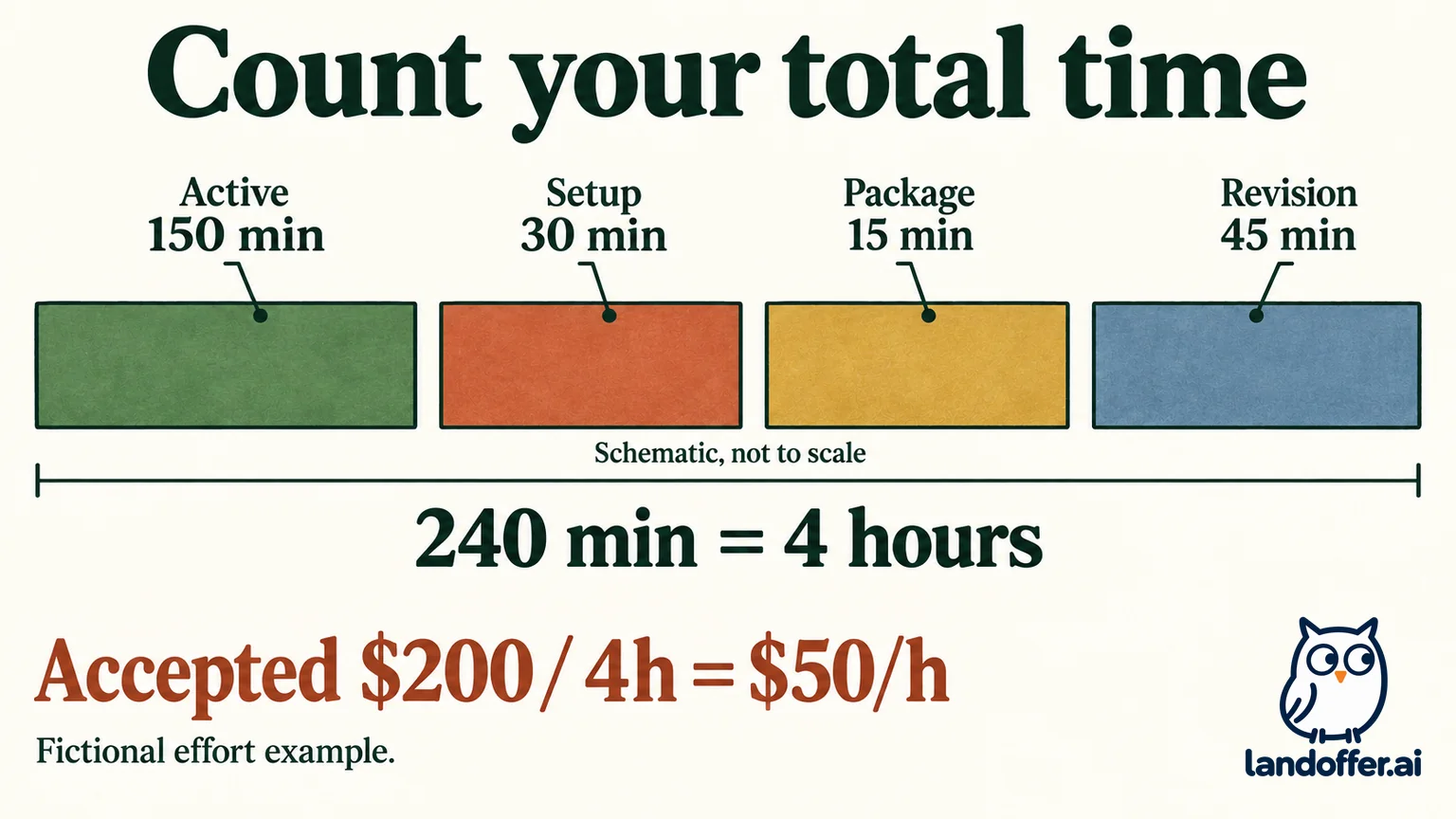
The four-hour total is invented for this example; it is not a measured Mercor workflow. Nor does it establish that setup or revisions are separately billable. A fixed accepted-session amount requires clarification of acceptance criteria, revision expectations, and any limits before you rely on the calculation.
| Scenario | Gross payment assumption | Personal time | Gross amount per personal hour |
|---|---|---|---|
| Accepted session, active work only | $200 | 2.5 hours | $80 |
| Same accepted session, all example time | $200 | 4 hours | $50 |
| Two accepted sessions with the same time | $400 | 8 hours | $50 |
| Submission awaiting acceptance | Payment not established | Time already spent | Do not count an unconfirmed payment as received |
A rejected or incomplete submission needs its own payment terms; this review does not invent a universal zero-payment rule for it. The ledger is a way to compare personal effort with a defined accepted payment, not an estimate of the probability of acceptance or a report of money received.
For the database pilot, $2,200 divided by its approximate 25-hour task estimate gives an $88 active-hour equivalent. If a fictional candidate instead spends 30 total hours including review, the equivalent becomes about $73.33. That calculation does not transform the listing into an hourly offer or promise that review will take five hours. It demonstrates how additional personal time changes the comparison.
Confirm the actual contract before starting work
Mercor's contract documentation distinguishes hourly contracts from deliverable-based contracts. Hourly offers specify a rate and weekly cap, with time tracked through Insightful. Deliverable-based contracts require completion and approval of assigned work and do not establish a minimum hourly guarantee. Whether that contract requires Insightful depends on its setup checklist.
The documentation also distinguishes a project's change between hourly and task-based pay from a separate deliverable-based contract. It says changes are announced and reflected in updated terms, with completed work not repriced retroactively. These are documented policies; we did not observe a real contract amendment or payout. A board label cannot replace the offer's explicit structure.
Write down the pay unit, approved scope, cap or deadline, and completion conditions before beginning. If the task's instructions and the offer disagree, resolve that difference through the project channel. Otherwise you may spend time optimizing an output that the agreement does not recognize as the required deliverable.
Keep assessments, tracked work, and payouts separate
The database pilot described a roughly 35-minute self-paced assessment and specified independent work without outside AI assistance, camera, microphone, and entire-screen sharing. Its separately described paid task began after selection. Do not assume the assessment is paid merely because the eventual task has a price. Check the actual assessment and offer terms before committing time.
Mercor's time-tracking policy defines the hourly pay week in India Standard Time, from Saturday midnight through Friday at 11:59 p.m. Its discussion separates legitimate project time from idle time, prohibited activity, and other exceptions reviewed by a human. It says low-quality output alone does not invalidate legitimate tracked time, though it can affect continued opportunities.
That hourly policy should not be generalized to every accepted-task contract. Likewise, an hourly cap sets the maximum approved weekly time; it does not prove that enough work will be available to fill it. Recheck the project's status and instructions when work is paused or the scope changes.
The payments guide describes USD contracts, region-based assignment of Stripe or Wise, and a first-payout Stripe hold. Separate approval, payout release, provider processing, and bank arrival when planning cash flow. Weekly processing is not a guarantee that the same amount reaches your bank every week. We did not connect a payout account or verify a transfer.
Make a bounded decision about data and project fit
Mercor's AI and data policy says matching uses résumé information, interview transcripts, and public profile data. It distinguishes internal recommendation-model improvement from training external models and says the outreach toggle does not hide a profile from companies. These descriptions are narrower than a claim that no one can see your search.
Recorded project sessions are also a separate decision from an AI assessment. Before contributing one, understand what is captured and ensure you have the rights to the project material. The coding-session listing explicitly calls for recorded work; do not infer its handling from a statement about interview data alone.
Mercor is worth considering when a specific deliverable fits your expertise and a variable project schedule fits your needs. Keep a broader job search active if you require stable employee work or a guaranteed workload. For a talent network, wait for the actual opportunity before planning income. For a task, confirm acceptance criteria, revision expectations, and the personal time you can commit. For an hourly project, confirm scope, cap, and tracking. Explore LandOffer.ai to compare those arrangements with the roles you are pursuing.