LandOffer
Product & Project Delivery
Validate a Localized Product Beyond Whether the Text Was Translated
A fictional sample-request form uses en-US, de-DE, and ar-EG to separate translated text from layout, direction, input, and stored meaning. A filled clipping defect and executed Node formatting/parser examples retain unverified language, device, RTL, and integrated-product checks.
Validate a localized product by checking whether people can complete the same intended task with appropriate language, layout, direction, formats, and input behavior. A translated string file does not establish that a button remains usable, a number is interpreted correctly, or a mixed-direction identifier stays readable. Define the supported locale configuration and inspect the complete input-to-result path.
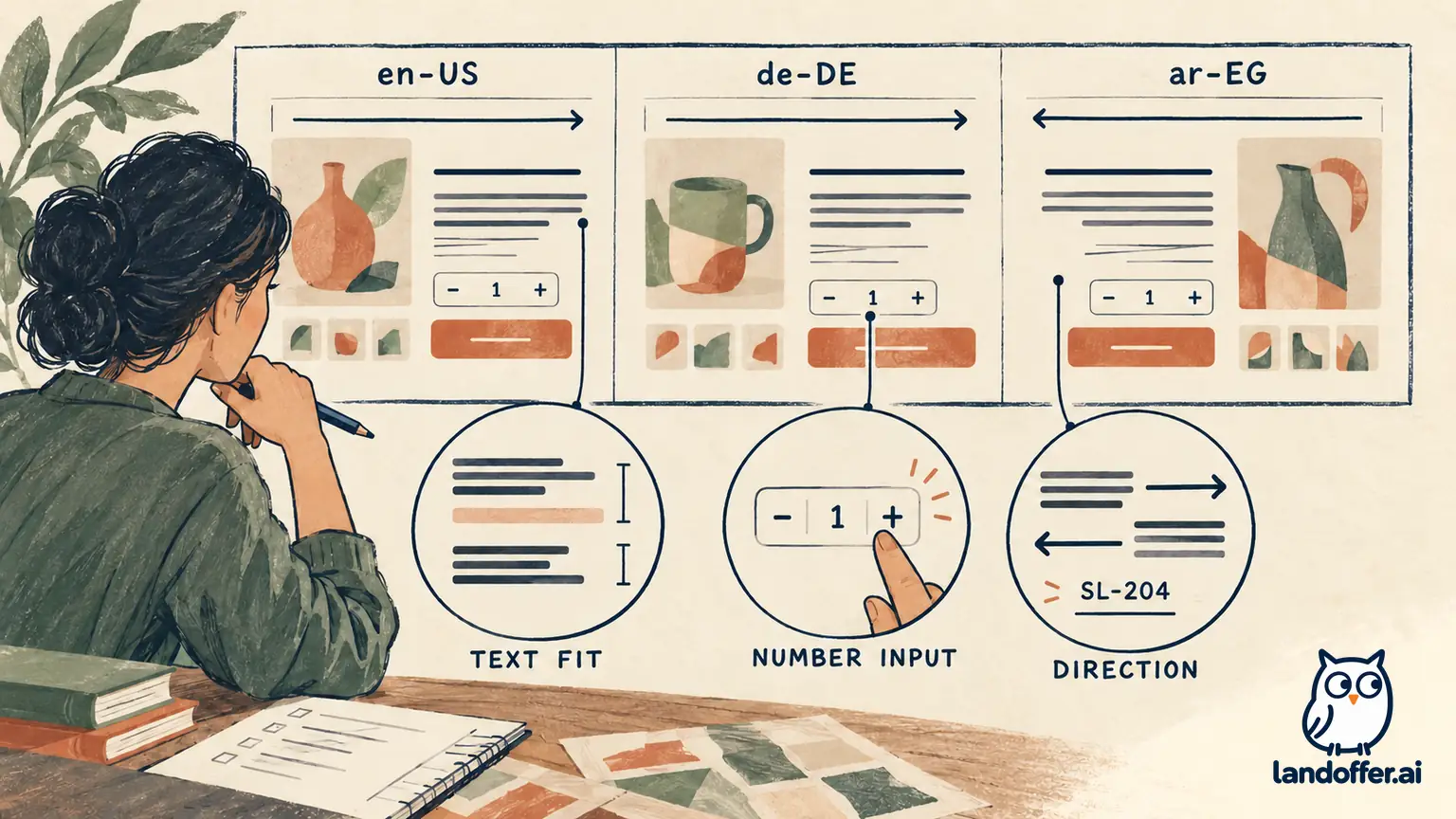
This LandOffer.ai guide uses a fictional sample-catalog request form across en-US, de-DE, and ar-EG. The product, UI observations, reviewers, and repair decisions are authored examples. A separate Node runtime fixture actually checks formatting and a restricted input parser; it does not test a browser, keyboard, assistive technology, translation quality, or a deployed product.
Define the locale and the task you intend to support
Specify the supported locale configuration rather than treating a country flag as a complete test specification. Language, region, number system, calendar, and user preferences can differ. The three configurations here are selected test cases, not assumptions about every person in the United States, Germany, or Egypt, or every Arabic-language user.
The fictional product, Sample Ledger, lets a team request a material sample. The task is to enter a package weight, choose a requested date, review the details, and save a draft request. The example uses a weight of 1234.50 grams and a date-only value of 9 November 2026. No sample is ordered, shipped, billed, or paid for.
The team explicitly chooses Gregorian dates for this exercise and two decimal places for its weight field. The fictional team chooses that precision for this field; it is not a universal measurement standard. Currency is not inferred from language or locale, and the form does not silently switch units between configurations.
The W3C description of localization and internationalization includes numeric and date formats, keyboards, sorting, script readability, and other requirements beyond translation. Use that breadth to frame the work. Internationalization enables the variations; localization validation checks the actual target experience and its intended meaning.
Record the application build, locale selection, device, viewport, input method, and relevant preferences when testing a real product. Without those details, “Arabic passed” or “German failed” is too broad to reproduce. A screenshot can expose clipping but cannot establish that the same form accepts and stores input correctly.
Completed asset 1: a three-locale validation matrix
Sample Ledger’s fictional release reviewer, Jo, fills in the following matrix with developer Eli and localization coordinator Farah. The numeric and date display examples come from the executed Node fixture; the UI checks remain case requirements and authored observations, not real product tests.
| Configuration | Display examples and intended stored meaning | Layout, direction, and input checks | Evidence boundary |
|---|---|---|---|
en-US |
Weight 1,234.50; date 11/09/2026; canonical weight 1234.50, date 2026-11-09 |
Preserve labels, units, error association, keyboard access, and the editable review step | Runtime display examples checked; full UI and device behavior untested here |
de-DE |
Weight 1.234,50; date 09.11.2026; same canonical values |
Check longer labels and actions at narrow width; accept the specified decimal/grouping syntax without partial parsing | Runtime examples and restricted parser checked; fictional clipping repair described below |
ar-EG |
Weight ١٬٢٣٤٫٥٠; date visibly ٠٩/١١/٢٠٢٦; same canonical values |
Check base right-to-left direction, mixed Latin identifiers, numeric order, cursor behavior, and actual supported input methods | Runtime output includes direction marks retained in the receipt; no native-language, bidi-rendering, or keyboard certification |
The date examples use the same Gregorian date and a UTC formatter fixture to avoid an accidental day shift during comparison. The Arabic runtime date contains invisible right-to-left marks around separators; the table shows its visible pattern. The retained code-point record makes that distinction inspectable rather than pretending strings with similar appearance are byte-identical.
The matrix ties each displayed value to the meaning that must survive validation, storage, and reopening. The review screen should show the intended weight and date after validation and storage. A successful translated label does not prove that 1.234,50 reached the backend as 1234.50, or that a date-only request retained the selected calendar date.
Use a complete task for each configuration: enter data, trigger an error, correct it, review it, save a draft, reopen it, and compare the resulting meaning. Include empty and populated states, long names, and representative identifiers within the product’s supported scope. A checklist of three locales is coverage of those configurations, not proof of global readiness.
Completed asset 2: repair text expansion and numeric interpretation
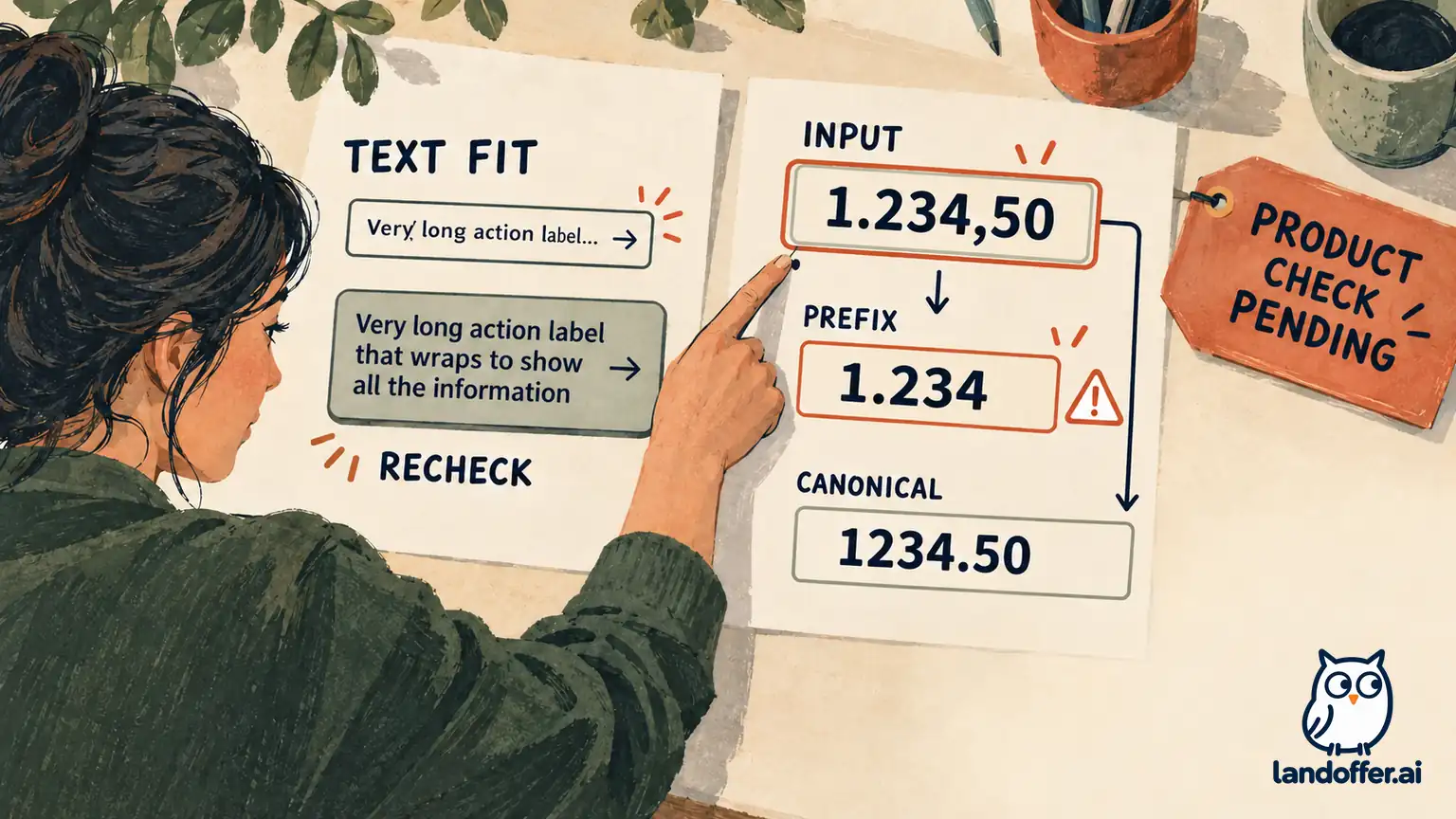
The first defect record concerns the review action. Sample Ledger’s authored German screen uses the illustrative phrase “Musteranfrage überprüfen” in a fixed-height, fixed-width control designed around “Review request.” At a narrow viewport in the fictional observation, the visible action text is clipped. The phrase is teaching material, not an approved German translation or a claim of review by a language expert.
Jo records the defect as a task problem: the complete review action is not visible in the selected state. She attaches the relevant locale, viewport, resource key, and before-state reference within the fictional record. She does not shorten the string herself just to make the screenshot fit.
The filled fictional record is L10: build L17, de-DE, request-review state, resource request.review, 390 CSS pixels wide at 100% zoom. Expected: the complete action remains readable and reachable. Observed in the authored case: the final word is clipped. The repair is recorded against build L18 at the same width and state. Keyboard focus and screen-reader output are separate pending checks, so the visual recheck cannot close them. These build labels identify stages in the teaching scenario, not downloadable product versions or actual screenshot captures.
Eli’s recorded repair removes the restrictive text container, allows the control to grow and wrap within the layout, and keeps the full accessible label associated with the action. Farah retains responsibility for linguistic review in context. The authored recheck says the full action is visible at the originally failing narrow width, while adjacent controls remain distinguishable.
That is a completed fictional defect-and-recheck example. No browser layout was executed for it here. The L18 fictional recheck covers the stated 390-pixel visual state only; other widths, zoom, fonts, focus behavior, and assistive technologies remain unverified. Counting characters would not prove that text fits; the actual font and rendered layout matter.
The second record is backed by an executed, restricted numeric example:
| Step | Input or rule | Result and interpretation |
|---|---|---|
| Broken reference behavior | JavaScript parseFloat('1.234,50') |
Returns 1.234, consuming only a prefix rather than the intended 1234.50 |
Intended de-DE meaning |
Supported form input 1.234,50 grams |
Canonical decimal string must be 1234.50 |
| Restricted repair fixture | Validate the whole string against the explicitly selected locale’s grouping and exactly two fractional digits | Accepts the three supported example forms and produces 1234.50 |
| Negative case | de-DE input 1,234 |
Rejected by this exercise’s two-decimal grammar; no silent choice of a different meaning |
| Further negative cases | Wrong locale separators, incorrectly grouped digits, or trailing letters | Rejected instead of accepting a numeric prefix |
The reference parser is deliberately small. It handles only the sample grammar for the three stated configurations, including mapping Arabic-Indic digits for the ar-EG example. It is not a general international-number parser and does not cover every digit system, sign, spacing convention, exponent, or precision rule. For production, select appropriate locale-aware components and validate the business field explicitly; this limited sample grammar is not a general parsing strategy.
The completed fictional defect disposition separates the evidence: the local conversion behavior is reproduced and the reference grammar is corrected; integrated form submission, server validation, storage, and reopened review values still need product tests. Eli owns those checks. Jo keeps the product defect open until the intended end-to-end meaning is verified.
Check direction and date meaning separately from appearance
For a right-to-left interface, mirroring every character is not the goal. W3C’s internationalization quick tips distinguish base document direction from embedded Latin text and numbers, which retain their own ordering. A sample identifier such as SL-204 therefore needs a deliberate mixed-direction check, not a screenshot reversed as an image.
Farah’s fictional review list includes the identifier beside Arabic surrounding text, numbers with separators, punctuation, caret movement, selection, and copied values. That list is not evidence that any of those behaviors passed. Use reviewers with appropriate language expertise and test the actual rendering and input environments; formatting a number in Node cannot establish those outcomes.
Date-only fields have another failure mode. The retained Node script executes this exact case: it formats the instant 2026-11-09T00:00:00Z in America/Los_Angeles and records 11/08/2026. That is expected time-zone conversion of an instant, but it would be wrong if the product meant to preserve a requested calendar date of 9 November.
Decide whether the domain value is a calendar date, a local time, or an instant before choosing storage and display behavior. This example preserves a date-only string, 2026-11-09, for the request. It does not propose UTC as the universal remedy for appointments, deadlines, or every date field. The right behavior depends on the product’s actual meaning.
The same care applies to inputs. A keyboard offering a decimal separator does not establish that the application accepts it correctly. Real validation should cover supported devices and input methods, including pasted values, corrections, error messages, and the value received by the server. Keep unsupported forms explicit so users receive an actionable error rather than an unexplained changed number.
Make a release decision from the evidence you have
Microsoft’s localization-testing guidance distinguishes functional, visual, and linguistic validation, and describes in-context review as a way to expose truncation, mirroring, and formatting problems. Those are complementary checks. Passing one category does not close the others.
Jo’s completed fictional decision is to hold the localized product release on the current evidence. The runtime fixture establishes selected formatting and parsing behavior; the authored clipping recheck illustrates a repair; linguistic review, real RTL interaction, device input, and integrated numeric/date persistence remain outstanding. Keep the release pending until the assigned reviewers supply the missing evidence; translation-complete status does not close those checks.
Farah accepts ownership of arranging appropriate in-context language review. Eli accepts integrated input and stored-value verification. Jo will review the resulting evidence against the declared supported configurations before changing the release disposition. These are fictional assignments, not messages sent to actual reviewers or promises that the checks will pass.
The companion receipt retains the Node and ICU versions, inputs, outputs, date code points, rejected cases, and the limits of the parser. Its sixteen passing checks are evidence for that fixture alone. They are not sixteen localized-product acceptance tests or a universal accessibility assessment.
For your next localization review, choose one complete task and trace both its visible content and stored meaning across the declared configurations. Give layout, input, direction, and language gaps separate owners and statuses. More practical workplace guides are available from LandOffer.ai.