LandOffer
Job search
LinkedIn Learning: Check Library Access Before Paying for a Personal Subscription
Check the exact library entitlement and three-course study plan before paying; certificate identity, CEU evidence, and profile history need separate review.
Check your library's LinkedIn Learning access before starting a personal subscription. A participating library may already provide the courses you need through its card-and-PIN login. Library access has different account and completion-record rules: library learning is not connected to your personal LinkedIn profile, its completion certificates do not carry your name, and continuing-education certification needs separate attention.
This guide reviews current LinkedIn and Johnson County Library instructions checked October 23, 2026. We did not sign into a library account, use a card, enroll, or purchase. LandOffer.ai publishes this guide. First browse recent roles on LandOffer.ai and identify what you need to learn or document. Course access, a completion record, and an employer's credential requirement are three different needs.

Find the library benefit through the library itself
Start with your own public library's online-resource directory. Look for LinkedIn Learning by name, read the current eligibility and sign-in instructions, and check whether your card type qualifies. Availability at one library is not evidence that every library in the same state or country subscribes.
Johnson County Library provides a concrete example. Its eLearning resource page lists LinkedIn Learning, requires a library card, and supplies its specific access route. The mobile instructions identify jocolibrary as the Library ID. That ID belongs to the institution; it is different from the patron's individual card number.
Use the link supplied by the library rather than a retail trial button on a course page. A public course page may advertise a personal subscription even when a sponsored route exists elsewhere. Seeing that advertisement does not establish that your library has stopped providing access.
If your school or employer also offers LinkedIn Learning, inspect its own resource page separately. Eligibility, account connection, and end-of-access rules may differ from a public-library license. A working university email alone does not prove that the current license covers alumni, and library instructions should not be reused as campus instructions.
Keep the sponsor, login route, eligibility condition, and support contact together so an access problem reaches the right institution. These details make an access problem easier to resolve without assuming the only solution is a purchase. If your library does not list the service, ask its staff about current availability instead of relying on an old search result or another city's link.
Know which account you are entering
LinkedIn's library-patron FAQ documents a library-specific login using a Library ID, card number, and PIN. It says a LinkedIn profile is unnecessary and directs access problems to the library. An institutional access route is therefore distinct from signing into the social network with a personal email.
Do not supply card credentials to an unfamiliar form simply because it mentions LinkedIn Learning. Begin with the library's official resource link or the documented app route. Keep the card number and PIN private; a support question can usually start by naming the resource and describing the error without publishing those credentials.
For personal subscribers, LinkedIn's individual-learner feature guide describes signing in with LinkedIn credentials, keeping learning history, downloading completion certificates, and adding them to a profile. These documented features explain the personal account's role, rather than proving that every feature differs from library access.
A school or employer license is another arrangement. LinkedIn's Enterprise learner guide describes organization-provided access and notes that organizations may see learning activity. Do not treat a library's privacy model as a promise about a university or workplace account.
Check which entitlement supplies the lesson you are opening. A personal profile may be signed in elsewhere in the browser while the library route uses its own account. Inspect the stated access context instead of assuming a familiar profile photograph tells you who is paying for access.
Compare course access with the record you need
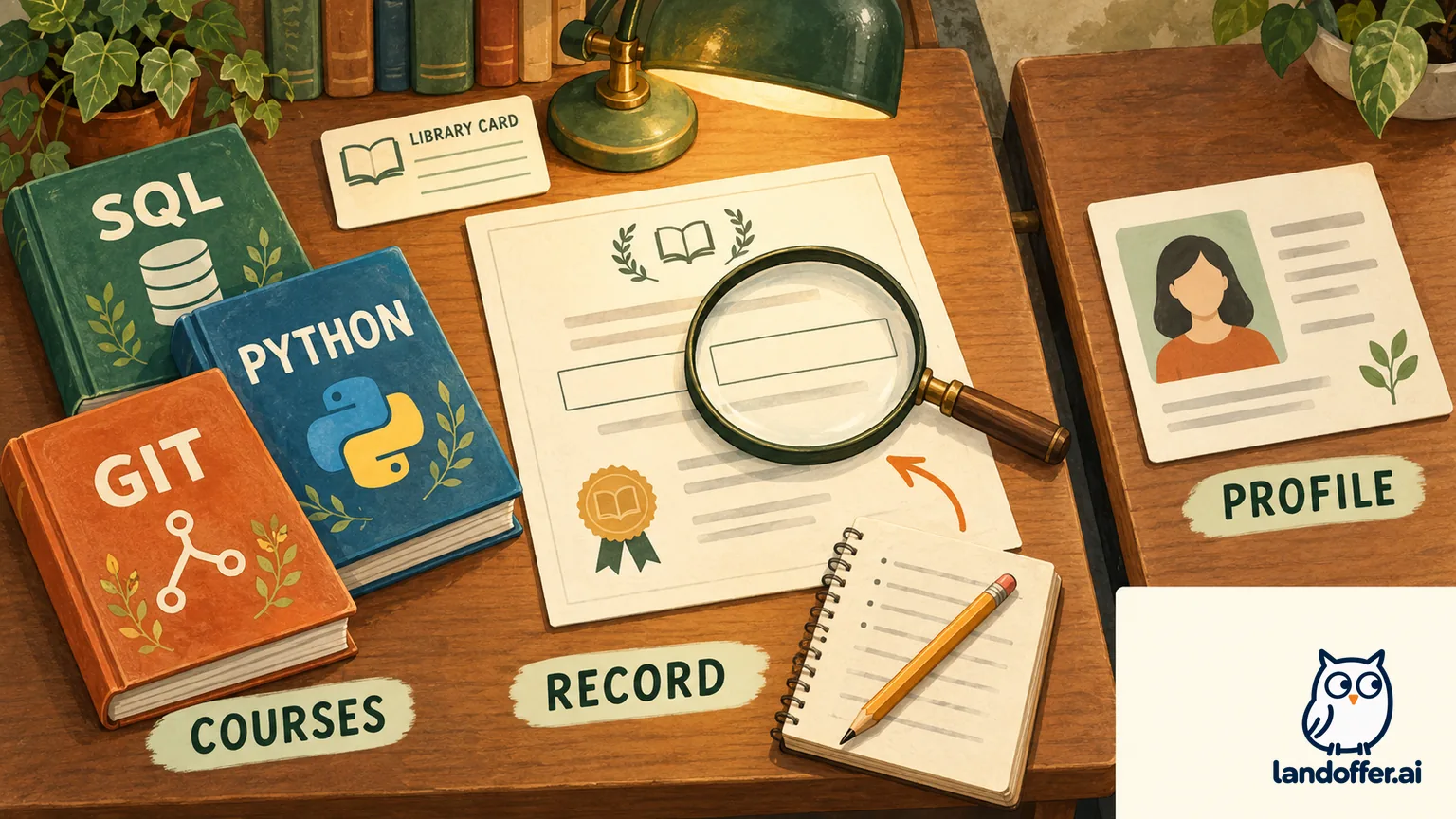
Johnson County Library's account-comparison FAQ, updated August 21, 2026, explains that its library pathway does not connect to an individual's LinkedIn social-network account. It also identifies unnamed completion certificates and the dependence of saved history on the particular card number.
Those limits do not mean the learning is unusable or that you cannot discuss completed coursework. They mean the record needs to be described accurately. A self-maintained note saying which course you completed is different from a provider-issued certificate bearing your name, and a manual profile entry is different from an automatic account connection.
| Requirement | Library route | Personal or other sponsored route |
|---|---|---|
| Watch relevant course lessons | Check the exact course through the participating library | Check the exact plan and course access |
| Avoid creating a LinkedIn social profile | Library FAQ says a profile is unnecessary | Personal access uses LinkedIn credentials |
| Automatically connect library history to a profile | Library accounts cannot make that connection | Verify the account's supported profile connection |
| Obtain a certificate with your name | Library certificates do not include patron names | Check the named record and completion requirements |
| Obtain accepted continuing-education evidence | Library CEU certification is unavailable | Verify the exact course, account type, and accreditor's requirements |
Choose around the row that matters. For self-directed SQL practice, a missing printed name may be irrelevant. For a continuing-education submission requiring a provider-issued named record, it can be decisive. Do not buy a personal subscription merely because a certificate exists; first establish whether that certificate satisfies the receiving organization's requirement.
Worked case: Rina has three courses and no need to pay again
Fictional access decision: Rina has a qualifying card at a participating library and wants structured refreshers before building a small data project. She needs lessons and practice, rather than continuing-education credit or automatic profile sharing. In this teaching case, she follows her library's authorized route and confirms access to the selected lessons before deciding against a new subscription.
The following real course pages were publicly available when we checked. Their existence does not prove access for any particular library account. Rina's successful library checks are stipulated fictional case facts, not tests performed by LandOffer.
| Selected course | Learning task in Rina's plan | Completed fictional access decision |
|---|---|---|
| SQL Essential Training, Walter Shields | Review queries and relational data before writing her own analysis | Lesson access confirmed through her library; no separate purchase needed for this task |
| Learning Python, Joe Marini | Practice reading files and working with structured data | Library lesson access confirmed; schedules independent practice afterward |
| Git Essential Training, Barbara Forbes | Practice commits and branches for her project | Library lesson access confirmed; keeps project work separate from course completion |
The exact public pages are SQL Essential Training, Learning Python, and Git Essential Training. Match Walter Shields, Joe Marini, and Barbara Forbes as well as the course titles so similarly named editions do not silently change your shortlist.
Rina records her incremental personal-subscription payment as $0 because she does not start one. This is not a claim that obtaining or maintaining every library membership costs nothing. Her decision assumes valid access already exists and the three required lessons work through it.
She also separates watching from demonstrating ability. Finishing a Python course does not prove she can design a production data pipeline. Her project record will describe what she actually builds and checks. If a specific exercise environment requires additional terms or an external account, she reviews that separately rather than treating video access as proof that every linked tool is included.
Worked case: Owen needs a named continuing-education record
Fictional buying decision: Owen has library access but must submit continuing-education evidence to a professional body. In this fictional case, its written instructions require an eligible course and a provider-issued certificate identifying him. He is considering paying personally to solve the record requirement.
LinkedIn's library CEU guidance says library access does not support CEU certification because those programs require personal information. It points readers toward an individual account or employer-provided option. That establishes a reason to investigate another route, not a guarantee that any paid course will satisfy Owen's particular body.
| Decision item | Owen's completed finding | Resulting action |
|---|---|---|
| Existing library access | Available for ordinary learning | Keeps it for study that does not require CEU certification |
| Required record | Named provider-issued evidence for an approved course | Does not treat an unnamed library certificate as sufficient |
| Candidate personal plan | May supply an appropriate account route | Requests confirmation of the exact course and record requirements |
| Employer benefit | Eligibility not yet confirmed | Checks this before paying personally |
| Purchase state | No verified course-and-record match yet | Holds the purchase instead of assuming any subscription solves the issue |
Owen's decision is complete even though he has not bought anything: the library route is unsuitable for this stated certification requirement, and the paid route remains unverified. Owen still needs confirmation that the exact course and account route meet the receiving body’s acceptance rules. It is not simply whether a payment button works.
He prepares a narrow question for the provider or benefits administrator: “For this named course, does my account route issue the completion record required by the approving body, including my name and the relevant credit information?” He supplies the real requirement privately when appropriate. No message was sent during this review.
If that match is confirmed, he compares the current offer with any employer entitlement and chooses the minimum purchase needed. He does not add a name to an unnamed document and represent the edited file as a provider-issued named certificate. A manual record can describe learning without changing what the provider originally issued.
Preserve history before changing access routes
LinkedIn's history-across-accounts FAQ explicitly excludes Library users from learning-history transfers. The broader account-sync instructions on that page should therefore not be used to promise a library-to-personal migration.
The library-patron FAQ also warns that a changed library-card number does not carry the old history to the new number. Before replacing a card or moving to another access arrangement, ask the library what remains available and keep permitted copies of your completion records. Saving a copy is different from transferring platform history.
Record the course title, instructor, completion date, and access route while you can still verify them. Keep any downloaded certificate in its original form. If you later describe the course on a resume, distinguish completed learning from a professional certification, degree, or independently assessed skill.
For a personal account, linked certificates and profile-sharing controls follow its own rules. Do not assume a library record will appear there after you start paying, or that keeping a social-network profile preserves an unrelated card-based history.
Make the purchase decision after the access check
We did not establish a universal current personal-subscription price. The public product URL was unavailable to the search tool, and a browser visit redirected to an account-specific Premium offer, which we closed without collecting a quote or taking action. Use the offer actually available to you for price, currency, billing period, trial eligibility, and renewal date.
A free trial is still a separate subscription decision. LinkedIn's subscription overview says current course access requires a subscription and that individual course purchases are unavailable. Older announcements about buying a single course are insufficient evidence for today's options.
Before paying, write one sentence naming what the purchase adds: unavailable course access, an appropriate named record, an account feature you need, or continuity after sponsored access ends. If the library already supplies your actual learning requirement, a retail trial button alone is not a reason to duplicate it.
Before purchasing, save the three selected course names, the verified access route, and the specific record or feature still missing. Then browse recent roles on LandOffer.ai and connect the learning to work you can demonstrate. Pay for the missing capability after verifying it, rather than paying simply to reproduce access you already have.
Sources and Further Reading
- LinkedIn: library-patron access and record FAQ
- Johnson County Library: eLearning access instructions
- Johnson County Library: library versus individual access
- LinkedIn: individual-learner features
- LinkedIn: Enterprise learner features and organization visibility
- LinkedIn: CEU certification and library accounts
- LinkedIn: history across accounts, including Library exclusion
- LinkedIn: current subscription overview