LandOffer
Job search
LeetCode Premium vs. NeetCode Pro: Targeted Practice or a Structured Course?
Choose targeted question selection or a structured learning sequence from evidence about your preparation gap, time, and access needs.
Choose LeetCode Premium when you already understand the relevant techniques and need a more focused set of questions or a particular paid explanation. Choose NeetCode Pro when an ordered course, demonstrations, and implementation exercises address a learning gap. Both products include practice and explanations; both advertise company tags. The useful distinction is which paid increment helps you complete your next preparation task beyond the resources you already have. A free route, or one paid product combined with free material elsewhere, may fit better than two subscriptions.
This comparison uses official sources and public pages checked October 13, 2026. We inspected loaded prices, public practice entries, course outlines, and terms without buying access or testing paid filters, AI assistants, or course lessons. The people and exercises below are fictional; the pointer trace was checked in local Python. LandOffer publishes this comparison. Start with recent tech roles and the employer's interview instructions to identify the skills you actually need to practice.

Compare the work each purchase would change
The LeetCode Premium offer emphasizes company filters by role, time, or frequency, additional questions and explanations, editor tools, and timed simulations. Those features can help someone who knows what to practice but wants a narrower selection. Premium access does not supply a personal instructor to decide why an attempt failed.
NeetCode Pro combines video courses, written explanations, and practice. Its beginner DSA outline deliberately orders topics from arrays and linked lists through recursion and later structures. The course expects basic programming-language knowledge. That is a useful starting distinction for someone who recognizes a solution after watching it but cannot explain or implement the underlying operation.
Use comparable criteria rather than assigning each product exclusive ownership of a feature:
| Decision criterion | LeetCode Premium | NeetCode Pro |
|---|---|---|
| Narrow an existing practice queue | Company role, time, and frequency filters advertised | Company-tagged practice also advertised |
| Follow a learning sequence | Paid questions, explanations, and Explore content; inspect the specific resource | Explicitly ordered courses with video, written material, and exercises |
| Try before paying | Public problem library and topic entry points | Public practice lists and selected free course units |
| Current access choices | $35 monthly or $159 billed yearly | $119 for one year or $297 lifetime offer |
| Personalized human assessment | Not established by the inspected Premium offer | Not established by the inspected Pro offer |
The distinction is not that LeetCode contains no teaching or NeetCode contains no targeted practice. If a particular LeetCode learning resource already explains your gap well, keep it. If NeetCode's free practice list already supplies a sensible queue, another company filter may add little. Judge the paid increment against your existing resources.
Diagnose selection trouble and learning trouble separately
A selection problem sounds like: “I can explain and implement these techniques, but I am spending too long deciding what belongs in my next rehearsal.” A learning problem sounds like: “I can follow the explanation, but I cannot reconstruct the state changes when the example changes.” They can occur together, but adding more questions does not directly repair a missing concept.
The public LeetCode problem library exposes topic entries and search while asking readers to sign in for saved lists and progress. The NeetCode practice page exposes curated lists; its Core Skills view distinguishes some exercises with Pro labels. We inspected these logged-out entry points, not a complete inventory of what every account can run for free.
For a first diagnostic, use a small exercise in a topic you believe you know. Record whether you chose an appropriate technique, explained why it applies, implemented it, and checked a changed input. Do not reduce every incomplete attempt to “needs harder questions.” A syntax mistake, an incorrect state update, and a slow choice of exercise call for different next steps.
A correct result after reading an explanation can be useful learning. Record that help rather than treating the attempt as independent. On a later attempt, close the explanation and change the input or requirement. The output you want is a reasoned implementation you can discuss, not a larger completion count. Neither a company tag nor a course badge establishes that output by itself.
Worked choice: Daniel needs a smaller practice queue
Daniel is a fictional backend engineer with a coding round in six weeks, a $50 preparation budget, and twelve available ninety-minute blocks. His total scheduled time is eighteen hours. Recent independent attempts show that he can explain basic data-structure operations and check edge cases, but he keeps changing his queue after reading new company lists.
His problem is choosing a bounded set of relevant rehearsals. He sets aside two blocks to review his attempt log, six to attempt a selected mix, two to revisit failures, and two for timed explanations. This is his own allocation, not a vendor study plan or a prediction that eighteen hours is sufficient for the employer's round. Each rehearsal leaves an attempt and one explanation of an error or tradeoff to review, so his queue produces work he can revisit.
Daniel first uses free topic and practice entries to build that queue. If he can select the work without a paid feature, his purchase is zero. If one relevant company filter or locked explanation would materially change the queue, a single observed $35 LeetCode month fits his budget. The $159 annual payment and NeetCode's $119 year do not. He declines both annual purchases for this preparation window.
LeetCode's company-grouping explanation says the lists are compiled from user surveys. The help article is older, but the current subscription FAQ repeated that basis when expanded. Daniel therefore uses a list as a selection signal. He does not assume that a company's next interviewer will use a listed question or that an unlisted topic is irrelevant.
His six-week window also exceeds a one-month purchase. He schedules the paid selection or explanation work during that month and reserves the remaining weeks for independent practice using material he can still access. If he needs a second paid month, the observed total would be $70, exceeding his limit. He changes the plan before paying rather than treating a short subscription as six weeks of access.
Daniel's completed choice is conditional but specific: free queue first; one month only for an identified paid increment; no automatic extension of his budget. Success means a stable queue and reviewed attempts. It does not mean that the subscription will produce a particular interview question or job offer.
Worked choice: Sara needs to preserve a link
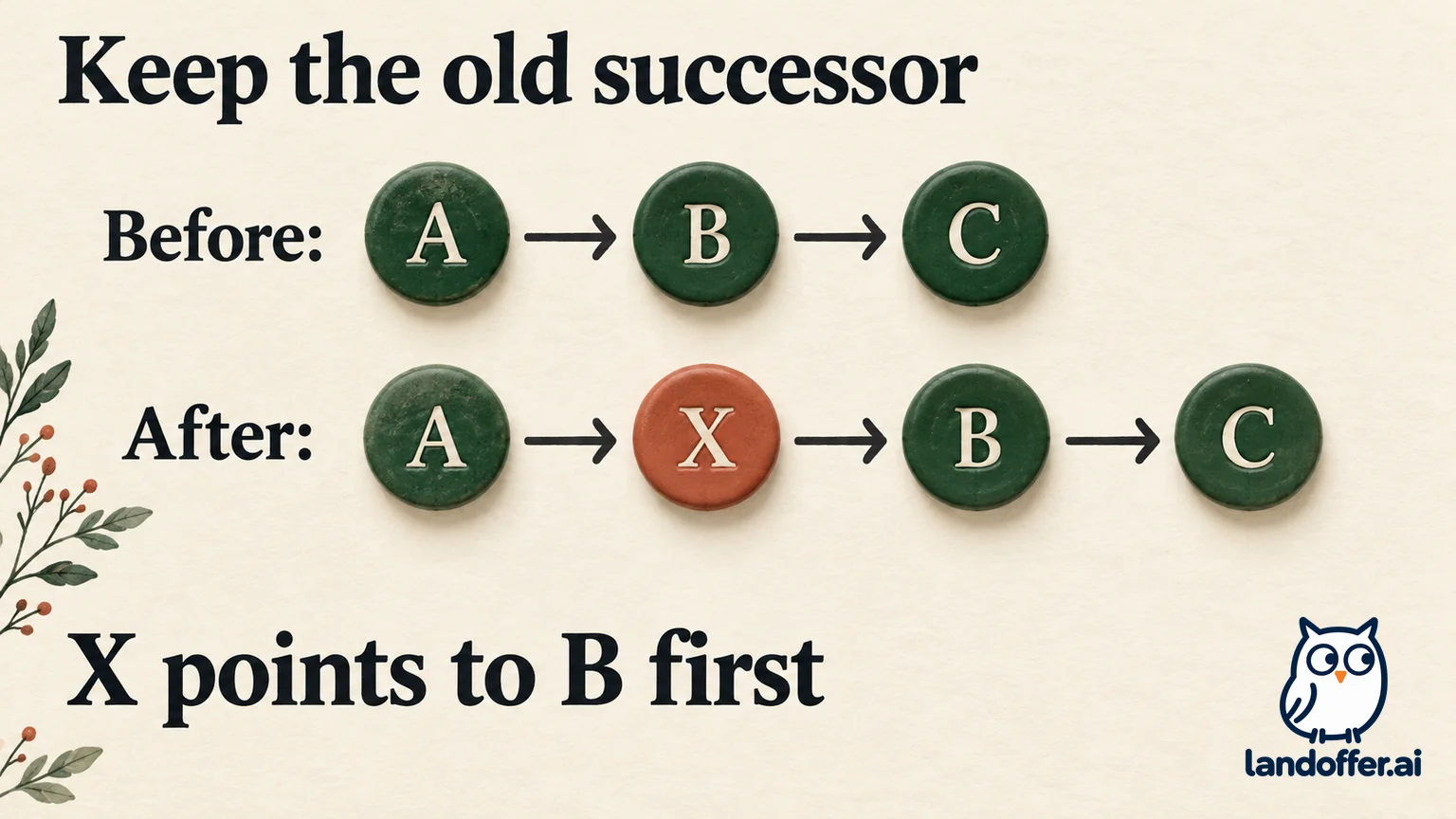
Sara is a fictional developer with ten weeks, thirty scheduled study hours, and a $130 budget. She can write ordinary application code, but a small linked-node exercise reveals that she cannot yet explain the order of pointer updates. She starts with a chain A → B → C and wants to insert a new node X immediately after A.
Her first attempt changes A.next to X and then sets X.next to A.next. At the second assignment, A.next already refers to X. The reachable chain becomes A → X → X, a cycle; B and C are no longer reachable from A through those links. She has overwritten the reference she needed to preserve. B and C may still exist as objects; the error is that following next links from A no longer reaches them.
| Operation order | Reachable result from A | Explanation |
|---|---|---|
| Set A's next to X, then X's next to A's current next | A → X → X repeatedly | The second lookup reads the already changed reference |
| Set X's next to A's old next, then A's next to X | A → X → B → C | X retains the old successor before A changes |
| Correct insertion after B instead | A → B → X → C | The same reasoning applies at another position |
We checked the wrong-order cycle and correct insertions after the head, middle, and tail in a local Python teaching model. These four checks are our original example, not a copied platform question, a submission to either vendor, or evidence that a paid course repaired Sara's understanding. The model assumes an existing node and a fresh insertion node; it does not implement concurrent modification or a complete linked-list library.
Sara's revised explanation is: “Before I replace A's outgoing link, X must retain the node that link currently reaches. Then I can redirect A to X without disconnecting the remaining chain.” Her follow-up check inserts after the tail, where the old successor is empty. She can explain why that produces A → X for a one-node starting chain.
This diagnosis points toward a lesson and implementation sequence. More company-tagged questions would not directly explain the lost reference. The public beginner outline labels the introduction, RAM, and Singly Linked Lists as free units. Sara uses those entry points to inspect the format, then considers relevant paid units if she needs a connected sequence. We did not assess the full paid course. She allocates fourteen hours to selected guided work and sixteen to independent implementations and review. She does not schedule every course in the catalog.
The observed $119 year fits her budget before any additional charges; the $297 lifetime offer does not. She chooses the year only if the public samples support the learning method she needs. Otherwise she keeps using free explanations and her own exercises. The failed trace gives her a specific operation to revisit. She can begin that work with free material and decide later whether the connected course adds enough value.
Combine resources when their jobs are different
Daniel and Sara do not need identical purchases. Someone with a longer preparation window may learn a topic through NeetCode and later use LeetCode for selected rehearsals. That combination makes sense when each resource has a defined job and the learner can explain why the second adds something useful.
At the observed prices, NeetCode's year plus one LeetCode month totals $154 before additional charges. That exceeds both fictional budgets above. The combined payment still has to fit the work and budget you have chosen. Start with the missing task, and buy the second resource only when the first resource and available free material leave that task unresolved.
The NeetCode learning guide, updated July 3, 2026, recommends attempting work, using explanations when needed, and revisiting difficult problems. You can apply that cycle without treating a platform's readiness advice as a personal hiring forecast. Keep separate notes for the first attempt, the explanation you used, and the later independent attempt.
If you already have access to one product, compare the remaining gap against its actual content before switching. A familiar editor and an existing review history can be useful. A new interface adds setup time, and repeating the same explanation in two places can displace the implementation work you intended to do. Switching should change the work, not merely reset the progress indicator.
Match the access period and feedback to your plan
The observed LeetCode annual equivalent of $13.25 per month is billed as $159 for the year. It is not a $13.25 one-month purchase. NeetCode's year offer also requires its stated upfront payment. We did not verify checkout charges, account-specific discounts, or future prices. Save the actual offer you intend to use and compare the total payment with your available budget.
LeetCode's cancellation policy, updated May 9, 2026, says to cancel before renewal, with access continuing through the paid period. Refunds are generally unavailable, with exceptions considered individually. We did not test cancellation or a refund request.
NeetCode's terms say annual automatic renewal is off by default and can be enabled. Disabling it does not create a refund. The terms generally exclude refunds, allow rare discretionary exceptions, and restrict account sharing and transfers. Confirm the email and renewal setting you will actually retain. A lifetime label is not evidence that you receive offline copies or an unchanging product.
Both main offers advertise AI assistance. We did not compare answer quality, quota equivalence, or whether either assistant diagnoses a learner's reasoning reliably. A proposed use would be to ask which link an assignment reads, then verify the answer against an independent trace. Neither an AI response nor a timed simulation is the same deliverable as a human observing and discussing your approach.
Browse recent roles on LandOffer.ai, choose one relevant preparation task, and complete a small diagnostic before paying. Write down whether the missing work is selection, explanation, implementation, or feedback. Name the specific paid resource that would change your next attempt, then confirm its total charge, access dates, and renewal setting. Keep the free route when it already supplies that work.
Sources and Further Reading
- LeetCode Premium features and current plans
- LeetCode public problem library
- How LeetCode groups questions by company
- LeetCode cancellation and refund policy
- NeetCode Pro offer
- NeetCode course catalog
- Beginner DSA course outline and introduction
- NeetCode public practice entries
- NeetCode learning guide
- NeetCode membership terms