LandOffer
Job search
Jobscan vs. Resume Worded: Job Matching Reports or Broader Writing Feedback?
Compare Jobscan Match Reports with Resume Worded writing and job-specific feedback, current plan costs, and a completed evidence-based resume edit.
Start with Jobscan's Match Report when you need a job-specific alignment review. Start with Resume Worded's Score My Resume when you first need broader writing feedback; its Targeted Resume also handles a particular posting. Both vendors offer job matching and writing-related features. The useful distinction is the report you need next, rather than a permanent label attached to either company.
This is a review of current public documentation and plan information, checked October 12, 2026, not a paid-account accuracy test. LandOffer publishes this comparison and provides job-search tools. You can browse recent roles on LandOffer to choose a real posting for your review; discovery does not establish that your resume meets its requirements.
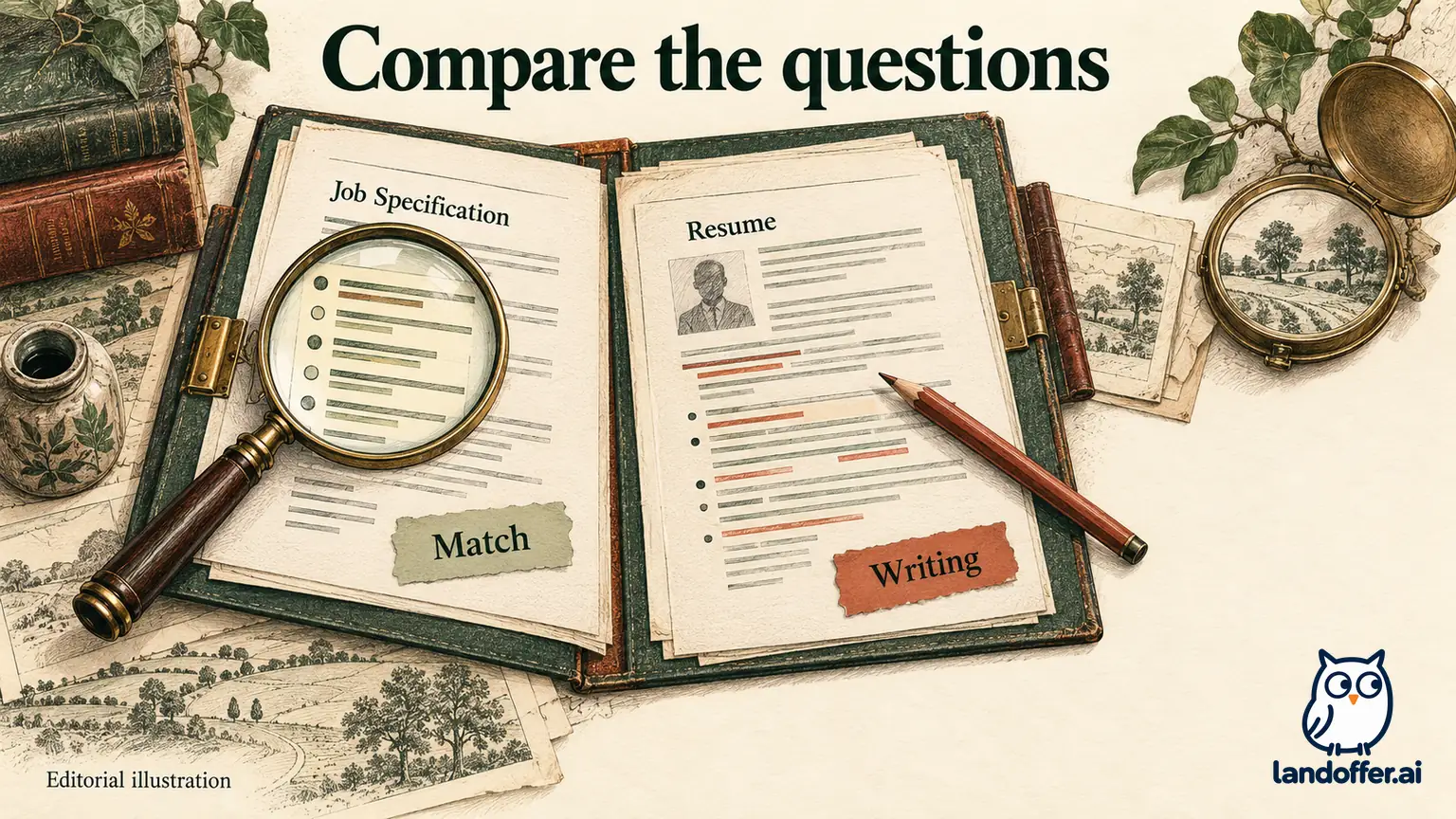
Compare reports that answer the same question
Jobscan describes a Match Report built from a resume and the job listing supplied by the candidate. Its tutorial separates skill and title alignment from other improvement tips. That makes it useful for asking whether relevant experience is visible for this particular opening. It does not establish how an employer will assess your application. Jobscan's tutorial is the source for the documented workflow, rather than evidence of measured screening performance.
Resume Worded offers two distinct entry points. Score My Resume reviews writing quality, including impact, brevity and style. Targeted Resume compares a resume with a supplied description and returns a Relevancy Score. Calling the entire product a general writing checker would omit its matching workflow. The vendor distinguishes the two scores in its score guide and explains the job-specific input on its Targeted Resume page.
| Your unfinished task | Jobscan route | Resume Worded route | What remains your decision |
|---|---|---|---|
| Check alignment with one posting | Resume plus description in Match Report | Resume plus description in Targeted Resume | Whether each requirement has defensible evidence |
| Improve a weak experience section | Read writing tips or available editing features | Score My Resume feedback and available rewrites | Whether a revised sentence accurately describes your work |
| Review a LinkedIn profile | LinkedIn Optimizer, subject to plan access | LinkedIn Review, subject to plan access | Whether profile and resume tell a consistent history |
| Decide whether to apply | Use findings as supporting information | Use findings as supporting information | Eligibility, interest, scope and effort required |
The matrix compares documented tasks, not the quality of generated output. A vendor having a feature does not prove that it finds every issue, interprets every file correctly or outperforms the other vendor. We did not run the same resume through paid reports, so the comparison cannot establish which vendor produces more accurate findings on identical input. If you have time for one review session, identify the unresolved question first so that the report leads to an edit you can actually make.
For example, a clear backend resume with a vague database bullet has a different problem from a page full of “helped with various tasks.” The first candidate may need to make an existing skill easier to find for a named job. The second needs a credible account of contribution before accumulating job-specific keywords. One report can be more useful at the current stage without becoming the better product for everyone.
Keep match percentages in their own context
A Match Rate and a Relevancy Score are not interchangeable units. Each belongs to a vendor's model, inputs and report rules. Resume Worded's broader resume score asks another question again. A higher number in one interface does not show that the same document is more likely to pass an employer's process than a lower number elsewhere.
Jobscan's resume matcher explanation describes its match rate as a visualization of alignment with the supplied description. Treat a flagged term as a prompt to inspect the posting and your evidence. A score cannot tell you whether a hiring team considers a requirement negotiable, has already filled the role, or values an unlisted specialization.
There are three possible findings behind “missing Python.” You may have done Python work but described only the business process. You may have used another language for a transferable task. Or you may lack the requested experience. Those findings call for a clarification, an honest adjacent example, and a gap decision respectively. Adding the same word to all three resumes would conceal the difference.
Keep the input pair stable when reviewing changes. Save the exact posting text and resume version, make one substantive edit, then note the reason. If you replace the posting midway through the exercise, the new number cannot isolate the effect of your edit. Even a controlled rescan measures a report response, rather than a change in hiring odds.
If you need more background on score interpretation, our Jobscan review examines report categories. This comparison focuses on deciding which review task to perform and whether another report would change a real editing decision.
A completed example: one resume, two review needs
The following case is fictional. Nia is an early-career engineer considering a backend opening at Cedar Market, requisition CM-28. The posting asks for Python, SQL, reliable data imports and collaboration with product staff. Kubernetes is preferred. Nia's work notes document a Python CSV importer, PostgreSQL validation queries and a repeatable error report. They do not document Kubernetes or team management.
Her original bullet reads: “Responsible for backend tasks and improving data quality.” The factual notes are more useful than the sentence. They identify a tool, an input, a decision and an observable output. Before asking either tool for another score, Nia compares the notes with the job's actual needs.
| Posting requirement or writing issue | Evidence in Nia's notes | Completed decision |
|---|---|---|
| Python and SQL are hard to find | Python importer and PostgreSQL checks | Name both tools in the experience bullet |
| “Improving data quality” is vague | Validation rejected malformed rows and produced an error report | Describe the validation and report without inventing a percentage |
| Kubernetes preferred | No supporting work or project | Leave it out; retain as a disclosed gap |
| Leadership wording sounds stronger | No reports or management responsibility | Reject “led a team”; describe her own implementation |
Her revised bullet is: “Built a Python CSV importer with PostgreSQL validation checks that rejected malformed rows and produced an error report for product staff.” It is more specific and more relevant while remaining within the supplied facts. A measured speed or error reduction might improve it further, but none is available in this fictional record.
The matching question is whether the existing Python, SQL and import evidence is visible against CM-28. The writing question is whether the bullet explains what she did. These questions overlap, but neither requires adding Kubernetes. A missing preferred technology remains a gap even if another edit improves a report's score.
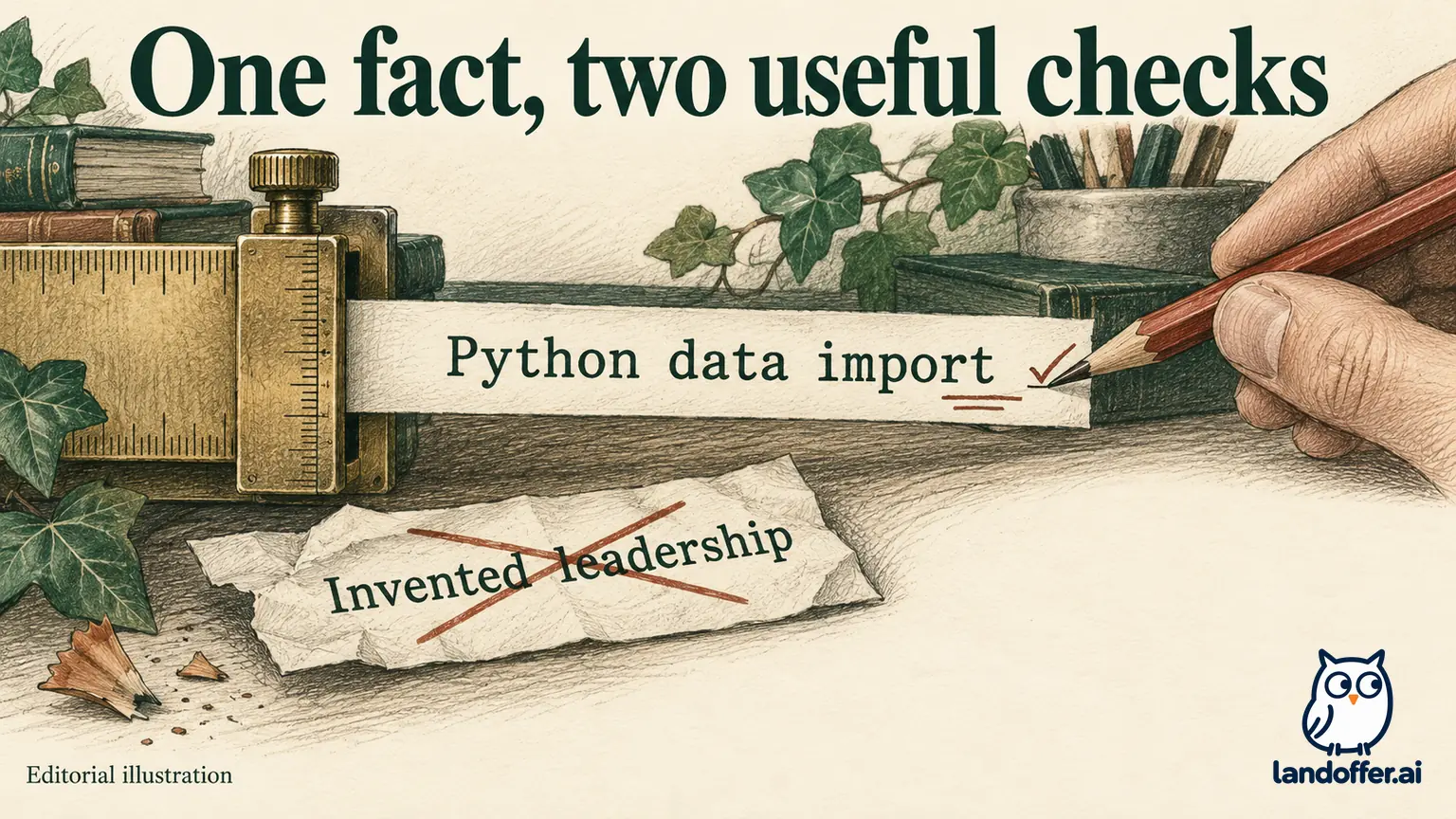
Turn feedback into a short editing queue
Nia's completed queue has three accepted edits: replace the vague importer bullet, move that bullet above a less relevant internal tooling task, and use consistent dates across the resume. She rejects one unsupported leadership rewrite and leaves Kubernetes absent. These are editorial decisions constructed for the example, not outputs observed from Jobscan or Resume Worded.
Ordering matters because a report can produce more suggestions than you need for one application. Start with inaccuracies, missing evidence for important requirements, and sentences that hide your contribution. Then handle repetition, length and presentation. If the suggestions feel overwhelming, fix the most relevant project first; verb choices can wait until its contribution is clear.
For every suggested rewrite, compare the actor, action, scope and result with your notes. “Built” and “led” are different claims. “Used a service” and “owned its architecture” are different claims. A fluent sentence can cross those boundaries without introducing a new technology name, so a keyword check alone cannot establish accuracy.
Keep an unchanged copy of the starting resume. Label the reviewed file with the role and date, then open the exported document. Verify that the relevant bullet survived, dates remain legible and the application will receive the intended version. These checks are useful whether you edit manually, accept an AI draft or keep your existing word processor.
If the same weak bullet appears across several target roles, improve the factual base once. If the weakness is relevance to CM-28, make a role-specific copy. Rewriting the master resume around every posting can gradually erase useful evidence for another track. The goal is a stable history with deliberate emphasis, rather than a different professional identity for each application.
Free access and paid reports: what is actually offered?
On October 12, Jobscan's publicly rendered plan page listed five free resume scans monthly, with limited findings. It showed $49.95 billed monthly and $89.95 every three months, displayed as about $29.98 per month. The quarterly option advertised a seven-day trial; the page distinguished that from monthly access and restricted some features during the trial. These are public plan descriptions, not entitlements tested in an account.
Resume Worded's Pro page listed $49 monthly, $99 every three months and a $229 one-year payment. It advertised full resume, targeted-resume and LinkedIn reports as Pro features. Its purchase FAQ says the plans provide the same Pro features. Free entry points therefore should not be confused with unlimited access to every part of a report.
Compare the amount charged and the access period, including applicable taxes and the terms shown at checkout. The vendors' monthly-equivalent labels can make a longer commitment look like a one-month purchase. A quarterly discount has little value if you need one editing session and stop using the product after a week.
Do not buy both subscriptions just to compare their percentages. A useful purchase needs an unresolved task that the accessible feedback cannot answer. If free findings already lead to Nia's three defensible edits, more scans may only repeat the same decision. Conversely, repeated detailed reviews across genuinely different roles can make paid access useful if she will act on the feedback.
Two candidates can reasonably choose differently
Nia already has a coherent resume and a specific posting. Her first task is job alignment, so Jobscan's Match Report or Resume Worded's Targeted Resume fits the question. She should begin with available free access. Before paying, she records the specific locked finding she needs or the scan allowance that prevents her next planned review. There is no evidence here to declare one matching engine more accurate.
Owen, another fictional candidate, has six years of work described in repetitive duty statements. He has not selected a posting yet. He starts with Score My Resume because broad writing feedback fits his immediate problem. After reconstructing ownership and results from his notes, he can use either vendor's job-specific route. His decision changes because his material needs different work, not because senior engineers should always buy a particular product.
Keep your current editor if it already produces accurate, readable documents and you can make the necessary revisions yourself. These tools supply feedback; they do not require moving every resume version or application record into a new system. For a candidate whose main problem is choosing roles, another resume subscription may be a distraction from reviewing scope and eligibility.
Choose one current opening from LandOffer's recent roles, write down the unresolved resume question, and select the report that answers it. Finish with a short accepted-edit list, then reopen the exported file and compare it with your factual notes before uploading it. That is a clearer stopping point than chasing matching percentages across two vendors.