LandOffer
Job search
JobLeads Resume Services: Free Review, Builder Access, and Membership Value
Separate the one-time review, builder access, and membership commitment; verify actual report and export rights before upgrading.
JobLeads’ resume services are worth separating into three decisions: use the one-time review, evaluate the builder’s actual document permissions, and decide whether the membership commitment fits your needs. Confirm the human-review allowance and the builder’s export rights separately.
The current help pages say Basic and Premium members receive one complimentary professional review. They describe Basic builder access for tailoring up to five documents, including resumes and cover letters, while trial and Premium access include unrestricted building and downloading. We did not verify those permissions inside an account. Review entitlement, builder access.
This review checked public pages on October 14, 2026. We did not upload a resume, consume the free review, register, start a trial, pay, or test a downloaded document. It evaluates resume feedback and builder membership value; it does not assess the job database or headhunter directory. The completed examples are fictional editorial exercises. For openings that help define a revision, browse recent roles on LandOffer.ai.
What the one-time review promises
The free-review page describes evaluation by a team member, with attention to organization, writing, and impact. Its public FAQ describes human-led analysis and a typical turnaround of about 24 hours, with longer waits possible during busy periods. These are provider descriptions; this review did not measure the turnaround or inspect a delivered report.
The entitlement is one review per member. Paying for Premium should not be interpreted as purchasing repeated free human reviews unless a separate current offer expressly says so. The help page states that no additional reviews are available after using the benefit. Resume-service charges.
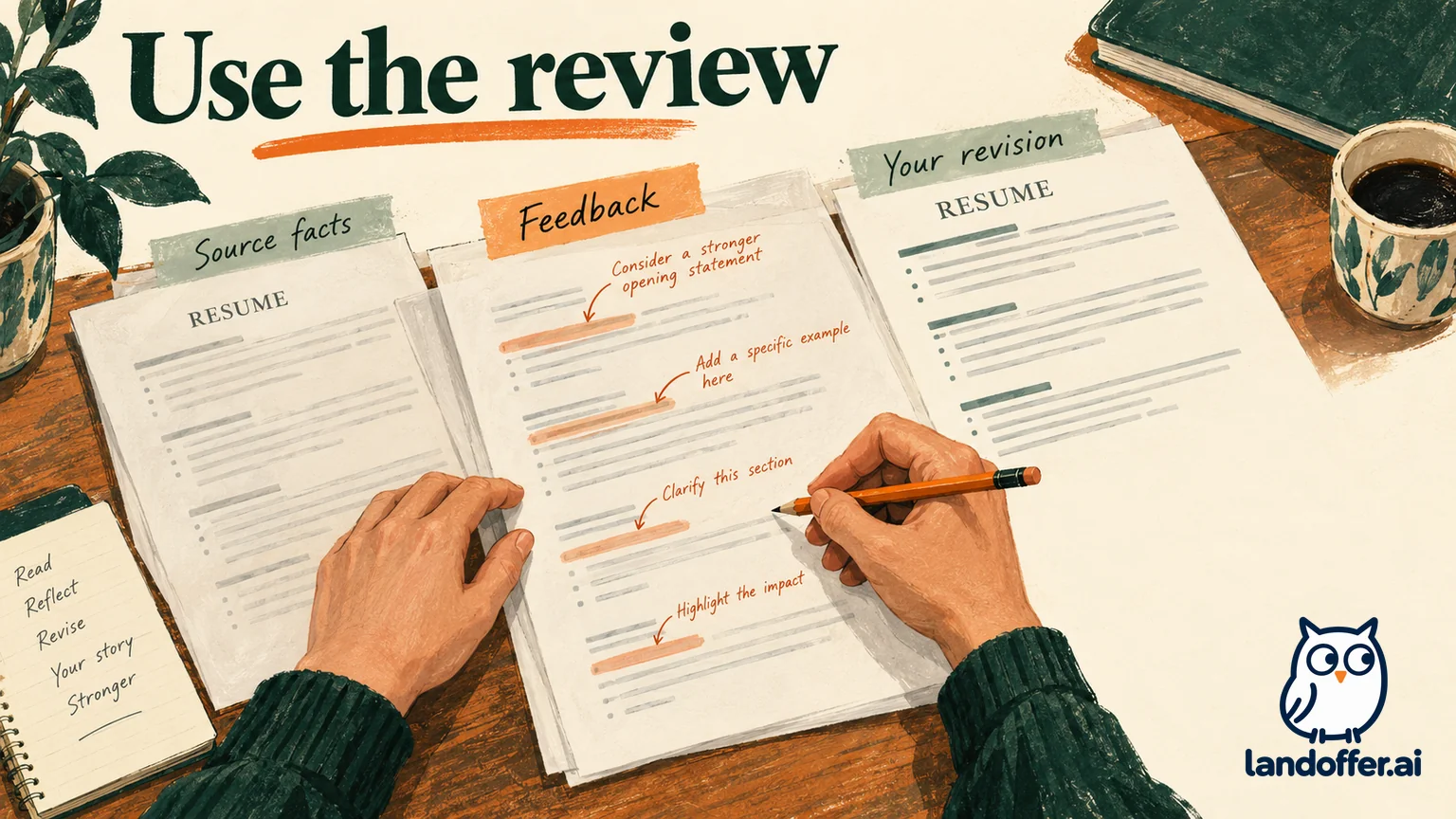
A review report is also different from a finished rewrite. Feedback can identify a problem and suggest a direction. You still need to decide which change is supported, revise the document, and check the result. Do not assume that a reviewer will verify your technical responsibilities or reconstruct missing metrics.
There is a scope ambiguity to resolve. The landing page describes an ATS check within the review, while the results help page says ATS analysis belongs to the Premium review experience and Basic members retain written feedback. Before upgrading for that analysis, inspect what your report actually contains and confirm the selected plan’s rights. Review page, results access.
Neither description establishes that a provider’s check reproduces a particular employer’s screening system. This review does not adopt the site’s broad rejection statistics or promises of interviews as verified outcomes.
Worked example: turn feedback into a factual technical correction
Sana is a fictional software engineer preparing a resume for a role involving developer tooling. Her source notes say:
Maintained seven GitHub Actions workflows for a small engineering team. Updated dependency-install steps, separated unit and integration jobs, and documented how to rerun failed checks. Investigated intermittent failures with teammates. Did not measure a before-and-after deployment-time improvement and did not own production release approval.
Her initial bullet reads: “Responsible for CI/CD and improving engineering efficiency.” It is vague and broader than her source. A useful review question is what she maintained and what changed. It is not a reason to invent a percentage improvement.
Here is her completed correction map. These prompts were not returned by JobLeads; they are editorial examples of how to use a report responsibly.
| Feedback question | Sana’s source evidence | Accepted revision | Limit preserved |
|---|---|---|---|
| What did you maintain? | Seven GitHub Actions workflows | Name the platform and seven workflows | Not ownership of the entire release process. |
| What changed? | Dependency steps and separate test jobs | Describe those changes directly | No unmeasured efficiency percentage. |
| Who used the work? | Small engineering team and rerun instructions | State the team context and documentation | No invented organization-wide scale. |
| What was shared work? | Failure investigations with teammates | Keep collaboration explicit | Not sole incident or release ownership. |
Her accepted bullet becomes:
Maintained seven GitHub Actions workflows for a small engineering team, updating dependency-install steps and separating unit and integration jobs; documented rerun procedures for failed checks.
A second bullet reads: “Investigated intermittent workflow failures with teammates and recorded reproduction notes for follow-up.” Sana keeps production release approval out of the ownership claim because another person held that responsibility.
A misleading rewrite would say: “Owned enterprise CI/CD and reduced deployment time by 50%.” Sana rejects it. Her notes support neither enterprise scope nor a 50% improvement. The number seven is useful because it describes an actual quantity in this fictional record, not because every resume bullet needs a number.
The completed correction gives Sana a clearer account of her work. It does not establish that JobLeads’ human review would have made the same suggestion or that the revision would pass any employer’s filters. In a real review, preserve the actual report and compare each recommendation with your own source material.
Use the report before deciding how to implement it
Start with changes you can make in your existing document. If the report flags unclear wording or a repeated section, you may be able to fix those problems without changing tools. If it identifies a layout problem, compare a revised export with the original rather than assuming a new template automatically solves it.
Keep three references: the resume submitted for review, the feedback you received, and the accepted revised version. Use those three references to check which recommendations you implemented and which you rejected. If a suggestion asks for a measurable result you cannot substantiate, describe the work precisely and leave the unsupported metric out.
For technical roles, a readable description of ownership often matters more than inflated impact language. Name the system, the task, and your contribution. Explain classroom, volunteer, personal-project, and employment work in their actual contexts. Keep those distinctions when using wording assistance.
Finally, inspect the document itself. Check titles, dates, links, page breaks, and the exported text order. A review category or score is not a substitute for reading the file an employer will receive.
Basic allowance and trial downloads need separate checks
The builder help page describes Basic members as able to tailor up to five documents, including resumes and letters. It lists unlimited versions, templates, editing, and PDF downloads for Premium access, including the trial. It does not establish a general Basic PDF-download entitlement for this review. Builder permissions.
Do not turn “five documents” into five downloads, a monthly replenishing credit balance, or five human reviews. The public description does not settle how revisions, deleted documents, or combined resume-and-letter work count against the allowance. Check the current account counter or ask support if those distinctions affect your plan.
The resume-service charges page describes a 14-day trial with unrestricted creation and downloading. That current statement differs from an assumption that trial users have a fixed download cap. We did not start a trial or test a gate, so we can report the published entitlement but not the actual account behaviour. Trial builder access.
PDF is the documented resume download format. This review does not establish Word export, editable-file quality, or universal parsing compatibility. Verify the particular deliverable the employer needs before making a subscription purchase for it.

Worked example: define the outputs before upgrading
Oren is a fictional backend engineer considering three openings. He wants three resume versions and two letters, because one employer asks for a resume only. His completed output plan is:
| Intended output | Purpose | Required artifact | Decision before paying |
|---|---|---|---|
| Payments resume | Reliability-focused opening | Checked PDF | Confirm export access for the selected plan. |
| API resume | Service-development opening | Checked PDF | Retain the accepted source text separately. |
| Platform resume | Developer-infrastructure opening | Checked PDF | Preserve the actual infrastructure ownership boundary. |
| Payments letter | Employer requests a letter | Employer-accepted file or text | Follow that employer’s delivery requirement. |
| API letter | Employer requests a letter | Employer-accepted file or text | Match the facts to the API resume version. |
Three resumes plus two letters are five planned documents. This is a local editorial plan, not evidence that Oren’s actual Basic account would consume exactly five allowance units. We did not test how the Basic counter counts these outputs or later revisions.
Oren’s free review, if available, is a separate one-time benefit. He does not allocate one human review to each planned version. Oren applies relevant feedback to his master, then changes the emphasis for payments, API, and platform work while preserving the same facts.
His buying decision changes with the actual need. If he wants only one finished PDF and can create it reliably elsewhere, recurring membership may offer little additional value for the resume task. If he will repeatedly tailor and export documents and the builder makes that work easier, he can evaluate the current paid offer against that workload.
He does not assign value to unrelated membership features merely because they appear in the bundle. For this decision, the relevant evidence is whether the builder can create, preserve, and export the resume versions he needs. The job database and headhunter directory would require separate evaluation and are outside this review.
Check the price and renewal on the actual offer
JobLeads’ trial help says the price applicable to your location is displayed during sign-up before confirmation. We did not inspect a completed US checkout, so this review supplies no universal trial or renewal price. Trial membership explanation.
The trial-end help says membership automatically converts to Premium unless cancelled before the trial ends. It directs users to account settings for the trial end and Premium start dates. Cancellation and a refund request are separate actions; this review did not test either or establish a refund outcome. Trial-end conditions.
Before confirming a membership, save the displayed trial charge, renewal amount, billing interval, and cancellation deadline. Do not assume “free review” means a paid membership trial is free. If you need only feedback, use the review entitlement as a separate decision from activating recurring access.
Preserve your source and understand report access
The results help page places feedback under the Resume tab and Free review section, with an email notification when ready. It says the review expires three months after becoming available. Preserve the recommendations you need within that access window; we did not verify an export button or post-expiry access. Finding your review.
The upload help says the original submitted file is not stored in your account, while its content is used for feedback, a base account resume, and matching purposes. “Not stored in your account” does not establish deletion from every system. A builder document is a separate editable record, so keep your original and accepted source independently. Upload and resume-data explanation.
JobLeads’ resume services are useful to evaluate when the one-time report helps identify a concrete problem and the builder’s verified permissions address the work you need afterward. Sana’s correction shows how to preserve facts; Oren’s output plan shows how to judge membership value. For relevant openings to guide that work, explore LandOffer.ai.