LandOffer
Work Arrangements
Setting Up a Job-Share Arrangement: Define Coverage, Accountability, and Benefits
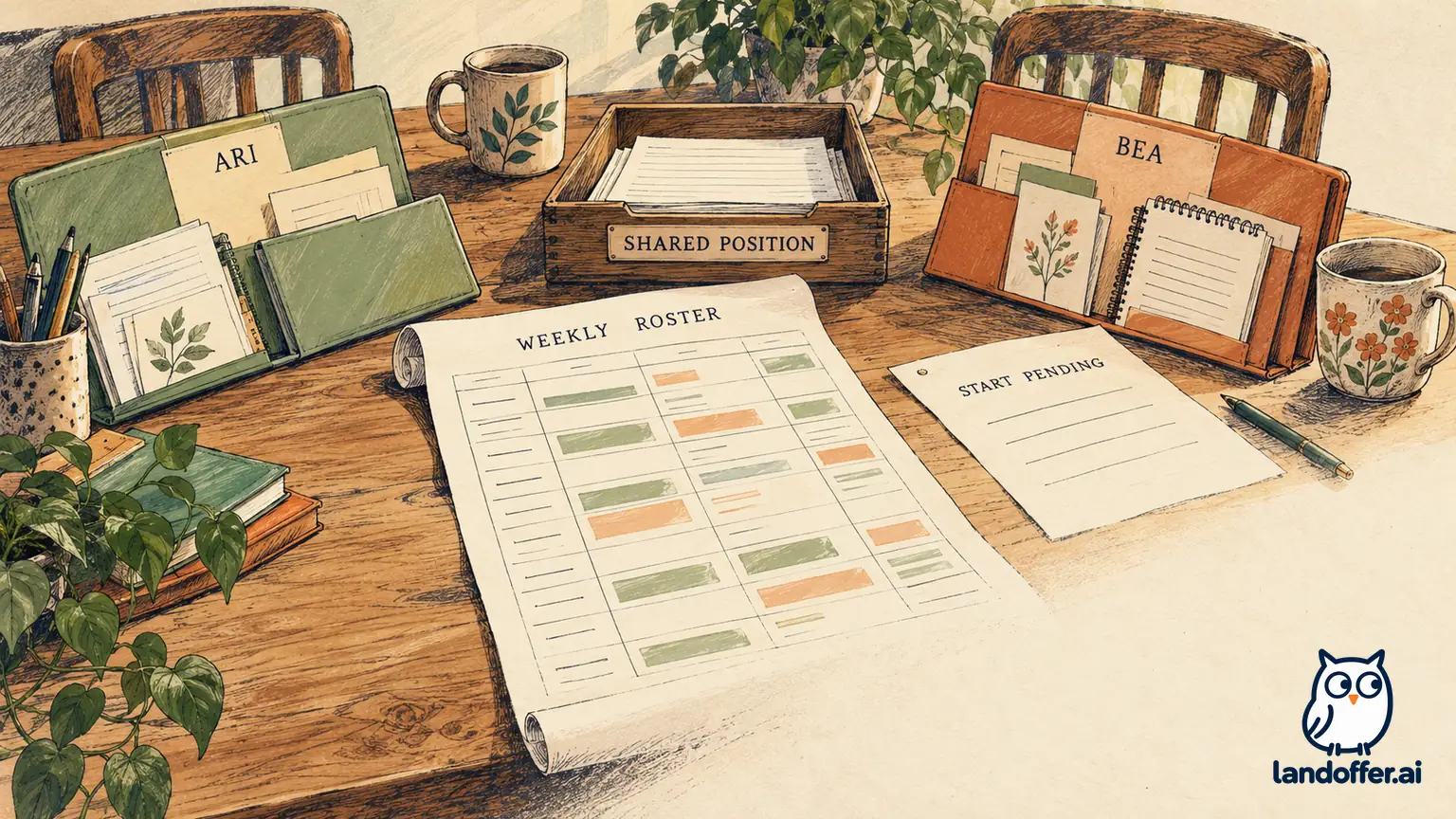
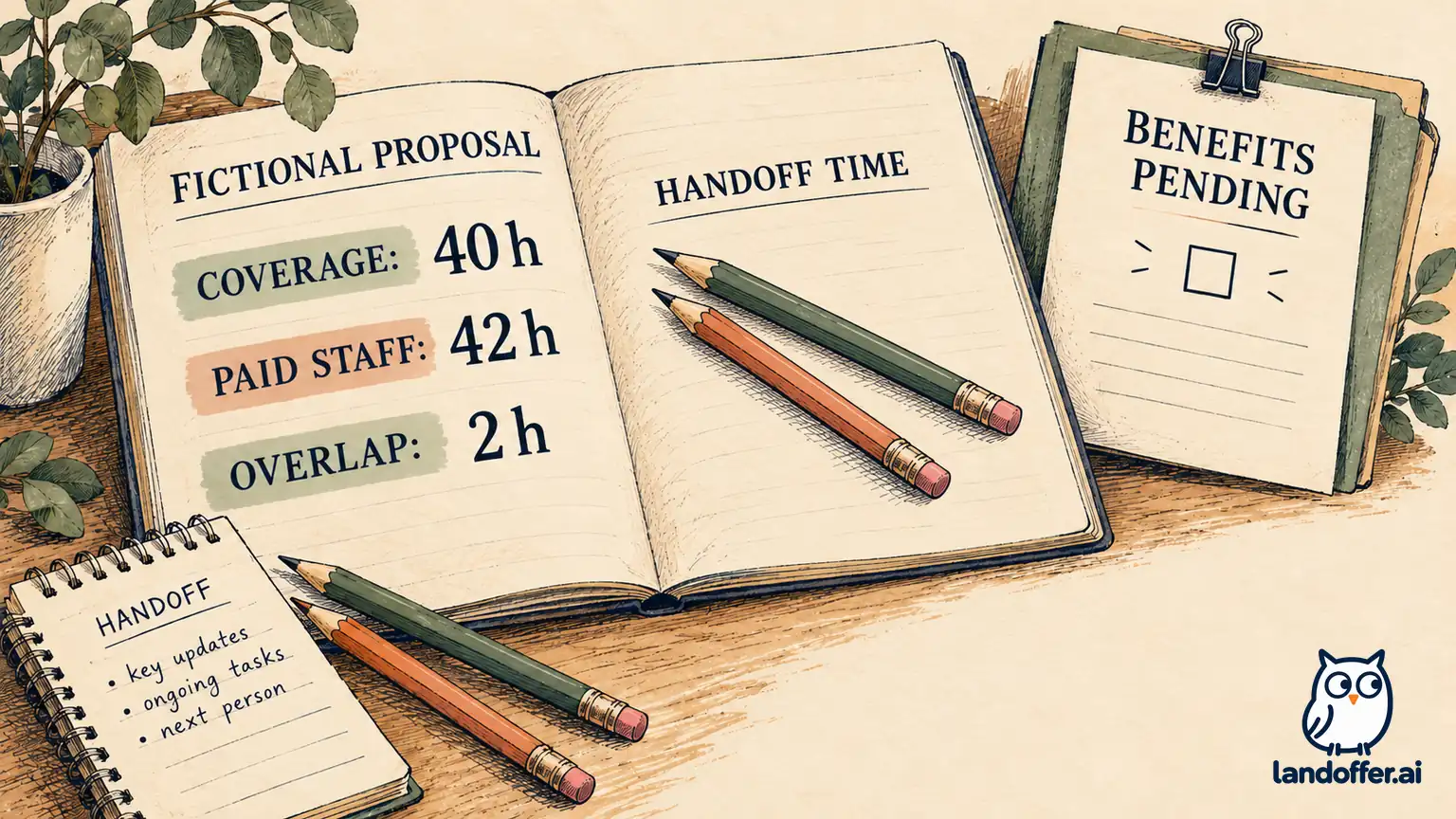
A complete fictional job-share proposal separates 40 coverage hours from 42 paid staff-hours, assigns unfinished work and rehearses a planned absence. Individual benefits and overlap funding remain unresolved, so operational support does not authorize the pilot.
A workable job-share proposal needs more than two people dividing a week. Specify who covers each service period, who owns unfinished work, what happens during absences, and what each employee’s hours mean for pay and benefits. Obtain the necessary written decisions before changing either schedule. Two people sharing one position does not establish equal benefits, automatic backup availability or approval to spend extra staffing hours.
This LandOffer.ai guide uses a complete fictional proposal for two current employees. The roster and absence calculations were checked locally; the employer, conversations and decisions are invented. No real job-share agreement, benefits determination or future coverage was tested.
Start with the position and the employer’s actual rules
List the service periods and decisions that need coverage before choosing how to divide the position. Which hours require a live contact? Which decisions require a manager? Can a task wait for its named owner, or must another authorized person take it over? Keep named assignments alongside the service responsibilities that both employees cover.
The U.S. Office of Personnel Management’s job-sharing guidance offers useful design questions: schedules, duties, communication, overlap, resources and individual performance standards. It addresses federal employment. Its benefits descriptions and sample agreements are not private-employer eligibility rules or a promise that another organization will approve the arrangement.
Employer constraints can also change the arithmetic. The University of Arkansas hiring page describes job-sharing and caps the sharers’ combined hours at the position’s normal full-time hours. That named policy matters: a proposal with paid overlap beyond a 40-hour position would need a different design there. Do not treat one employer’s permission or limit as universal.
Bring the actual position description, service hours and applicable policy to the discussion. Identify who can approve staffing, classification, benefits and access. A manager’s support for a useful coverage model does not answer every employment question.
Worked roster: 40 hours of coverage requires 42 staff-hours
In this fictional case, Ari and Bea coordinate developer education operations at WillowLatch. They currently hold separate assignments; they propose sharing one existing coordinator position. Nico manages the service. The proposed six-week pilot runs January 11–February 19, 2027, with a January 29 midpoint review. It has not been approved to start.
The queue serves internal course organizers from 09:00–17:30, Monday–Friday, America/Los_Angeles time. Service pauses from 12:30–13:00. For this example, employees are fully relieved during that unpaid meal period; the assumption is not a finding about meal-break law. Each full coverage day therefore contains eight working hours.
| Day | Ari’s proposed working periods | Bea’s proposed working periods | Coverage and handoff |
|---|---|---|---|
| Monday | 09:00–12:30; 13:00–17:30 | Off | Ari owns the live queue |
| Tuesday | 09:00–12:30; 13:00–17:30 | Off | Ari prepares Wednesday’s open-item list |
| Wednesday | 09:00–12:30; 13:00–14:30 | 12:00–12:30; 13:00–17:30 | Two paid overlap hours; Bea takes the queue at 14:30 |
| Thursday | Off | 09:00–12:30; 13:00–17:30 | Bea owns the live queue |
| Friday | Off | 09:00–12:30; 13:00–17:30 | Bea leaves Monday’s open-item list |
Ari works 8 + 8 + 5 = 21 hours. Bea works 5 + 8 + 8 = 21 hours. Wednesday’s overlap is 12:00–12:30 and 13:00–14:30: two hours, excluding the common meal pause. Together, they provide 40 distinct coverage hours using 42 paid staff-hours.
The 42-hour request uses 1.05 times a 40-hour staffing allocation, so the overlap needs an explicit budget decision. It is not a cost-neutral split of 40 paid hours. The two overlap hours support handoff and training; they do not establish twice the throughput. Finance has not approved the additional staffing allocation. HR must determine each employee’s applicable classification and pay treatment rather than infer an overtime result from their combined total.
Twenty actual local calendar and minute-set checks confirm the roster totals, daily coverage, overlap, review dates and absence-plan arithmetic below. These checks do not establish benefit eligibility, legal compliance or actual attendance. Their result is an arithmetic finding, not an approval: WillowLatch must decide whether to fund 42 hours or require a revised roster.
Give unfinished work one accountable owner
Coverage answers who is present; accountability answers who must move a particular item forward. Ari and Bea therefore attach the following ownership record to the roster.
| Responsibility | Named owner | On-duty cover and authority boundary |
|---|---|---|
| Monday/Tuesday course setup requests | Ari | Bea may continue routine documented setup on her days; changes requiring spending go to Nico |
| Thursday/Friday organizer requests | Bea | Ari may continue routine documented setup on his days; the same spending restriction applies |
| Weekly course-material release | Bea | Ari checks supplied links during overlap; Nico retains final release authorization |
| Shared incoming queue | Whoever is on duty | That person records the next action and alerts Nico to an unowned urgent item |
| Monthly guide cleanup | Ari | Discretionary work may be deferred by Nico when absence coverage takes priority |
Every open-item entry includes an identifier, requester, current state, next action, named owner and relevant date. “Waiting for organizer” is insufficient without the outstanding question and follow-up owner. Sensitive information stays in the approved system, with separate authorized accounts; the arrangement does not require sharing credentials.
During Wednesday overlap, Ari and Bea review the queue together, demonstrate unfamiliar tasks and confirm who accepts transferred work. A handoff is recorded when the receiving person accepts it, not when the sender tags a name. Outside overlap, the on-duty person uses the record or escalates to Nico. The off-duty partner is not an implied emergency service.
This division leaves Bea accountable for preparing a release without granting her Nico’s approval authority. It also prevents Ari’s absence from silently turning every one of his assignments into Bea’s additional work.
Complete the proposal, including the absence that breaks the first draft
On December 16, 2026, the fictional team rehearses a known absence: Ari will be unavailable Tuesday, January 19. Their first draft says “partner covers leave.” Bea points out that Tuesday is her nonworking day and she has not accepted that shift. They replace that sentence with a fully assigned contingency.
Nico accepts queue coverage from 09:00–12:30 and 13:00–15:00, totaling 5.5 hours. Sam, a trained backup, accepts routine queue coverage from 15:00–17:30, totaling 2.5 hours. Nico remains the approval and escalation contact during Sam’s block. The combined eight hours cover the published service day, with the usual meal pause and no overlap.
Nico defers the discretionary guide cleanup to the next workday and accepts responsibility for reprioritizing it. Sam’s acceptance covers this one planned shift, not every future absence. If Sam becomes unavailable, Nico must arrange another authorized backup or explicitly reduce service; Bea’s off-duty availability cannot fill the blank by assumption.
The completed proposal now reads:
Proposed arrangement, December 16: Ari and Bea request the January 11–February 19 pilot using the attached 21-hour schedules. The queue remains open for 40 hours weekly, excluding its published meal pause. Two paid Wednesday overlap hours make the staffing request 42 hours.
Ari and Bea accept the ownership and handoff record above. Nico retains spending, release and priority decisions. Each person will use an individual authorized account. No off-duty response commitment is included.
For Ari’s January 19 absence, Nico accepts the first 5.5 working hours and Sam accepts the final 2.5 routine-coverage hours. Nico remains the escalation owner and defers guide cleanup. Other absences require a separately accepted coverage plan.
Before a start decision, HR must confirm each person’s employment terms, pay and benefit treatment in writing; Finance must decide the extra overlap allocation. Nico will review the proposed service and individual evidence on January 29 and decide next steps with HR before the pilot ends. No continuing arrangement is promised.
The rehearsal resolves the missing backup commitment on paper. It does not demonstrate that January’s service has been delivered. The completed contingency removes one unsupported assumption: Bea has not accepted an extra Tuesday shift.
Confirm benefits separately for each employee
Do not calculate all benefits by multiplying the full-time package by 21/40. That fraction describes proposed hours, not every plan’s eligibility, employer contribution, leave accrual or retirement treatment. Ari and Bea could receive different answers because their individual circumstances and applicable terms differ.
The Department of Labor’s group health-plan responsibilities guidance describes written plan structures for private-sector plans covered by ERISA. The practical question here is which actual plan provisions apply to each proposed employment change. The source does not determine WillowLatch’s nonexistent plan or either employee’s coverage.
In the fictional follow-up, HR contact Lena receives a separate request from each employee: proposed hours and effective date; current enrollment; applicable eligibility criteria; employee premium and employer contribution; any coverage-change date; and the responsible plan contact. They also request the applicable written terms for leave, holidays and retirement contributions. Neither shares private dependent or medical information in the common operational proposal.
Lena acknowledges both requests but has not supplied the determinations. Ari’s record therefore says “health-plan eligibility and premium pending Lena”; Bea’s says the same for her own case. Acknowledgment is not continued coverage. The proposal remains blocked even though Nico supports the operational design.
If HR’s answer depends on an hours threshold or enrollment step, record that condition, its effective date and who will confirm completion. For example, a promised calculation still needs its actual result and effective date. Ask whether the information describes the pilot only, an ongoing change, or an enrollment action requiring a separate step. Do not combine the employees’ service or hours to invent pooled eligibility.
Evaluate the pilot without making the partners interchangeable
Nico’s proposed review record combines service evidence with individual contributions. Shared measures include queue coverage against the agreed schedule, open items without an accepted owner, and escalations needing a different authority. Individual evidence includes Ari’s setup decisions, Bea’s release preparation, the quality of their handoffs and support they requested when work exceeded capacity.
The review should record circumstances alongside the concern. A missed action caused by an unavailable approval owner differs from an accepted task that was not completed. Neither commit counts nor identical output quotas establish a fair comparison between employees working different assignments. Resolve the specific issue before treating the shared queue as evidence against both people.
At the December 16 readback, Nico accepts the roster and contingency as a proposal worth reviewing, not an authorization to begin. Finance’s overlap decision and Lena’s individual confirmations remain open. The January 29 review and February 19 end date are proposed future checkpoints, not successful pilot results.
They also record what happens if one partner leaves or needs a longer absence: Nico and HR must decide whether to replace the partner, redesign coverage, end the pilot or offer another arrangement under applicable terms. The remaining employee has not agreed to become full-time automatically. Any extension needs an explicit decision before the current period ends.
Use this LandOffer.ai example to prepare one complete proposal: roster, paid-hour total, accepted absence cover, individual benefits questions and named decision owners. Request the outstanding budget and individual employment decisions before changing either schedule; record the approved effective date if the proposal proceeds.
Sources and Further Reading
- OPM: Part-Time Employment and Job Sharing — federal design guidance; not private-employer benefit rules.
- University of Arkansas: Hiring — a named employer’s job-sharing and combined-hours constraints.
- U.S. Department of Labor: Group health-plan responsibilities — written-plan context for covered private-sector plans.