LandOffer
Workplace Communication
Internal Incident Updates: Keep Leadership Informed Without Interrupting Responders
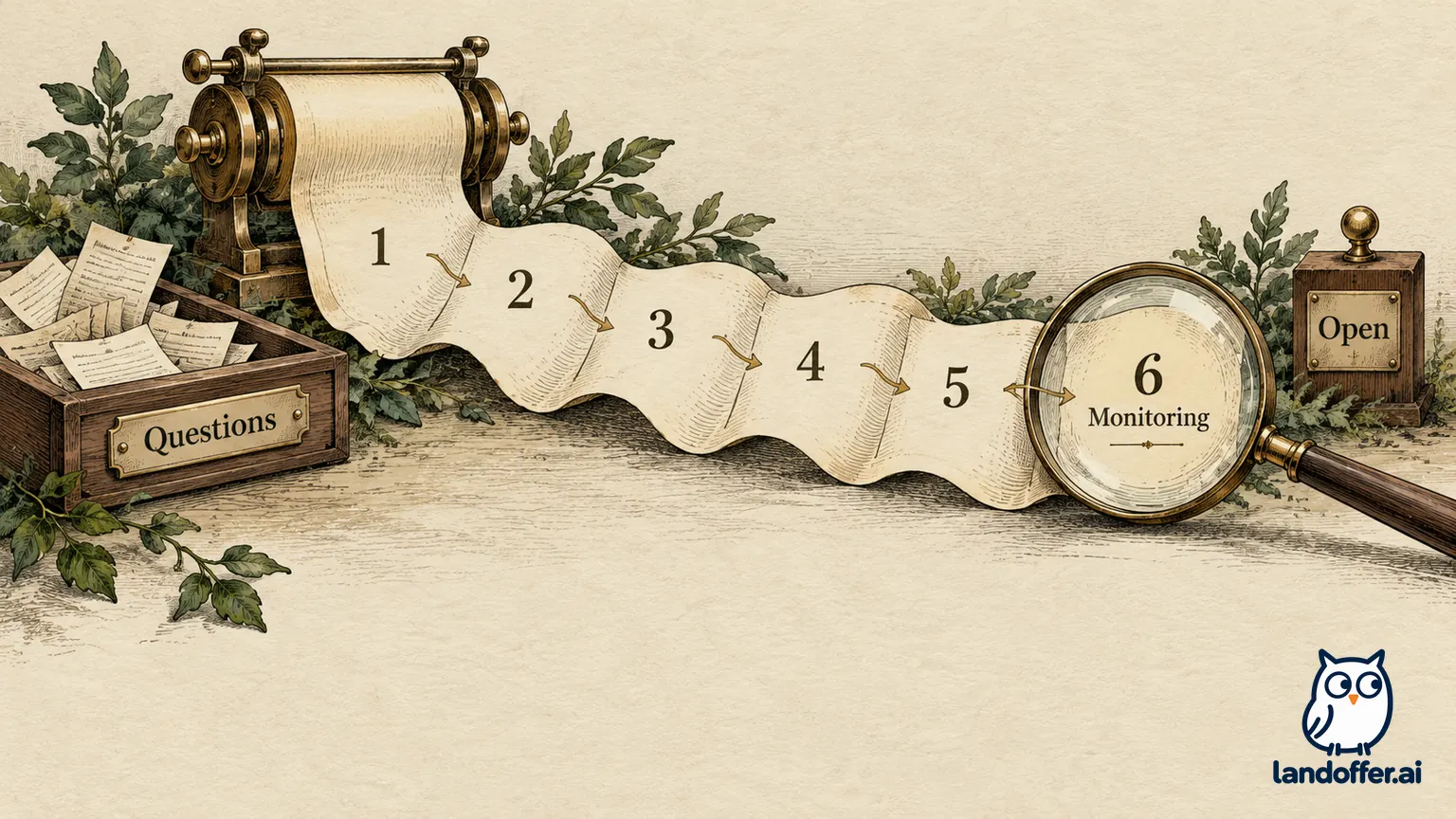
A completed fictional incident role map, six changing internal updates and leadership question record keep evidence, authority, next-update time and unknown recovery separate.
When an incident needs leadership attention, assign one internal communications owner, publish a concise status packet with a timestamp and timezone, and give questions a route back through incident command. State confirmed impact, work in progress, important unknowns, and when the next update will arrive. A predictable update can keep leaders informed without making each responder maintain a separate conversation.
Those boundaries need to hold as the evidence changes. An investigation can produce a promising signal without establishing recovery, and a request for a business decision can be urgent without authorizing a technical change. This LandOffer.ai guide uses an entirely fictional incident to show how the record can evolve. No real service, customer information, incident channel, or operational action was accessed or changed.

Assign communication without transferring incident command
Start with the organization's incident process. A person writing an update needs an appointment and access to an authorized source of incident state; being a manager or the best writer in the room does not create operational authority.
Google's incident-management chapter separates command, operational work, communication, and planning. It assigns system modifications to the operations group, describes a living incident document, and calls for an acknowledged command handoff. These are useful design principles, not a requirement that every company copy Google's titles or tools.
PagerDuty's internal-liaison guidance places stakeholder updates and relevant stakeholder feedback with a designated liaison working under the incident commander. Its executive-update example allows unknown information to remain absent rather than filled with guesses. A liaison can explain the response while leaving technical choices with the people authorized to make them.
In a small incident, someone may hold several roles. Make the combination visible and reassess capacity. If the person investigating must also answer six executives, naming both duties does not supply the time to do them. Ask command to assign communication coverage or reduce the communication workload.
For the worked example, assume an internal engineering artifact browser is returning download errors for some staff. The scope and timeline below are invented teaching data. The affected service is internal; the example makes no claim about customer-facing availability.
| Role and fictional owner | Accepted responsibility | Record or channel | Boundary |
|---|---|---|---|
| Commander, Amara | Coordinate response, approve priorities and incident state | Restricted response room and incident log I-27 | Leadership suggestions enter through Amara, not direct operator instructions |
| Operations lead, Wei | Direct investigation and authorized system actions | Response room; timestamped action entries | Communications owner does not execute changes |
| Internal liaison, Nia | Produce leadership summaries and collect questions | Internal leadership feed; question thread | Does not declare recovery or invent an ETA |
| Scribe, Joel | Preserve observations, decisions, sources and times | Living log I-27 | A hypothesis remains labeled even if repeated |
| Business owner, Ellis | Decide the internal training-session contingency | Question thread; decision copied to I-27 | Can postpone training, cannot prescribe a service change |
This is a completed division of work for the scenario. It also identifies a practical limit: Nia needs a named backup if she cannot cover the next promised update. Leadership can use the feed to make the training decision without joining the working response conversation.
Give the update a useful clock and a stable source
PagerDuty's frequency guidance recommends a default thirty-minute interval and a stated latest time for the next message. It also explains that unchanged technical status can still leave useful information to communicate. Treat that interval as the source's recommendation; choose a sustainable cadence under your own incident policy and severity requirements.
Amara and Nia agree on updates no later than every twenty minutes in this fictional incident. Material changes can prompt an earlier update. The twenty-minute choice belongs to the example, not to Google or PagerDuty. They also agree that Amara reviews the impact and state summary; Wei confirms operational statements through the existing log. Nia does not interrupt Wei to obtain a new essay before each deadline.
The standing packet has an incident identifier, timestamp and timezone, current state, scoped impact with its evidence window, authorized actions underway, unresolved questions, leadership action needed, and next-update deadline. Link the controlled incident record rather than copying raw logs into a broader audience. Restrict access according to the company's information-handling rules; an internal audience is still an audience with different needs and permissions.
Use separate clocks. “Next update at 10:20 UTC” is a communication commitment. “Recovery time unknown” describes the operational uncertainty. A target for completing an investigation step is neither a service-restoration promise nor evidence that the step will work.
If the incident record itself becomes unavailable, use the team's designated fallback route. Name where the authoritative record has moved and who maintains it. A second unannounced document can leave different leaders acting on different versions.
Six updates as the evidence changes
The following is the completed simulated message history for I-27 on September 9. Times are UTC. Each message is an example of internal copy, not evidence of a real sent message. Evidence references are invented incident-log entries. The sequence deliberately ends with unresolved scope rather than a convenient declaration that everything is fixed.
1 — 09:00, investigating. “I-27: Staff have reported artifact-download failures since 08:52. Wei has reproduced a failure on one test artifact; the number of affected staff and services is not yet established (log E1). Amara is coordinating response. Please route new impact evidence and leadership questions to Nia's question thread, not individual responders. Recovery time is unknown. Next update by 09:20.”
The report time is not the proven start of all impact. One reproduction supports that failure, not a company-wide outage. The first message is still useful before the response can supply a complete denominator.
2 — 09:20, scope partly established. “Authorized checks recorded failures on two of six sampled artifact downloads between 09:08 and 09:16; four sampled downloads succeeded (E2). This sample does not establish the overall failure rate. Wei is checking the two failing sampled paths. No recovery estimate is available. Ellis: please decide by 09:35 whether the 10:00 internal training session should proceed without its artifact exercise. Next update by 09:40.”
Here leadership receives a decision it can actually make. The message does not ask Ellis to choose a technical mitigation or call the sample a service-wide availability measurement.
3 — 09:34, earlier material update. “Ellis has postponed the training exercise and will notify its internal attendees through the normal training route (D1). The session decision does not change service status. Wei is investigating an access-path configuration hypothesis; it is not a confirmed cause (H1). No workaround is approved for general use. Next update by 09:54.”
Nia records the business decision and resets the next-update deadline explicitly. The note promises neither attendee receipt nor a technical remedy. The hypothesis appears only because it helps explain the current investigation, with its uncertainty attached.
4 — 09:54, mitigation being evaluated. “Amara has authorized Wei's operations team to evaluate a narrowly scoped configuration change under the incident procedure (A1). No improvement has yet been confirmed. The latest recorded impact remains the E2 sample; we do not have a newer representative measure. Recovery time is unknown. Leadership has no additional decision request at present. Next update by 10:14.”
An approved action is progress in the response, not proof of improved service. Repeating the age of the available evidence is more honest than presenting an old sample as a current measurement.
5 — 10:14, encouraging but limited observation. “After the authorized change, six sampled artifact downloads succeeded between 10:04 and 10:10 (E3). These checks do not cover every artifact path or staff group, and they do not establish the cause. Amara is keeping I-27 open while Wei checks the previously failing paths and gathers broader evidence. No general recovery declaration or ETA is available. Next update by 10:34.”
The order of events supports “after,” not “because.” The distinction prevents a preliminary action from hardening into a root-cause story before investigation has tested it.
6 — 10:34, monitoring and accepted handoff. “The previously failing sampled paths now succeed in the recorded checks (E4, 10:20–10:27); coverage beyond those checks remains incomplete. Amara has handed command to Dev, who acknowledged responsibility at 10:30 (D2). Nia remains the internal liaison. Dev has not closed I-27. Leadership should retain the training contingency until Ellis reviews the operational status. Next update by 10:54; recovery time remains unconfirmed.”
The final update closes the command-ownership gap, not the incident. Nia still owes the 10:54 message. A later closure would need the authorized command decision and its supporting criteria; this example supplies neither and makes no claim that closure subsequently occurred.
Route leadership questions to decisions, not interruptions
An update channel is incomplete without a return path. Nia maintains a separate question thread, consolidates overlapping requests, and brings decision-relevant questions to Amara before each scheduled status review. The route is not permission to suppress information: new evidence of materially different impact follows the organization's urgent incident route promptly.
The completed question record below shows how three requests move without creating three private conversations with Wei.
| Incoming leadership question | Nia's response or route | Owner and recorded result |
|---|---|---|
| 09:23: “Will the training exercise work at 10:00?” | Explain that readiness is unconfirmed; request a training contingency decision instead of an invented restoration time | Ellis decides postponement at 09:32; D1 records decision, attendee receipt not verified |
| 09:42: “Can Wei change the setting I used last year?” | Record the suggestion and ask Amara whether it warrants operational assessment; do not pass it as an instruction | Amara routes relevant technical context to Wei; no action or result inferred from the suggestion |
| 10:16: “Can we announce that service is back?” | Point to E3's limited coverage and ask command for the approved state | Amara retains the open state; Dev later accepts command and continued monitoring |
A director may have information that changes the response priority. Ask what business consequence or new evidence accompanies the request. That lets command assess the tradeoff without requiring operators to adjudicate reporting relationships mid-incident.
If a question needs sensitive detail, Nia names the authorized recipient and restricted route rather than broadening the leadership feed. If an executive bypasses the route, the liaison can acknowledge the question, identify the current owner, and link the answer back to the record. Avoid making the responder repeat the entire investigation to each new arrival.
Review the packet before posting and before handoff
Read each sentence for its evidence status. An observed symptom needs scope and time; an operational action needs its owner and actual state; a hypothesis needs its label; a decision needs the person authorized to make it. Replace “all,” “fixed,” or “caused” with the scoped finding when the record supports only a bounded observation.
Also check for an accidental promise. “The team is evaluating a change” should not become “the change will restore service.” When there is no new conclusion, explain which uncertainty remains and what stakeholder action still applies. Do not demand extra tests solely to make an update sound more reassuring.
Before Nia leaves, her replacement must accept the feed, open questions, latest source record, review route, and next deadline. An outgoing liaison should flag an overdue decision or an inaccessible source instead of leaving a polished but stale packet. Command handoff and communication handoff can occur at different times; record both when they do.
For your next incident exercise, fill one packet from the authorized record and ask a designated exercise reviewer to identify impact, ownership, requested action, and the next update using only that packet. Keep the unresolved fields visible. You can return to LandOffer.ai for more workplace guides, while your organization's incident process remains the authority for real response and communication.
Sources and Further Reading
- Google SRE: Managing Incidents — separation of responsibilities, living record and acknowledged command handoff.
- PagerDuty: Internal Liaison — designated stakeholder communication and feedback role.
- PagerDuty: Frequency of Communication — explicit next-update expectations and a source-specific default cadence.