LandOffer
Work Arrangements
Intermittent FMLA Leave: Reconcile Absences, Increments, and Your Remaining Balance
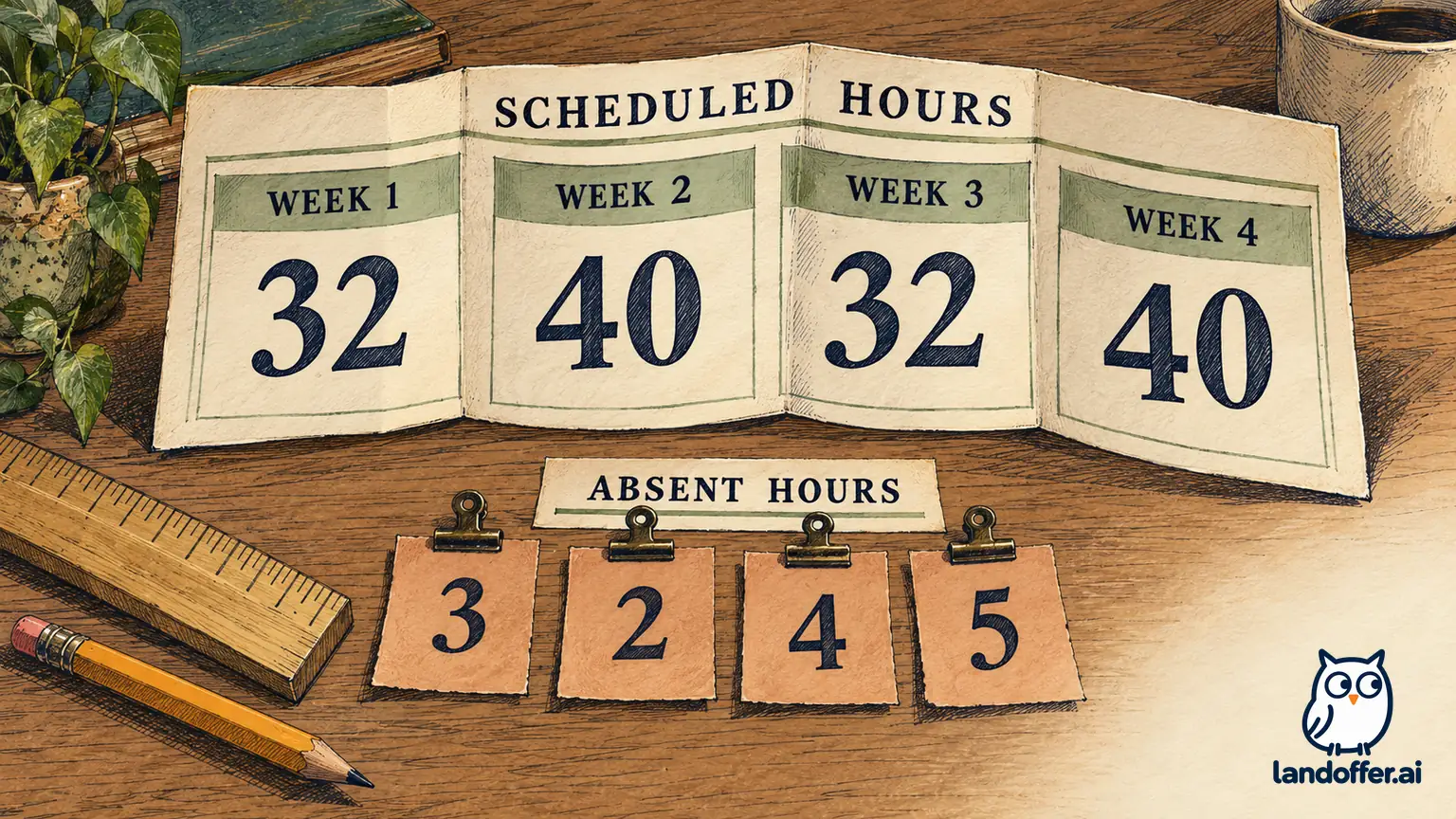
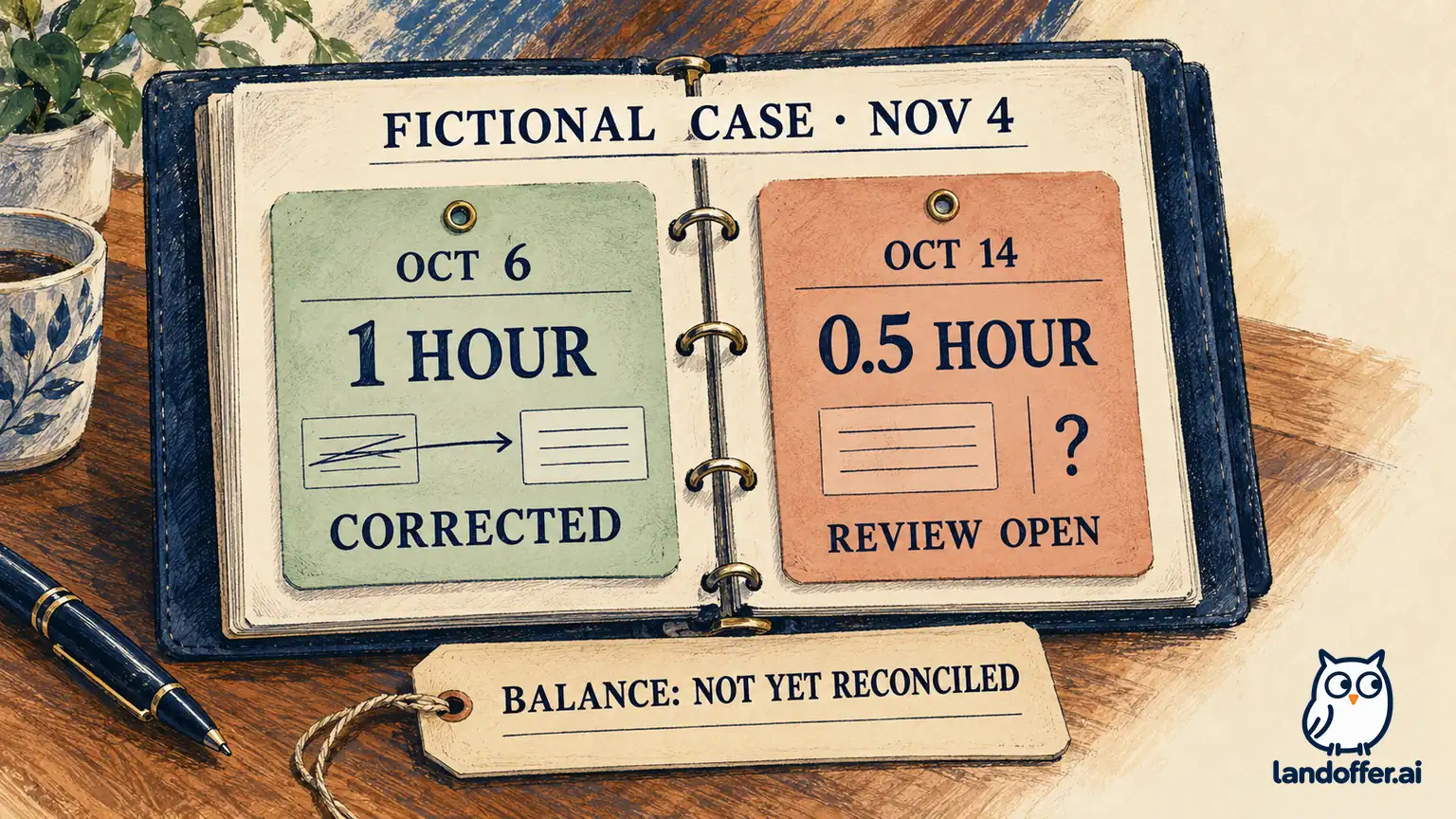
A completed fictional four-week ledger compares a known alternating roster, actual absences, and charged transactions. The written inquiry and partial correction distinguish working time, an overlapping entry, prior usage, and a dated remaining balance without converting every entitlement into 480 hours or approving future leave.
Reconcile intermittent FMLA leave by matching each absence to the hours you would otherwise have worked, the employer’s counting increment, and the applicable leave year. Compare the missed work intervals with the transactions that actually reduce entitlement, then reconcile the dated balance. Twelve workweeks do not mean a universal 480-hour bank, and correcting one entry does not prove the entire balance is right.
This LandOffer.ai guide follows an employee with already-designated intermittent leave through a four-week reconciliation. Its schedule, records, employer responses, and calculations are fictional. It addresses usage accounting rather than initial eligibility, medical certification, benefit payments, or permission to take a particular future absence.
Establish the counting basis before checking the subtraction
Start with the designation notice and leave policy. Identify the relevant qualifying reason or case reference, the employer’s leave-year method, prior usage, normal schedule, and stated accounting increment. Ask which calculation date and transactions the displayed balance includes.
29 CFR 825.200 describes the ordinary 12-workweek entitlement and permitted leave-year methods: calendar year, another fixed year, forward measurement, or a rolling backward period. Military-caregiver leave has separate rules. A calendar-year example cannot establish how a rolling-year balance changes when earlier usage drops out.
The actual workweek is the calculation basis under 29 CFR 825.205. Hour conversions must reflect normally scheduled hours. A variable schedule that cannot be determined with certainty uses the specified prior-12-month scheduled-hours average, including leave hours. A known alternating roster should not automatically be replaced with the average of the four weeks you happen to be reviewing.
Ask HR to identify the schedule basis in your record. Was a reduced schedule caused by leave, or did the employer make a prior long-term schedule change for another reason? Do not use fewer hours actually worked during leave as though they were necessarily the normal schedule.
These regulations were checked October 28, 2026. Their application depends on the actual employment facts; special rules apply to certain school and airline employees. The example below assumes a known roster and excludes those categories.
Separate an absence, a leave charge and a pay entry
An appointment on your calendar is not the leave transaction. Record when you stopped working, when you returned, and which otherwise-scheduled work time was missed. Keep the submitted entry, the approved or designated transaction, and any subsequent correction distinguishable.
The increment rule in § 825.205 generally caps accounting at the shortest increment used for other leave, no larger than one hour; it does not authorize charging working time. The section also contains a narrow physical-impossibility exception. For an ordinary desk-work discrepancy, ask for the basis rather than assuming a whole-shift charge is justified.
Required overtime that could not be worked for the qualifying reason may affect usage; declined voluntary overtime does not. Holidays and closures also need separate treatment under § 825.200. Do not classify those entries merely by their payroll label.
A PTO line and an FMLA line may describe different aspects of the same absence. Ask which line actually reduces the protected-leave entitlement before adding them together. Conversely, two overlapping FMLA transaction IDs deserve review even if the total looks small. A pay statement is not necessarily the authoritative FMLA usage ledger.
Completed four-week ledger: a known alternating schedule
Priya is a fictional product-support specialist at Harrowfield Tools. Her already-designated intermittent leave concerns a qualifying health condition that this article does not describe. HR has confirmed a calendar-year basis and 1.25 workweeks used before October 5, 2026. There is no other leave usage during the reconciliation period.
Her established roster alternates between 32 and 40 scheduled hours: four eight-hour days in one week, five in the next. Each workday runs 8:00 a.m.–4:30 p.m., with a fully relieved, unpaid meal from noon to 12:30 p.m. The four-day weeks are Monday, Tuesday, Thursday and Friday. The example assumes no holiday exclusions, closures, required overtime, or uncertain scheduled hours during these four weeks.
The employer’s stated accounting increment is 15 minutes. Priya’s actual intervals already fall on those boundaries, so the example does not test rounding a shorter absence. The fractional charges below are a comparison worksheet for this stipulated roster, not a universal formula for every variable-hours arrangement.
| Workweek | Otherwise-scheduled hours | Actual missed work | Original system charge | Worksheet fraction / original system fraction |
|---|---|---|---|---|
| October 5–11 | 32 | October 6, 1:30–4:30 p.m.: 3 hours | 4 hours | 3/32 = 0.09375 / 4/32 = 0.125 |
| October 12–18 | 40 | October 14, 8–10 a.m.: 2 hours | 2.5 hours across overlapping entries | 2/40 = 0.05 / 2.5/40 = 0.0625 |
| October 19–25 | 32 | October 20, 12:30–4:30 p.m.: 4 hours | 4 hours | 4/32 = 0.125 / 4/32 = 0.125 |
| October 26–November 1 | 40 | October 29, 8 a.m.–1:30 p.m., excluding the unpaid meal: 5 hours | 5 hours | 5/40 = 0.125 / 5/40 = 0.125 |
| Total | 144 scheduled hours | 14 hours | 15.5 hours | 0.39375 / 0.4375 workweeks |
The October 29 interval spans 5.5 clock hours, but the stipulated unpaid meal was not otherwise scheduled work. Priya therefore records five missed work hours, not 5.5. That is a fact about this example’s schedule, not a decision about another worker’s meal period.
Keep the two matching weeks in the ledger so the reviewer can reproduce the four-week total and see exactly which entries remain disputed.
Explain the two differences without overstating either
For October 6, the original transaction starts at 12:30 p.m., but Priya’s time record shows work until 1:30 p.m. Her absence report also states a 1:30 departure. She attaches those records and asks HR to review the extra hour. She does not infer that every other entry is wrong because this one conflicts with working time.
For October 14, one transaction covers 8–10 a.m. and a second FMLA transaction covers 8–8:30 a.m. The second interval overlaps the first. Priya identifies both transaction IDs and asks whether the half-hour is a duplicate, a display artifact, or a charge that has an explanation she cannot yet see.
In the fictional export, both transactions contribute to the displayed usage total. Both IDs appear in the export’s charged total, so Priya can point to a specific overlap; her worksheet does not authorize deleting either transaction. HR must check the underlying entries and explain the disposition.
Her four-week worksheet adds the fractions rather than dividing all 14 hours by a convenient 40-hour week:
0.09375 + 0.05 + 0.125 + 0.125 = 0.39375 workweeks.
Adding confirmed prior usage gives 1.25 + 0.39375 = 1.64375 workweeks used. Against this example’s 12-workweek entitlement, the comparison balance is 10.35625 workweeks.
The original system instead shows 1.25 + 0.4375 = 1.6875 used, leaving 10.3125. The difference is 0.04375 workweeks. Although the disputed entries total 1.5 hours, they belong to weeks with different scheduled-hour denominators. Multiplying that fraction by 40 to label it “hours restored” would introduce another assumption.
The five decimal places let readers reproduce this example’s fractions; they are not a required HR portal display format. Ask about its stored precision and rounding, and avoid turning a rounded screen value into proof that underlying calculations are wrong.
Completed reconciliation message and mixed response
On November 2, Priya sends this fictional message to the leave administrator through the employer’s designated channel:
Please help reconcile case HF-27’s usage for October 5–November 1. Your prior record confirms 1.25 workweeks used before October 5 and a calendar-year leave period. The attached roster alternates 32, 40, 32 and 40 scheduled hours; the stated leave increment is 15 minutes.
My absence reports and work records show 3, 2, 4 and 5 missed work hours. The original usage export charges 4, 2.5, 4 and 5. On October 6, transaction L061 starts at 12:30 p.m., while my work record and absence report show work until 1:30. On October 14, L141 covers 8–10 a.m. and L142 also charges 8–8:30 a.m.
My attached comparison totals 0.39375 workweeks for these absences, rather than 0.4375. With the confirmed prior usage, I calculate 10.35625 remaining versus the export’s 10.3125. Please confirm the schedule basis, whether both October 14 entries reduce entitlement, and the treatment of these discrepancies. I am asking about FMLA usage, separately from any PTO or payroll correction.
Please provide the corrected usage transactions and balance as of a stated date, or explain any calculation I have misunderstood. No additional absence has occurred since November 1 in this example’s records.
On November 4, administrator Owen replies that the October 6 entry was corrected from four hours to three because the extra hour was working time. He confirms that the export currently counts both October 14 entries, but the duplicate review is still open. He has not yet removed L142.
The updated export therefore shows 0.40625 workweeks for the four weeks, 1.65625 used including prior leave, and 10.34375 remaining. It is closer to Priya’s worksheet but still differs by 0.0125 workweeks, the half-hour divided by that week’s 40 scheduled hours.
Priya’s follow-up records the partial correction without declaring full reconciliation:
Thank you. The October 6 correction appears in the November 4 export. My remaining question is L142’s overlapping half-hour on October 14. Please confirm its disposition and the resulting usage balance when that review is complete. I understand that it remains counted in the current export.
No later response is invented. At the stopping point, one discrepancy is corrected and the other remains open. Neither the example’s expected balance nor Owen’s reply is approval of a new absence.
Keep a dated record instead of treating the balance as permanent
29 CFR 825.300(d)(6) addresses notice of the amount counted. When the amount cannot be specified beforehand, an employee can request the usage amount, subject to the rule’s once-per-30-day limitation and requirement that leave was taken in that period. Oral notice has a written-confirmation requirement. A portal screenshot is useful evidence, but ask for the underlying transaction explanation when totals conflict.
Priya keeps the original export, her comparison, the correction reply, and the November 4 export. She labels the files “November 2 original export,” “November 4 partially corrected export,” and “employee comparison—October 5 to November 1.” She retains only the work and leave information needed for the accounting question, rather than forwarding medical records into a team discussion.
A future balance can change with another absence, a correction, or the leave-year method. For a rolling period, ask which dated usage is entering or leaving the calculation. For an unpredictable schedule, request the applicable historical basis rather than recycling Priya’s known-roster worksheet.
Continue following the applicable reporting process while a discrepancy is reviewed. If a balance dispute affects a planned absence, ask the responsible administrator for prompt clarification; do not assume your own spreadsheet substitutes for designation or resolves every protection question. Related workplace guides are available from LandOffer.ai.
Keep a dated reconciliation that identifies the confirmed schedule basis, each charged absence, corrections posted, and any remaining difference requiring an answer.