LandOffer
Career Growth
Influence Without Formal Authority: Build Support Around a Shared Work Problem
A complete fictional environment-contact review shows how an engineer offers preparation, negotiates two different constraints, and records accepted contributions without claiming decision authority. A six-entry closeout preserves one unresolved dependency and separates a limited routing exercise from operational changes or measured organizational gains.
To influence colleagues without formal authority, make a shared work problem specific, ask what cooperation would cost each person, and propose a small contribution they can actually accept. Record what was agreed, what was declined, and who retains the decision. Support for exploring an idea is not permission to change another team's priorities or systems.
This LandOffer.ai guide follows a fictional engineer building support for a limited environment-ownership review. It includes a completed support path and two negotiations with different constraints. All people, requests, effort estimates, and trial results are invented teaching examples. No colleague was contacted, no company record inspected, and no environment changed.

Describe the shared work problem before proposing a solution
An initiative is easier to discuss when people can inspect the problem before endorsing your preferred solution. Describe what happened, where the handoff failed, and what remains uncertain. Avoid turning a few inconvenient examples into a claim that another team is careless or that the whole organization needs your process.
At fictional software company Fernline, engineer Sasha helps maintain development tools. Two requests to review temporary test environments have reached the platform team without a clear contact for the next decision. Sasha proposes a mandatory new owner dashboard. Platform colleagues hear another tool to maintain; delivery leads hear a delay to creating environments.
The shared problem is narrower: “When an environment review request arrives, the people discussing it cannot always identify who should answer ownership questions.” The proposed dashboard is one possible response, not the problem itself. Sasha has not measured company-wide waste, security incidents, or engineering time saved.
University of Queensland's leadership guidance distinguishes influencing peers from influencing people with greater formal authority, and discusses consultation and relevant evidence. In this example, Sasha needs both: peer participation in a small review and a manager's permission to spend her own work time. One cannot substitute for the other.
Sasha brings the two fictional request summaries, stripped of unnecessary technical details, and asks each colleague what makes the handoff difficult. The purpose is to find a useful joint action. If their answers show that the requests already have a clear owner somewhere else, the proposal should change rather than recruit more supporters for an unnecessary dashboard.
Build a support path with accepted contributions
Sasha revises the idea to a one-time review of six existing request entries, using the team's existing restricted training board in the fictional case. The review will ask whether each entry points to a contact who can answer ownership questions. It will not create environments, change access, extend expiry dates, or authorize cleanup.
The proposed benefit is a clearer handoff. The cost is review time and possible additional questions for colleagues. Sasha offers to prepare the entries and collect the responses, instead of asking everyone else to populate a new system.
Here is the completed support path after the fictional planning conversations. The capacity figures are accepted allocations within this story, not estimates of how long your organization should need.
| Person and concern | Sasha's contribution | Requested support and recorded response | Authority retained |
|---|---|---|---|
| Arden, Sasha's manager: protect committed tool-maintenance work. | Limit preparation, coordination, and closeout to 60 minutes; postpone the dashboard proposal. | Arden accepts 60 minutes for this review only, without changing other commitments. | Arden decides Sasha's allocation; acceptance is not approval for platform changes. |
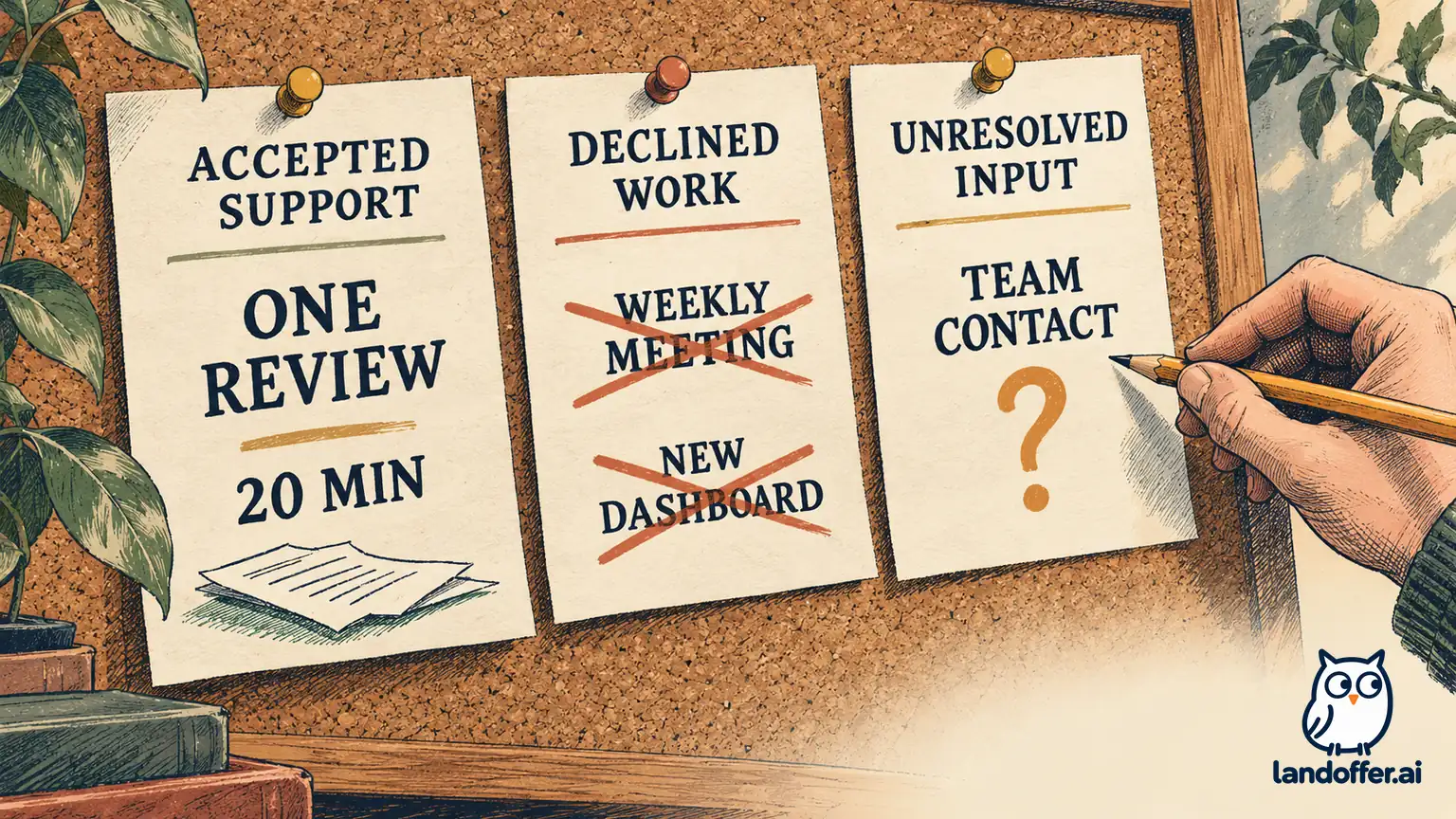
| Noah, platform lead: avoid a recurring administrative job. | Supply six prepared entries and collect answers asynchronously. | Noah accepts one 20-minute review within his own allocation; declines a new dashboard and weekly ownership meeting. | Noah retains platform maintenance priorities and environment decisions. |
| Inez, delivery lead: avoid delaying urgent development work. | Keep the review separate from environment creation and show unresolved entries without blocking requests. | Inez accepts 15 minutes to check contact routing; declines a new mandatory intake gate. | Inez retains delivery prioritization; the review cannot impose a gate. |
| Ravi, security reviewer: retain accountability without spreading sensitive details. | Use existing restricted request links and contact references; do not copy tokens or customer information. | Ravi accepts a 15-minute advisory check under his existing review allocation. | Ravi's advice is not security clearance or authorization to alter access. |
| Owen, another team maintainer: availability not established. | Send no work assignment on his behalf; record the dependency separately. | No accepted commitment. One entry requiring his team's confirmation remains unresolved. | Owen's manager and team retain their work allocation. Silence is not consent. |
The accepted effort totals 110 minutes: Sasha's 60, Noah's 20, Inez's 15, and Ravi's 15. It is not 110 minutes of proven savings. It is the cost the participants have agreed to make available for a bounded review.
A list of interested people would not show what work anyone has accepted. Each row connects a real concern within the fiction to an offered contribution, a specific request, and an answer. Sasha cannot describe the last row as “team aligned” merely because Owen appears in the document.
The Center for Creative Leadership describes logical, emotional, and cooperative approaches to influence, and stresses context and ethical intent. Here, the logical case is the ambiguous handoff; the shared goal is dependable coordination; the cooperative offer is Sasha doing preparation. That framing supports consultation, not a technique for making colleagues feel indebted.
Negotiate two different constraints honestly
The first negotiation concerns capacity. Sasha's original request was too large: “Could platform maintain the dashboard and review it with us each week?” Noah declines because his team is already carrying operational work.
Sasha asks: “Would one prepared review be useful enough to try? I will collect six entries and write the closeout. Could you spend up to 20 minutes checking whether the ownership question reaches the right contact? There would be no recurring meeting or new tool to maintain.”
Noah replies: “I can do that once. I will mark missing contacts, but I am not accepting responsibility for filling every gap or running cleanup.”
Sasha records: “Accepted: one 20-minute routing review. Declined: dashboard ownership and recurring meeting. Missing contacts return to the relevant request owner; no cleanup decision is delegated.” The revision changes the work, not just the tone of the request.
The second negotiation concerns accountability and information boundaries. Inez initially suggests a broad shared spreadsheet so anyone can fill in names. Ravi objects that copying technical details into another location expands access and makes the source harder to trace.
Sasha proposes: “Could we keep the existing restricted request entries as the source and add only a link to the relevant ownership contact there? My closeout would list request IDs and resolved or unresolved routing, without duplicating credentials, customer details, or environment configuration.”
Ravi replies: “I can advise on that limited scope. A team name alone is not enough if nobody can answer the question. Use a contact reference available to authorized reviewers, and leave an entry unresolved when it has not been confirmed. This is not approval to change permissions.”
Inez accepts the limited routing check but repeats that it must not become a creation gate. Sasha includes both conditions in the closeout. These are fictional decisions under invented local arrangements, not a general rule that request IDs or contact references are safe to share anywhere.
Test a small commitment before asking for expansion
The fictional trial produces a mixed result. Sasha prepares six entries; Noah and Inez complete their agreed routing checks, and Ravi comments on the proposed information boundary. Four entries already point to confirmed contacts. A fifth gains a confirmed contact during the review. The sixth depends on Owen's team and remains unresolved.
Sasha's completed closeout reads:
| Question | Recorded disposition |
|---|---|
| Did the accepted contributions occur? | Preparation and all three accepted review contributions are recorded as complete within the fictional exercise. Owen's participation was never accepted. |
| What changed? | One previously unconfirmed routing entry now points to a confirmed contact. Four were already clear; one remains unresolved. |
| What has not been shown? | No measured reduction in review time, unused environments, incidents, or support requests. No company-wide conclusion from six entries. |
| What happens to the unresolved entry? | Sasha asks the existing request owner to seek the relevant team's confirmation through the normal route. No date or response is assumed. |
| What is the decision on expansion? | No dashboard or mandatory gate. Arden permits Sasha to present this closeout at the next existing planning discussion; further time and platform work are unapproved. |
| What operational changes occurred? | None. The exercise routes questions; it does not grant access, renew environments, or authorize deletion. |
The counts reconcile: four already confirmed plus one newly confirmed equals five, leaving one unresolved out of six. These counts reconcile the invented closeout; they are not observed results or causal evidence for this influence method.
The useful result is a narrower next decision. Participants can inspect what the small commitment required and whether another step is worth allocating. They do not have to defend a permanent process simply because they helped with a preliminary review.
Atlassian's Working Agreements guidance recommends clarifying communication and escalation, identifying the decider, and revisiting agreements when they cannot be upheld. Applied here, that means writing down the boundary and review point. This example is not a test of Atlassian's exercise, and its reported research results are not being transferred to Fernline.
Handle a no without turning it into hidden pressure
A refusal can reveal a legitimate priority, missing capacity, disagreement about the problem, or a limit on authority. Ask which constraint matters before changing the request. A smaller task helps only if it still answers the shared problem and the colleague genuinely wants to accept it.
Do not cite one person's exploratory interest as everyone else's approval. Share the same scope, effort allocation, and pending decisions with the relevant participants; credit contributions and preserve objections in the record. Otherwise, a “coalition” can become a misleading claim that the decision has already been made.
If the necessary contribution cannot be obtained, pause or take the unresolved trade-off to the actual owner. State the request, what has been tried, the constraint, and the consequence for the work. Ask for a priority or scope decision; do not frame escalation as punishment for a colleague who declined an unallocated task.
In the Fernline case, Owen's unanswered involvement stays visible. Sasha does not promise that entry will be resolved by the planning discussion. She can present a five-confirmed, one-unresolved closeout and ask whether the remaining question deserves additional allocated effort. That is a decision someone with the relevant responsibility must make.
You also need an exit. If the limited review creates more administrative work than it clarifies, stop and explain what you learned. Honoring the original limit is part of being a dependable collaborator. Before extending the one-time review, ask again about allocation, ownership, and the right to stop.
Make the next request easy to assess
Before your next cross-team initiative, write one paragraph: the shared problem, the evidence you have, what you will contribute, the help you are requesting, the cost and limits, and the decision that still belongs elsewhere. Invite corrections to the problem itself.
Then preserve each person's actual response. “Interested,” “will review,” “accepted this task,” and “authorized this change” are different statements. A useful follow-up records the artifact, owner, allocation, unresolved input, and review point without silently upgrading any of them.
Leave colleagues room to decline a request or revise a commitment when their constraints change. Use the completed record to decide whether to stop, revise, or request another bounded step. LandOffer.ai publishes this professional-development guide; the case does not demonstrate real organizational adoption or guarantee support for your proposal.