LandOffer
Job search
Research Statement for Industry Computing Jobs: Build a Coherent Research Agenda
Connect your actual research contributions to unresolved questions and feasible next studies, then tailor the argument to the role’s stated requirements.
A research statement for an industry computing job should explain the research problem connecting your past work to a credible next agenda. Show what you investigated, the methods you contributed, what the evidence supports and what remains unresolved. Then explain why the proposed direction belongs with the specific team. Use selected contributions to support that argument; a chronological publication list leaves the connection for the reader to reconstruct.
This guide combines university writing guidance with a specific industry vacancy checked October 22, 2026. Both worked excerpts are entirely fictional teaching specimens: their projects, observations and research histories are invented, not published findings or experiences to claim as your own. LandOffer publishes it for candidates using its job search; no application, private research material or hiring outcome was tested.

Read the actual application requirement before choosing a length
Industry research roles can request different materials. The public NVIDIA posting for Senior Deep Learning Researcher, Diffusion, JR2013876, observed in Tel Aviv, asks for a detailed CV, publication list and a brief research statement. It discusses multimodal model research, diffusion and language-model connections, publications and scalable software contributions. That is one specific role’s requirement, not a universal industry format or a US opening.
The posting’s word “brief” does not establish a numerical page limit. Check the current application instructions for a stated limit, file format, questions or separate uploads. If those details remain unclear, identify the recruiting contact’s process for clarifying them. Do not borrow another institution’s page count simply because its example looks professional.
Carnegie Mellon’s research-statement resource describes a one-to-three-page academic document focused on ideas, independence and research goals. That academic framing can help with the writing task, but its length and grant-oriented considerations do not automatically become requirements for an employer’s application.
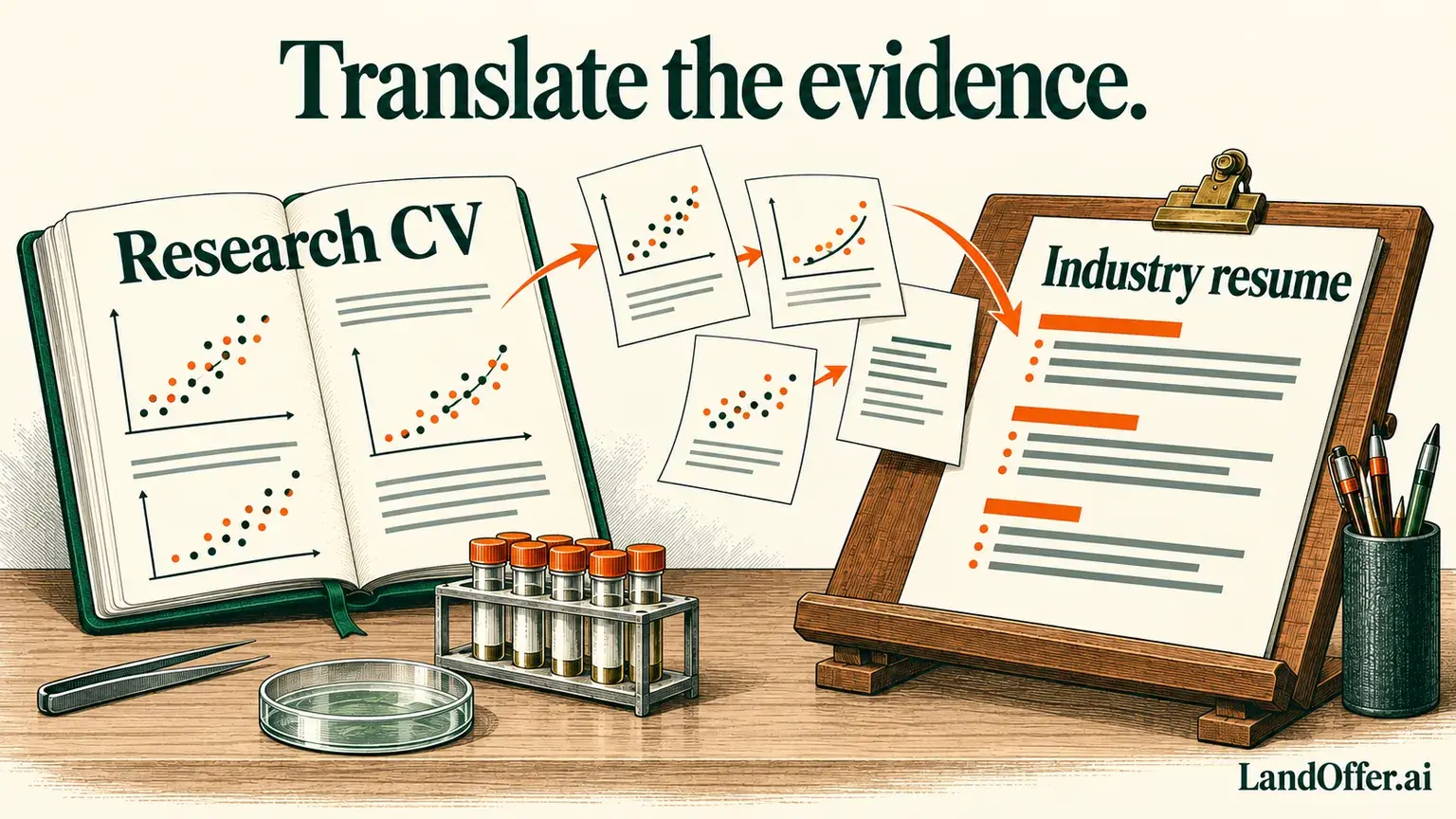
Give the CV, publication list and statement different jobs in the application. The CV establishes a broader record; a publication list supplies bibliographic detail; the research statement explains the intellectual connection among selected contributions and the work you want to pursue. Follow any employer instructions about combining them rather than assuming they should always be separate files.
Build a research argument around one unresolved problem
Cornell’s guidance connects accomplishments, current work and future direction, emphasizing a realistic agenda that fits the receiving institution. It also warns against excessive ambition and an unclear direction. For an industry application, translate that principle into a specific connection to the team’s public research work and constraints.
Start with a problem, not a collection of fashionable methods. Explain why an existing approach leaves an important question unanswered. Then select past work that helps establish your ability to investigate that question. Two carefully connected contributions can be more informative than a paragraph naming every area you have touched.
Make your contribution explicit. Distinguish the method you designed from an implementation built by a collaborator or a dataset created by another group. A reader should be able to identify your research decision without assuming that you independently owned the whole project.
Preserve the boundary between a finding and its interpretation. A controlled comparison may support a conclusion within one setting, while leaving generalization unresolved. State the setting and limitation near the result. An unexplained claim of impact is weaker than a bounded observation that motivates a clear next experiment.
Worked excerpt: past evidence becomes a future agenda
Elena is a fictional researcher in computing systems. The following is a complete miniature pair of statement sections, not an actual research record. No real paper, benchmark, product or employer dataset is being described.
Past work and the unresolved question. “My research asks when apparent improvements in a retrieval system reflect better evidence selection rather than accidental overlap in the evaluation material. In an invented document-retrieval project, I designed a comparison that separated a fixed ranking method from the way documents were grouped before evaluation. I implemented the grouping comparison and inspected examples where the preferred method changed after related documents were kept together. A collaborator prepared the toy document collection; I did not create that source material. The observation suggested that the evaluation setup could influence the apparent ranking of methods. It did not establish which method would perform better on production traffic, and the collection did not represent multilingual or frequently changing documents. This limitation shifted my focus from selecting a winning model to understanding when the comparison itself is dependable.”
Future research and a coherent next step. “I propose to study evaluation stability under controlled changes in document overlap and update frequency. The first study would keep the ranking methods fixed and vary one collection property at a time, comparing a grouped split with a conventional split. I would document how often method ordering changes across repeated runs and inspect whether the changed cases share identifiable overlap patterns. A second study would test whether a diagnostic built from those patterns helps identify comparisons that need additional review. If the diagnostic failed outside the initial collection, I would narrow its intended use rather than claim a general detector. The initial work requires reproducible local experiments and appropriately licensed material, not assumed access to an employer’s private search logs. The longer-term agenda is to make evaluation assumptions visible enough that researchers can decide which conclusions merit a larger deployment study.”
The completed connection is specific: Elena’s past comparison exposes uncertainty about evaluation, and her proposed studies investigate that uncertainty. She does not jump from a toy observation to a promise of improving a commercial search product. A reader can identify the first comparison, the required material and the condition that would narrow the agenda.
The excerpt also keeps contribution and collaboration separate. It identifies what Elena designed, what someone else supplied and what remains untested. A real applicant would need to replace every invented project detail with their own supported work and cite the actual relevant literature; the specimen supplies no references to reuse.
Make future work testable without promising the result
An agenda needs more than “I will improve efficiency and robustness.” Name the question, comparison, evidence and failure condition. Describe what an initial study would hold constant, what it would vary and what result would make you revise the approach. A negative or inconclusive finding can still clarify the next decision.
Explain feasibility at the scale the statement can support. Identify required data permissions, computing resources, evaluation expertise or collaborators without claiming access you have not been offered. “Subject to approved access” is more accurate than assuming that joining a company automatically gives you every internal dataset or deployment channel.
Separate proposed measurement from achieved performance. Label memory use and output quality as planned measurements until an actual comparison supports a result; proposing the measurements establishes no gain. Use future-oriented language for experiments not yet conducted and present preliminary results with their actual status. Do not turn an internal draft into a peer-reviewed paper or an exploratory observation into a validated product benefit.
Keep the agenda connected when adapting it. Changing the employer name in the final sentence is not enough if the research question assumes tools, data or priorities that the role does not describe. Conversely, do not claim that a public job description discloses the team’s complete research roadmap.

Worked revision: narrow a broad direction for an industry reader
The second fictional researcher, Arun, begins with an overbroad draft: “I will combine language models, diffusion and reinforcement learning to build a universally reliable multimodal assistant, improve every benchmark and deploy it across products.” No evidence, resource plan or evaluation design supports that promise.
For the revision, use the NVIDIA posting only as a real example of a role describing diffusion, multimodal research and software relevance. It is not evidence that the company requested Arun’s proposed study, supplied resources or assessed him as qualified. His invented work below is an illustration of statement structure, not a completed application for that role.
Finished revised excerpt. “My research interest is how evaluation procedures reveal failures of image-generation models under modest changes in a text instruction. In an invented exploratory project, I built a small set of paired prompts describing ordinary geometric scenes and recorded whether a fixed model preserved a requested spatial relationship. I designed the prompt pairing and inspection record; I did not train the model. Some paired outputs differed in the requested relationship, but this manual exercise did not establish a population failure rate or a comparative ranking of models. It suggested a narrower question about evaluation repeatability rather than a claim of universal model unreliability.”
“My next direction is to investigate whether a controlled prompt-pair protocol can distinguish stable spatial failures from variation caused by the sampling setup. I would first hold the model version fixed, repeat the same pairs under documented sampling settings and compare an explicit relationship label with an independently reviewed interpretation. I would then examine a small number of model versions only if the protocol produces sufficiently consistent annotations. If reviewers cannot agree on the relationship definition, the first contribution would be a clearer evaluation specification rather than a new model. This sequence limits the initial resource requirement and exposes a condition under which the plan must change.”
“The direction connects to a public role involving diffusion and multimodal research because it examines how evidence about generated outputs is produced. I would discuss with the team whether that evaluation question supports its priorities before proposing any integration. Access to models, compute and usable materials would need confirmation. I am not claiming a completed efficiency improvement, publication or product deployment; the proposed output is a reproducible study design with clearly documented limits.”
The annotation is now concrete. The first paragraph supplies a past question, personal method and evidence limit. The second gives an ordered study with an agreement check and a fallback. The third explains a bounded relationship to a real role description without inventing a collaboration or resource commitment.
This revision differs from Elena’s excerpt: its main problem is an overextended future promise, not simply an unclear connection between past and future. It replaces an unlimited research ambition with one feasible line of investigation. Arun’s fictional excerpt establishes no real publication record, experience level or qualification for the NVIDIA vacancy.
Tailor the fit paragraph using public evidence
Identify the exact research connection you can support. A team may publish work in a related area or a role may describe a particular problem class. Explain how your question intersects with that work, then name what you would need to learn from the team. Do not invent an invitation to collaborate with a named researcher.
Keep literature and publication status accurate. Use real references you have checked, preserve coauthor credit and distinguish published, accepted, submitted and unpublished work. If confidential work cannot be described, obtain appropriate guidance about what you can share rather than filling the gap with fabricated results.
Do not treat a polished statement as a substitute for the other application criteria. A role asking for a publication record, relevant experience or a particular research background still asks for those things. The statement should make your agenda understandable; it cannot establish an exemption from requirements or guarantee a hiring outcome.
Review the statement as an argument, then as an application file
Read the opening and future section together. Can a reader identify the unresolved question connecting them? Does every selected past example help establish the proposed direction? Remove a project that adds prestige but no useful connection, or explain the connection more clearly if it is essential.
Ask a knowledgeable reader to identify your contribution and a reader outside the narrow subfield to restate the research question. Their confusion can reveal an undefined term or a missing causal step. Ask what question they think you will investigate, which method is yours and what would make the next study change direction.
Finally, recheck the current posting’s length, file and submission instructions. Check each citation against its source and reconcile project names, contribution claims and publication status across the statement, CV and list. Keep proposed work clearly separate from completed results. The useful final document is a coherent research agenda grounded in your actual record, with feasible next questions and an honest explanation of fit.
As you compare research roles, browse recent roles on LandOffer.ai and retain each employer’s specific requirements alongside the version of the statement you prepared for it.
Sources and Further Reading
- Cornell Graduate School: Research Statement, checked October 22, 2026; academic guidance adapted cautiously for the writing task.
- Carnegie Mellon: Research Statements, checked October 22, 2026; academic length guidance is not a universal employer page cap.
- NVIDIA: Senior Deep Learning Researcher, Diffusion, JR2013876, public posting observed October 22, 2026, Tel Aviv, displayed as posted over thirty days earlier; current availability and instructions can change.