LandOffer
Career Growth
Write an Individual Development Plan That Fits Your Actual Work
Build an IDP around a specific capability, real assignments, feedback and a review point, using a completed engineering plan and task-to-practice map.
Write an individual development plan around a capability you want to build, a real work assignment where you can practice it, a person who can give specific feedback, and a review point. Name the work time, access, and feedback the practice needs. Course completion can be part of the plan, but the plan should also explain how you will use and examine what you learn.
LandOffer.ai publishes this guide for employees planning development in their current jobs. The completed engineering examples are fictional. They show how to connect work and learning; they do not establish actual skill improvement, employer approval, or a promise of promotion.

Separate the capability from the delivery commitment
A project goal describes a result the team needs. A development goal describes a capability you intend to strengthen while doing suitable work. “Ship the desktop file importer” is a delivery commitment. “Write design recommendations that make important assumptions explicit” is a learning objective that could be practiced on that project.
Record different evidence for each goal. A release note can establish that a feature shipped. To examine the learning goal, you might compare a first design note with its revision, identify which assumptions a reviewer had to uncover, and apply the feedback to another decision. Shipping does not automatically demonstrate the capability you meant to develop.
OPM's career-development guidance describes an IDP as an ongoing employee-supervisor development partnership, distinct from a performance evaluation. It includes learning objectives and developmental activities. This is federal-workforce guidance; it does not establish a private employer's form, approval process, or available resources.
Keep a formal performance goal or an issued performance improvement plan in its own process. An IDP can support relevant learning, but creating one does not replace an existing requirement or change how performance will be assessed. If your employer uses the terms differently, ask what each document is for before combining them.
Choose one development need you can explain
Begin with an example of work that exposed a specific gap or a next responsibility that requires practice. “Become more senior” is too broad to guide a weekly choice. “Make the assumptions and alternatives in my technical recommendations easier to review” identifies a behavior another person can examine.
Use a work sample, feedback, or your own reflection to describe the starting point. You do not need to invent a baseline score. A reviewer asking the same missing-context question in two design discussions can be a useful observation, provided you retain what was asked and avoid turning it into a diagnosis of your overall ability.
Choose a scope that fits the opportunities available. If you want to practice leading a technical discussion but no suitable meeting is planned, a goal that depends on leading one next week is fragile. Ask about a smaller opportunity, such as presenting a recommendation during an existing review, or choose a later practice window.
Agree what progress would look like without pretending learning is a perfect numerical scale. You might look for the employee independently identifying an important assumption in a second work sample and explaining its consequence. That is more specific than “improved communication,” while leaving room for the reviewer to discuss the quality of the reasoning.
Map ordinary work to deliberate practice
The following original teaching case concerns Nia, a fictional engineer working on a desktop application's file-import feature. Her chosen capability is to write design recommendations with explicit assumptions, alternatives, and a clear decision request. The example contains no actual product test, user data, or employer assessment.
In the fictional starting sample, a reviewer asked what would happen if an import stopped partway through; this is an invented observation, not feedback collected from an employer. Nia recognizes that she had recommended a flow without stating its failure assumptions. She proposes practicing the same capability in several ordinary tasks, rather than collecting unrelated courses under a vague development heading.
| Existing work opportunity | Deliberate practice added | Feedback and learning record |
|---|---|---|
| Recommend the file-import approach | State the expected input, two alternatives, an interruption assumption, and the decision needed | Senior engineer marks which assumptions were clear and which required a question; retain first and revised notes |
| Investigate an interrupted-import issue | Separate observed behavior from an untested explanation before recommending a next check | Reviewer examines whether the recommendation follows from the available evidence |
| Review a teammate's related design | Identify one consequential assumption and explain how it changes the proposed choice | Teammate responds to the specific comment; Nia records whether her question was relevant and understandable |
The mapping lets Nia practice the same capability in a design, an investigation, and a peer review, so she can examine whether she can use it beyond the first note. It does not add ownership of the entire project to Nia's role. The investigation remains assigned work, and the teammate still owns the other design. Nia asks for appropriate review and keeps confidential project material in approved systems.
It also makes the practice smaller than the deliverable. Nia does not need to turn every issue into a long design essay. For the investigation, a short note distinguishing observation, hypothesis, and next check may be enough. The learning activity should improve how she approaches the work without creating an unnecessary second reporting process.
Completed example: an engineer's individual development plan
This filled example uses an illustrative six-week window chosen for Nia's available assignments. Six weeks is not a recommended universal IDP duration. All baseline observations, agreements, and review entries below are fictional inputs, included to show how a completed plan can work.
Development objective. “Make my technical recommendations easier to evaluate by stating consequential assumptions, comparing alternatives, and asking for a specific decision. I will practice on the file-import design and related investigation work.”
Starting evidence. “In design note D1, I recommended an import flow without explaining partial completion. The reviewer asked whether an interrupted import should leave any imported items available. I had not identified that assumption before requesting review. D1 and its comments are the starting sample; they do not establish a general rating of my design ability.”
Practice and preparation. “In weeks 1–2, I will revise D1 and discuss the review comments with the senior engineer. In weeks 3–4, I will use the same assumption-and-alternative check on the interrupted-import investigation. In weeks 5–6, I will apply it in a peer review and prepare a short comparison of what I noticed independently. I will read one relevant internal design example before revising D1.”
Feedback arrangement. “The senior engineer has agreed in this fictional case to two 25-minute reviews, one after the D1 revision and one after the investigation note. I will send the artifact and one focused question beforehand. The question is whether the note exposes the assumption that would most change the recommendation, not whether the reviewer likes my writing style.”
Time and support. “My manager has agreed in this example that preparation and feedback are part of the planned work, with up to 45 minutes of reflection time each week. No paid course is requested. If the import assignment is cancelled or the reviewer is unavailable, we will choose another suitable work sample and record the change before treating the practice as completed.”
Review evidence. “At week 2, the revised D1 explicitly asks for a decision about partial completion and states how each alternative handles it. The reviewer still found the cancellation assumption unclear. I will revise that part before applying the method to the investigation. I have completed the first practice cycle, but I have not yet demonstrated independent use on a different decision.”
Next review. “At week 6, compare D1, its revision, and the investigation note. Discuss which assumptions I identified without prompting, which still needed help, and whether another practice cycle is needed. Record the decision and a concrete next activity. Completion of the window will not automatically mean the capability is fully developed.”
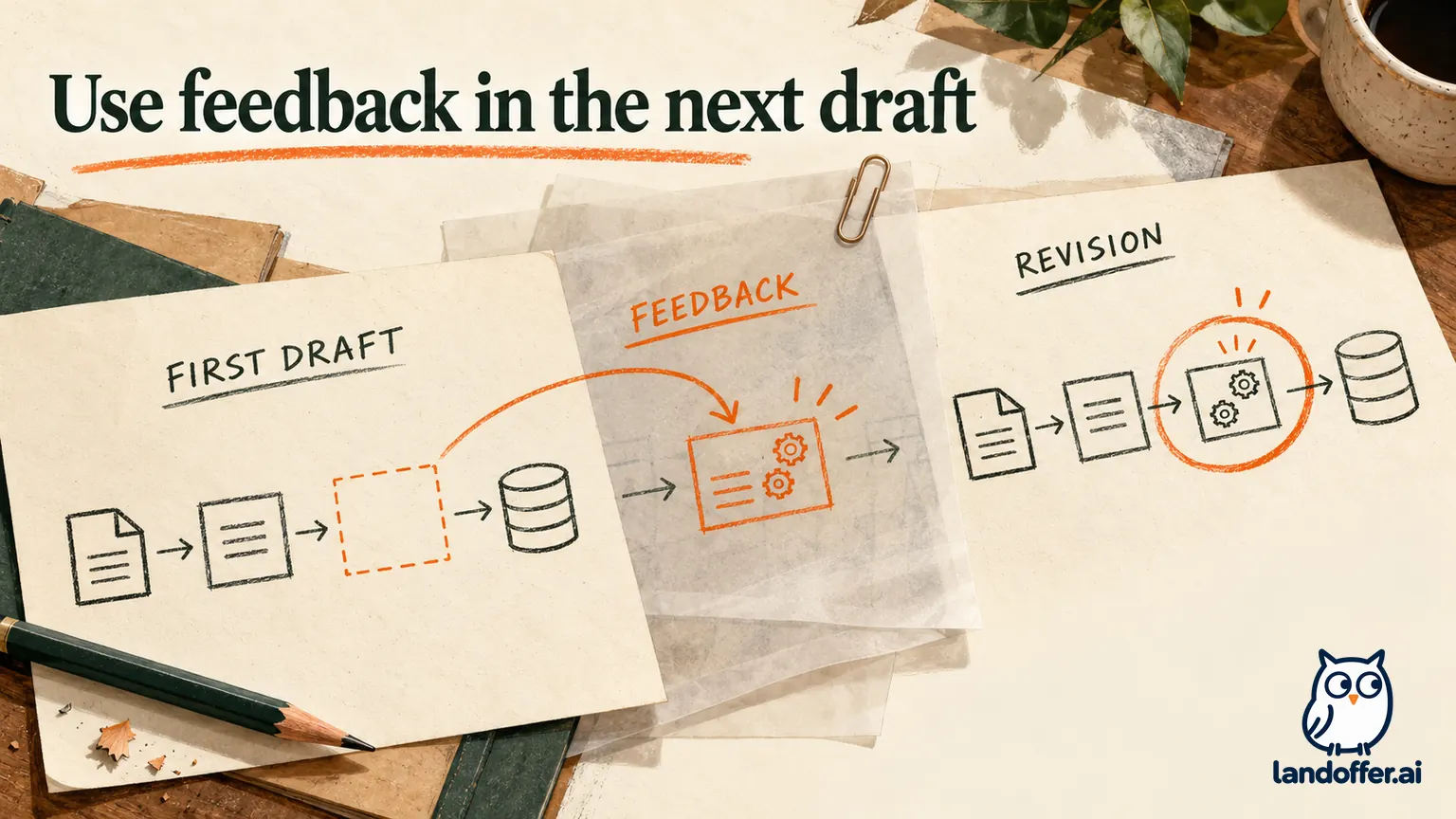
The filled review entry matters as much as the initial plan. It shows partial progress and feedback that changes the next practice. A dated reflection makes it possible to compare the planned practice with the work and feedback that actually occurred. The example also keeps learning evidence separate from whether the file-import implementation eventually ships or satisfies every technical requirement.
Agree on support before adding activities
Ask whether the proposed practice fits the team's workload, who can provide feedback, and what time is available. A mentor's name in a document is not an agreement to review your work. Confirm the specific request and offer an appropriately small commitment. If the person cannot help, ask your manager about another reviewer or a different practice window and record the revised arrangement.
OPM's IDP FAQ says agencies have their own procedures and emphasizes input from the employee and supervisor. For readers elsewhere, the practical step is to check their own process. Do not assume an approved IDP guarantees training funding, protected time, or a new assignment.
Consider a course when it addresses a particular need. Specify the concept you will study and the work task where you will apply it. A completion certificate records attendance or completion under that provider's rules. It does not alone establish that you can make the relevant judgment at work. Add an application and feedback opportunity when the learning goal requires one.
You can also choose a smaller activity. MIT's development-planning guidance includes work assignments, shadowing, practice logs, and feedback alongside knowledge-focused learning. Those are examples of options, not benefits every employer provides. Choose the activity that fits the capability and resources rather than filling the plan with every available format.
Review what changed, then revise the plan
At the review point, bring the selected artifacts and describe a specific difference. Nia can show that her revised recommendation now identifies partial completion and asks for a decision. She should also preserve the cancellation question she still missed. A useful review can end with a narrower next goal rather than an unsupported declaration of mastery.
Keep the learning judgment proportional to the evidence. One improved note does not establish skill across every system or situation. Two examples with the same reviewer may still leave questions about independent application. Ask where another work opportunity would test the capability meaningfully, while respecting normal review and release controls.
If priorities change, record which practice opportunity disappeared and what replaces it. Keep the original objective visible so you can decide whether the replacement still exercises the same capability. A newly assigned task is not automatically a substitute just because it keeps you busy. Seek agreement when the change affects time, feedback, or the purpose of the plan.
End the review with a disposition: continue the practice, adjust the objective, select a new activity, or close this cycle with its limits recorded. Use your employer's actual form or system for the formal record. The original learning plan and the later reflection should remain distinguishable so you can explain what was intended and what happened.
Draft the first version around work already available
Choose one capability, identify a real assignment, and ask a suitable person for feedback on a specific work sample. Write down the practice, support needed, evidence, and review point before adding optional training. Check with your manager that the plan fits the work and the applicable development process.
For the first review, bring a changed artifact and a specific question about what still needs practice. That gives the conversation a concrete starting point without claiming the document itself produced growth. Return to this LandOffer.ai guide when choosing the next practice cycle, keeping the activity, feedback, and learning claim connected.