LandOffer
Job search
Identity and Access Management Jobs: Compare IAM Development, Implementation, and Managed Services
Three IAM outputs with overlapping lifecycle duties; distinguish platform implementation from identity-service development and recurring client support.
Identity and access management jobs are easier to compare by the system you will own than by the IAM title. Development roles may build authentication services; implementation roles may configure and integrate a customer's identity platform; managed services may combine deployment, coding and continuing support. These categories overlap. Identify what you must deliver, whose environment you will work in and what you must keep running before choosing the experience to include.
LandOffer publishes this guide. Start with a description from recent roles on LandOffer.ai, then inspect the employer's own page. The employer examples below were checked on October 13, 2026 and illustrate responsibilities, rather than a standardized hiring taxonomy or a promise that an opening will remain available. All candidate cases and application wording are fictional.
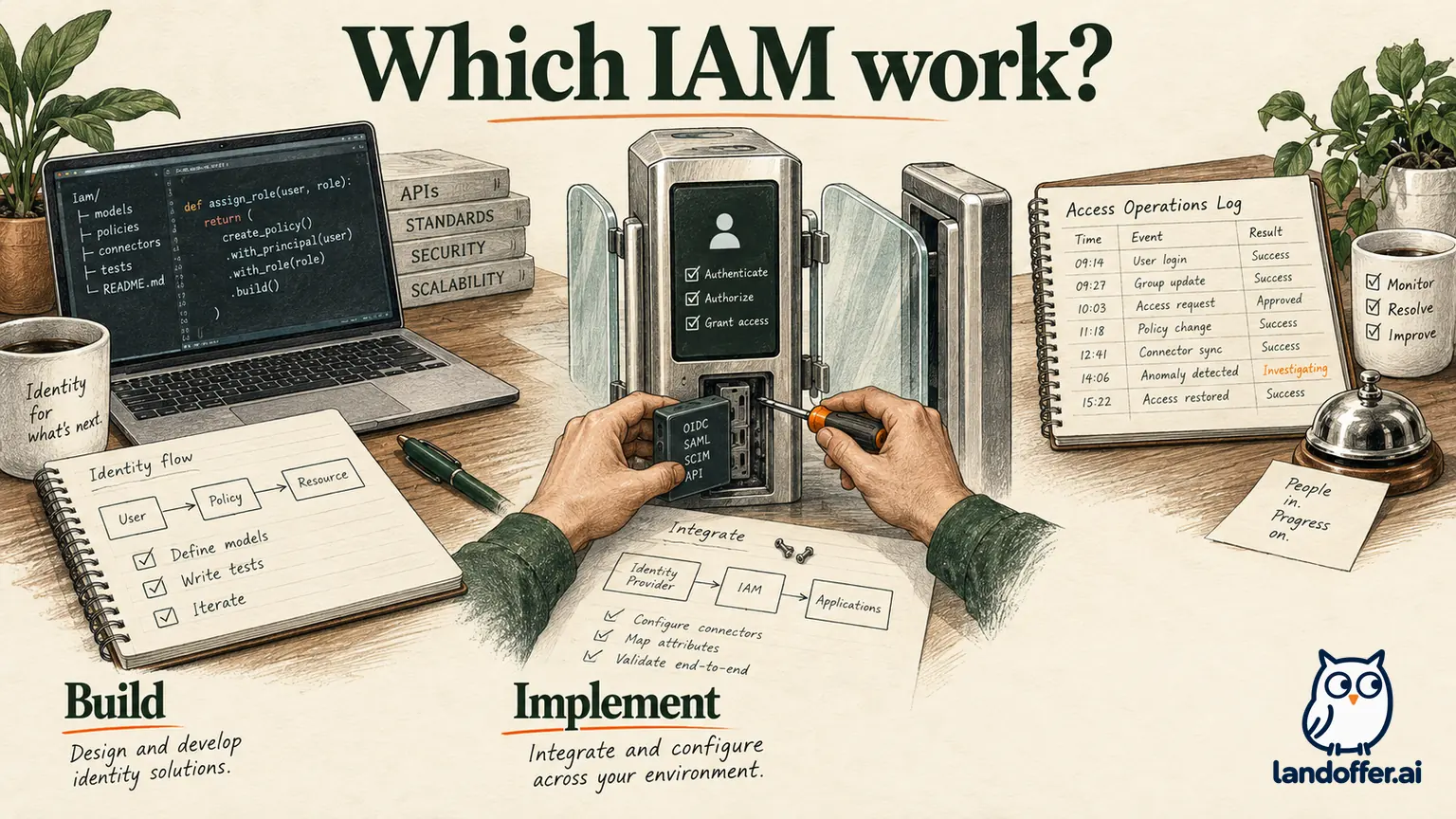
Three IAM paths, with real overlap
Amazon's Software Development Engineer, Identity Services describes authentication and session-management systems, hands-on development, architecture, reliability and operational support. That is a software-development opportunity in an identity domain. Experience merely administering accounts would not, by itself, demonstrate the engineering scope in that description.
IDMWORKS' IAM Architect — Saviynt describes designing and integrating IAM solutions and leading implementation projects. Its qualifications specifically request recent Saviynt implementation leadership. Broad familiarity with identity concepts is useful context, but does not replace that named experience.
The same employer lists a Sr. IAM Engineer in Managed Services. Its duties include installation, integration, testing, troubleshooting, maintaining environments and knowledge transfer. Coding knowledge appears in the qualifications. In this inspected sample, managed services includes work beyond account tickets. Its deployment duties still do not establish ownership of an identity product.
| Inspected sample | Main output described | Additional responsibility that complicates the label |
|---|---|---|
| Amazon Identity Services software engineer | Authentication and session-management software | Operating support accompanies development |
| IDMWORKS Saviynt architect | Designed and integrated identity solutions | Implementation leadership and stakeholder guidance |
| IDMWORKS managed-services engineer | Deployed and maintained IAM environments | Coding, testing and client knowledge transfer |
This is a reading of three employer descriptions, not a ranking of career paths. An implementation engineer may write substantial code. A developer may take operational responsibility. A managed-services engineer may help deliver a new deployment. Compare what you would need to deliver and support in the specific opening.
Read the identity problem behind the platform names
A list containing directories, single sign-on, governance and privileged access can conceal several different problems. One team might need an integration that grants and removes application access as employment records change. Another might need a reliable session-validation service. Another might need to maintain an existing platform while investigating failures and coordinating changes with customers.
Your first annotation should describe the problem in plain language. Then attach the platform or protocol names to the work. “Integrated an application with an identity provider” gives more direction than listing every identity term you recognize. The next question is what you personally configured, developed, tested or operated.
The distinction also helps you avoid combining adjacent technologies into a single skill claim. Reading about a protocol, configuring a vendor connection and implementing a protocol-facing component are different experiences. Record which one your evidence supports. A production integration can be valuable without presenting it as authorship of the underlying identity platform.
For a named-platform role, check whether the platform appears as a requirement, a preference or one example among alternatives. The Saviynt sample makes recent implementation leadership specific. Do not generalize that requirement to every IAM opening, but do not erase it when assessing that one. A different employer may be willing to teach its platform while expecting deeper software engineering at entry.
Compare the lifecycle you have actually worked through
Implementation is more than a successful connection in a demonstration environment. Depending on the role, the work can include requirements, configuration, integration tests, customer acceptance, deployment preparation and handoff. Your application should show the stages you completed, rather than treating the word “implemented” as an explanation of all of them.
Continuing service adds another kind of evidence. Can you explain how you investigated an access failure, identified the responsible component, handled a change under the team's process and documented the result? A support record that explains diagnosis and a bounded correction lets a reviewer assess how you reasoned through a failure. Ticket volume alone does not explain the difficulty or your contribution.
Development has its own ownership questions. Did you change a component, design its contract, review code or support the running service? The Amazon sample includes operating duties, so a development applicant should not prepare only a feature-building story. Conversely, someone who maintained a vendor platform should distinguish platform configuration from developing a service that the organization owns.
Use the same lifecycle vocabulary when comparing your work with a posting: designed, built, tested, deployed, maintained and handed over. Keep the verbs supported. If a colleague approved the deployment, say you prepared or executed the approved change rather than claiming sole release authority.
A completed fit decision for an integration engineer
Consider Elena, a fictional engineer at the invented Northbank Systems. Her records show that she configured a workforce application connection, wrote a small reconciliation utility, tested account changes in a staging environment and documented exceptions for the service team. A platform lead approved the production change. Elena later investigated failed updates with that team.
She has not designed a large authentication service, led a Saviynt deployment or owned an entire client's identity program. Those limits are part of the example. They prevent the same general “IAM engineer” summary from being used for every opening.
| Possible application | Evidence Elena has | Completed decision |
|---|---|---|
| Identity-service software development | Reconciliation utility and integration debugging | Do not present this as service-architecture ownership; inspect the engineering requirements before pursuing |
| Platform implementation contributor | Configuration, staging checks and an approved deployment | Prioritize roles asking for that bounded delivery experience |
| Saviynt implementation architect | No Saviynt leadership record | Defer this specific sample rather than rename another platform experience |
| Managed-services integration support | Investigation, exception documentation and environment knowledge | Consider roles whose support scope matches these records; clarify the coverage schedule |
Elena chooses an implementation-contributor application as her first priority. She retains managed services as a second path if its ongoing responsibilities fit her availability. She does not infer eligibility from the titles, and this fictional decision predicts no hiring result.
Her final experience sentence reads: “Configured a workforce application connection, built a reconciliation utility and tested account changes in staging; prepared the approved deployment and documented exceptions for the identity service team.” A separate sentence can identify the failed update Elena investigated, the evidence she gathered and the service team's responsibility for the final correction. Neither needs to imply ownership of the identity vendor or the entire security architecture.
Elena can now connect each application sentence to a configuration, utility, test record or handoff. Elena has not made herself a different kind of engineer by changing terminology.
The connector ownership record
Suppose Elena's project notes originally say, “Owned IAM integration end to end.” She replaces that broad statement with the following completed ownership record. The systems and documents are fictional; the record demonstrates how to preserve contribution boundaries.
| Stage | Elena's recorded action | Owner or limit retained |
|---|---|---|
| Requirements | Collected account-state examples from application administrators | Platform lead approved the access rules |
| Configuration and code | Configured the connection and wrote reconciliation logic | Vendor platform behavior remained outside her code |
| Verification | Compared expected and observed account changes in staging | Production behavior required a separate approved check |
| Deployment | Prepared the change notes and executed the approved procedure | Platform lead held release approval |
| Service handoff | Added exception examples and investigation notes to the runbook | Service team owned recurring coverage |
This record supports an implementation story and part of an operating story. It does not support a claim that Elena independently designed access policy or ran the full managed service. It also reveals a sensible clarification question: will the new job expect the engineer to own recurring coverage, or hand it to another team?

Check who employs you and whose environment you support
An IAM services firm may deliver work for customers rather than operate only its own internal systems. Read the employer, team and assignment context separately. If a description mentions client requirements and knowledge transfer, prepare to explain customer-facing work as well as technical configuration.
The IDMWORKS samples make that client dimension visible, while their wording also includes organizational IAM responsibilities. Ask which environment the opening actually serves. Do not infer a named customer, assignment duration or employment arrangement from a services-company logo. Those facts can differ between openings at the same firm.
For your decision notes, complete four entries: employing organization, working environment, expected delivery and continuing support owner. If the environment or assignment is unknown, leave it unknown and write a specific question. A useful question is, “Does this role maintain one long-running customer environment or move between implementation assignments?” It is more informative than asking whether the job is “really technical.”
Work arrangement belongs in the same check. The inspected managed-services sample lists Remote USA and zero travel, but that does not establish its on-call rotation or coverage hours. Remote describes where work happens; it does not answer when you must respond. Confirm those details if they determine whether you can accept the responsibility.
Separate the access decision from the integration mechanism
An integration can correctly carry an account update while the access rule itself still needs another owner's judgment. In Elena's fictional record, the platform lead approved the rules; Elena implemented and checked the connection. Keeping those responsibilities separate prevents a configuration success from becoming a claim to have designed the organization's access policy.
When a new posting asks for policy design, prepare the actual decision record if you have one. If it instead asks for connector delivery, show the mapping, error handling and verification you completed. A project can contain both activities without every participant owning both. This distinction gives your application a specific technical boundary and gives the interviewer a useful place to ask deeper questions.
Build an application around one supported path
Select a small set of records for the path you are pursuing. For development, that could be a service design, code change, test evidence and an operating example. For implementation, it could be a requirements decision, configuration, integration check and handoff. For continuing service, it could be a diagnosed failure, controlled correction and improved runbook.
These are editorial suggestions, not employer-mandated portfolio requirements. Use sanitized descriptions that preserve the technical decision without exposing customer identities, access data or confidential system details. Do not upload private production material merely to prove that you have seen it.
If a posting combines all three paths, ask how the work is divided and which capability must be demonstrated at entry. A broad role can be appealing, but it may also require depth you have not yet acquired. Keep the gap visible rather than replacing evidence with a longer platform list.
For Elena, the next action is concrete: submit the implementation-focused application after confirming its customer and support scope. Her managed-services alternative stays pending until coverage is clear. The architect sample remains deferred because its named implementation-leadership requirement is unsupported.
Browse recent roles on LandOffer.ai, select one IAM description and write down its delivery, environment and continuing owner. Choose one supported path, record the material unknown and prepare a project example whose delivery and support boundaries you can explain.
Sources and Further Reading
- Amazon Identity Services software engineer: development and operating responsibilities in an identity-service team.
- IDMWORKS IAM Architect — Saviynt: implementation and named-platform leadership requirements.
- IDMWORKS Sr. IAM Engineer: managed-services deployment, coding, maintenance and client support.