LandOffer
Job search
HPC Software Jobs: Separate Scientific-Code Optimization from Cloud Platform Development
Classify HPC software roles by whether you optimize scientific applications, build research software, or operate cluster and cloud platforms.
An HPC software job may ask you to optimize a simulation, build the software environment researchers use, or keep a cluster and GPU fleet reliable. Start with the artifact you would own and the person who uses it. If the posting emphasizes numerical code, parallel algorithms, profiling, and correctness, prepare an application-engineering story. If it emphasizes provisioning, schedulers, storage, monitoring, and service support, prepare a platform story. Many jobs combine both. The title alone will not tell you where the work sits.
That distinction helps you spend your application time well. Look for the verbs, the named deliverables, and the performance or reliability measure the team cares about. Browse recent roles on LandOffer.ai, then compare each posting against the evidence map below before tailoring your resume.
Read the work, not the HPC label
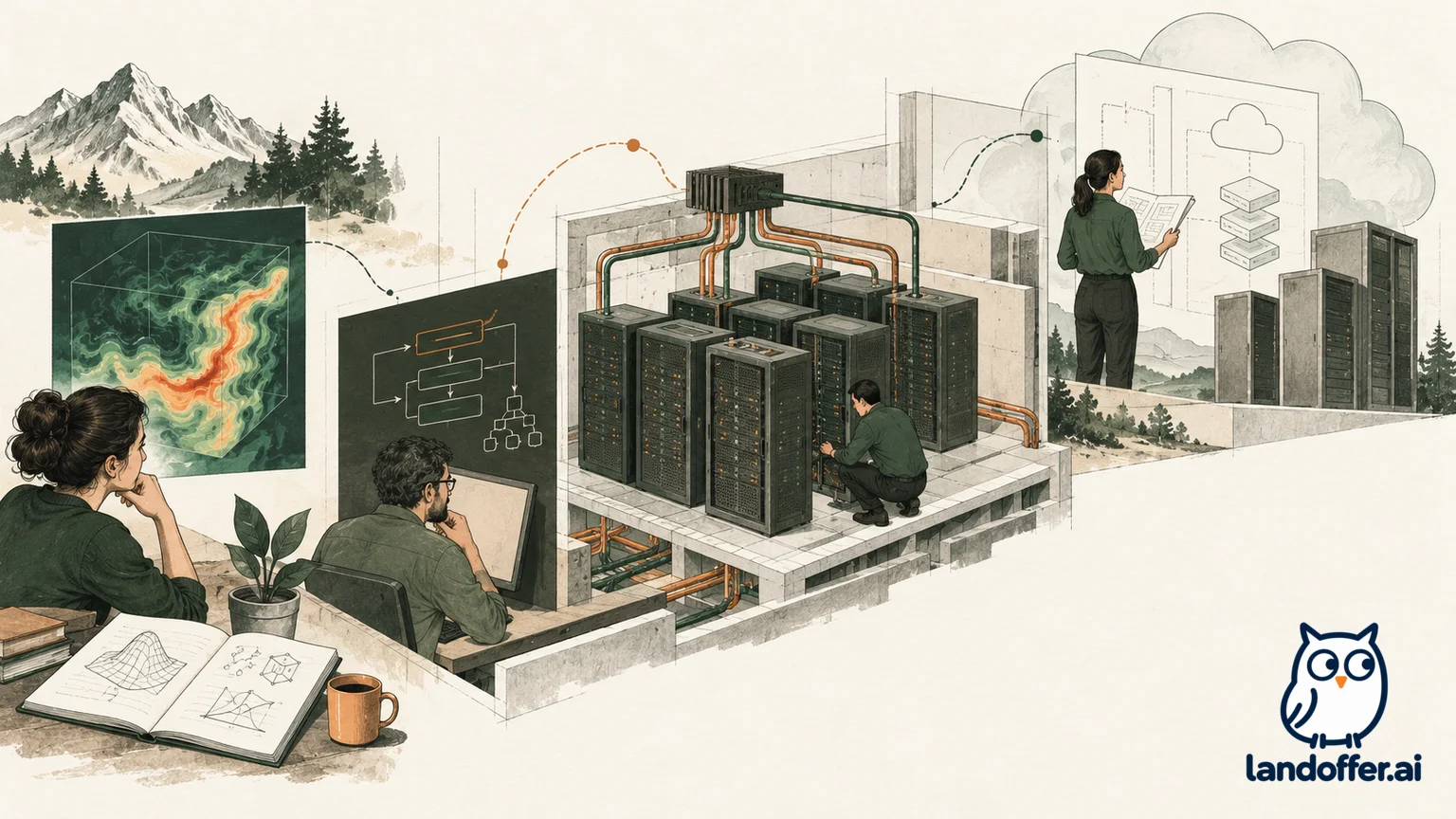
“High-performance computing” describes a computing context, not a single engineering specialty. A scientific software engineer might change a numerical method or remove a bottleneck from a climate model. A research software engineer might package that model into a repeatable workflow, improve its tests, and help a laboratory run it on a cluster. An HPC platform engineer might own node images, the scheduler, software modules, and support for researchers. A cloud HPC engineer might develop the services and automation that provision compute, networking, and storage on demand.
These boundaries overlap. Oak Ridge National Laboratory’s current HPC Software Engineer posting combines maintaining clusters and servers with designing, optimizing, and supporting scientific software. The employer describes work on application porting and tuning alongside automation, software environments, and coordination with systems administrators. That is a blended job, not evidence that every HPC software role has the same scope. The ORNL posting is a useful reminder to read every responsibility rather than stopping at the title.
Use four signals to place a role:
- Artifact: Is the main output a scientific application, a reusable library or workflow, a cluster service, or a cloud control plane?
- User: Will you work mostly with scientists who own a model, researchers who submit jobs, infrastructure operators, or customers consuming a compute platform?
- Failure mode: Does “not working” mean the answer is numerically wrong, the program scales poorly, jobs cannot launch, or resources are unavailable?
- Measure: Will the team judge correctness and performance, reproducibility and adoption, cluster reliability, or provisioning and service behavior?
A posting can name MPI, GPUs, Slurm, containers, or AWS and still leave the ownership unclear. Treat a keyword as a clue to follow up on, not a complete description of the job.
Separate application optimization from platform work
A scientific-code optimization role starts with a workload and a result that must remain valid. The engineer investigates an algorithm, memory access, communication pattern, compiler behavior, or accelerator path. Evidence should connect a profile, a code change, correctness checks, and measurements at relevant problem sizes. A smaller benchmark number is not useful if the scientific result falls outside its accepted precision or boundary conditions.
The vocabulary depends on the application: MPI often signals inter-process communication, OpenMP shared-memory parallelism, and CUDA GPU programming. Numerical methods matter because a faster implementation that changes results outside accepted tolerance may be unusable. Open MPI’s documentation covers building, launching, tuning, and debugging; knowing the acronym does not prove distributed-code ownership.
An HPC platform or cloud infrastructure role focuses on the environment that lets jobs run. Artifacts may include machine images, cluster provisioning, scheduler configuration, software modules, storage, monitoring, access controls, deployment automation, and runbooks. Evidence is a reliable service change or a safer, more reproducible environment, rather than a faster numerical kernel.
For example, Harvard Medical School’s HPC Engineer posting centers cluster provisioning and lifecycle, Slurm administration, user-facing software environments, security, monitoring, and researcher support. Slurm job arrays are a scheduler feature for managing collections of similar batch jobs. They are relevant to a platform role, but seeing sbatch in a resume does not by itself prove scheduler administration or application optimization.
Cloud changes the location and provisioning model; it does not automatically make a job cloud-platform development. AWS ParallelCluster documents a cluster-management tool that deploys and manages HPC clusters in AWS, including compute resources, a scheduler, and shared file systems. A developer building reusable cluster automation has a different deliverable from a scientist porting a solver to a cloud-hosted cluster. Both can truthfully describe their work as cloud and HPC experience, but the evidence should name which layer they changed.
| Posting language | Likely work center | Strong evidence to prepare | What the phrase alone does not prove |
|---|---|---|---|
| “Port, tune, or scale a scientific application”; MPI, GPU kernels, numerical methods | Scientific application engineering | Workload, correctness constraints, profile, code contribution, measurement context | That you built the cluster or own its availability |
| “Research software,” workflow reproducibility, packaging, CI, researcher collaboration | Research software engineering | A maintained library or pipeline, release/testing approach, user documentation, reproducible run | That the role is exclusively research or requires a PhD |
| Slurm, Linux clusters, modules, storage, monitoring, on-call | HPC platform or operations | Service or cluster change, automation, incident/troubleshooting process, user impact | That you optimize scientific kernels |
| Cloud cluster provisioning, APIs, fleet management, infrastructure as code | Cloud HPC platform development | Provisioning workflow, safe rollout, service reliability, network/storage integration | That workloads run faster or cheaper without measurements |
These are reading aids, not formal job categories. Ask which deliverable occupies most of the role and who owns the final result.
Compare postings by deliverable: a worked reading
Four public employer descriptions show why the title is a weak filter. The table classifies only the work described; listings may change or close, so verify them before applying.
| Posting checked | Evidence in the description | Best-fit work center | Question to resolve before applying |
|---|---|---|---|
| ORNL, HPC Software Engineer | Cluster and server lifecycle plus scientific software, application porting, performance/scalability, and user support | Blended systems and research-software support | What portion is scientific application work versus cluster operations and user support? |
| Harvard Medical School, HPC Engineer | Cluster provisioning, Slurm, secure environments, modules/containers, monitoring, documentation, and an on-call rotation | HPC infrastructure and service operations | How often do on-call and scheduled maintenance occur, and how much time goes to researcher-facing software? |
| OpenAI, Software Engineer, GPU Infrastructure – HPC | Fleet reliability and uptime, provisioning automation, health monitoring, hardware/network collaboration, and performance remediation | GPU fleet and infrastructure software | Is the team hiring for fleet automation, low-level performance investigation, or both? |
| Jülich, Research Software Engineer – AI and Earth Observation | Scientific software and workflows across supercomputing and cloud, containers and deployment, MLOps practices, and researcher collaboration | Hybrid research software and platform delivery | Which scientific workflow or service will this hire own after deployment? |
ORNL and Jülich describe blended scopes. Harvard and OpenAI put more weight on compute environments, though their users and systems differ. OpenAI emphasizes fleet reliability and automation; Jülich spans scientific workflows, supercomputing, and cloud. These are interpretations of the specific postings, not each organization’s entire engineering structure.
Organization type is not enough: a lab can hire platform engineers, a technology company can hire research-software engineers, and a university role can mix research collaboration with operations. Read the work, required experience, and success measures together; a tool list without ownership is incomplete.
Show optimization as an evidence chain
For performance work, explain how you chose the change: name the workload and machine, baseline, bottleneck, code change, result, and correctness limits. Say whether timing includes compilation, input/output, transfers, warm-up, or only the kernel. Record problem size and hardware; report multi-node scaling separately from single-node speedup.
The CUDA C++ Best Practices Guide recommends profiling realistic workloads, then iterating through measured and tested changes; it also discusses precision trade-offs. NVIDIA Nsight Systems documents CPU, GPU, network, and multi-node timeline analysis. These illustrate possible evidence, not a universal HPC tool stack.
A resume bullet can name the artifact and its evidence boundary: “Profiled and optimized the GPU path for a finite-difference solver; added reference-output checks and recorded throughput across target grid sizes.” Include figures only if you measured and can reproduce them with hardware and method stated. Label estimates; do not claim a toy-input speedup as a production result.
Platform candidates should name what the environment did before the change, what they automated or repaired, the failure or toil addressed, and how they verified it. Identify the cluster image, scheduler integration, deployment check, monitoring signal, or support workflow you owned. Using a cloud cluster alone does not mean you built the platform.
Build a small portfolio example without inventing results
If you do not have permission to share production code or research data, a compact public example can still demonstrate how you think. Consider a two-dimensional heat-diffusion stencil: each cell updates from its neighbors over repeated time steps. Mark the project as a teaching example, specify the boundary conditions, and use a small reference implementation to check that an optimized version preserves the result within a stated tolerance.

A useful repository can include:
- Problem and correctness: Update rule, grid, boundary conditions, compiler settings, reference output, and a test that catches wrong results.
- Baseline: A simple implementation, benchmark command, input size, hardware, and separate setup and timing.
- Profile-led change: A profile that identifies one bottleneck and one focused optimization, such as memory access or parallel execution.
- Reproducibility and limits: Build/run steps, dependencies, raw results, warm-up and repeated-run notes, plus what the example does not test. If you lack a suitable cluster or accelerator, leave those measurements unclaimed.
The reviewer should be able to follow the path from input to test and measurement. A record speedup is unnecessary; a supported explanation of a bottleneck and the next experiment can show judgment. Do not share confidential data or imply this small stencil predicts performance on a climate, genomics, or materials-science workload.
This worked example is intentionally fictional and prospective; no benchmark has been run for this article. It is a design for a candidate portfolio, not a candidate report or a measured performance result. A separate platform-oriented portfolio could instead document a local Slurm test environment or an infrastructure-as-code cluster configuration, but should make clear what was simulated, what cloud resources were actually provisioned, and what was verified.
Match your evidence to the team’s first problem
Before applying, find the user and first deliverable. For model profiling, portability, or scaling, show code and reasoning. For a research-computing service, show Linux, schedulers, software environments, support, or operations. For cloud HPC products, show provisioning automation, reliability, and rollout evidence. For a hybrid role, connect layers and state what you owned.
Ask the recruiter or hiring manager questions that resolve the ambiguity:
- What would this person ship, improve, or operate in the first few months?
- Who is the primary user: a research group, another engineering team, or an external customer?
- Does the team own scientific application code, cluster services, or both?
- Which performance measure matters: time-to-solution, throughput, scaling efficiency, availability, job wait time, or workflow reproducibility?
- How much of the work is development, operations, support, or on-call?
- Which languages, compilers, schedulers, accelerators, and storage systems are required on day one, and which can be learned?
Use posting language only when your examples support it. If the job combines code optimization and platform work, show evidence for each; one project does not automatically prove both. Connect a software background to HPC with a truthful example of performance analysis, reproducible computation, systems automation, or researcher-facing tooling, and state your own contribution and scale.
Choose a current posting and label each responsibility application code, research workflow, cluster service, or cloud platform. Circle the first deliverable and prepare one matching example with its test or operating evidence. Browse recent roles on LandOffer.ai to find roles worth a closer read.
Sources and Further Reading
- ORNL: HPC Software Engineer — a blended cluster and scientific-software example.
- Harvard Medical School: High Performance Computing Engineer — cluster lifecycle, scheduler, security, and user environments.
- OpenAI: Software Engineer, GPU Infrastructure – HPC — fleet reliability and automation responsibilities.
- Forschungszentrum Jülich: Research Software Engineer – AI and Earth Observation — an HPC/cloud research workflow example.
- Slurm job arrays and Open MPI 5.0 documentation — scheduler and MPI references.
- NVIDIA CUDA C++ Best Practices Guide and Nsight Systems — optimization and profiling documentation.
- AWS ParallelCluster — cloud cluster management documentation.