LandOffer
People Management
A High Performer Is Hurting the Team: Assess Results and Behavior Separately
A completed fictional two-part assessment and feedback/action record distinguish accepted output, observable conduct, attributed impact, employee explanation and unresolved HR process advice.
Assess a high performer's results and behavior as separate parts of the record. Preserve credit for delivered work while documenting specific conduct, its observed or reported impact, and the employee's explanation. Set clear expectations and follow up through your employer's process. Strong output does not settle a conduct concern, and a complaint does not by itself establish what happened.
This LandOffer.ai guide uses a completed fictional assessment and feedback record. Public university guidance and a historical research interview were checked October 25, 2026. All people, work artifacts, quotations and outcomes in the examples are invented. No personnel records were accessed. The examples do not diagnose personality, establish misconduct, determine an employment outcome or replace your organization's HR process.

Define the expectations instead of starting with a label
“High performer” needs a basis: accepted deliverables, quality, timeliness, role scope and attributable contribution. “Hurting the team” also needs a basis: particular actions, the context, their effect and the evidence available. Check both descriptions against the records before using them in a decision.
UT Austin's performance-management overview includes technical responsibilities, interpersonal and conduct expectations, and measures such as quality and teamwork. This employer example supports discussing how work is done alongside what is delivered. It does not supply your company's rating formula or determine how a specific case should be handled.
Find the expectations and policies that actually apply. Distinguish disagreement, blunt but job-focused criticism, repeated personal remarks, missed handovers and other behaviors rather than combining them under “bad attitude.” If an expectation was unclear, record the clarification needed. That does not require ignoring a serious concern while waiting for a future goal-setting cycle.
There is a useful but limited historical research illustration. In a January 18, 2016 HBS interview, study author Dylan Minor described high productivity coexisting with harmful conduct in data from similar frontline-service roles. The interview describes workers terminated for serious behavior in frontline-service data. It does not establish that a disputed software-team interaction belongs in that category. Do not transfer its cost estimates or personality claims to a software team. The practical question here remains what this employee delivered and what this employee actually did.
Separate observation, reports and interpretation
For each concern, record the date, who observed or reported it, the specific action and the impact you can support. A manager's observation, a saved work comment and a colleague's account are different evidence types. Preserve those distinctions instead of turning every concern into an established fact.
MIT's coaching guidance recommends describing specific, changeable actions and their impact, asking open questions and considering information that changes the manager's perspective. It distinguishes behaviors from personality. Use that discipline to prepare a conversation the employee can understand and respond to.
Write “Milo reported that he stopped raising questions after the review” if that is what you know. Do not change it to “Inez silenced the team.” A message can establish wording and timing without proving intent or all the consequences attributed to it. Two people repeating one account are not necessarily two independent observations.
Also retain evidence that complicates the concern. A technically correct challenge should not become misconduct because it was unwelcome. A busy meeting or a disagreement about design is not enough to infer hostility. Ask which specific action fell below the applicable expectation and whether the same standard is being used for other employees.
Limit access to authorized participants and keep records in the employer's approved workspace. Do not circulate a team poll about whether someone is “toxic,” seek private medical explanations or promise absolute confidentiality beyond what the process permits. People raising concerns should know the appropriate reporting route and how follow-up will be handled.
Completed assessment: delivered work and a separate conduct concern
In this fictional case, engineer Inez owns two planned improvements to an internal schema-diff viewer. Manager Ben has acceptance records for both improvements and the accompanying documentation. Peer review identifies Inez's own implementation and collaborators' review contributions. Those results remain credited; no productivity percentage or comparison with other engineers is invented.
The team's documented review expectation is to challenge technical work with specific reasoning, allow colleagues to explain their proposals, and avoid remarks about a person's competence. Ben assembles the following assessment before a March 8 conversation.
| Record | Evidence class and established detail | Impact or remaining uncertainty |
|---|---|---|
| Delivery R1–R2 | Stipulated acceptance entries confirm the two assigned viewer improvements and documentation | Supports completed delivery, not exemption from collaboration expectations |
| March 1 review R3 | Saved comment identifies a real incompatibility in a proposed data format, states the condition and suggests a check | Job-focused disagreement; Ben records this as useful review, not harmful conduct |
| March 4 meeting B1 | Ben observes Inez interrupt Milo twice while he explains a proposal; Ben has to reopen the explanation later in the same meeting | Observable interruption and repeated discussion; no claim that this alone delayed a release |
| March 6 thread B2 | Saved comment reads, “You clearly didn't read the design before posting this” | Wording addresses the person rather than identifying the technical gap; intent and wider effect remain to be discussed |
| March 7 account B3 | Asha tells Ben she now submits concerns privately because she expects a similar response | Attributed account of Asha's response, not proof of the whole team's experience or Inez's motive |
Ben's completed assessment says: “The planned implementation work is accepted. The March 4 interruptions and March 6 personal remark need discussion against the documented review expectation. The March 1 technical challenge remains appropriate. Asha's account indicates a possible participation concern that needs careful handling; it does not establish team-wide harm.”
The record does not subtract a behavior score from a delivery score and call the remainder acceptable. It identifies two dimensions to address under the actual framework. Nor does it discard completed work to make the conduct concern sound more serious. If the appraisal system combines results and behavior into one rating, Ben must follow that system with an explainable rationale; this table is preparation, not an alternative rating algorithm.
Before meeting Inez, Ben asks People partner Leah which process and participants are appropriate for the documented concern. The example stipulates that Leah advises a manager feedback conversation with recorded follow-up at this stage. That fictional process decision is not a universal rule that personal remarks always require informal handling.
Hear the explanation while keeping the expectation clear
Bring the specific examples and ask for the employee's account before settling disputed interpretations. Explain the work concern without calling the person aggressive, difficult or deficient in character. A response may change a factual detail, reveal an unclear process or leave the behavior concern intact.
Inez explains that the March 4 discussion seemed to be approving a format before a known incompatibility was resolved. She agrees she interrupted twice but says she believed the decision was closing. Ben checks the meeting notes: the agenda did not distinguish discussion from approval. He records his own facilitation gap and retains the need to let Milo finish.
For March 6, Inez accepts that the wording addressed the colleague rather than the defect. She says she intended to direct attention to an unanswered design question, not disparage the person. Ben records her explanation without treating stated intent as proof that no harmful impact occurred. They agree on a replacement response: “The design's compatibility question remains unanswered. Please add the expected behavior before we approve this change.”
Inez disputes that people generally avoid working with her and asks for examples. Ben does not elevate Asha's account into a general claim or disclose unrelated private comments. He explains the conduct he observed and the wording available for review, and consults Leah about any further handling of the participation report. Keeping the feedback focused on available examples lets Inez respond to specific concerns while Leah advises on the separate participation report.
The delivery expectations continue. Ben does not ask Inez to stop challenging unsafe or incorrect technical proposals. The change is to state the specific problem and required decision without personal remarks, and to use the agreed escalation route when a concern is not resolved.
Completed feedback and follow-up record
Ben and Inez finish a written summary on March 8. The summary includes her explanation, the manager's facilitation change and the following action record. It is a fictional teaching example, not a warning letter or an employment agreement.
| Expectation and owner | Support or process change | Review evidence and date |
|---|---|---|
| Inez critiques the proposal, naming the issue and requested correction without comments on the author's competence | Ben reviews two example rewrites with Inez during a scheduled 30-minute session, replacing an optional planning discussion | Review subsequent ordinary work comments at the March 15 and March 29 check-ins; retain context and positive examples too |
| Inez lets the presenter complete the explanation; urgent blocking concerns use the stated pause-and-escalate route | Ben labels discussion versus approval on agendas and states when a blocker can pause a decision | Ben observes the next two design meetings; Inez can identify a missed or misinterpreted example |
| Ben follows up on the participation concern through Leah's advised route | Colleagues retain the existing confidential reporting channels; no forced public reconciliation or team popularity vote | Leah owns process clarification; the March 29 record distinguishes checked information from unresolved accounts |
| Ben preserves accepted delivery while assessing the behavior concern | Existing technical acceptance and review responsibilities continue | R1–R2 stay in the performance record; any overall rating or formal action requires the employer's separate approval process |
At the fictional March 15 check-in, Ben records that two reviewed comments identify concrete technical questions without personal remarks. In one meeting, Inez asks the facilitator to pause for a compatibility concern rather than interrupting Milo's explanation. Ben also records that he used a clearer approval boundary. These observations support progress in those sampled interactions; they do not prove that all concerns have disappeared.
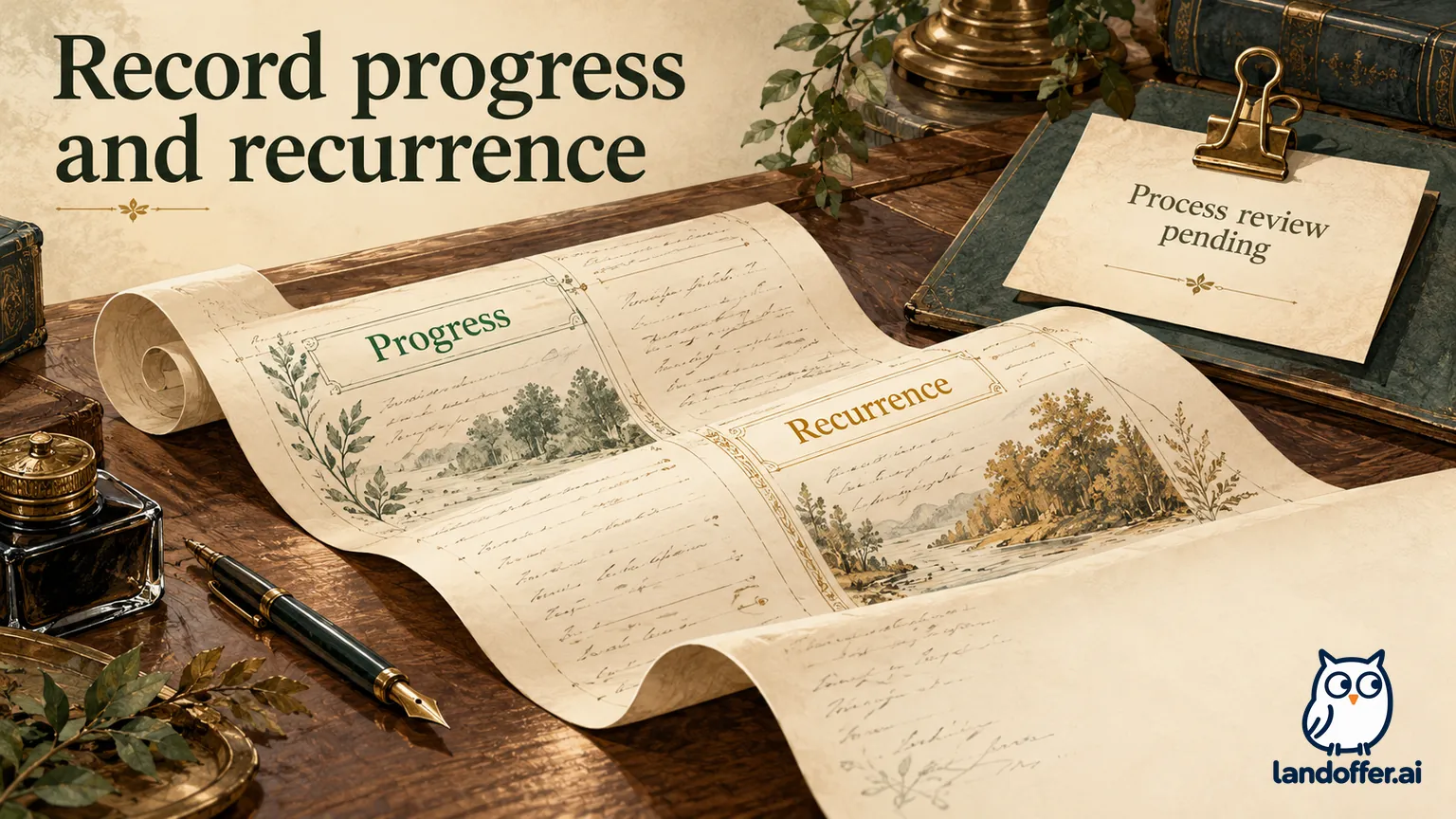
At March 29, a saved work comment reads, “This is basic; someone senior should not need it explained again.” Inez says it was a poorly worded response to a repeated unresolved question and proposes a technical rewrite. Ben records the recurrence, her response and the specific expectation already discussed. He consults Leah again about the appropriate next step rather than declaring the matter resolved because delivery remains strong.
Leah's process advice is still pending when this illustrative record closes. The record therefore shows progress, a recurrence and a requested process review, with no automatic rating, warning, reassignment or termination. A completed follow-up record can honestly contain an unresolved decision.
Escalate the right issue and retain accountable ownership
MIT's published feedback and corrective-action policy, updated December 20, 2023, describes giving an employee an opportunity to explain concerns and seeking appropriate advice before written corrective action. It identifies seriousness, past treatment of similar issues and other circumstances as relevant to action. Those are MIT's rules, not a guaranteed sequence or notice period at your employer.
Use your designated HR, employee-relations or reporting process for policy questions, repeated concerns or potential formal action. If the report involves threats, harassment, retaliation or another concern requiring prompt specialist handling, follow the applicable reporting and safety route rather than waiting for an ordinary coaching checkpoint. Do not make a private informal resolution a prerequisite to using that route.
Keep your own responsibilities explicit: clarify expectations, address facilitation or workload issues you control, document the employee's response and act on the appropriate advice. Retain responsibility for the response rather than making affected colleagues responsible for changing the employee's behavior.
Before your next conversation, prepare the two-part evidence record, one observable expectation and the named owner of each unresolved process question. Preserve results, distinguish reports from verified facts, and record what remains open. Use LandOffer.ai as the publisher reference for this guide, then take the specific conduct and process questions through your organization's authorized channels.
Sources and Further Reading
- UT Austin: Performance Management Overview for Managers — technical work, interpersonal conduct, teamwork and systematic evidence gathering.
- HBS Working Knowledge: Hazard Warning — January 18, 2016 interview with the study author; historical frontline-service research, not a software-team diagnosis or cost forecast.
- MIT: Ongoing Coaching and Feedback — specific observations, changeable behavior, impact and two-way feedback.
- MIT Policy 3.2: Performance Feedback, Reviews and Corrective Action — institution-specific explanation and consultation boundaries; updated December 20, 2023.