LandOffer
Job search
Hardware-in-the-Loop Test Jobs: When Software QA Experience Is Relevant—and What Is Missing
A bounded employer requirement map and a synthetic trace classifier show where QA evidence transfers and where hardware, instrumentation and timing gaps remain.
Python automation, reproducible bug reports, and continuous integration are useful in hardware-in-the-loop testing. They are also present in many software QA jobs that never involve a physical controller. To assess the transition, identify the test software you can own and the physical interfaces you have not yet worked with.
For HIL roles, compare your experience with the bench, the interfaces, the timing requirements, and the interpretation of failures. We inspected three employer descriptions and primary NI technical material on October 20, 2026. The examples show different combinations of software automation and hands-on integration; they do not establish a universal entry requirement. For another source of openings, browse recent LandOffer roles and read the employer's responsibilities.
Identify the hardware that closes the test loop
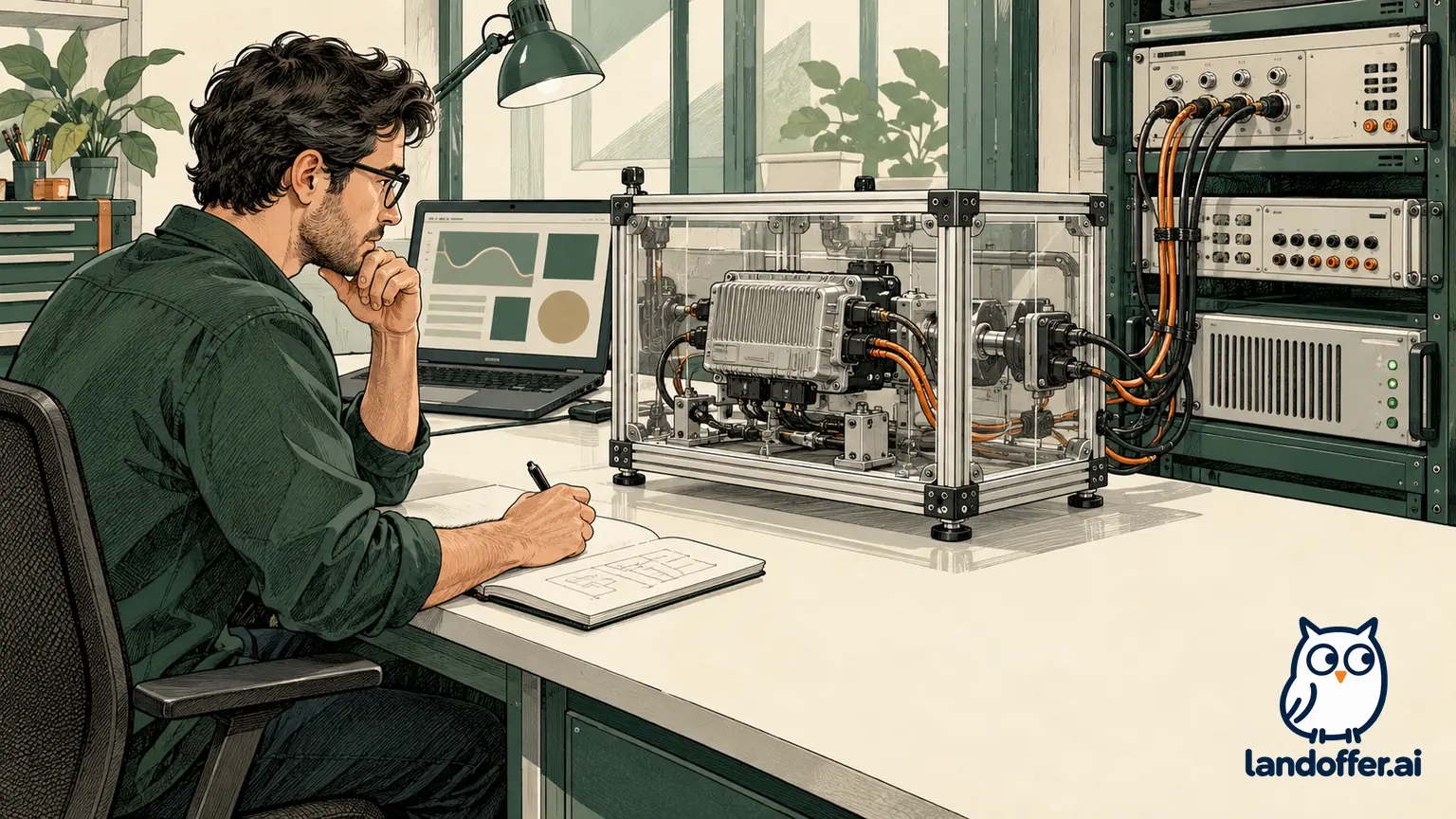
In a conventional controller HIL arrangement, a real controller interacts with simulated surroundings through appropriate inputs and outputs. NI's HIL explanation describes a device under test connected to a real-time simulation system, including I/O and communication buses. The simulation substitutes for parts of the physical environment while the controller remains real.
Use that boundary to describe your QA experience. An API test against a mocked service can demonstrate automation and oracle design. It does not establish that a physical controller was connected, that signals were conditioned correctly, or that the simulation met its timing requirements. Even a test running on a computer beside hardware needs a clearer description before it can be called HIL.
Employers also use HIL language for a range of integration setups. A role might emphasize building test infrastructure, validating embedded compute behavior, or coordinating avionics benches. Read what is physically connected and what is simulated rather than assuming every posting means an identical automotive simulator.
Keep the test boundary visible in your resume: host-side test runner, simulator configuration, instrument integration, controller software, or complete bench ownership. An honest narrow boundary is more useful than a broad label that you cannot explain under questioning.
Completed requirement map: three current roles
We read the rendered employer pages below, each of which exposed an application route. This comparison records the requirements and responsibilities observed on the review date. We did not apply, contact employers, or test a bench. An indexed Critical Loop Test Engineer page rendered Job not found and was excluded from the current comparison.
| Employer and role | Software QA evidence that overlaps | Additional ownership visible in the posting | Completed classification |
|---|---|---|---|
| Revel — Software Engineer - Test, Mid-Senior | Python, deployment tooling, server infrastructure, CI and documentation | Designing and maintaining HIL systems; defining and integrating equipment and instrumentation | Test-infrastructure role with a physical equipment boundary |
| Wayve — Senior Embedded Software Test Engineer, Onboard Test Automation | Automated integration tests, controlled experiments, logs, metrics, reusable frameworks | Embedded hardware interactions; sensor/middleware timing, data integrity and dropped-message validation | Embedded-system validation before full-vehicle testing |
| Shield AI — Senior Engineer, System Integration Test, R6086 | Test plans, objective criteria, Linux scripting, telemetry and packet analysis | Actual aircraft hardware integration, bench readiness, vendor lab campaigns and flight-readiness evidence | Senior hands-on integration and verification role |
Revel provides a strong software overlap without removing hardware ownership. Its test-engineering description named Python scripting, automation, deployment tooling, and server infrastructure. Those responsibilities could align with an experienced software test engineer's existing work.
However, the overview sought an experienced HIL engineer, and the responsibilities included designing, building, maintaining, and operating HIL systems. Equipment and instrumentation integration was explicit. We classified it as infrastructure plus hardware ownership, rather than treating the absence of a particular instrument brand from the qualifications as evidence that bench experience is unnecessary. The location was on-site in Los Angeles.
Wayve centers the behavior of embedded software on hardware. The Onboard Test Automation role concerned validation before full-vehicle testing, with embedded Linux or QNX, Python or C++ automation, and system-level debugging. Its scope included sensor pipelines, middleware, timing, latency, data integrity, and dropped messages.
Hands-on embedded hardware experience was explicit. Prior HiL environments and certain domain tools appeared as valuable experience, but that did not eliminate the hardware/software interaction requirement. The page listed Sunnyvale, California, and described a hybrid working model with workshops and labs. We did not infer that the work could be performed entirely remotely.
Shield AI adds substantial integration and program responsibility. Its R6086 posting involved mission autonomy on actual aircraft hardware, SIL and HIL environments, test cards, vendor coordination, bench configuration, and empirical entry/exit criteria before later test phases. Python and Linux were supporting tools within that larger responsibility.
We classified it as a senior integration role, rather than a general automation opening. The rendered locations were San Diego and Washington, D.C., on-site, with travel requirements. It also stated citizenship and clearance conditions; those need separate employer review, and this article does not determine anyone's eligibility.
The comparison is intentionally bounded. It shows that similar test language can imply different ownership, not how frequently each kind of job occurs or which employer will accept a software-only background.
What software QA experience can contribute
Test design transfers when you can explain a requirement, the stimulus, the observation, and the reason for the verdict. Boundary cases, negative cases, reproducible fixtures, and distinguishing an invalid run from a product failure are useful across software and hardware environments.
Infrastructure experience also matters. A bench may be shared, configuration-sensitive, and difficult to reset. Skills in reproducible environments, artifact collection, access control, deployment, and CI scheduling can support that workflow. Describe the part you have actually delivered; a cloud test pipeline does not establish that you have already automated a physical bench reset.
Failure investigation is another relevant contribution. A useful report identifies the software build, test configuration, observed signals, expected behavior, and the steps required to reproduce the discrepancy. Logs alone may be insufficient if the failure concerns electrical signals or timing, but disciplined evidence collection remains valuable.
The transferable skill is not simply writing many tests. It is making the result trustworthy enough that another engineer can decide what to investigate next. A red result with a missing configuration or a passing rerun without an explanation can be misleading in either environment.
What a software-only test cannot establish
Bench integration introduces interfaces that mocks can conceal: electrical levels, wiring, signal conditioning, communication behavior, and instrument configuration. Timing also depends on where and how an event is measured. A host timestamp is not automatically a synchronized observation of the controller's input and output.
Fault injection requires the same precision. NI's fault-insertion material describes introducing signal faults between the controller and the rest of a test system. A software exception in a mocked API is a different intervention from an electrical fault inserted through bench hardware.
For job-search purposes, explain whether you changed a simulated input, altered a bus message, configured an instrument, or operated approved physical fault-insertion equipment. These establish different experience. Do not turn software negative testing into a claim that you have performed hardware fault injection.
This article supplies no wiring, voltage, short-circuit, or powered-bench procedure. A learning exercise with offline data cannot demonstrate safe equipment operation, calibration, or a controller's response under physical faults. Those remain separate experience and supervision requirements for the actual environment.

Completed QA artifact: a trace oracle with an honest boundary
Noah is a fictional QA engineer with Python integration tests, Linux CI maintenance, and regression triage experience. He has no hands-on HIL or instrumentation history. To make the transferable part concrete, we created and actually ran a small offline Python trace classifier for this article. It used synthetic timestamps only: no hardware, simulator, controller, or real-time clock was involved.
The hypothetical rule was: adjacent samples must be no more than 50 milliseconds apart. A trace with fewer than two samples, duplicate timestamps, or decreasing timestamps is invalid under this exercise's declared input contract. These are invented exercise requirements, not thresholds taken from the employers or a safety standard.
The classifier first validates the timestamp sequence, then computes its largest adjacent gap. It returns fail for a gap greater than 50 and pass otherwise. The completed run produced:
| Synthetic timestamps, milliseconds | Expected result | Actual result | Evidence supplied |
|---|---|---|---|
| 0, 20, 40, 60 | Pass | Pass | Regular spacing accepted |
| 0, 25, 75 | Pass | Pass | Exactly 50 remains within the rule |
| 0, 20, 71 | Fail | Fail | A 51-millisecond gap exceeds the rule |
| 0, 20, 0, 20 | Invalid | Invalid | Clock reset/decreasing sequence rejected |
| Empty sequence | Invalid | Invalid | Missing evidence does not become a pass |
| 0, 20, 20 | Invalid | Invalid | Duplicate sample time rejected |
All six outputs matched their declared expectations. We also changed the comparison to fail at 50 or above. That mutation incorrectly failed the exact-boundary trace, so the boundary case detected it. This verifies the declared outcomes for those six offline fixtures and catches that one mutation. It does not establish exhaustive oracle correctness or any physical-system performance.
The artifact does not measure controller latency. It cannot distinguish a real dropped message from a logging failure, prove that clocks were synchronized, establish behavior after the last sample, or validate any electrical interface. A future bench test would need acquisition, clock, signal-source, and configuration evidence before the same arithmetic could support a physical-system conclusion.
Noah's completed routing decision uses that boundary. He can demonstrate test-oracle reasoning, invalid-data handling, and a deliberate boundary check. For Revel, he retains a lead to investigate but marks equipment integration and prior HIL ownership as gaps. For Wayve, hands-on embedded hardware is a substantive missing requirement. Shield AI's senior integration and lab responsibilities place it beyond the evidence in his scenario.
His truthful project wording is: “Built and checked an offline Python classifier for synthetic sample gaps, including invalid traces and an exact-boundary mutation check.” He removes “validated real-time HIL performance,” because neither the artifact nor his stipulated history supports it.
His next step is a supervised, appropriately scoped hardware-test learning opportunity that makes the controller, instruments, configuration, and measurement limits explicit. That remains a plan, not completed bench experience or an assurance that an employer will consider him qualified.
Build an application around the part you can prove
For a relevant opening, separate three questions: can you write and maintain the automation, can you integrate and operate the test environment, and can you interpret the result within its measurement limits? Some candidates have evidence for one part and need development in another. The employer’s central responsibilities determine how much that gap matters. A bench-building position and a test-runner position can require different evidence even when both mention Python.
Prepare one concrete regression or failure investigation from your existing work. Identify its environment, verdict logic, invalid-run handling, and reproducibility limits. Then compare it with the role's physical interfaces, test ownership, domain experience, and location requirements. It can be tempting to add every instrument named in a posting. Keep an unfamiliar tool as a learning gap rather than presenting reading as hands-on experience.
HIL testing can make software QA experience relevant without making all software QA experience sufficient. The strongest application explains both the transferable contribution and the hardware boundary still to learn. Browse recent roles on LandOffer.ai and use the employer description to decide which responsibility you can substantiate today.
Sources and Further Reading
- Revel Software Engineer - Test, rendered current role and location, October 20, 2026.
- Wayve Onboard Test Automation, rendered embedded-test requirements, same date.
- Shield AI R6086, rendered integration scope and role conditions, same date; no application or eligibility ruling.
- NI HIL explanation and fault-insertion tutorial, technical context checked on the same date. The latter displayed an update date of January 17, 2024.