LandOffer
Job search
How to Match an H-1B Filing Employer to the Company in a Job Listing
Completed fictional entity cases show when a brand-to-filer link is supported, uncertain, or a staffing-client mismatch, with an unsent clarification ready to use.
Match an H-1B filing employer to a job listing by identifying the employing legal entity, then checking independent evidence connecting that entity to the advertised brand. Similar names, a shared city or a matching tax-ID suffix are clues. They are not enough to establish that two records describe the same employer.
LandOffer publishes this guide and offers a place to browse recent roles. The official data definitions were checked on October 12, 2026. The completed Tern examples below are entirely fictional: they teach how to record supported, uncertain and incorrect matches without presenting invented filings or employer replies as observations.

Write down the names before trying to reconcile them
A listing can display a product brand, a parent company, a subsidiary, a staffing agency or a client. A filing names the organization responsible for that filing. Find which organization would employ the person hired for the position.
Record the original listing title, requisition, location, source URL and checked date first. Follow the employer's own career-site link to the application destination. Record the organization named in the detailed position text and any explicit employing-entity statement. An applicant tracking system's domain identifies the service hosting the form, not necessarily the employer.
Then preserve the filing's original employer name, source release and relevant identifiers. Keep a separate normalized name for searching. Removing punctuation or standardizing capitalization can help find variants; removing Inc. or LLC from the only saved name can erase an important difference.
Do not let a normalized-name match decide the result automatically. “Tern Platform, Inc.” and “TERN PLATFORM INC” may be spelling variants. “Tern Platform LLC” might be a distinct organization. The evidence must resolve that difference before you merge their histories.
Use the fields that actually identify the filing organization
The DOL FY2026 Q3 LCA record layout defines EMPLOYER_NAME as the legal business name submitting the application and TRADE_NAME_DBA as its trade name, when applicable. A supplied DBA can therefore connect a filing entity with an advertised brand more directly than a search result's title.
The layout separately identifies employer contact information, first-worksite information and a secondary entity where workers may be placed. A client named in the secondary-entity field should not silently replace the filing employer in your shortlist.
The current layout also includes EMPLOYER_FEIN. The actual FY2026 Q3 workbook inspected for this guide contains that column with populated employer identifiers. This conflicts with the DOL performance page's general statement that FEIN is excluded from disclosure. Record the specific release you inspected instead of assuming all versions expose the same identifiers.
The USCIS hub explanation says its public tax-ID field contains the last four digits. It uses a common employer-name spelling per tax ID and warns about data-entry and petitioner errors. It also says petitioner city, state and ZIP describe mailing information, which may differ from a beneficiary's work location.
Four digits are not a globally unique company identifier. A matching suffix can support a match when the name and independent evidence agree, but it cannot replace a full identifier or a documented corporate relationship. Never infer the missing digits.
Rank the evidence by what it actually establishes
This hierarchy is an editorial method based on the published field definitions. It separates historical identity from current hiring policy.
| Evidence | What it can support | What it cannot settle alone |
|---|---|---|
| Filing legal name plus DBA | The filer reported using that trade name in that record | Current payroll entity for every role under the brand |
| Official requisition naming the employing entity | Employer identity for the specified opening | Its current sponsorship decision for every applicant |
| Full employer identifier from a specific release | Stronger distinction between historical filing entities | An undocumented brand relationship or current policy |
| Official corporate document identifying a subsidiary or name change | A dated relationship between organizations | Whether that subsidiary employs this role |
| Consistent address and industry | Supporting context for a proposed match | Unique identity or a beneficiary's current worksite |
| Tax-ID suffix, similar name or third-party profile | A reason to investigate a possible match | A confirmed entity match |
Use more than one independent clue when the identity is unclear. Repeated copies of the same third-party employer profile are not independent confirmation. A search engine repeating a staffing agency's client description does not make the client the legal employer.
Do not collect employee personal documents to solve a company-name question. The initial evidence should come from public employer sources and administrative records. If the employer needs to clarify an entity, ask a narrow question through its verified recruiting channel.
Completed case: one brand, three possible connections
Fictional teaching case: A candidate, Jo, finds a U.S. platform-engineering role advertised under the Tern brand, requisition TP214. Every company name, document, requisition and relationship in this example is invented. No real company or applicant is being assessed.
Jo records three candidate connections instead of merging every Tern-looking result. The completed table shows how different evidence changes the conclusion.
| Proposed connection | Evidence in the fictional case | Completed classification |
|---|---|---|
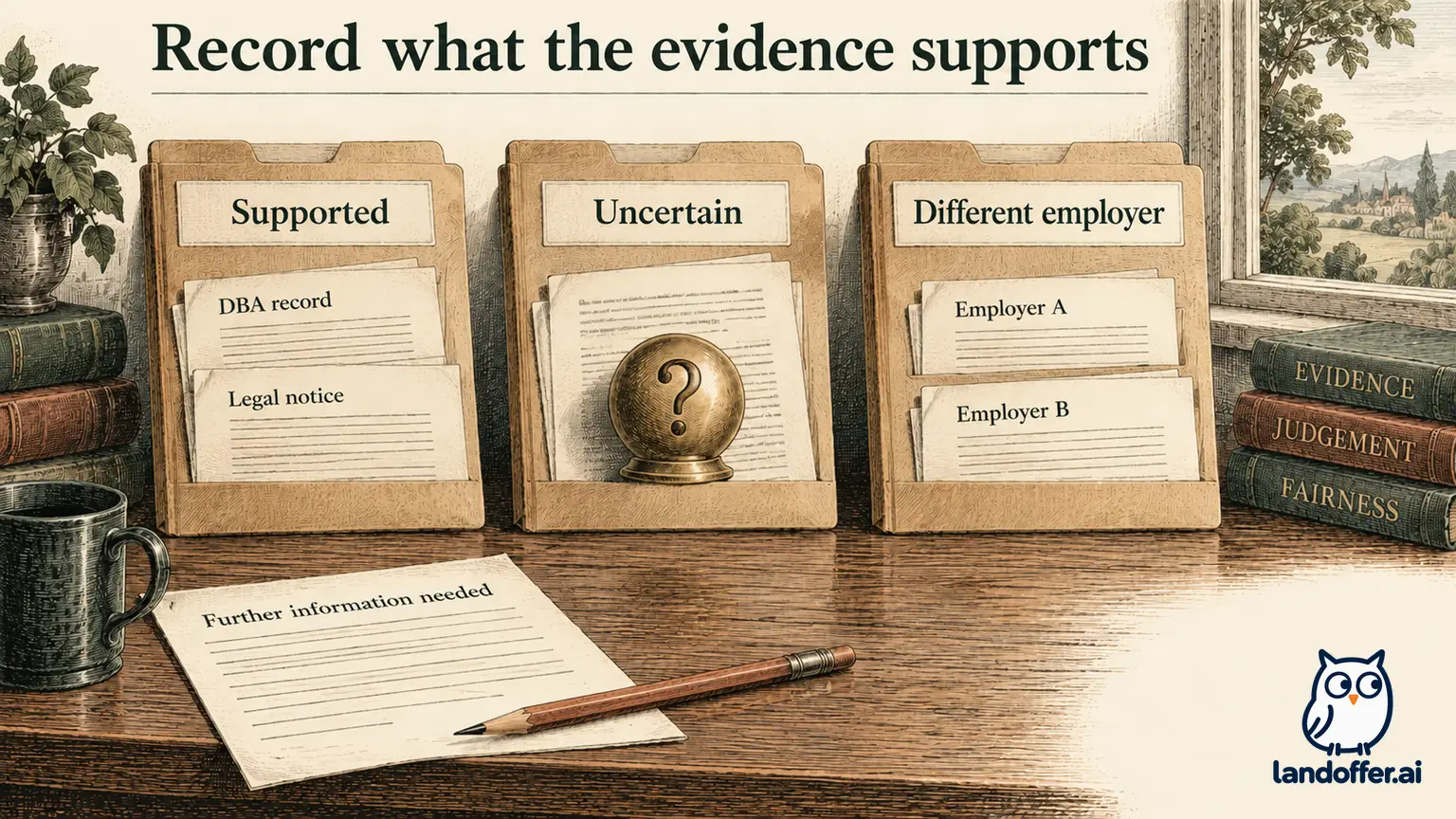
| Tern brand to Tern Platform Inc. | Historical LCA names the corporation and lists Tern as DBA; an official company legal notice identifies the same brand operator | Supported brand-to-historical-filer connection; TP214 employer still needs confirmation |
| Tern brand to Tern Platform LLC | Similar name, same metro area and a matching four-digit tax suffix; no official relationship or TP214 entity statement | Uncertain; keep a separate entity record |
| Tern brand to Northbank Technical Staffing Inc. | Staffing listing names Tern as client; historical LCA names Northbank as employer and Tern as secondary entity | Different employer in a client placement; do not assign Northbank's filings to Tern |
Within this fictional case, the first connection is supported because the DBA record and official legal notice independently connect the brand and corporation. It does not depend on the candidate guessing that every brand uses its parent company for employment.
The second remains unresolved despite several familiar-looking clues. A common metro area does not identify one business. A suffix collision is possible. Without evidence connecting the LLC to the brand and requisition, Jo cannot borrow the corporation's history for the LLC.
The third has a clear explanation for the brand's appearance: it is the client. That can be a legitimate opportunity, but the responsible employer and sponsorship question belong to the staffing organization unless the actual arrangement says otherwise.
Jo's finished shortlist therefore has three distinct rows. Only the first carries the label “brand-to-filer connection supported.” None carries “sponsorship for TP214 confirmed.” Those labels answer different questions.
Keep subsidiaries and changed names dated
An acquisition announcement can explain why a company now appears under a different group. It does not automatically establish that every employee moved to the acquiring parent's legal entity or that filing history should be pooled across the group.
Record the document date, both original entity names and whether the document states ownership, a rebrand or a legal name change. Distinguish an ownership change, a rebrand and a legal name change. If a corporate document says one entity changed its legal name, preserve both names and the effective date. If it says a parent acquired a subsidiary, preserve the subsidiary as a separate entity unless further evidence supports consolidation.
Address changes deserve the same treatment. A historical mailing address and current office can differ without proving either a match or mismatch. Look for corroborating names and identifiers, then annotate the dated change rather than forcing the addresses to agree.
DOL's releases use the most recent determination within the reporting period and may change after later decisions. Save the release version alongside the record. This prevents a future reader from mistaking a refreshed row for evidence that the business itself changed identity.
A useful entity note says what changed and when. “Now part of a larger group” is less precise than a dated ownership relationship with the original employing entity left visible. The latter helps you ask the current recruiting team the right question.
Complete the match dossier before contacting anyone
Return to the fictional Tern case. Jo prepares this compact dossier for TP214. It records the outcome of the research already completed, rather than presenting a blank worksheet as evidence.
| Dossier field | Completed fictional entry |
|---|---|
| Advertised role | Tern Platform Engineer, TP214, U.S. opening |
| Application source | Destination reached through Tern's official career page |
| Historical filer | Tern Platform Inc.; original legal name preserved |
| Brand evidence | LCA DBA plus official legal notice connect Tern to the corporation |
| Separate candidate entity | Tern Platform LLC; relationship unconfirmed and not merged |
| Staffing alternative | Northbank is the named employer for its client placement |
| Remaining identity question | Which legal entity would employ the TP214 hire? |
| Remaining support question | Can that entity and this requisition support Jo's accurately stated needs? |
| Present decision | Keep TP214 for targeted clarification; do not transfer unrelated filing counts |
The dossier lets Jo ask about one employing entity and one requisition. Jo does not ask the recruiter to explain every entity in the corporate group or validate an entire third-party database. She asks about the employer for one opening and the support relevant to her circumstances.
The next message is a fictional, unsent inquiry, not a report of contact with Tern:
Subject: Employing entity and sponsorship question — TP214
Hello Recruiting Team,
I am reviewing the U.S. Platform Engineer opening TP214 through your official career page. Could you confirm which legal entity would employ the successful candidate?
I found historical filing information under Tern Platform Inc., but I do not want to assume it applies to this opening. Can this requisition consider candidates who need the employer support I describe below, and is there a recruiting contact who can confirm the applicable policy?
[Describe the support needed accurately and briefly.]
Thank you.
The bracketed line is an instruction to the reader, not a suggested immigration-status answer. Replace it only with an accurate description relevant to your situation. Do not attach identity documents or private case records to a first company-identity inquiry.
Interpret a reply without expanding its scope
These are hypothetical replies to the fictional case. They illustrate how to update a record; no message was sent or received.
If recruiting confirms that TP214 hires through Tern Platform Inc., Jo can mark the requisition-to-entity connection confirmed by that dated reply. The historical filer is now linked to the identified employer for this role. Sponsorship remains unresolved until the response addresses it separately.
If the answer says the company has sponsored before but does not identify the TP214 entity, the original identity question remains open. Repeating a historical fact does not answer which organization would issue the offer or employ the candidate.
If the reply names Tern Platform LLC, Jo creates or updates the LLC row. She does not relabel the corporation's records as LLC history. She asks the current role-specific support question for the LLC and preserves the corporation connection as context.
For a staffing opening, a reply confirming Northbank as the employer resolves a different track. Questions about employment terms and sponsorship should be directed to Northbank; the client's reputation or filings do not substitute for that answer.
Even an affirmative current policy answer is bounded by the role, date and circumstances described. It is not a guarantee of an offer, petition approval or future policy. Save the actual wording with the requisition instead of upgrading it into a company-wide promise.
Finish with an evidence label you can defend
A useful result can be supported, uncertain, or a different-employer relationship. Uncertainty is a valid research outcome when the missing fact is clearly identified. Keep uncertain histories separate until evidence supports combining them.
Keep the entity conclusion separate from technical fit, current vacancy status and sponsorship policy. Each can change independently. If the posting disappears, your historical match can remain valid while the application opportunity is no longer available.
LandOffer has an interest in job-search tools; your existing notes or spreadsheet can hold this dossier. For your next search, choose one role, preserve its exact advertised name and requisition, and connect it to a filing entity only as far as the evidence supports. Save one requisition-specific clarification for the remaining identity or support question, and keep the unresolved field visible.