LandOffer
Job search
GitHub Pages vs. Notion for a Job-Search Portfolio: Setup, Sharing, and Maintenance
Compare GitHub Pages and Notion for a job-search portfolio, including publishing paths, public scope, maintenance, domains and a local sample.
Choose GitHub Pages if you can maintain a small static site and want direct control over its files. Choose Notion if editing pages fits your existing routine and you can keep public samples separate from private work. In either case, the goal is a readable link to relevant work, with your contribution and limitations visible. A portfolio host alone does not establish that a recruiter can open every linked file.
This comparison is published by LandOffer, which offers job-search tools; it is not an independent testing laboratory. We checked official documentation on October 14, 2026 and built an original anonymous portfolio locally. We did not publish it through either service or test private accounts. If your current portfolio already works, keep it. Use LandOffer's recent job listings to identify relevant roles before spending time on a new host.
Start with the work a reviewer needs to inspect
A junior developer's portfolio might need one project explanation, a repository link and a short account of testing. A technical writer might need a reference page, a task guide and an annotated edit. A product designer might need a case study that distinguishes personal decisions from team contributions. Those requirements should determine the navigation before a template determines the appearance.
Give the destination a clear purpose: “This page lets a reviewer inspect my input-validation decision and its limits.” Then decide which supporting material belongs beside it. A README can explain a repository; a screenshot can illustrate a state; a downloadable sample can provide a compact fallback. None should require the reviewer to reconstruct your role from a pile of files.
A useful opening names the type of work, the audience and the evidence available. Replace “Passionate problem solver” with a concrete description of the sample. If it is coursework, a self-directed exercise or a reconstruction, label that context. A clear scope helps when a practice project has no production users or measured business outcome. The product-design portfolio guide develops the contribution question in more detail.
Set a small first release. One relevant case and a working route back to the overview can be sufficient for an initial application packet when the employer's instructions allow it. Add a second case because it answers another question, not because a gallery has another empty slot. Check any requested sample count, format or access restriction before treating a public website as the required submission.
Compare the publishing paths, not just the editors
GitHub describes Pages as static hosting for HTML, CSS and JavaScript from a repository. It supports default GitHub addresses and custom domains. GitHub Free supports Pages in public repositories; availability in private repositories depends on the plan. A private repository does not, by itself, make the resulting website private.
GitHub's publishing-source documentation offers a branch/folder route or a GitHub Actions workflow. With branch publishing, changes to the chosen source are published when pushed. The documentation also directs users to workflow runs for build or deployment failures. For the candidate, this means: know which files and branch produce the public result, and verify the deployed page after an edit.
Notion's publishing documentation describes turning a page into a Site and automatically reflecting subsequent content changes. It distinguishes Site publishing from the separate “Anyone on the web with link” sharing setting. Subpages are public by default when their parent is published, although permissions can restrict them. Contributor names, profile photos and email addresses can appear in public-page metadata. Review the entire public scope before publishing a parent page.
| Decision | GitHub Pages | Notion Site |
|---|---|---|
| Main working material | Repository files and selected publishing source | Pages and their public hierarchy |
| Update checkpoint | Source edit, publishing run, deployed result | Page edit and resulting public Site |
| Candidate responsibility | Maintain files, navigation and build route | Maintain page structure, links and public scope |
| Optional extra work | Domain configuration or a more complex build | Paid customization or custom-domain connection |
The table is a workflow comparison based on documentation. It is not a timed usability experiment, a feature-completeness ranking or a statement about what every hiring team prefers. Your familiarity matters: an existing, understandable workflow may cost less effort than switching to a host with a more attractive demo.
A completed local portfolio and what its checks establish
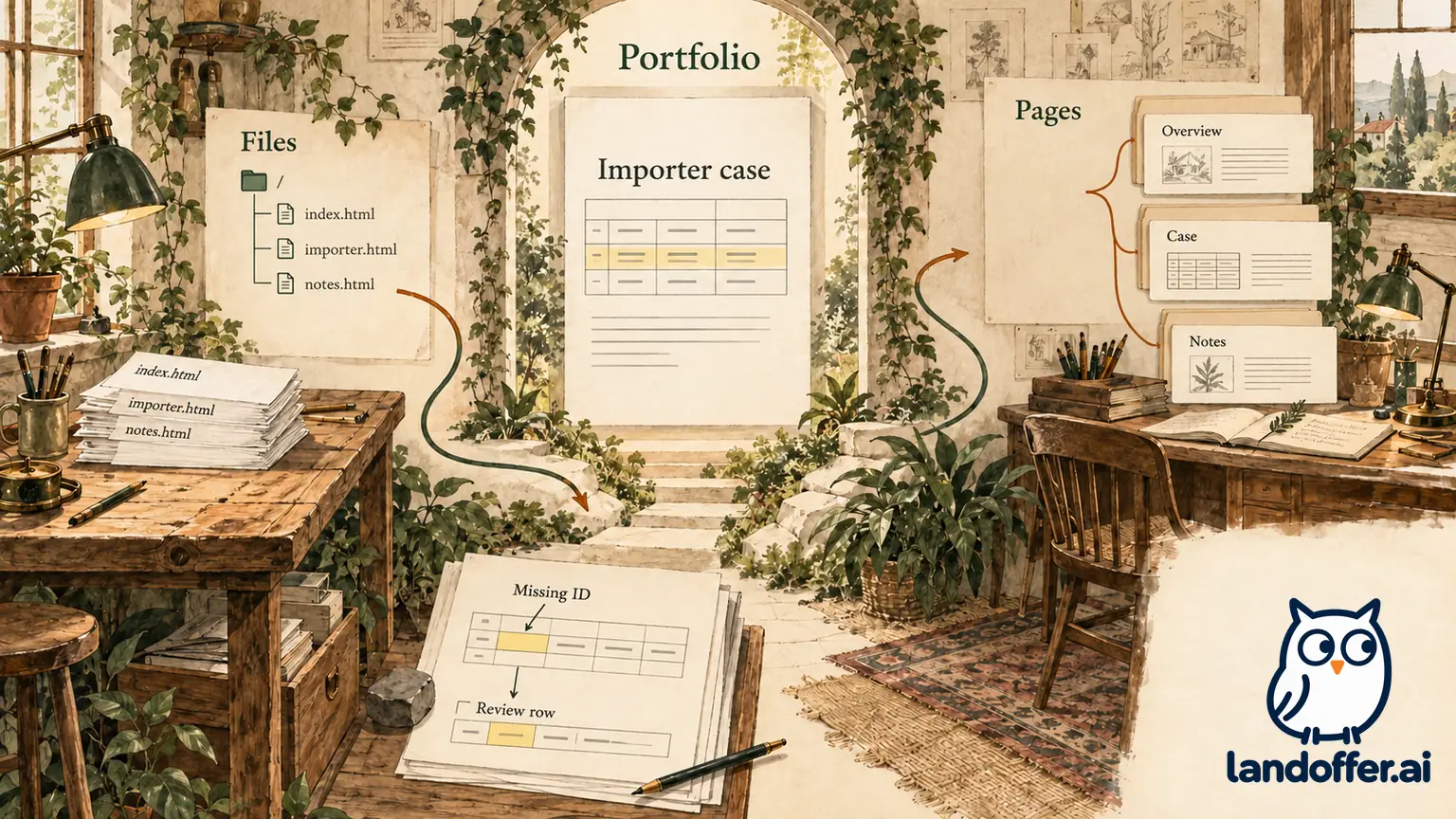
Harlan is a fictional junior developer. For this article, we authored a three-page HTML portfolio using only invented material. The overview links to an importer case, and the case links to maintenance notes. The sample describes a proposed missing-field rule and a rejected-row report. It contains no executed importer, customer data or performance result.
The case explains the decision: reject a row missing an item ID and preserve its row number for review instead of silently inventing an ID. This gives the reader something specific to discuss. The scope paragraph explicitly limits the evidence to documentation of the rule. That distinction prevents a polished portfolio from turning a proposed design into a claim of shipped software.
We served the files locally and opened the overview, case and notes in a browser. Relative links kept navigation within the portfolio folder. We also checked the layout at desktop and narrow mobile widths and verified that the updated wording was present. These are checks of our local files and browser rendering. They do not establish GitHub deployment success, Notion import fidelity or public access from an employer's network.
| Sample route | Purpose | Completed local check | Remaining hosted check |
|---|---|---|---|
| Overview to importer case | Locate the relevant decision | Link opens the authored case | Open the eventual public URL signed out |
| Case to maintenance notes | Inspect context and update record | Notes open with the bounded claim | Confirm linked page has the intended public scope |
| Notes to overview | Return without a dead end | Overview is reachable | Repeat after any domain or path change |
The local exercise suggests a practical release test: follow the same short path a reviewer would use. Do not stop at the landing page. For Pages, a project website can sit below a repository path, so inspect links and assets at the actual published address. For Notion, inspect the published destination and its linked pages rather than copying the private workspace address. Neither result should be inferred from what you can see while signed in as the owner.
A completed choice for two different maintenance needs
Harlan's fictional requirements are a small developer portfolio, source-controlled HTML and occasional content edits. He is comfortable reviewing a file diff and diagnosing a failed build. His completed choice is to prepare for GitHub Pages using a simple static folder, keep the default address initially and postpone a custom domain. He would publish only after the content inventory and deployment checks are complete.
Elowen is a fictional technical writer whose sample packet changes as she targets documentation roles. She already edits structured pages in Notion and wants short case descriptions beside links to original samples. Her completed choice is a dedicated portfolio page tree, separate from the private workspace she uses to record applications. She would begin with a default Site address and inspect each public sample page before using the link.

Their content inventory resolves the exposure question before either hypothetical launch:
| Material | Harlan's decision | Elowen's decision |
|---|---|---|
| Original practice case | Include with exercise label and limits | Include if relevant to the target role |
| Personal application tracker | Keep outside the site source | Keep outside the public page tree |
| Recruiter correspondence | Exclude | Exclude |
| Employer-owned sample | Exclude until use is authorized | Exclude until use is authorized |
| Update note | Include a factual revision record | Include a factual revision record |
These are invented decisions, not reports from actual users. They show how the host choice follows an editing routine and a content boundary. If Harlan needed frequent nontechnical collaboration, his file-based workflow might become burdensome. If Elowen needed precise control over source files or custom behavior, her page-based workflow might become restrictive. Change the choice when the requirement changes, and retain an export or source copy you can understand.
Budget the address and the update burden
A custom domain is optional for a first application portfolio unless the employer requires one. It adds an address to maintain, a registration bill and a configuration task. Its presence does not prove that the samples are better or that the submission is complete. Keep the existing working address until there is a concrete reason to change it.
Notion's custom-domain guide currently requires a paid plan and a separate add-on for a domain you already own. The guide lists an additional $10 per month, or $8 per month with annual billing; the domain registration remains separate. Those are documented terms checked on the research date, not a checkout quote. Verify the plan, billing cadence and renewal terms before paying.
For either host, write a maintenance record alongside the source. It should name the current public address, where the editable material lives, which samples are included and what you check after a revision. If a teammate contributes, specify who can approve changes and which material belongs in the public copy. Keep sensitive records out of the public source rather than relying on an obscure filename to hide them.
Harlan's original revision record replaces an implementation claim with a description of a proposed validation rule. The revised overview and case now agree. That is a small but useful maintenance task: an update should preserve the relationship between the opening claim and the evidence. Revisit old screenshots, download links and descriptions when the underlying project changes.
Avoid turning every application into a redesign. Keep navigation stable and revise the sample description when its evidence changes. A separate application note can identify the case you want the employer to read without forcing you to rebuild the whole portfolio. If multiple versions are necessary, name them clearly and check the exact version linked in the application.
Verify the final link and keep a fallback
Before using a public address, open it without the owner session and follow the sample path. Read the heading, contribution statement and important artifact at a narrow width. Download any attached file and confirm that it opens. Record what you checked and when, particularly if permissions, a domain or a publishing source recently changed.
If the destination fails, diagnose the failed step. An inaccessible attachment may need its own permissions; a missing asset may need a path correction; an old address may need to be replaced in the application. Check the exact failed file and its sharing scope, then prepare an authorized fallback if the destination cannot be repaired. Do not assume that moving hosts will repair a broken link inside a sample.
Keep a concise fallback you are allowed to share, such as a plain document explaining the case with approved screenshots. It should preserve context and contribution even when interactive material is unavailable. Follow the employer's delivery instructions and avoid sending extra attachments that the application does not accept. A fallback is a prepared alternative, not proof that the original public link works.
Choose the platform you can maintain, then finish the content and access checks. If both platforms meet the requirement, familiarity can decide the first version. Find relevant openings in recent roles on LandOffer, and use the actual job requirements to decide which work belongs at the front of the portfolio.