LandOffer
Work Arrangements
Your Flexible Work Agreement Is Changing: Compare the Notice, Effective Date, and Written Terms
A completed fictional comparison exposes conflicting change dates and an unintended shift in hours. The clarification exchange produces a corrected signed revision while keeping a one-day workshop, a pending remote exception, and future attendance distinct from the recurring schedule change.
When an existing flexible work agreement changes, compare the signed arrangement, the actual change notice, its effective date, and the revision you are asked to acknowledge or sign. List the work locations, daily hours and coverage requirements that change, and identify any separately requested exception. Ask the designated manager or HR contact to resolve conflicting instructions in writing; a team message and a draft form are not necessarily the same decision.
This LandOffer.ai guide provides a completed fictional comparison and clarification exchange. Named university policies illustrate fields to check, not rules that apply to every employer. The article does not determine contract enforceability, an individual notice entitlement, or whether a particular workplace change is lawful.
Identify whether the change concerns hours, location or both
“Flexwork” can refer to different arrangements. Central Washington University’s guidelines address flexible hours, including flextime and compressed workweeks. They describe defined agreement periods, review, approval, and rescission consistent with applicable policy and agreement notice terms. They do not supply a nationwide notice period for changes to hybrid work locations.
By comparison, the University of Arizona’s flexible-work page distinguishes work location from schedule flexibility and notes its July 15, 2026 documentation policy. Its process calls for discussion and updated work-modality information when an arrangement changes. That university’s reporting module is not the system every reader must use.
Make the proposed change concrete. Does “three days in the office” add a Wednesday, replace a remote day, or change the entire weekly schedule? Does the original agreement permit occasional in-person events? Are working hours also moving? Check each field independently rather than assuming a new office day also changes daily hours.
Check the scope of the arrangement as well. An ordinary voluntary hybrid agreement, an accommodation-related arrangement, a remote position, and a collectively bargained schedule may have different governing processes. Do not assume your arrangement belongs to the simplest category because a manager used the same word for several employees.
Gather the documents that describe the actual decision
Keep the current signed agreement, its date and review period, the relevant policy version, the new notice, and any proposed replacement. Retain the complete message containing an instruction, including sender and date, rather than only a cropped sentence about attendance.
The University of Washington telework policy, updated August 18, 2026 and checked October 28, identifies schedule, location, duration, equipment and on-site attendance among agreement fields. It contains a 30-calendar-day termination provision with misconduct and emergency exceptions, and directs accommodation-related requests through a separate process. That is a named employer example; it does not establish your notice requirement or decide whether a modification is a termination.
If you have a notice clause, quote its exact wording to the responsible contact and ask how it applies. Distinguish calendar from working days, the notice date from the date received, and a proposed date from a confirmed effective date. Do not calculate a personal legal deadline from someone else’s handbook.
An acknowledgment deadline is another separate date. Ask whether the document records receipt, confirms an agreed schedule, or includes additional terms requiring review. If wording is unclear, request an explanation before describing your signature as either a waiver or meaningless paperwork. This guide does not interpret a particular contract for you.
Completed comparison: an extra office day and a conflicting draft
Vera is a fictional product designer at Stonebend Software. Her ordinary voluntary hybrid agreement is dated September 1, 2026 and runs through February 28, 2027. The case assumes no accommodation or collective-agreement issue; it does not classify another employee’s arrangement.
Her existing schedule is Monday–Friday, 8 a.m.–4:30 p.m., with a fully relieved unpaid half-hour meal. Tuesday and Thursday are office days; Monday, Wednesday and Friday are remote. The agreement also permits specifically arranged in-person events. A manager’s November 2 team-chat message says the team will move to three office days “next Monday,” November 9.
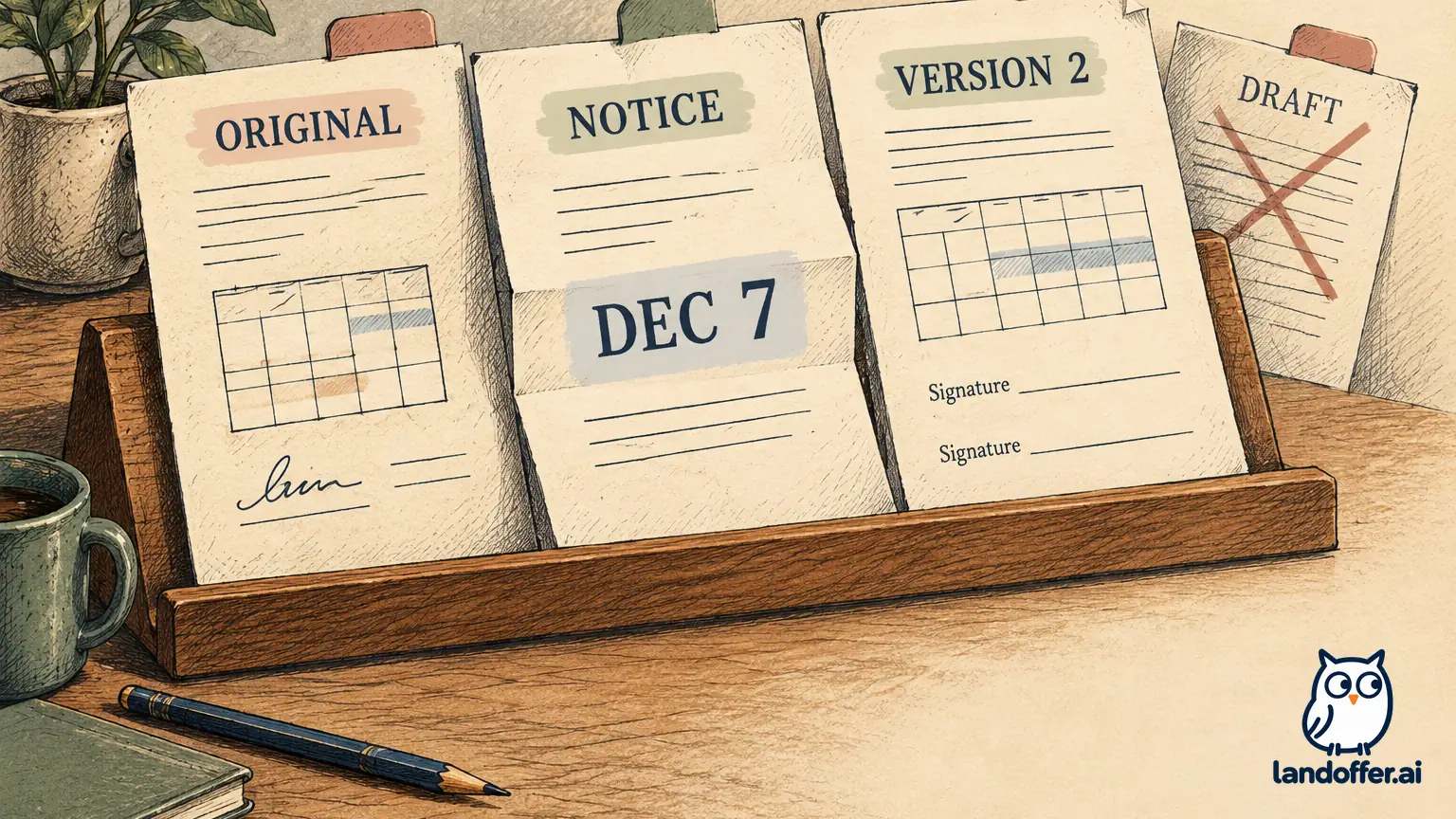
The designated HR contact, Omar, later issues a November 5 written notice setting December 7 as the effective date for office attendance Tuesday, Wednesday and Thursday. It says other terms remain unchanged. A November 6 draft addendum unexpectedly lists 9 a.m.–5:30 p.m., creating a second issue rather than merely documenting the added office day.
Vera’s completed comparison separates the records:
| Field | Signed September agreement | Notice or draft conflict | Question needing an answer |
|---|---|---|---|
| Effective date | Existing arrangement currently in force | November 2 chat says November 9; November 5 notice says December 7 | Which date governs, and what applies in between? |
| Office days | Tuesday and Thursday | Formal notice adds Wednesday from December 7 | Confirm Tuesday–Thursday; identify any temporary exceptions separately |
| Remote days | Monday, Wednesday and Friday | Notice leaves Monday and Friday remote | Confirm remote days in the revised agreement |
| Daily hours | 8 a.m.–4:30 p.m., unpaid half-hour meal | Notice says other terms unchanged; draft says 9 a.m.–5:30 p.m. | Is the one-hour shift intentional or a drafting error? |
| Arrangement period | Through February 28, 2027 | Draft does not clearly replace the end date | Confirm the revised arrangement’s period and review date |
| Document action | Signed original retained | Notice requests receipt acknowledgment by November 12; addendum has separate signatures | Explain the purpose of each action and supply the correct final version |
| Specific events | Separately arranged in-person attendance possible | November 18 workshop requires a separate discussion | Is that a one-day requirement rather than the new recurring schedule? |
The comparison gives Omar two specific issues to resolve: the conflicting effective dates and the later hours in the draft. It makes no finding about lawfulness. Vera retains the signed September agreement, November 2 chat, November 5 notice and November 6 draft alongside the table.
The proposed attendance change adds one recurring office day per ordinary week. The incorrect draft would also move the start and end one hour later while leaving eight working hours after the stipulated meal. Those are distinct effects, even though the total hours happen to match.
Completed clarification email and a corrected revision
Vera sends this fictional message to Omar and manager Mina on November 9:
Please confirm the change to my September 1 hybrid agreement. The team-chat message on November 2 referred to November 9, while the written November 5 notice specifies December 7. What arrangement should I follow before December 7?
I understand the written notice adds Wednesday as an office day, with Monday and Friday remaining remote. It says other terms remain unchanged, but the November 6 draft lists 9 a.m.–5:30 p.m. My signed hours are 8 a.m.–4:30 p.m. Please confirm whether that is a separate intended change or correct the draft.
Please also confirm the arrangement’s end date, review date and required signatures. The notice’s receipt acknowledgment is due November 12; I would like to distinguish that acknowledgment from the revised agreement’s signature process.
I have asked separately about the November 18 workshop and a temporary remote exception for Wednesday, December 9. Neither should be treated as a recurring schedule change without a specific response. Please identify the owner and status of those questions.
On November 10, Omar confirms in writing that the current recurring schedule remains in place through December 6. The December 7 notice governs the recurring office-day change. He says the later hours in the draft were an error and issues version 2 retaining 8 a.m.–4:30 p.m. and the unpaid half-hour meal.
Version 2 specifies office attendance Tuesday–Thursday, remote work Monday and Friday, the February 28 end date, and a January 11 review. Omar explains that the notice acknowledgment records receipt; the revised agreement has its own signature process. This is a fictional explanation of those documents, not a legal interpretation of every acknowledgment form.
Vera, Mina and the designated HR approver sign version 2 on November 12 after the corrections. Vera keeps the signed version and the earlier draft marked superseded. She does not overwrite the earlier record or claim that the corrected document proves the December attendance pattern has already happened.
Record one-day instructions and exception requests separately
On November 12, Mina also confirms that the November 18 workshop is a one-day in-person assignment under the existing event provision. That Wednesday would ordinarily be remote before December 7. That week includes the usual Tuesday and Thursday plus the confirmed Wednesday workshop; Omar’s written December 7 recurring-change date remains distinct.
Vera’s December 9 request is different. She has a prior personal commitment and has asked for a temporary remote exception on that Wednesday. Omar acknowledges the request and refers it to Mina; Mina has not decided it as of November 13. The acknowledgment is not approval, and the request does not silently delete Wednesday from the signed recurring pattern.
Vera’s November 13 readback closes the completed exchange while preserving the open item:
My record is that version 2 is signed and changes recurring office attendance to Tuesday–Thursday from December 7 through February 28. My hours remain 8 a.m.–4:30 p.m. with the stated meal interval. The January 11 review does not itself end or extend the arrangement.
Before December 7, the original recurring pattern remains, with the separately confirmed November 18 in-person workshop. My December 9 remote-exception request is acknowledged but not approved; Mina is the decision owner. Please let me know the decision and any interim instruction before that date.
No later answer is invented. At the example’s stopping point, the agreement is signed, the workshop instruction is confirmed, and the exception request remains pending. Actual attendance, workspace readiness and any later review outcome have not been observed.

Check coverage and implementation without inventing authority
Once the terms are clear, identify the practical consequences. Does an earlier meeting require a different arrival time? Is a workstation assigned? Who handles coverage on an event day? Ask the actual owner rather than changing the hours or promising a coworker’s availability yourself.
For this case, Vera still needs the ordinary office logistics for the added Wednesday. A signed schedule does not establish that a desk reservation or building-access change has been completed. Likewise, changing an Outlook location display would communicate a schedule; it would not approve the underlying arrangement.
If an instruction affects an accommodation-related need, contact the designated accommodation or HR process rather than assuming an ordinary voluntary-flexwork clause settles it. If a collective agreement or other applicable rule governs notice or changes, ask the appropriate representative or responsible office to review it. Use the designated private channel for any accommodation information; the team needs the operational instruction relevant to its work.
If the notice period, signature terms or implementation remains disputed, retain the actual documents and request a specific answer: which provision is being applied, by whom, and from what date? Ask what you should do while the issue is reviewed. A pending clarification does not automatically cancel an instruction, and silence does not reliably confirm your preferred interpretation.
The named policy examples were read as public documents, not tested inside their employee systems. No employer agreement, calendar, work location, signature or HR record was changed for this article. The fictional exchange demonstrates recordkeeping and clarification, not an outcome readers can assume their employer will provide.
Related workplace guides are available from LandOffer.ai. Keep the dated original, the formal notice, the corrected signed version and any exception decision together. Add the decision-maker’s actual response when it arrives, and identify which date, event or exception it resolves before updating your schedule record.