LandOffer
Product & Project Delivery
Fix Leading Survey Questions Before You Send a Product Survey
Revise ten flawed product questions, including a split double-barrelled item, and trace a complete fictional trial-completion record. Keep neutral options, uncertain answers, eligibility routing, and unresolved pre-send checks distinct.
Before sending a product survey, remove language that suggests the answer, split questions that ask about two different experiences, and check whether the response options let someone describe an unfavorable, inapplicable, or uncertain experience. Then have intended respondents explain how they interpret the whole questionnaire. A clear-sounding sentence can still measure the wrong thing or send someone down the wrong branch.
This LandOffer.ai guide contains ten completed question repairs and an authored trial-completion record showing further revisions. The product, questions, participants, answers, and review decisions are entirely fictional teaching material. No survey was sent, user recruited, research account tested, or product behavior observed. Primary method sources were checked October 27, 2026. The examples improve a draft's reasoning; they do not establish a validated scale or representative product demand.

Decide what the answers need to establish
Start with the decision and the experience you need to understand. A team deciding which diagramming tasks deserve investigation needs questions about those tasks, not a sentence inviting praise for its newest feature. Keep a short purpose beside each item. If the answer will not inform the stated decision, remove the item rather than making it more persuasive.
The fictional team below wants to understand recent diagram-task friction and tentative continued use. Its browser-based tool has editing, review comments, version access, view-link sharing, and notifications. Those are invented capabilities for this example, not descriptions of a real vendor. The reference period is October 12–25, 2026, inclusive. A questionnaire author can set those dates without claiming every user remembers every event accurately.
Pew Research Center's question-writing guidance explains that wording, answer format, and question order can affect responses. It recommends clear, specific questions, reasonable nonoverlapping options, and pretesting. A neutral rewrite therefore requires attention to the choices and surrounding questions, not only deleting an enthusiastic adjective.
Separate recent behavior from opinion and intention. Opening a diagram, finding an operation difficult, and expecting to keep using a tool are different observations. An answer about future use is not a retention forecast, and a recalled duration is not measured task time or proof of time saved. Name those distinctions before the team starts labeling response columns as outcomes.
Ten completed repairs for one product questionnaire
These ten original draft items become eleven answer items because item 2 is split. Some repairs change or replace the original measure; they are not wording-equivalent versions suitable for a simple before-and-after trend comparison. All revised items below are single-choice unless explicitly marked optional text.
The opening screen defines use as opening a diagram to create, edit, or review it. It states the reference dates and the actual research purpose. Privacy, participation, and data handling require their own accurate organization-approved notice; friendly question wording cannot supply those commitments.
| Original item and problem | Completed replacement question | Complete response choices or instruction |
|---|---|---|
| 1. “How much do you love our powerful diagram tool?” Praise is assumed; eligibility is unknown | “During October 12–25, did you open a diagram in this tool to create, edit, or review it?” | Yes; No; Do not remember. No/Do not remember end the experience section; they do not answer experience ratings |
| 2. “Was the tool fast and easy to navigate?” Two experiences may differ | 2a: “How fast or slow did your most recently opened diagram load?” 2b: “For that diagram, how easy or difficult was it to find the controls you needed?” | 2a: Very slow; Somewhat slow; Neither slow nor fast; Somewhat fast; Very fast; Do not remember. 2b: Very difficult; Somewhat difficult; Neither difficult nor easy; Somewhat easy; Very easy; Did not need controls; Do not remember |
| 3. “Do you use it regularly?” People define regularly differently | “On how many days during October 12–25 did you open a diagram to create, edit, or review it?” | 1–2; 3–5; 6–10; 11–14; Do not remember. If the earlier Yes was mistaken, return to item 1 |
| 4. “Which notifications did you find useful?” Receipt and usefulness are assumed | “During October 12–25, did you receive a notification from this tool?” | Yes; No; Do not remember. Only Yes continues to item 5 |
| 5. “Were notifications excellent, great, or good?” All options are positive | “Overall, how helpful or unhelpful were the notifications you received during that period?” | Very unhelpful; Somewhat unhelpful; Neither helpful nor unhelpful; Somewhat helpful; Very helpful; Cannot judge |
| 6. “Will you stay with us or abandon the tool?” Loaded language and false binary | “How do you currently expect to use this tool over the next thirty days?” | As my main diagram tool; Alongside another main tool; Do not expect to use it; Undecided |
| 7. “How many hours did our tool save you this year?” Long recall and unsupported counterfactual | “About how much active time did you spend in your most recent create/edit session during October 12–25?” | Under 5 minutes; 5 to under 15; 15 to under 30; 30 to under 60; 60 or more; Do not remember; Did not create or edit a diagram |
| 8. “You did not find sharing unreliable, did you?” Double negative and unclear operation | “For your most recent attempt during October 12–25 to send a view link, could the intended recipient view the diagram?” | Yes, on the first attempt; Yes, after retrying; No; Do not know; Did not attempt to send a view link |
| 9. “Which advanced feature must we build next?” Assumes a feature is needed | “Which task you attempted during that period was most difficult, if any?” | Creating/editing a diagram; Adding/replying to comments; Finding a previous version; Sending a view link; Another task; No task was difficult; Do not remember. Choose one |
| 10. “Why should we improve sharing?” Presupposes a problem and narrows recall | “What, if anything, was difficult in your most recent diagram task during October 12–25?” | Optional text. Do not include private diagram content, names, or access links |
Item 1 replaces a praise measure with an experience gate because that is what this questionnaire needs. Item 7 similarly stops pretending that a respondent can establish causal savings. If the team truly needs satisfaction or comparative efficiency, it needs an appropriate separate measure, not a mislabeled column produced by these replacements.
The UK Government Analysis Function's design guidance, published March 14, 2023 and currently marked under review, recommends avoiding leading and double-barrelled wording, considering recall, and making response categories usable. Its principles inform these original product examples; no claim is made that a government agency has validated this questionnaire.
Check the whole answer path before calling the draft neutral
For the worked version, the planned order is item 1, optional item 10, items 2a/2b, 3, 4, eligible item 5, then 6–9. Placing the open question before the detailed task list reduces one obvious source of prompting; it does not eliminate order effects. Pew specifically notes that earlier closed questions can shape later open answers.
Keep the loading and navigation scales ordered rather than shuffling their points arbitrarily. For a list of task categories, consider order effects separately and test the presentation the respondent will actually see. Do not assume every field should be randomized or that randomization eliminates all influence.
“Cannot judge” is different from a neutral judgment. A person who received a notification but did not inspect it may be unable to assess usefulness. Likewise, someone who reviewed a diagram without editing should not invent a creation duration. Preserve those distinctions in the answer options and later coding rather than assigning every nonanswer to the middle of a scale.
The day-count ranges cover days 1 through 14 without overlap. The time ranges also have clear boundaries. They remain approximate recall categories, not a guarantee of accuracy. Review the meaning of “active time”: a respondent may include an unattended open tab unless the question and any short help text make the intended activity understandable.
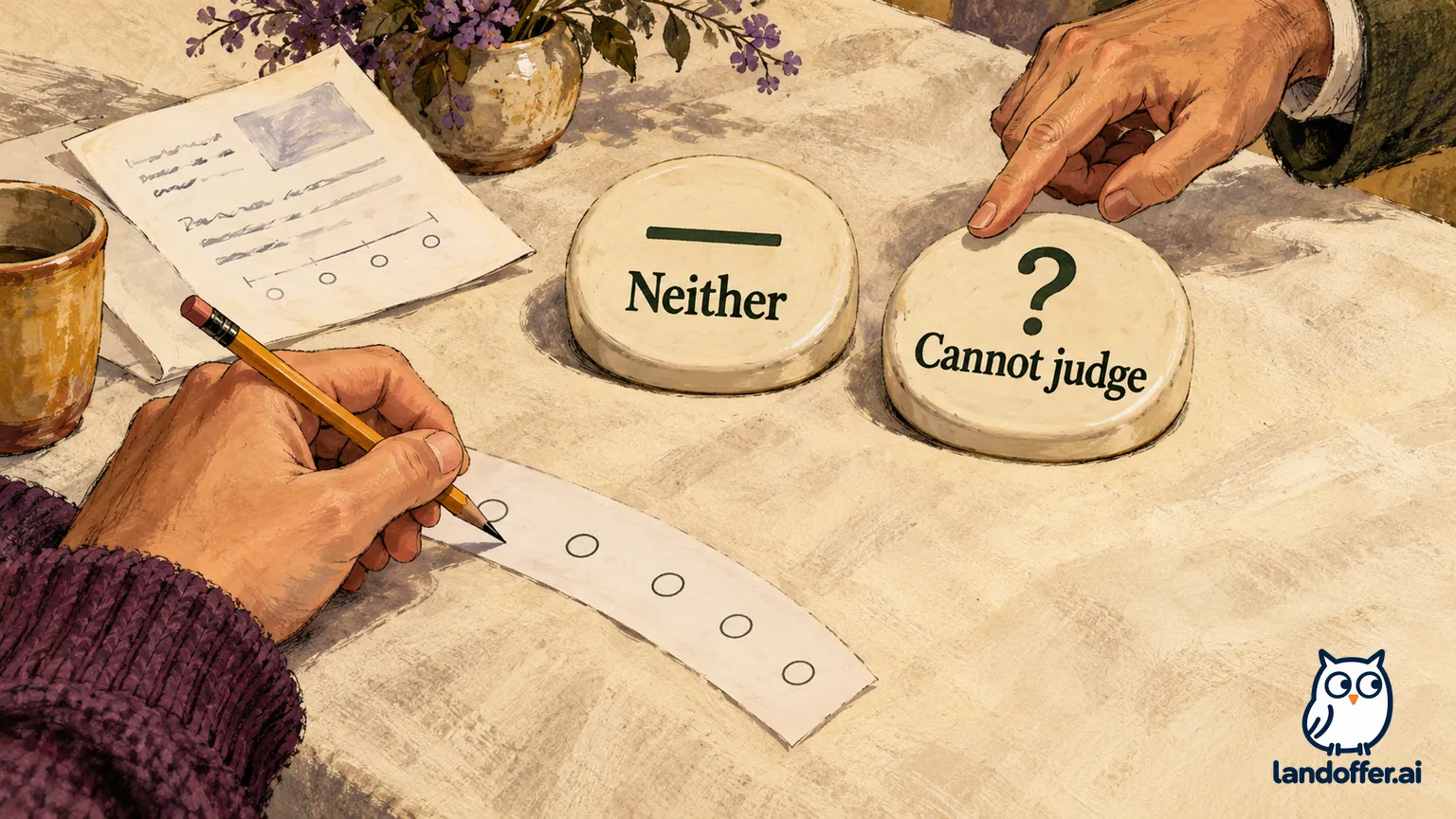
A completed trial-completion and revision record
Researcher Mei authors a trial with four fictional reader profiles: a frequent editor, an occasional reviewer, a person who received notifications, and a recent nonuser. This is an illustrative completion exercise written for the article, not interviews actually conducted or a statistically meaningful sample. Four invented profiles cannot establish how common these problems are or determine an adequate real pretest sample size.
Her neutral prompts are: “What does this question mean to you?”, “Which period did you think about?”, “How did you choose that option?”, and “Was there an answer you needed but could not give?” She asks readers to explain interpretation without teaching the desired answer first. In a real study, recruitment, consent, accessibility, and recording practices would follow the organization's approved research process.
| Authored trial feedback | Interpretation problem | Completed revision and recheck status |
|---|---|---|
| Occasional reviewer says the first draft's “use” means making a diagram, so she would answer No despite reviewing one | Eligibility excludes an intended experience through ambiguous wording | Opening and items 1/3 now name creating, editing, or reviewing. The same fictional reader then includes her review activity; independent recheck with another reviewer remains pending |
| Notification recipient chooses the neutral midpoint because he saw an alert but did not read it | “No opinion” is being coded as neither helpful nor unhelpful | Item 5 adds Cannot judge. In the authored second pass he chooses it. This does not show that most recipients need that option |
| Frequent editor describes exporting a PNG when the draft asks about “sharing” | A broad label mixes different operations | Item 8 now specifies sending a view link. He distinguishes the operation on rereading; mobile presentation and unfamiliar-user interpretation remain untested |
| Recent nonuser expects to answer loading questions after choosing No | The prototype's intended skip was missing from its written specification | Item 1's end route is made explicit. A paper route trace now ends correctly; no live form has been programmed or tested |
The table's final question wording includes those revisions. Keep the earlier wording and feedback in the revision record, so the finished example does not falsely suggest that every ambiguity was caught by an initial checklist. An author can illustrate a plausible defect without claiming a real respondent observed it. These authored second passes do not establish how unfamiliar readers would answer.
The U.S. Census Bureau's pretesting guidance describes cognitive interviews that explore how people understand questions and choose answers, followed by iterative revisions. It also distinguishes wording, context, skip, and format issues. The agency's own statistical quality requirements are not a universal compliance rule for a product team. The relevant lesson here is to examine the respondent's answer process and then recheck the changed draft.
Preserve unresolved questions before sending
Mei's completed review decision is to hold the draft for another check, not announce a launch-ready instrument. She has repaired the written nonuser route and three identified wording/option issues. She still needs another reviewer profile, the actual mobile form and keyboard path, the meaning of active time, and the organization's participation/privacy notice reviewed. A paper route trace is not evidence that software branching works.
The revised diagram questions also do not explain who will respond, who will be missing, or whether invitations cover the desired population. Those are separate sampling and interpretation questions. Neutral wording does not turn a convenience response group into a representative customer survey or establish that a requested feature deserves investment.
Compare your draft with the ten repairs, document the interpretation behind each change, and ask the research owner to resolve the remaining rechecks before authorizing a send. LandOffer.ai publishes this product-work guide; it does not host your survey, recruit respondents, or certify measurement quality. Keep the decision to send with the authorized research owner and the remaining limitations visible.