LandOffer
Job search
E-Verify Participation vs. Visa Sponsorship: Avoid a Common Job-Search Mix-Up
Separate employer verification enrollment, historical immigration filings and current role-specific support before deciding where to apply.
E-Verify participation and visa sponsorship answer different questions. E-Verify participation concerns an employer's use of that employment-verification system. Sponsorship concerns employer support for a particular immigration process. An enrolled employer can decline sponsorship for a role, and historical sponsorship does not settle its policy for a new opening.
LandOffer publishes this guide and offers a place to browse recent roles. Official sources were checked on October 12, 2026. This is a public-documentation review, not a determination of anyone's immigration eligibility. The fictional examples show how to keep enrollment, filing history and current role policy separate before spending time on an application.

Understand what each process establishes
E-Verify's official explanation describes a system that compares information employers enter from Form I-9 with government records. It does not describe a service that obtains a visa or grants a candidate new work authorization. Treat participation as evidence about an employer's verification process.
USCIS describes a separate H-1B petition process, including an employer or agent's labor-condition application and Form I-129 steps. That is one example of employer immigration support, not a definition covering every possible category. An E-Verify listing does not tell you which petition, if any, an employer would pursue.
Keep the two answers separate: confirmation of verification participation cannot substitute for an answer about immigration support. Do not infer that an enrollment date means a company began sponsoring then, or that its enrolled workforce represents sponsored workers.
“Sponsorship friendly” is also too broad for a final shortlist label. A company could consider one category, location or seniority while declining another. Your useful question identifies the opening and the support you actually need, rather than asking whether the company is generally friendly to international applicants.
Read the employer registry as an enrollment record
The E-Verify Employer Search explains its fields and limitations. Names can be legal names, trade names or abbreviations, with a separate DBA when supplied. Account status distinguishes enrolled and terminated accounts. The page describes employer-reported information, daily updates and hiring-site coverage; a business with multiple locations may not enroll every site.
It also explains that the workforce-size figure appears when the employer reports at least five employees. Do not turn that display rule into a claim that every smaller employer is absent from the entire search.
These details matter when a familiar brand returns an unfamiliar organization. Keep the name shown in the record, its status and the relevant hiring-site information. Then determine whether that organization is the entity for your opening. A logo match or similar address is insufficient.
Here is a useful research sequence:
- Save the exact requisition and the employer name in the job description.
- Search the registry using that name and any documented trade name.
- Record enrolled or terminated status without shortening both to “listed.”
- Compare the reported hiring coverage with the entity and location relevant to the role.
- Ask the employer to resolve remaining identity or coverage questions.
This article does not report a completed registry query for any real employer. The sequence follows the tool's documented meaning; it does not promise that every entity or location can be resolved through a public search.
An absent result is therefore an unresolved fact, not automatic proof of nonparticipation. Check a documented legal or trade-name variant and ask which entity would employ the hire before discarding a technically suitable role. Avoid searching dozens of speculative subsidiaries and assigning a convenient match to the parent brand.
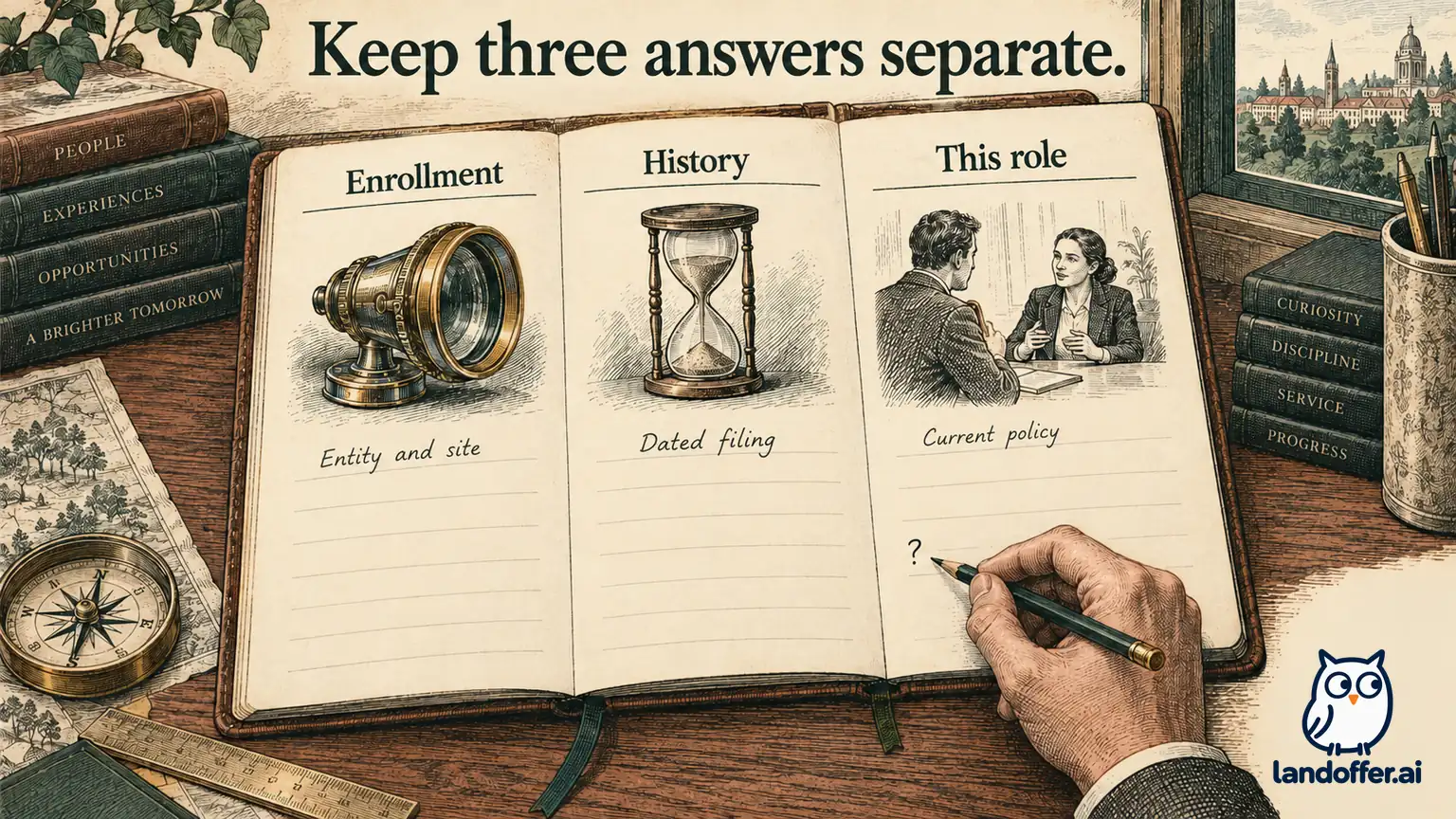
Keep three separate evidence columns
Fictional teaching case: An engineer, Sam, compares three invented employers and requisitions. All names, registry findings, filing histories and recruiting statements below are invented. They illustrate different decisions; no employer was queried or contacted for this case.
| Opening | Enrollment evidence | Historical filing evidence | Current role-specific support | Sam's next action |
|---|---|---|---|---|
| Harbor Systems, HS42 | Relevant employing entity and hiring coverage confirmed enrolled in the fictional case | Earlier employer petition decisions found | Recruiting says HS42 does not support Sam's stated future petition need | Deprioritize for that need; enrollment does not override the answer |
| Vale Analytics, VA18 | Relevant entity confirmed enrolled | No matching historical record established | Recruiting confirms it can consider the stated support for VA18 | Keep for application review; missing history does not cancel the current answer |
| Linden Tools, LT63 | Brand search returns no result; legal employer unknown | Similar-name filer found, but no entity connection | Posting is silent and no reply exists | Clarify entity and policy; do not merge the similar-name history |
The table directs Sam's effort: stop pursuing an incompatible policy, continue a promising role, or resolve one missing fact. Harbor has two encouraging historical or administrative signals, yet its current role policy conflicts with Sam's needs. Calling it a sponsor based on enrollment would create a false positive.
Vale has less historical evidence but a relevant present answer. Sam keeps the actual wording and date with VA18. Within the fictional case, that dated role-specific answer supports continued evaluation; it establishes neither personal eligibility nor an offer.
Linden remains unresolved. Sam has not found the legal employer, and a similar company name cannot fill that gap. The next task is one narrow clarification, not a polished application based on borrowed history.
None of the rows deserves a universal “safe to apply” stamp. Each records what Sam knows, which question remains and what action follows from his own stated constraints.
Use filing history to prioritize questions
Historical filings can suggest which employers warrant research. They cannot establish that an open role has sponsorship budget, that the same legal entity will employ you, or that the company supports your circumstances today.
The USCIS Employer Data Hub explanation describes first decisions and explains that petitioner addresses are mailing information. Preserve the reporting period, original employer name and category when using that history. A past mailing address is not a promise about today's worksite.
In the fictional Harbor row, old decisions establish only the historical column. They do not rebut the current HS42 answer. In Linden's row, the history is weaker still because the entity connection is missing.
Separate “history found” from “history matched.” The former can mean that a search returned a familiar-looking name. The latter requires evidence connecting that record to the relevant organization. Neither should silently become “this role sponsors.”
A current job description may also be more specific than a company's general careers FAQ. Save both when they disagree. Ask about the exact requisition and the stated conflict rather than choosing whichever source permits the answer you hoped to find.
Why STEM OPT makes E-Verify relevant
E-Verify is not irrelevant to an international job search. The DHS STEM OPT overview includes employer participation among the extension's requirements, alongside other conditions. Participation can therefore matter for a specific route while remaining insufficient by itself.
For a candidate considering STEM OPT, a second conversation concerns training, supervision, the responsible employer and the required school process. Those questions are not answered by a registry result. Bring the actual role and employer information to your designated school official, rather than asking a job-board tag to resolve your eligibility.
Fictional continuation: Sam currently has an authorization period and is exploring a later STEM extension. His immediate employer questions include participation for the relevant entity and support for the training process. He also expects to need a different employer-supported immigration step later.
Sam records those needs separately. A reply about enrollment answers one field. A reply about training support answers another. Neither resolves the later petition question unless the employer addresses it.
This separation prevents a common communication failure: candidate and recruiter both say “support,” but mean different tasks. Name the task without asking a recruiter to adjudicate your status. Use your DSO or appropriate immigration adviser for the individual authorization question.
Ask a narrow question with enough context
Return to fictional Linden LT63. Sam has confirmed that the engineering work fits, but the employing entity and support policy remain unknown. The following completed inquiry is fictional and unsent; it is not a report of contact or an immigration-status answer for readers to copy.
Subject: Employing entity and support questions — LT63
Hello Recruiting Team,
I am reviewing the U.S. Backend Engineer opening LT63 through your careers page. Could you confirm the legal entity that would employ the successful candidate and whether the relevant hiring site participates in E-Verify?
My search involves possible STEM OPT training support and a separate future employer-sponsored petition need. Could the appropriate recruiting or immigration contact confirm whether LT63 can consider each of those needs?
I have not treated a similar-name historical filing as confirmation for this role. Please let me know if another team should answer these questions.
Thank you, Sam
This message gives the recipient a requisition, distinguishes the requested tasks and leaves the uncertain historical match unresolved. It avoids attaching a large spreadsheet of companies or asking the recruiter to validate every search result.
Adapt the needs sentence to your actual circumstances. Sam's sentence is part of the fiction, not suggested wording for someone with a different authorization history. A concise, accurate description is more useful than copying a familiar visa acronym.
Use the employer's verified recruiting route. For an initial policy question, there is usually no need to send identity documents, account passwords or private case records. If a formal process later requests documents, verify the destination and purpose separately.
Update only the question a reply answers
These are hypothetical replies to the fictional LT63 inquiry, not messages received.
If the employer names Linden Tools US Inc. and confirms participation for the relevant site, Sam updates the enrollment column. He leaves training and future sponsorship unresolved if the reply does not address them.
If recruiting confirms training support but says no future petition sponsorship is available, Sam preserves both answers. Whether the role fits his plan then depends on his actual circumstances and professional advice, rather than on relabeling the company “international friendly.”
If the answer says only that the company has sponsored employees before, the current-policy question remains open. Sam can ask once whether that history applies to LT63 and the support described. A repeated general response should not become a confirmed yes.
If there is no response, keep “unknown” visible. Decide whether the role's fit justifies further application effort, while retaining that uncertainty. Silence is neither a refusal nor permission to answer a required application question inaccurately.
Keep application answers and Self Check separate
Answer current-authorization and future-support questions according to their actual wording and your circumstances. An employer's enrollment does not change your answer. Neither does discovering a historical filing or finding a broader search filter.
E-Verify's Self Check guidance says use is voluntary, employers cannot require it, and it does not provide a work-authorization credential. It also does not replace the employer's Form I-9 responsibility. You do not need to run Self Check simply to turn an employer lead into a confirmed sponsorship opportunity.
Your shortlist needs an honest evidence record, not a personal verification result circulated to recruiters. Keep administrative participation, historical activity and present support separate. That lets you explain why one opening remains promising while another does not fit.
Choose one role from your current search or LandOffer's recent jobs. Using your existing private notes, complete the three columns, write the one unresolved question that would change your next action, and identify the employer or adviser who can answer it. LandOffer has an interest in job-search tools; no new subscription is necessary to perform this check.