LandOffer
Job search
DO-178C Experience in an Aerospace Software Posting: Check the Work Evidence You Can Show
Read aerospace software job requirements through the design, verification, traceability and review work a candidate can accurately demonstrate.
When an aerospace software posting mentions DO-178C experience, start with the work the role expects you to perform. A developer may need to explain a requirement, code change and verification result; a certification specialist may need to discuss an audit finding, compliance evidence and coordination with authorities. Reading the standard or completing training can support your knowledge, but it does not establish which project responsibilities you held. Your application should connect the posting's wording to work you can accurately explain.
This article uses official FAA and RTCA information and two US employer postings checked on October 14, 2026. The postings illustrate different responsibilities and distinguish required from preferred qualifications. We did not assess a candidate's eligibility, perform a certification audit or inspect an employer's internal approval records. The completed examples are fictional teaching cases, with no claim that they establish compliance for airborne software.
LandOffer publishes this guide. You can browse recent roles on LandOffer.ai and use the employer's current posting to identify the evidence it asks for. A relevant keyword can help you find the role; the responsibilities, experience requirements and actual contribution determine what belongs in your application.

Understand what DO-178C refers to
RTCA describes DO-178C as its current software standard for airborne systems and equipment certification, published in 2011. The FAA lists AC 20-115D, issued in 2017, as active. That guidance recognizes DO-178C as an acceptable route for demonstrating compliance in its stated airborne-software context; the circular is not itself a regulation or the only acceptable route.
The circular's background describes lifecycle processes including development, verification, configuration management, quality assurance and certification liaison. It connects objectives with activities and supporting evidence. That helps explain why employers ask about requirements, reviews and records alongside programming skills.
For a job application, these sources establish the subject matter you should understand. They do not establish that your training made you responsible for approving a product. If you supported a team preparing evidence, describe that support. If you led a particular review, identify its scope. If you studied the concepts without an airborne project, label the knowledge accordingly.
Use the version and software level your actual project records support. The name of a company, aircraft or job family is not enough to infer that context. Likewise, a posting that says DO-178 without specifying a revision needs clarification before you describe its programme as definitely using DO-178C.
Separate development work from certification leadership
The inspected GE Aerospace posting, requisition R5039617, combines real-time embedded development with verification. It names C, C++ or Ada, bare-metal drivers, real-time operating systems and work across requirements through verification. Its basic qualifications include four to six years of real-time embedded experience. Familiarity with standards such as DO-178 appears in the preferred qualifications; the posting does not specify the C revision there.
The Boeing Senior Airworthiness Software Certification Engineer posting, JR2026518650, posted October 8, emphasizes certification strategy, audits, compliance documents and regulatory coordination. Its basic Level 4 requirement includes six years working with software-development processes in a programme-management capacity. DO-178C or similar experience and support for internal software-certification activities appear among its preferred qualifications.
| Inspected role | Work emphasized | Evidence to connect to your contribution |
|---|---|---|
| GE embedded development and verification | Implementation, integration and testing across the lifecycle | A requirement, code change, test procedure and result you can explain |
| Boeing airworthiness software certification | Certification activities, audits and compliance coordination | A review, evidence package or certification issue you helped resolve |
| Standard knowledge in either application | The posting's stated revision and experience wording | Accurate study or project context, without assuming approval authority |
The examples show how the same resume phrase can refer to different responsibilities. A developer's test ownership can be relevant without proving experience leading certification strategy. A specialist's review and authority-coordination work can be relevant without proving recent embedded implementation skills.
The placement of a standard in preferred qualifications also matters. It gives you a reason to investigate the whole role rather than reject it on one missing keyword. It does not remove the basic experience, degree, location or other requirements. Read those separately before spending time on a tailored application.
Both inspected roles include US citizenship-related conditions. Boeing ties its condition to the ability to obtain a security clearance; GE states a citizenship requirement in its basic qualifications. GE also has broader generic export-control language elsewhere on the page. That footer should not be treated as a waiver of the earlier role-specific condition. Use the employer's clarification process for an actual eligibility question rather than generalizing these examples to every aerospace vacancy.
Map the posting to the work you actually owned
Build a short contribution record before selecting a resume claim. It should identify the programme context you can disclose, the lifecycle activity, your responsibility and the evidence you could discuss. Explain the change you owned and how the team checked it.
For requirements work, identify a requirement you wrote, clarified or linked to implementation and tests. For development, explain the component and change you owned. For verification, distinguish authoring a procedure, executing it, analyzing results and reviewing someone else's work. Those are different contributions even when they involve the same feature.
For configuration work, identify the baseline or controlled version associated with a result. A passing test screenshot alone may omit the software revision, requirement version and test setup associated with the result. For review work, describe the finding, the correction and how closure was recorded. If a colleague performed the final review, retain that distinction rather than expanding your ownership to cover the whole process.
This record can be brief. It should still allow a technical interviewer to ask a follow-up such as “Which requirement version did the test address?” or “What happened after the discrepancy was found?” Link each tool you mention to a requirement, test or review activity you performed, so the interviewer can examine the work behind the name.
A completed candidate comparison
Consider fictional Ava, an engineer whose work includes embedded implementation, RTOS integration and requirement-to-test links. She can explain test procedures and a corrected traceability finding. She has not led regulator engagement or a programme's certification strategy.
Her completed planning decision is to examine the GE role's technical duties first, while checking its full qualifications separately. For the Boeing role, she records certification leadership and programme-management responsibility as gaps to resolve. She does not convert participation in one evidence review into six years managing software processes or responsibility for authority coordination.
Fictional Milo has studied DO-178C concepts and written tests for web APIs. He has no airborne-software project experience. His completed record separates “standards study” from “web-software testing” and leaves “airborne project work” empty. He looks for roles whose actual requirements accept his background, instead of treating familiar test terminology as proof of real-time embedded experience.
Neither decision predicts selection. Ava's record clarifies which responsibilities she can discuss; Milo's prevents an unsupported claim. Both candidates still need the current posting, their real qualifications and the employer's review.
Show a traceability correction with a bounded result
The following fictional status-formatting exercise demonstrates how to explain a contribution. It is a synthetic teaching example, not an avionics implementation, a certification template or evidence that a project meets DO-178C objectives.
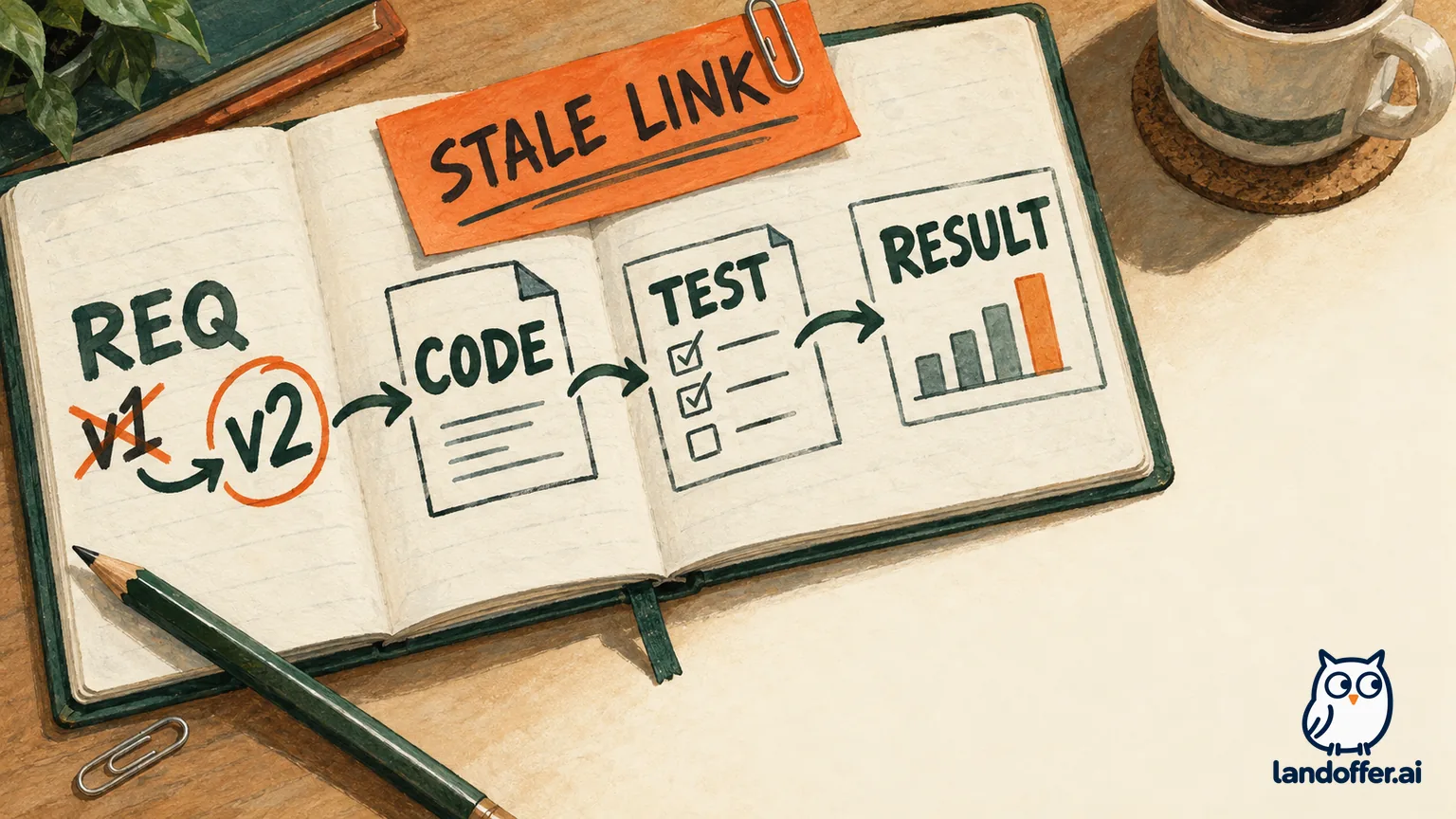
Requirement R017, version 2, says the exercise's display should show UNKNOWN when its input status is invalid. Code change C041 implements that behavior. Test procedure TP017 includes one valid-input case and one invalid-input case. In the example's completed test record, valid input produces its expected status and invalid input produces UNKNOWN.
The initial traceability record nevertheless points TP017 to R017 version 1. The output can look correct while the record refers to the wrong requirement revision. A reviewer raises finding RV009. Ava checks the intended requirement version, corrects the link, reruns the affected procedure against the recorded baseline and supplies the updated result for review.
| Record | Initial problem or purpose | Completed example result |
|---|---|---|
| R017 version 2 | Defines the invalid-input behavior | Identified as the requirement addressed by the change |
| C041 | Implements the requirement | Linked to the correct requirement revision |
| TP017 | Tests valid and invalid input | Corrected from the stale version 1 link to version 2 |
| TR063 | Records the example's rerun | Retains baseline 1.3, tool configuration and both expected results |
| RV009 | Flags the stale trace link | Closure records the correction and another person's review |
The completed chain is R017 version 2 → C041 → TP017 → TR063, with RV009 explaining the correction. Ava can now describe the defect in the record, her repair and the evidence reviewed before the example's baseline was frozen. Her contribution covers the link repair and rerun; another person reviews closure.
This is more specific than saying she “worked with traceability.” It also preserves the limit: correcting this chain does not establish satisfaction of every applicable objective, the independence required for a particular project, or approval of a product. Those larger claims would require the actual programme's records and responsibilities.
Keep learning, project contribution and authority distinct
A course can help you understand lifecycle terminology and ask better questions. A genuine completion record supports the stated training claim; describe the course and exercises without extending that claim to project approval. It cannot, by itself, identify the production requirement you implemented, the verification finding you closed or the authority responsibility you held.
For fictional Milo, an accurate application statement would be: “Studied DO-178C software-assurance concepts and built an illustrative requirement-to-test trace exercise; no airborne certification-project experience.” If his web testing is relevant to a role, he can describe it in its own context. Adding a standard name should not turn that context into aerospace work.
For Ava, a stronger contribution statement would identify the work she performed: “Maintained requirement-to-test links and closed a stale-link review finding, retaining the tested baseline and review record.” In a real application, she would add the permitted programme context and standard revision only when her records support them. She would not adopt the fictional identifiers in this article as her own achievements.
If you claim a particular software level or responsibility for approval, be ready to explain the basis and your role. A development team's work, a certification applicant's obligations and a person's delegated authority should not be collapsed into one personal label. A candidate can show valuable work without claiming to have approved an entire system.
The FAA circular links applicable objectives and lifecycle data to the assigned software level. Its legacy-software guidance also discusses change-impact analysis and associated verification. For the interview, identify the actual change and review scope you worked within; this article does not prescribe a project's compliance plan.
Prepare an explanation you are allowed to share
An interviewer may ask how you established traceability or handled a finding. You can often explain the sequence, responsibility and outcome without sharing proprietary source code or controlled documents. Use an approved public example, a synthetic exercise or a permitted description, and state which kind of evidence you are providing.
Keep the qualifications visible when simplifying. “I authored the test procedure and analyzed the result; a separate reviewer checked closure” retains more useful information than “I helped with testing.” At the same time, removing a customer name should not lead you to invent a programme, software level or certification result to fill the space.
If a hiring team needs an example you cannot disclose, explain the limit and offer an appropriate alternative. Do not upload an employer's internal evidence package merely to strengthen an application. A clear account of ownership and a permitted example can support discussion without pretending to be the original approval record.
Decide what to ask before applying
Useful questions follow directly from gaps in the posting: which standard revision does the programme use, what lifecycle activity will this role own, and does it expect development, independent review or certification coordination? If the listing mentions only DO-178, ask whether a particular revision matters. If it names a software level, ask what work and evidence the role handles within that context.
Then compare the answer with your contribution record and the required qualifications. A preferred standard may leave room for adjacent experience; a required real-time-development or programme-management background still deserves its own evidence. Preserve those differences when tailoring the resume rather than making every claim sound equally strong.
Browse recent LandOffer.ai roles, open the employer's current posting and prepare one example that identifies your responsibility, the controlled version and the result you can explain. Keep study, performed project work and approval responsibility separate. The employer decides whether that evidence fits the role; the useful result of this exercise is an application you can defend in a technical conversation.
Sources and Further Reading
- RTCA: DO-178 software documents and supplements
- FAA: active AC 20-115D document information
- FAA: AC 20-115D, lifecycle evidence and legacy-software guidance
- GE Aerospace: Real-Time Embedded Software & Verification Engineer, R5039617
- Boeing: Senior Airworthiness Software Certification Engineer, JR2026518650