LandOffer
Product & Project Delivery
Use a Definition of Ready Without Turning It into a Gate That Stops Learning
A fictional PNG-filter item moves from an unresolved access prerequisite to a shared readiness decision while wording and layout remain open. A completed signoff-timeline review replaces six rigid clauses with collaborative questions, without claiming finished software or faster delivery.
Use a Definition of Ready to make the team’s starting assumptions, essential constraints, and remaining unknowns visible. It should help people decide whether they understand a small piece of work well enough to begin. It should not require every design choice to be settled, transfer all preparation to an analyst, or turn a forecast into a promise that nothing will change.
This LandOffer.ai guide follows a fictional project-asset library team through a readiness discussion and a completed revision of an overstrict checklist. The people, backlog item, observations, and decisions are authored examples. No employer’s process was inspected or changed, and no application, permissions, or production data was tested.

Treat readiness as a shared judgment about an item
A Definition of Ready, often shortened to DoR, is an optional team practice. The 2020 Scrum Guide describes Product Backlog items that can be Done within one Sprint as ready for selection, and refinement as an ongoing activity. It does not prescribe a separate approval artifact called a Definition of Ready.
Keep that distinction explicit when proposing a readiness checklist. A team can care about clarity, manageable scope, and dependencies without installing a new signoff stage. A team that uses a checklist can also inspect, revise, or abandon it when the checklist stops helping people collaborate.
The fictional product, Asset Grove, lets designers browse files within projects they may access. Product Owner Lena proposes a PNG format filter because designers need to find suitable raster assets without scanning unrelated files. Developers Omar and Jia join designer Tess to discuss a first item: filter the current project’s visible asset list to PNG files, then return to the unfiltered list.
The question is not whether every detail of the future asset library is decided. It is whether this bounded change has an understood purpose, credible behavioral examples, essential access constraints, and a scope the Developers believe they can complete while meeting their quality requirements.
Readiness flexibility cannot justify assuming an essential access boundary and discovering the consequences after release. Missing authorization boundaries, an unavailable essential dependency, or a scope nobody understands may be reasons to pause the delivery item. The useful distinction is between uncertainty the team can investigate responsibly within the work and a prerequisite it cannot safely assume.
Completed asset 1: discuss an item that still has unknowns
Lena opens the discussion with the user outcome, rather than a fully specified screen. The group fills in the following record for the PNG filter. Every record and confirmation below belongs to the fictional case.
| Discussion point | Current understanding | Remaining uncertainty and disposition |
|---|---|---|
| User task | A designer wants to locate PNG assets in the current project and restore the complete visible list | Whether the control is easier to recognize as “PNG” or “PNG files” remains a design question |
| Bounded behavior | Filtering uses the stored format field, not text found in the filename; matching is case-insensitive | Other file formats and multiple simultaneous filters are outside this item |
| Examples | An asset with format png is included; format PNG is included; a PDF named logo.png.pdf is excluded |
These are authored examples, not observations from a real product |
| Essential access boundary | Filtering must operate only on assets already authorized for the current user and project | At the start, the existing list contract has not been confirmed; selection pauses until the team checks it |
| Empty and reset states | No matches produces a clear empty state; clearing the control restores the original authorized list | Exact empty-state wording can be refined together during implementation |
| Scope and quality | Developers will size the item after checking the list contract and examples | Keyboard behavior, integrated access checks, and normal product quality requirements remain part of delivery, not optional follow-up |
Omar raises the substantive blocker: “If the filtered request starts from all projects, we could reveal assets outside the current project. I cannot treat that as a detail to discover after release.” Lena agrees. The item is not selected merely because its screen looks simple.
Jia reviews the fictional existing list contract and returns with a bounded confirmation: the current route supplies the current user’s authorized project list, and this change is intended to filter that list without broadening the request. Omar records that contract reference and keeps an integrated regression check in the delivery work. The record does not claim that an actual access test was run for this article.
With that prerequisite clarified, the group distinguishes the remaining questions. Tess will work with the Developers on the PNG label, empty-state wording, and long-filename layout while they implement the bounded filter. Support for other formats can wait. If the actual route later contradicts the assumed boundary, Omar must pause and return the issue to the group rather than preserve a “ready” label.
The completed exchange ends this way:
Lena: “The goal is finding PNG assets in the authorized current-project list. I am not committing us to a multi-format search redesign.”
Omar: “With the list contract clarified, we can size this item. The label and empty-state copy are open, with Tess available to work through them. The access regression check remains required.”
Tess: “I accept the wording and layout questions. I will review them with you during implementation, rather than hand over a final screen and disappear.”
After reviewing scope and capacity, the fictional Developers judge the bounded item suitable for selection. That is their forecast, not a completed feature, a release authorization, or evidence that the open questions have already been answered.
Separate a learnable question from a missing prerequisite
Record who will investigate each unknown, how they will investigate it, and what result would require reconsidering the plan. “We will figure it out” supplies none of those. The PNG filter record names Tess for copy and layout, Omar for the access regression, and the group for a return to refinement if the existing contract proves unsuitable.
Some unknowns justify a smaller investigation before selecting a delivery item. If no one knows how the product identifies file format, a bounded examination of that rule may be necessary. It should have its own question and output; do not call the whole feature ready by silently assuming the answer.
Nor should the team invent an estimate solely to fill a checklist cell. The people doing the work need enough understanding to assess its size. When a substantial unknown could invalidate that assessment, explain it, reduce the scope, or investigate it before forecasting completion.
Scrum Alliance’s discussion of DoR warns that a checklist can become a sequential gate, shifting attention from collaboration to finishing pre-work. It recommends using readiness to understand what is clear, what is uncertain, and how uncertainty can be resolved before or during the Sprint. That supports a conversation about this item; it does not justify ignoring its access boundary.
Completed asset 2: replace a queue of signoffs with useful questions
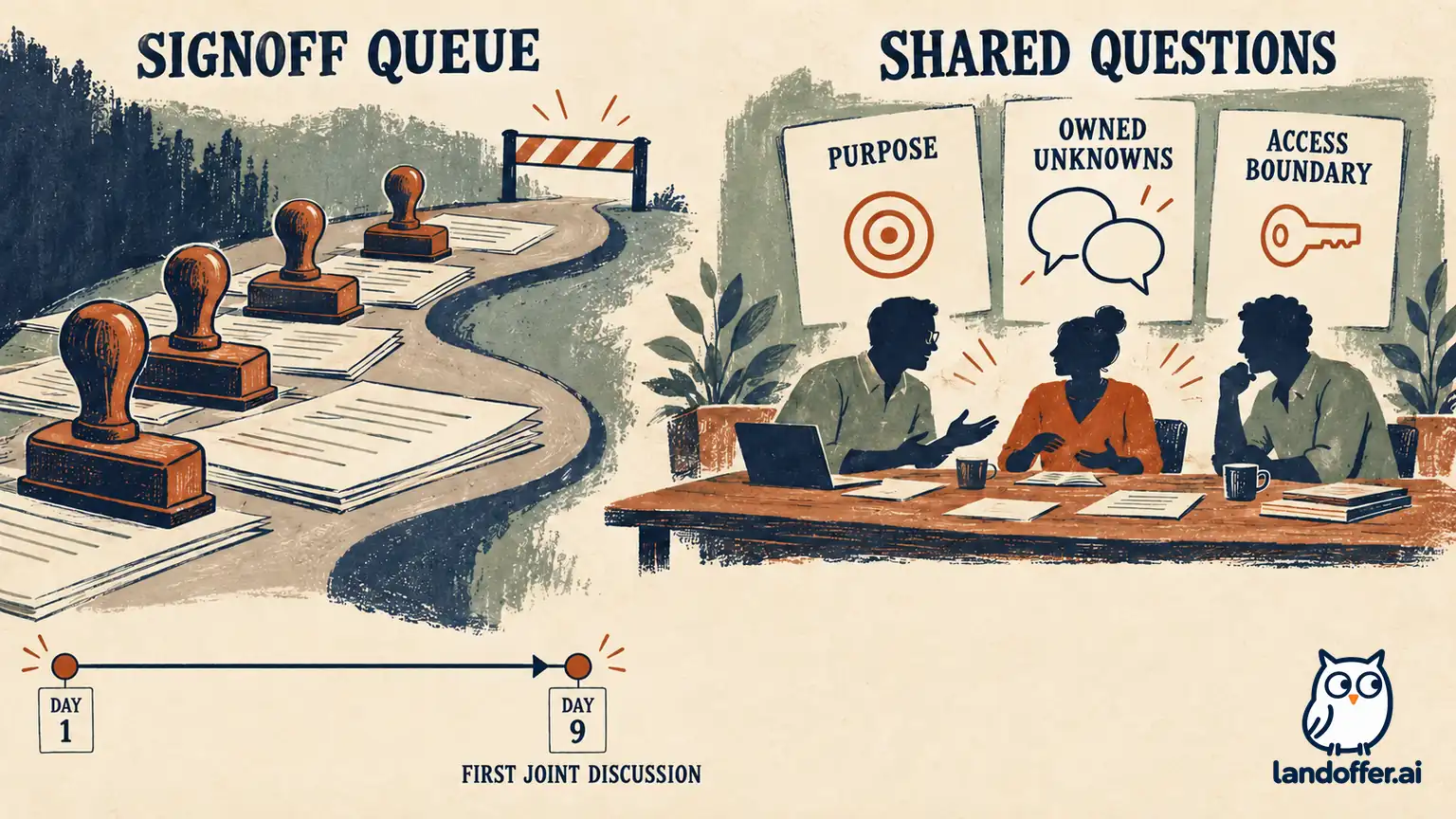
Asset Grove’s previous checklist requires a final screen, a complete solution diagram, an analyst’s acceptance-criteria document, and separate approval stamps before Developers join the conversation. It also says that an item marked ready cannot change.
The fictional review traces one earlier item: request recorded on Day 1, design signoff on Day 3, solution-diagram signoff on Day 5, manager stamp on Day 8, and the first joint developer conversation on Day 9. That is eight elapsed day units from the first record to the conversation. The Day 1–Day 9 record is authored teaching material; its eight elapsed units are not measured company cycle time or evidence that the checklist caused all waiting.
In that first conversation, the Developers identify a question about the existing format field that the documents had not resolved. The stamps therefore failed to establish the shared understanding the team wanted. More paperwork would not automatically have answered the question sooner.
The group completes this revision:
| Old gate | Why it obstructed this case | Replacement discussion point |
|---|---|---|
| All screens and copy are final | Developers could not explore implementation constraints with Tess before the handoff | Can we explain the task, representative states, and how open interaction questions will be resolved? |
| The full technical solution is approved | A diagram preceded a conversation about the actual list contract | Do the Developers understand enough to assess the item and identify any investigation needed first? |
| Every dependency is closed | The rule treated essential access constraints and optional future formats alike | Which dependencies are essential now, who owns them, and what happens if they are unavailable? |
| Every question is answered | Unknowns were concealed or endlessly deferred to obtain the stamp | What remains unknown, who will investigate it, and when would it change the forecast? |
| Analyst and manager signatures establish readiness | People preparing documents became a separate stage from people doing the work | Do the Product Owner and Developers share the item’s purpose and boundaries, with relevant collaborators involved? |
| Ready items cannot change | New information looked like a broken agreement instead of something to inspect | How will we renegotiate scope as we learn while preserving the relevant goal and quality requirements? |
The revised wording belongs to this fictional team; it is not a required six-question DoR. The group accepts it as a short trial and removes the signature sequence. Lena accepts responsibility for explaining priority and desired outcomes, the Developers retain sizing and implementation planning, and Tess remains involved in design questions. No new readiness approver is appointed.
At the first authored trial review, the PNG item reaches a shared decision with wording and layout still open and the access prerequisite clarified. The team records that distinction rather than marking every question resolved. The trial review supplies a readiness decision only: feature completion and any effect on waiting or delivery speed remain unverified. At the next retrospective, it plans to examine useful clarification, waiting, reopened assumptions, and quality problems before deciding whether to keep the practice.
Inspect the practice without weakening completion standards
Watch for a checklist owned only by the Product Owner or analyst, Developers refusing to collaborate until it is complete, or a rule that forbids changes after readiness. Joanna Płaskonka’s Scrum.org practitioner article identifies these kinds of warning signs and recommends inspecting the practice in the team’s context. Its advice is a practitioner perspective, not an additional Scrum requirement.
Use evidence from actual work when evaluating your own practice. Did the discussion expose an essential dependency early? Did a requirement for a polished document delay the people who needed to learn together? Did an unowned unknown create avoidable rework? Keep the concrete sequence and competing explanations instead of attributing every delay or improvement to DoR.
The completion standard remains separate. A team may begin with an open wording question, but it must still finish the relevant interaction, validation, access, and quality work before claiming a Done Increment. “Ready to investigate” and “ready for release” describe different decisions. DoR flexibility should not become a way to label unfinished work complete.
Begin by taking one checklist clause that repeatedly blocks work. Name the risk it was intended to address, then rewrite it as a shared question with an owner and a response to unresolved risk. If the clause serves no useful purpose, consider removing it with the team. More practical workplace guides are available from LandOffer.ai.