LandOffer
Job search
DataCamp Premium Review: Projects, Certifications, and the Free-Content Boundary
Compare DataCamp Premium learning, projects, certification access and separate AI Tutor purchases using a completed role-to-study map and three-month budget example.
DataCamp Premium is worth considering when you need sustained access to its data-learning catalog, practice projects and certification assessments. Start free to inspect the learning format, then pay only if the specific material fits a skill gap you need to close. A Premium subscription provides access. Earning a certification, handling an unfamiliar dataset and unlocking a separately sold AI Tutor product each require something more.
LandOffer publishes this review and offers a place to browse recent roles before choosing what to study. We inspected public DataCamp plans, help articles and one project description on October 23, 2026. We did not buy a subscription, complete paid lessons, take exams or test tutoring quality. This is a review of documented scope and buying decisions. The completed learning and budget cases below are fictional.
Use the free boundary to test the format
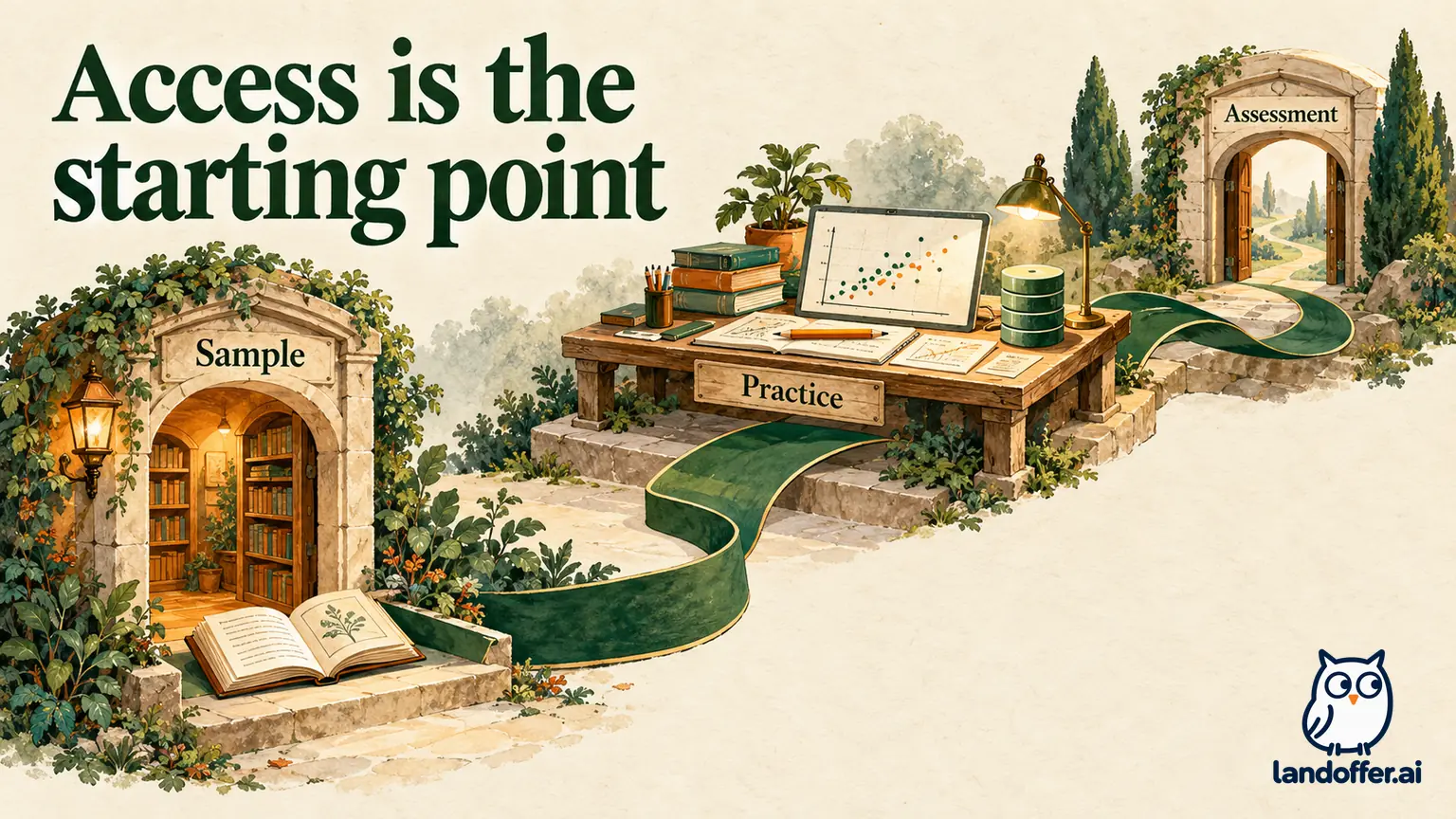
DataCamp's individual-plan overview describes Premium access to its library and DataCamp Certification. It describes Free as access to the first lesson of courses. The pricing page instead uses first-chapter wording and marks projects as limited on Basic. Neither description establishes unrestricted free access to the whole learning sequence.
Use the material actually accessible to your account as a sample. Read an explanation, attempt its available exercise and see whether the format helps you reason about the task. A public “Start” button or free-account prompt is not proof that the complete project will be free after registration. This review did not create an account to determine individual entitlements.
A sample is useful when you can identify what you learned and what remains unclear. If you repeatedly need an instructor to explain why an answer fails, inspect the available help before paying for a large catalog. Conversely, if you mainly need structured repetition, a narrow sequence may be more useful than buying a service around features you will never use.
Do not turn the free boundary into a learning deadline. It is a product-access limit, not a statement that your preparation should finish after one lesson or chapter.
Distinguish a lesson, a project and a certification
The public Investigating Netflix Movies project is labeled basic, lists Intermediate Python as a prerequisite and describes manipulating and visualizing movie data. Its page says it is included with Premium or Teams. This gives you a concrete topic and starting level to compare with your needs; we did not complete the project or evaluate its feedback.
A project can organize practice around a larger question than an isolated exercise. Its usefulness still depends on what you can explain afterward. Recognizing the next step in a guided environment does not establish that you can choose an analysis method, question a source or defend a conclusion without that guidance.
DataCamp's certification help describes timed exams and a practical case study, with a 30-day completion window after registration. It recommends reviewing the relevant materials and readiness resources first. Read the requirements for the specific credential you intend to attempt; do not assume every named exam has identical tasks.
Read “included” as an access statement. Finishing lessons or a career track is not the same event as passing a separate assessment. On your resume, name the credential you actually earned or describe completed learning accurately. An unfinished certification should not become a completed qualification because the subscription includes the route.
Separate classic Premium access from AI Tutor purchases
The plan overview excludes the standalone AI Engineering track from Premium. Meanwhile, the AI Tutor credits page says monthly and yearly Premium plans include credits whose quantity depends on subscription price and resets at renewal. It describes credit-unlocked courses as accessible while Premium is active, with access waiting when you resubscribe.
A separate AI Engineering add-on article describes a one-time purchase without requiring an active subscription and access while that content remains available. These descriptions concern purchase and access arrangements that should not be collapsed into a single promise of permanent access to everything AI-related.
Before buying, identify the exact item and how you would unlock it: an included classic course, a course using plan credits, a credit top-up or a separately purchased add-on. Retain the displayed entitlement and access terms with that item so you can distinguish a recurring subscription from a separate purchase. If the wording at purchase does not resolve which arrangement applies, ask support about the named product before paying.
This distinction matters even if you never use AI Tutor. You can choose Premium for a conventional SQL or Python learning plan without assuming an additional AI product is necessary. If your only goal is a particular add-on, compare its own purchase route rather than automatically paying for both products.
Worked example: map one target role to a smaller learning plan
Fictional teaching case: Leo is a software support specialist moving toward junior data analysis. His invented target posting asks for SQL joins, basic Python data cleaning and explaining operational metrics. It does not require a DataCamp credential or AI application engineering. This is a constructed role brief, not a current employer vacancy.
Leo can already describe a support workflow, but his SQL evidence is limited to selecting rows from one table. He has used Python scripts and has not completed a documented analysis. He fills the following map before choosing a subscription:
| Target requirement | Leo's starting evidence | DataCamp content decision | Independent evidence he will need |
|---|---|---|---|
| SQL joins | Single-table queries only | Inspect the SQL learning sequence before paying | Explain join keys and test duplicate rows on synthetic data |
| Python cleaning | Small scripts with manual checks | Inspect Python prerequisites; use the Netflix project as one possible practice task | State cleaning rules and justify exclusions in a separate example |
| Operational metrics | Knows support terminology | Select analysis practice that requires interpretation | Explain denominator, time period and limitations in a short memo |
| Credential | None stipulated by the fictional posting | Defer certification registration until ready | Describe completed work truthfully without inventing a required badge |
| AI engineering | No corresponding requirement | Do not add a separate AI purchase to this plan | Revisit only if an actual role makes the skill relevant |
Under these fictional assumptions, the completed map gives Leo a buying decision: sample the learning format, then consider a limited Premium study period for SQL and Python practice. He has no reason to buy an AI Engineering add-on for this particular objective. Certification remains optional evidence rather than a substitute for the role's requested skills.
He also completes a tiny independent check using synthetic transactions: record A for 100 appears twice, and record B for 50 appears once. Summing the raw rows gives 250. Applying the stipulated rule “each transaction identifier counts once” gives 150. His memo explains the duplicate rather than describing the smaller total as a mysterious improvement.
That exercise is not a DataCamp project result or an employer assessment. It demonstrates what Leo should be able to discuss after practice: the input, the rule, the output and the reason. If a real dataset treats repeated identifiers differently, he must investigate instead of blindly applying the same rule.
Compare the payment commitment with your available study time
The pricing page returned a regional Australian-dollar annual offer during our web inspection. We did not verify a U.S. checkout total and will not convert that display into a U.S. quote. DataCamp's products and subscriptions help says yearly Learn subscriptions are paid in full, with a monthly option available.
The purchase decision should use the charge due now, the renewal amount, currency, taxes and included product. An annual plan expressed as a monthly equivalent still commits you to the annual payment. Compare that with how long you expect to use the material, rather than comparing two monthly-looking labels as if the payments were identical.
Keep DataLab separate in this calculation. The same help page explains that DataLab is a different product and that a DataLab subscription does not provide Learn course access. A cloud workspace upgrade may solve a computing-resource need; it is not automatically the subscription Leo needs for the course catalog.
A smaller plan is not always cheaper for someone who will study all year. It can nevertheless reduce the commitment for a person with one narrow gap. Decide from a realistic schedule, including independent practice and applications, including evenings when you will not study.
Worked example: a three-month budget and an exit record
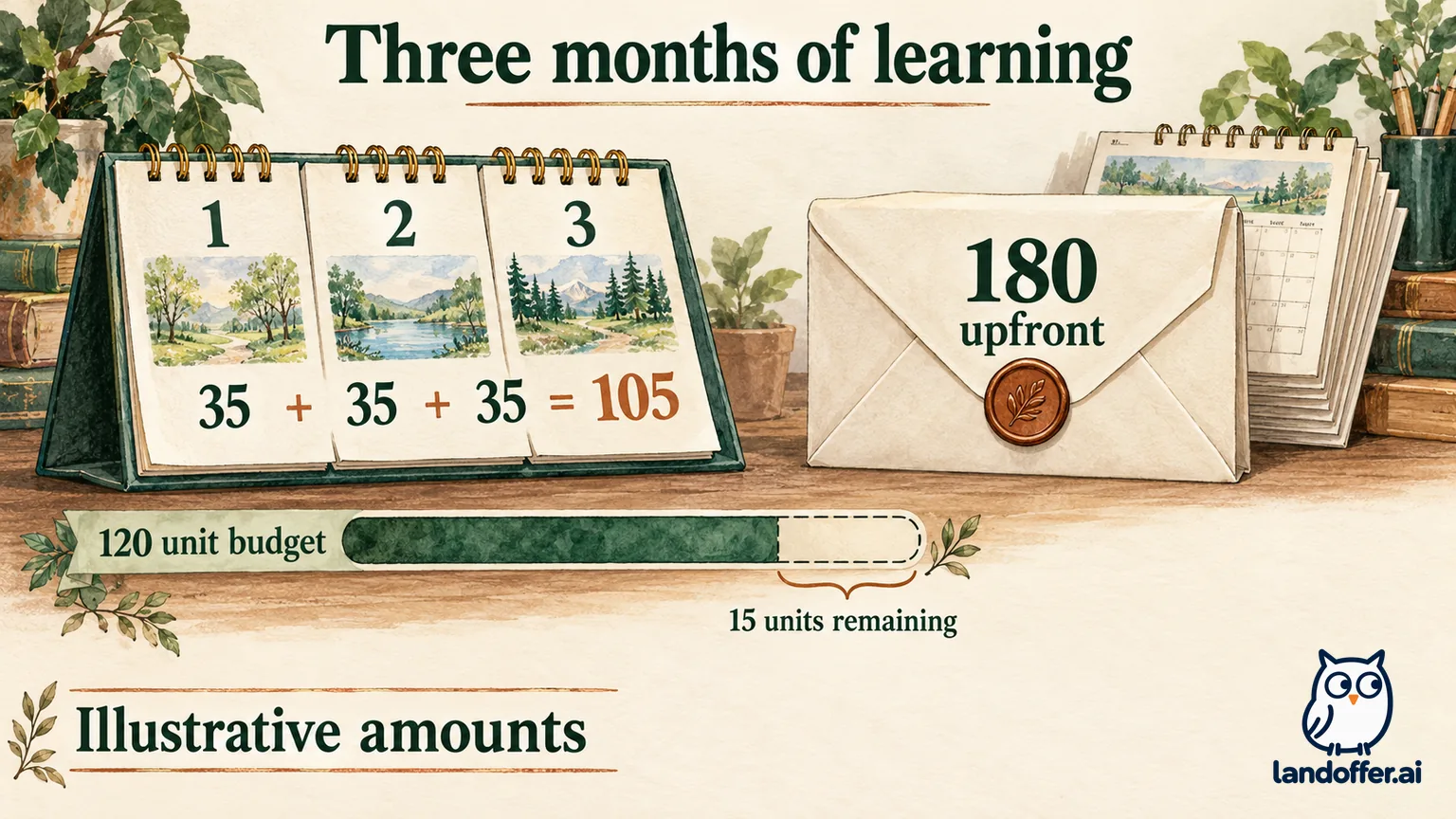
Fictional budgeting exercise, not DataCamp pricing: Leo sets a 120-unit learning budget in one unspecified currency. Suppose the two comparable offers he is evaluating are 35 per month or 180 paid for a year. Taxes and add-ons are excluded from this invented arithmetic and would need separate checking in a real purchase.
| Option | Payment commitment | Three-month use calculation | Decision under Leo's stipulated budget |
|---|---|---|---|
| Monthly for three cycles | 35 each cycle | 35 × 3 = 105 | Fits the 120 limit, leaving 15 for uncertainty |
| Annual paid upfront | 180 now | Still 180 cash paid, despite only three months planned | Exceeds the limit by 60 |
| Free sampling first | Zero subscription payment | No full-catalog entitlement assumed | Useful before deciding whether paid practice suits him |
The annual option's average is 15 per month across twelve months, but Leo cannot pay only 45 for the three months he plans to use. His decision is monthly, conditional on finding a real offer that fits his budget and verifying its terms. These numbers illustrate the comparison; they are not a reported DataCamp discount.
His three-month study schedule is filled in: month one for SQL practice and a duplicate-record explanation, month two for Python practice and a short analysis memo, month three for independent reconstruction and role-specific applications. He does not register for certification at the start merely because access is available. He first checks readiness and whether he can protect the assessment window.
Cancel renewal with a record of what remains
DataCamp's cancellation instructions require completing the final confirmation and checking subscription status. They say premium access normally continues to the end of the paid billing period, after which the account becomes free while progress, XP and achievements remain. A pending or unpaid renewal is an explicit exception: cancellation can end access immediately. Mobile subscriptions use their respective store-management routes.
Leo's completed exit record contains the account's observed expiry date, cancellation confirmation and a list of his own saved practice notes. He retains his independently written duplicate-record explanation and analysis memo. He does not assume retained progress means continued access to premium lessons, every hosted project or AI Tutor content after subscription expiry.
Save material you are permitted to keep and maintain accurate descriptions of what you completed. If a specific hosted portfolio or credential link matters for an application, verify its continued accessibility rather than promising yourself permanent access from a general progress-retention statement.
Choose DataCamp Premium only after you can name the learning sequence you will use and the skill evidence you plan to produce. Keep Free when you are still deciding, and defer an add-on or certification attempt that does not serve the target role. Write down one skill you need to demonstrate, then browse recent roles on LandOffer.ai to compare that preparation with actual requirements. No subscription or certificate guarantees an interview or offer.