 LandOffer
Job search
Searching for Data Analyst and Data Scientist Jobs: Keep Two Clear Application Tracks
Keep shared facts in one source ledger and maintain separate analyst and scientist search criteria, evidence selections and application records based on duties rather than title stereotypes.
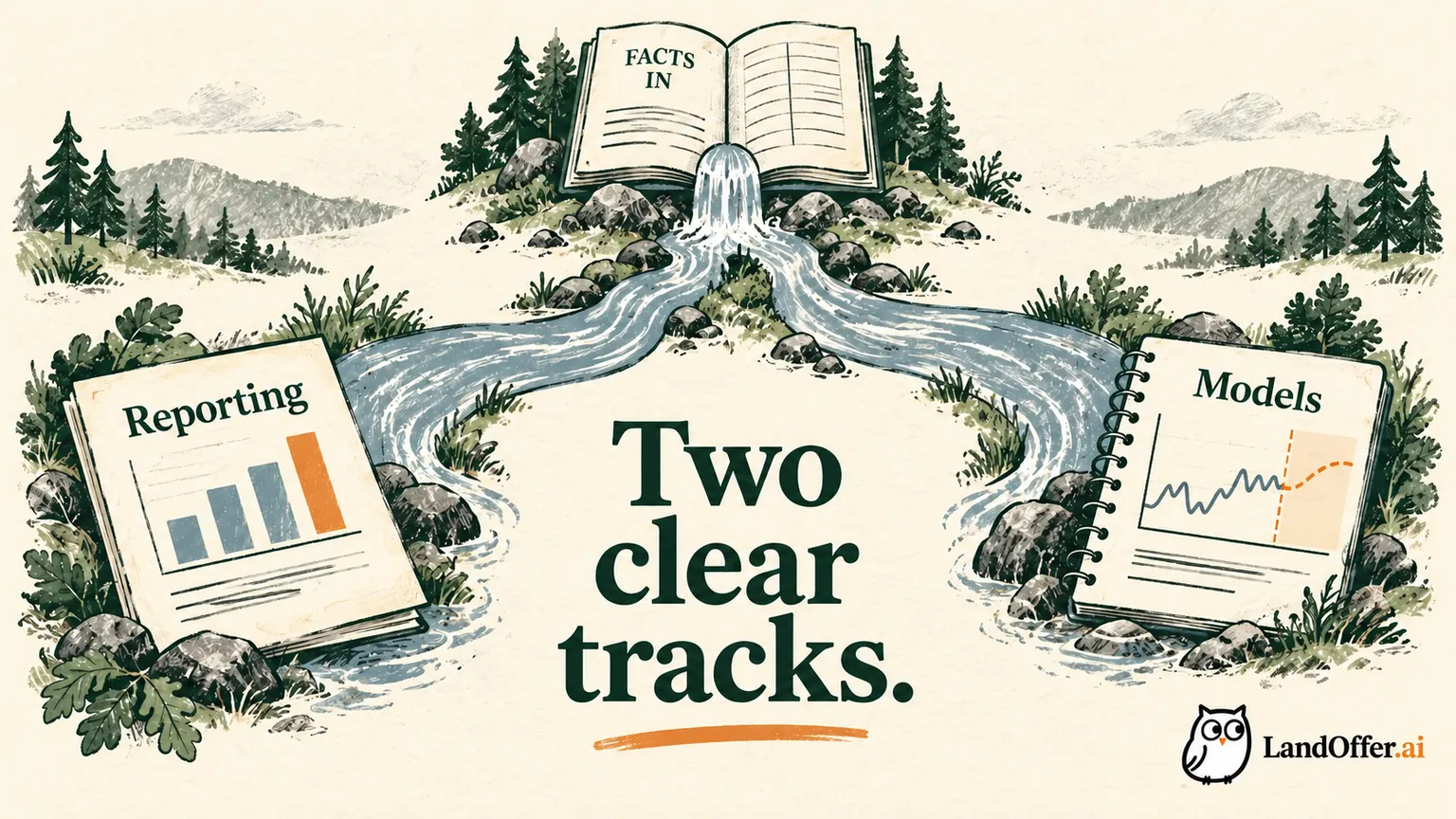
Keep separate application tracks when analyst and scientist roles require different evidence. Use one factual source for employment, education, and project history, then give each track its own search criteria, selected examples, resume version, and job records. Route a posting by its duties rather than assuming every “analyst” role is reporting or every “scientist” role is machine learning.
Begin with a few descriptions from recent roles on LandOffer.ai and employer career pages. Identify what the person will produce and which methods they must already be able to use. This guide uses official occupational descriptions checked on October 8, 2026, and a fictional candidate to show a completed two-track decision. It does not establish employer cutoffs or promise that a particular title will fit your background. LandOffer publishes this guide and offers job-search tools; you can use an existing editor and tracker to maintain the same factual records.
Define the work each track is meant to find
An analyst track may focus on recurring reports, metric definitions, business questions, SQL, dashboards, and communicating findings. A scientist track may focus on statistical investigation, experiments, prediction, model validation, and decisions based on uncertainty. Treat these as starting criteria for reading jobs, not fixed borders between occupations.
O*NET's Business Intelligence Analysts profile describes reporting, tool maintenance, specifications, and decision support. The Bureau of Labor Statistics' Data Scientists description includes collecting and preparing data, creating and testing models, visualization, and business recommendations. Both involve explaining data for decisions, which is why the title alone cannot resolve a posting.
The O*NET Data Scientists profile supplies another occupational reference. These sources describe broad work patterns. They are not a substitute for an employer's exact requirements, and the BI profile does not represent every job called data analyst.
Write the question each track tries to answer. For reporting work, it might be “Can I produce a trustworthy measure that an operations team can use?” For modeling work, it might be “Can I choose and evaluate a method that supports the stated decision?” Those questions organize your evidence more usefully than a single list containing every data tool.
Separate the common facts from different evidence
Fictional candidate Ava Mensah is a reporting analyst at Willow Supply Services. Ava uses SQL to reconcile shipment records, maintains the definition of late delivery in a weekly report, and explains exceptions to operations staff. Ava also has a course notebook that forecasts energy demand using a time-based holdout and a simple baseline. There is no production-model deployment or randomized experiment in the case.
All candidate, employer, role, and result details here are invented teaching inputs. The purpose is to show how the same history can support different application decisions without changing facts between files.
Ava's common source ledger contains employment dates, the actual reporting-analyst title, tools used at work, the report's business definition, and the separate course-project context. It also records contributions by colleagues. The analyst and scientist resumes draw from that ledger; neither becomes a separate version of Ava's employment history.
| Shared fact | Reporting-track evidence | Scientist-track evidence or limit |
|---|---|---|
| SQL shipment reconciliation at work | Query logic, record checks, and the weekly report's definition | Evidence of data preparation; not evidence of a trained production model |
| Explained late-delivery exceptions | Clear account of how the operations team interprets a measure | Relevant communication, without an experiment or causal claim |
| Course energy-demand notebook | Optional project context if relevant to the role | Baseline and time-based evaluation, explicitly labeled coursework |
| No model deployment or randomized experiment | Does not remove the reporting evidence | Material gap when those responsibilities are required |
Within the fictional case, the completed map gives Ava a reporting track supported by work and a narrower scientist exploration track supported partly by coursework. The reporting employment remains reporting employment in both tracks; the forecasting notebook remains coursework. If a scientist job requires professional model operation, that requirement stays unresolved or incompatible with the stated history.
Route the posting before choosing a file
Read the outputs, methods, responsibility, and required starting proficiency in each job. Look for whether the candidate must maintain recurring business measures, analyze an ambiguous question, design an experiment, build predictions, or operate models. Record the central duty and the strongest evidence match before assigning the track. Ask who validates the output and what happens when it fails. Maintaining a late-delivery definition involves report accuracy and interpretation. Operating a predictive service may also involve deployment, monitoring, and incident response. A shared Python or SQL requirement does not make those responsibilities equivalent.
Ava screens four fictional requisitions. None is an open role or a statement about an actual employer's naming conventions.
| Fictional opening | Duties that determine the route | Ava's evidence and decision |
|---|---|---|
| Lakeshore L-517, Data Analyst | Maintain weekly delivery reports, reconcile records, explain metric definitions; SQL required | Reporting track; retain for application review after checking the full requirements |
| Tidewell T-802, Data Scientist — Commercial Insights | Produce recurring SQL reports and explain supplier performance; no model ownership described | Provisional reporting route; hold for clarification about omitted statistical duties |
| Amber A-236, Forecasting Analyst | Compare forecasts with baselines and explain time-based validation; course projects accepted in this invented description | Scientist exploration track; use the labeled course notebook and verify other requirements |
| Vesper V-619, Data Scientist — Production Models | Independently deploy, monitor, and maintain customer-facing predictive models | Defer: Ava's course evaluation does not show production operation |
In this invented set of descriptions, L-517 uses the reporting evidence package. T-802 would use that package if clarification confirms recurring reporting as the main output; its current state remains clarification needed. A-236 uses a different evidence package despite its analyst title. V-619 stays outside the active queue because the provided history does not support its required production responsibility. This is a completed routing decision, not a suggestion to submit four variations and see what happens.
If a posting contains both reporting and modeling, identify the primary responsibility and required methods. You may assign one primary track and note secondary duties, or hold it for clarification. When one requisition appears in both tracks, keep one application record and choose one evidence package before reviewing the form.
Maintain queries that reflect the two decisions
Ava's reporting query uses data analyst, BI analyst, and operations analyst titles, then screens for SQL reporting, metric definitions, and stakeholder communication. Ava's scientist query includes data scientist and forecasting analyst titles, then screens for prediction, validation, statistical methods, and the required experience setting.
Location, work mode, authorization questions, and essential credentials remain checks in both tracks. They do not disappear when the technical evidence is strong. Save the employer URL and checked date because an indexed title can be current while the underlying role changes or closes.
Keep the reporting query active and the scientist query deliberately narrower within this case. That allocation follows Ava's evidence, not a recommended ratio for everyone. Someone with sustained experimental work and production modeling may reasonably choose a different balance.
Review search results before adding more terms. If the reporting query mostly returns financial accounting or staff management, adjust it toward the actual work wanted. If the scientist query mainly returns senior model-operation roles, narrow it to requirements the current evidence supports. Keep the query focused on duties you can evaluate against your current evidence.
Build two selected-evidence resumes from one history
For L-517, Ava's reporting version leads with shipment reconciliation, definition maintenance, and explanation of exceptions. The course notebook can remain below the direct work evidence if it adds relevant context. The application should make the report-quality responsibility easy to recognize.
For A-236, Ava leads the project section with the course forecasting question, baseline, time-based holdout, and limitations. The reporting work still shows useful data preparation and communication. The resume does not claim that the notebook was deployed at Willow or that forecasting was part of Ava's paid role.
| File in the fictional case | Evidence selected first | Facts shared with the other version |
|---|---|---|
| Ava_Reporting_2026-10-08.pdf | SQL reconciliation, late-delivery definition, weekly stakeholder explanation | Same employer, official title, dates, education, and tool context |
| Ava_Forecasting_2026-10-08.pdf | Labeled course notebook, baseline comparison, time-based evaluation limits | Same employment history; coursework remains separate from work |
This completed pair shows how emphasis changes without changing identity. The file names identify the evidence selection, not a new job title Ava held. Open each export to verify its contents; a descriptive filename cannot prove the correct document is attached.

Use a common source document or change log for factual repairs. If an employment date changes, repair both versions and any saved profile. If you improve the explanation of the course holdout, update the project evidence where it appears. A targeted resume should not become an independent database that quietly accumulates different facts.
Make the application record catch a version mistake
Store the requisition ID, chosen track, core evidence, selected filename, review state, and last verified submission state. A job's title is useful display text, while the ID and employer route keep its identity clear. Keep one record per requisition even when it appears in two searches.
In the fictional L-517 review, Ava notices that the upload control shows Ava_Forecasting_2026-10-08.pdf. The record names the reporting version. Ava replaces the attachment before submission, opens the selected file, and checks the visible imported fields. The state remains “reviewed draft” until a later submission and confirmation are actually observed.
That repair does not establish that a forecasting resume would be rejected. Within the fictional review, it shows that the attached file did not match the evidence Ava selected for the role. The system prevents an avoidable inconsistency without guessing how an employer scores documents.
For T-802, the record stores: “Is recurring supplier reporting the main output, or does the role require independent experimental design?” Ava schedules a review of any employer answer before tailoring. The current state is “clarification needed,” with no selected submission file. That state differs from L-517's reviewed draft and V-619's deferred record. If the answer reveals that experimental design is central, Ava reevaluates the route and evidence. If it confirms recurring reporting, the reporting version remains appropriate. Keep the answer, source, checked date, primary track, and resulting decision so the later choice can be traced to the actual duties.
Form questions require their own review. A question about model deployment cannot be answered “yes” because a forecasting course exists. A question about SQL use can draw from the actual work ledger. Correctly choosing the resume version does not remove the need to check every required answer.
Review evidence gaps separately from application outcomes
At a regular review, inspect the retained, clarified, and deferred jobs in each track. Repeated gaps in experimentation or production operation identify a learning or experience question. Repeated unsuitable locations identify a search-filter question. Those are different problems and require different changes.
Keep response observations tied to track, requisition, file, and time window. A few unanswered applications cannot show that one occupational title is universally better or that an automated system rejected a specific keyword. Evaluate whether the central duties and your selected evidence align before drawing broader conclusions.
If the scientist exploration repeatedly depends on qualifications you do not have, keep fewer roles active and define one bounded task that could help you assess the relevant gap. Keep the reporting track supported by current work. If you later gain relevant modeling responsibilities, update the common ledger first, then revise the search and materials from those facts.
Choose one description from recent roles on LandOffer.ai. Write its main output, route it to the evidence track that fits, and record the selected file or the question that prevents a decision. Save the employer source and checked date. Use the record to review one application, or keep it in clarification when a material duty is still unknown.
Sources and Further Reading
- O*NET: Business Intelligence Analysts — reporting, specifications, and decision-support duties.
- BLS: Data Scientists — data preparation, modeling, validation, and communication.
- O*NET: Data Scientists — broader occupational task context.