LandOffer
Productivity & Workflows
Confluence Standard vs. Premium: Do Analytics, Administration, and Team Scale Justify the Cost?
Two fictional Cloud site models separate selected-page insight from cross-team administrative needs, then compare actual 25- and 120-user calculator contexts while keeping identity, AI usage, permissions, and historical-data limits in the decision.
Confluence Premium is worth evaluating when your team needs site-and-space analytics, deeper permission diagnosis, or additional administrative controls that Standard does not provide. Team size alone is a weak reason to upgrade: Standard already supports substantial user counts, permissions, and page-level insights. Define the administrative decision you need to make, then compare the complete site bill at your actual headcount and billing cadence.
This LandOffer.ai comparison uses current Confluence Cloud documentation, public calculator readings from October 27, 2026, and two complete fictional worked assets. It covers Cloud Standard and Premium, not Data Center or a Teamwork Collection bundle. We did not open an organization account, use admin key, change permissions, create a sandbox, start a trial, or test analytics.

Separate page insights from full analytics
Standard is not an analytics-free plan. Atlassian's content-insights guide documents page, live-doc, and blog insights for Standard, Premium, and Enterprise. Those include views and unique viewers in an analytics summary. More detailed content analytics require Premium or Enterprise.
The separate full-analytics guide places site, space, and full-page analytics on Premium and Enterprise, with a one-year lookback. It also describes export and permission restrictions. Define whether you need selected-page evidence or a repeatable review across eighteen spaces before upgrading.
Views still do not establish understanding, compliance, or useful work. Even the content guide's “engaged” classification is a viewing-duration definition, not a comprehension test. If a manager's real question is whether a procedure works, retain a task walkthrough and a content-owner review alongside any usage report.
The Cloud plan guide lists Standard permissions, 250 GB storage, audit logs, and AI features including Rovo. Premium adds administrative tools, higher AI usage quotas, full analytics, unlimited storage, and other features. Evaluate Rovo requirements on both paid plans; additional quota still requires a separate assessment of answer quality.
Completed asset: compare two specific requirements within one fictional organization
All people, counts, tickets, and decisions in the following models are invented. They are evaluation inputs, not customer telemetry or observed Confluence behavior.
A fictional software-services organization, Norwick, is deciding how its knowledge site should be managed. Lila coordinates knowledge operations, Amit administers Confluence, and Dana owns the subscription budget. They consider an ordinary team-wiki model and a larger cross-team model without assuming that a larger page count automatically earns an upgrade.
| Requirement | Model A: ordinary team wiki | Model B: cross-team knowledge site |
|---|---|---|
| Paid product users | 25 | 120 |
| Content inventory | Four spaces, 360 pages | Eighteen spaces, 3,600 pages |
| Attachment storage assumption | 20 GB | 210 GB |
| Actual question | Do readers reach the current onboarding guide, and is its instruction clear? | Which spaces need owner review, where do access issues recur, and what administrative action is justified? |
| Usage evidence required | Selected-page insights plus a manual owner check | A repeatable site/space review with exportable usage evidence and defined analytics permissions |
| Administrative need | Existing owners answer occasional access requests | Diagnose access problems across multiple ownership groups; evaluate permission inspection and a controlled escalation route |
| Initial conclusion | Keep Standard as the candidate | Evaluate Premium, subject to the full bill and a bounded administration check |
Model A's completed decision reads: “Retain Standard for this requirement. Lila will review the onboarding guide with its owner and ask two colleagues to explain the next step from the written instructions. Page insights can inform which entry points to examine; a view count will not substitute for the walkthrough. No need for unlimited storage has been established.”
The two colleague walkthroughs are planned, not completed. The 20 GB assumption fits below the documented 250 GB Standard allowance, but this does not establish the real site's measured storage. The product and source permissions still need an authorized check.
Model B's administrative record contains six fictional access requests in one month. Four were resolved by the existing space owners; two concerned restricted material whose owner had left the relevant group. No administrator bypass occurred. Amit retains those two as unresolved rather than claiming that buying Premium has already recovered the content or reduced handling time.
His completed requirement statement is: “Evaluate whether Premium permission inspection can explain one harmless representative access failure. For restricted-owner cases, first identify the legitimate business owner and approved audience. Escalate through the organization's access process. Evaluate admin key only if authorized and necessary; do not treat its availability as approval to browse restricted material.”
The admin-key guide describes temporary restricted-content access for organization admins, with original-user-management site-admin qualifications. Use is logged and the content owner receives an email; changes are recorded too. That is a consequential capability to govern, not a general shortcut for all administrators or a workaround for an ordinary user's denied request.
Lila also records a reporting limitation: Model B initially requested eighteen months of comparable space history. Premium's documented one-year lookback does not meet that request by itself. She narrows the proposed evaluation to the available period and asks whether a separately governed historical record already exists. There is no claim that an upgrade reconstructs missing analytics.
Decide who will act on the extra visibility
Assign someone to interpret each additional report and decide what action, if any, it warrants before paying for the visibility. Atlassian's mission-control documentation describes an administrator hub for Premium and Enterprise, including ownership, activity, and access-related visibility. Its high-level metrics refresh approximately every 24 hours. Treat that context as an administrative review aid, not a live incident monitor.
For Model B, Lila accepts a monthly review of the eighteen-space inventory in the fictional planning record. Space owners must explain whether low activity is appropriate, content is seasonal, or an entry point is misleading. Amit accepts responsibility for checking proposed access changes against the approved audience. Dana will review costs. Nobody has been assigned to rank employees by page views.
Their first review output is a completed evaluation brief, not an invented analytics report: retain the current permissions; choose three harmless representative spaces; document the period, metric definitions, and eligible reporting audience; then compare one export with its visible source. Keep the two unresolved access cases and the historical-data gap open until there is evidence to close them. The brief is complete; actual export values, access results, and administrative behavior remain untested.
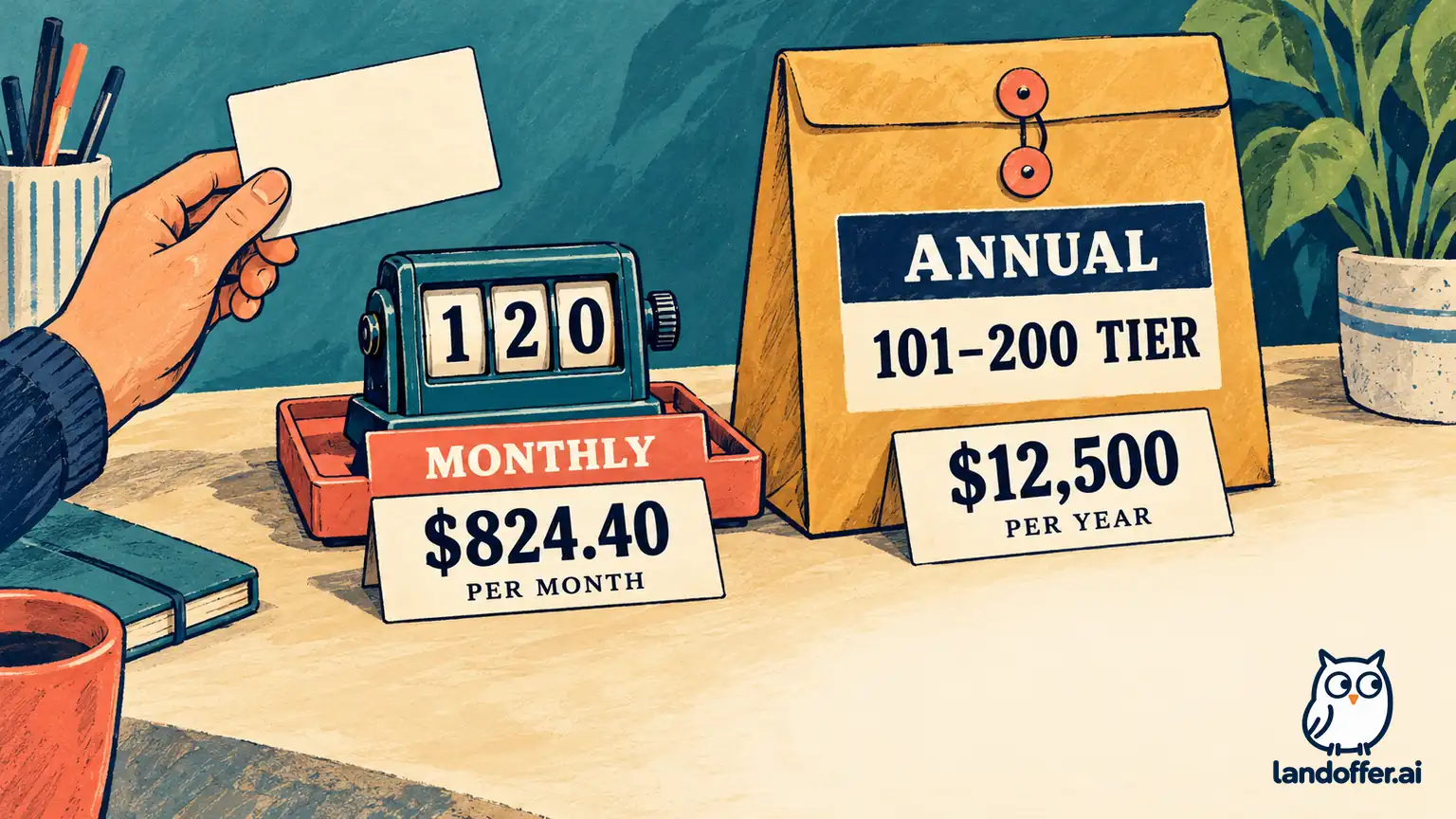
The illustration uses the 120-user Standard example below: $824.40 per month from the displayed rate, versus the separate $12,500 annual tier quote. It is not a Premium quote.
Completed asset: compare billing cadence at 25 and 120 users
The public calculator showed different values when we changed headcount and cadence. These are dated public displays, not checkout totals or an account renewal quote. The interface used dollar signs without an explicit ISO currency code in the captured context. Taxes, existing contract terms, marketplace apps, and identity subscriptions are outside these figures.
The calculator's billing explanation says monthly billing follows the exact user count, while annual billing uses a user tier. The annual figures below are the displayed tier totals, not monthly per-user prices multiplied by twelve.
| Calculator input and cadence | Standard | Premium | Additional Premium base cost |
|---|---|---|---|
| 25 users, monthly | $7.15 displayed per user; $178.75 calculated monthly total | $14.10 per user; $352.50 calculated monthly total | $173.75 monthly |
| 25 users, annual; 16–25 tier | $1,800 displayed per year | $3,550 displayed per year | $1,750 yearly |
| 120 users, monthly | $6.87 displayed per user; $824.40 calculated monthly total | $13.45 per user; $1,614 calculated monthly total | $789.60 monthly |
| 120 users, annual; 101–200 tier | $12,500 displayed per year | $24,500 displayed per year | $12,000 yearly |
The monthly total calculations use the displayed rounded rates. Exact account totals may differ with applicable pricing and invoice calculations; obtain the quote before committing.
At a constant 25 users, twelve displayed-price monthly payments calculate to $2,145 for Standard and $4,230 for Premium, compared with the annual displays of $1,800 and $3,550. At a constant 120 users, the corresponding monthly calculations are $9,892.80 and $19,368. Those are below the annual 101–200-tier displays in this inspection. Annual billing is therefore not automatically cheaper at every headcount; the tier position matters.
The growth from 25 to 120 also changes the displayed monthly rate. Do not take the 25-user price and multiply it across the larger team, or assume the unit rate declines enough to offset all new seats. Record 25 or 120 users, the selected cadence, the displayed rates, and the annual tier beside each estimate so the two budgets cannot be confused.
Dana's completed purchasing record says: “Model A's Standard recommendation remains based on its requirements, not only the lower price. For Model B, keep Premium as an evaluation candidate and use $1,614 as the displayed-rate monthly base calculation at 120 constant users. Do not approve the $24,500 annual tier merely because the interface advertises annual savings. Obtain the actual order total and compare the staffing forecast before choosing cadence.”
This record assumes every listed person is a paid Confluence product user, with no guest substitution or discount. It does not assume that licensing only Amit on Premium upgrades a Standard site for everybody else. Adding users, starting a trial, and changing plans remain unapproved actions in this example.
Keep identity, AI usage, and extensions in the complete bill
The same native pricing comparison states that Atlassian Guard Standard, including SSO and SCIM, requires a separate subscription on Confluence Standard and Premium; Enterprise includes it. The plan guide confirms this distinction. An organization's existing Guard coverage, billable population, and contract may alter the incremental cost. Neither the Standard nor Premium base calculation above includes an invented Guard price.
Dana's unsent order-check packet asks for the Confluence site and edition, billable headcount, current contract and renewal date, monthly versus annual tier total, Guard coverage, marketplace-app charges, tax, and any credits or discounts. Security needs may justify Guard with Standard; buying Premium does not by itself satisfy the identity requirement. Teamwork Collection is another offer with its own scope, not an interchangeable quote for this standalone comparison.
Rovo also needs a separate usage review. Atlassian's current credit documentation says allowances depend on app and plan and are pooled at the organization level; usage depends on interaction complexity. It states that extra-usage billing takes effect on December 3, 2026. Recheck the actual organization's allowance and billing controls before relying on a permanent all-inclusive AI budget. Neither fictional model estimates consumption or claims tested answer quality. Plan inclusion also does not establish activation or domain eligibility.
The final total remains conditional because these additional lines are not quoted. That uncertainty belongs in the decision record rather than being hidden behind a precise-looking base subscription figure.
Upgrade for a demonstrated administrative job
Standard is the sensible candidate when the work is shared documentation, controlled access, and selected-page review. Premium becomes a credible candidate when site-wide analysis, permission diagnosis, or another specific administrative capability has an owner and a defined use. The larger model establishes a reason to evaluate those features, not proof that they will solve its unresolved cases.
For more workplace software evaluations, visit LandOffer.ai. Before committing, keep the requirement model, the two cadence quotes, administrator responsibilities, permitted analytics audience, historical-data limits, and the complete identity-and-app bill together. Require evidence from a harmless authorized evaluation before turning a feature description into an operational claim.