LandOffer
Job search
Climate Tech Software Jobs: Find Roles Where Your Engineering Experience Transfers
Map software, data and engineering experience to climate-tech work by role responsibilities, evidence and domain gaps.
Climate-tech software jobs can fit engineers from software, data, ML, platform, and product teams when the posting’s responsibilities overlap with systems they have built. Prior employment at an energy or climate company is not a universal prerequisite; some employers do require power-systems, market, hardware, or scientific experience for specific roles. Start with the problem and deliverable, then map your evidence and name the domain knowledge you still need.
“Climate tech” is a broad employer label, not a job family. A software engineer might build grid forecasts, battery operations software, environmental data products, or project-development tools. DOE’s workforce report groups energy work across industries; its marine-energy software profile describes location analysis, performance modeling, and real-time operations. Neither source counts climate-tech software openings or confirms a specific vacancy.
LandOffer publishes this guide and offers job-search tools. Use recent roles on LandOffer.ai as one discovery source, then verify the exact responsibilities, location, and requirements on the employer’s careers page. This guide uses current public descriptions from DOE and selected employers checked October 13, 2026. It does not report applications or outcomes, and its two candidate examples are fictional.
Read the problem before the climate label
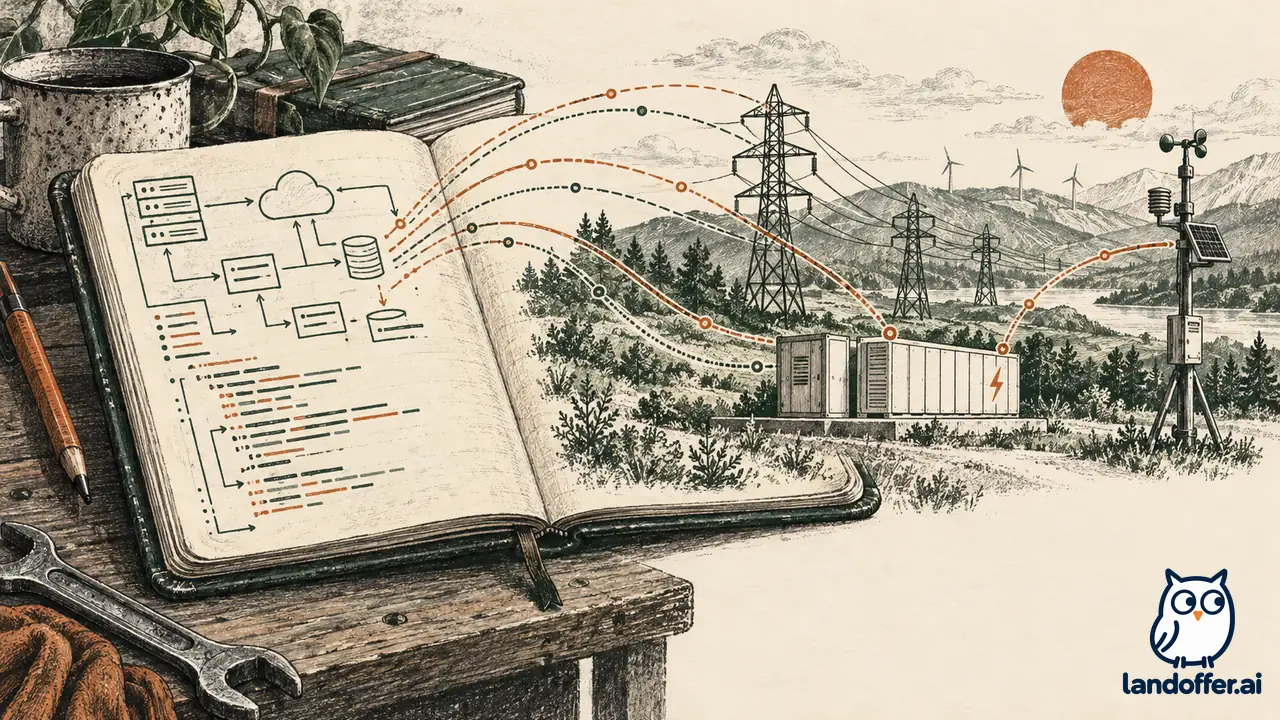
A climate mission does not tell you what you would build. Read for the user, system boundary, output, and constraints: does the team ingest weather or market data, forecast demand, control equipment, model a site, or build tools for engineers? Does the role own production services, analytics, research, or customer deployments?
The 2025 U.S. Energy and Employment Report tracks power generation; transmission, distribution, and storage; efficiency; motor vehicles and components; and fuels. It is a workforce framework, not a climate-company taxonomy or software-vacancy count.
DOE’s marine-energy software profile names tools for location assessment, performance analysis, real-time monitoring, visualization, and system modeling. It is one sector-specific example, but shows software work can sit close to physical assets even when the title is simply “Software Developer.”
Map engineering experience to the work families
Role labels vary by employer, so search by responsibilities as well as titles. Treat the matches below as a shortlist for investigation. A transferable skill is evidence to explore a role; it is not proof that you meet every qualification.
| Climate or energy work setting | Search terms and deliverables | Experience that may transfer | Domain questions to resolve |
|---|---|---|---|
| Grid forecasting, markets, and optimization | Software Engineer, Data Engineer, ML Engineer, Research Engineer; weather, load, price, grid-condition data, forecasts, optimization, backtesting | Time-series pipelines, probabilistic models, event processing, data quality, reproducible experiments, services used in operational decisions | Does the team require power-market or grid knowledge? Are models research, decision support, or production control? What does uncertainty mean for the user? |
| Grid, storage, and asset operations | Platform, Backend, SRE, IoT, Embedded, Controls Software; telemetry, fleet management, battery systems, fault reporting, device command, operational monitoring | Distributed systems, observability, reliability engineering, device fleets, streaming data, incident response, APIs | Does the job touch hardware or controls? Are there safety, uptime, field, or on-call responsibilities? What data can the software read or change? |
| Site, resource, and project-development tools | Geospatial Engineer, Data Engineer, Full-Stack Engineer, Mapping or Product Engineer; location analysis, resource assessment, project planning, engineering tools | GIS, spatial databases, data integration, workflow products, visualization, complex technical users | Which datasets and engineering assumptions are central? Does the role build analysis software, perform engineering analysis, or support project delivery? |
| Energy-efficiency and electrification software | Product, Backend, Mobile, Data, or Integration Engineer; energy usage, equipment, charging, building systems, customer or operator workflows | SaaS product delivery, integrations, mobile apps, time-series analytics, billing or scheduling workflows | Does the posting center on software, devices, installations, utility programs, or customer implementation? Are technical qualifications tied to a regulated or physical system? |
| Climate and environmental data products | Data Platform, Analytics, ML, Backend, Geospatial, or Research Software Engineer; measurement, reporting, data catalogs, APIs, modeling and analysis | Data contracts, lineage, ETL/ELT, scientific computing, quality controls, dashboards, model operations | Where does the data originate, how is uncertainty handled, and what claims may users make from the output? Is domain expertise required or learnable on the team? |
The rows combine role-language patterns with inference, not official occupation categories. Gridmatic describes engineering work across energy, ML, optimization, weather, markets, transmission, and telemetry. Its October 13 job-board snapshot included data, ML infrastructure, battery, full-stack, and security roles; this sample can change and does not represent sector-wide hiring.
A “Software Engineer, Grid-Scale Batteries” result may fit someone with service or data-pipeline experience, but the title does not show whether the work is trading, controls, product, or infrastructure. Read the requisition first.
Turn a posting into an evidence bridge
For each responsibility, record the employer’s wording, an example from your work, and any domain or scope gap. Include what you built, whom or what it served, and evidence you can defend. This shows whether tailoring an application is worthwhile. Never copy an employer’s desired outcome as if you achieved it.
| Posting responsibility | Your evidence | Gap or question |
|---|---|---|
| “Build and operate services that ingest weather, prices, load, and grid conditions for forecasts.” | “Built Python ingestion jobs for daily inventory and sales data; added schema checks and alerts for missing partitions; documented recovery steps for late files.” | Have you handled time-series drift, probabilistic forecasts, weather data, or electricity-market semantics? Which are required on day one? |
| “Create fleet management and fault-reporting software for distributed devices.” | “Owned a device registry and event API; added idempotent processing and traced a duplicate-event defect across service logs.” | Have you worked with embedded devices, field connectivity, grid equipment, or safety-related controls? Does the role require those, or can you learn them with domain teammates? |
These are fictional examples, not candidate reports. They show how to describe relevant work without claiming energy experience. Lena’s evidence supports a bullet such as: “Built Python ingestion jobs for daily inventory and sales data, adding schema checks and recovery alerts for delayed files.” It does not support “improved grid forecasting accuracy.”

The same mapping can reveal a gap worth investigating. If a role owns market bidding, power-flow models, protection systems, building controls, or scientific interpretation, ask what experience is required and what support exists. A portfolio project may show that you can code or analyze a dataset. It does not replace the professional power-market, controls, or commissioning experience that an employer explicitly requires. Keep your own project, employment contribution, and domain coursework distinct.
Complete two role-fit decisions
Lena, a fictional backend engineer, has owned APIs and ingestion services for logistics, including retry behavior, duplicate-event handling, monitoring, and incident reviews. She has no energy-market experience. A hypothetical grid-software posting lists service ownership, telemetry pipelines, and Python as core work; market knowledge is preferred. Lena can consider applying, cite her reliability work, and ask how the team teaches market concepts. She should not claim grid-operations experience.
If that same posting instead makes power-flow analysis or energy-market dispatch a required qualification, Lena should not treat her API background as a substitute. She could look for a product or platform role adjacent to that work, or build a clearly labeled learning project. The distinction is about the stated responsibility, not whether Lena is enthusiastic about climate work.
Ravi, a fictional data engineer, has built retail-demand pipelines and data-quality checks, but not probabilistic forecasts or power-market models. For a posting that combines weather and grid data with model evaluation and production pipelines, he should clarify whether forecasting is his responsibility or whether the team needs a platform partner for researchers. His evidence supports a line such as: “Built and monitored retail-demand pipelines; added validation checks and recovery notes for late or incomplete inputs.” It does not support a claim about forecasting renewable output or electricity prices.
The decisions are conditional: Lena considers a role where domain knowledge is preferred; Ravi asks about model ownership before deciding. Neither predicts an employer response. Replace each fictional example with your own work record.
Decide whether domain experience is required
Employers use “required,” “preferred,” and “nice to have” differently. A posting’s degree, license, location, years-of-experience, or specific domain requirements may be screening criteria. A list of preferred context may describe an advantage without establishing a universal barrier. Read how each requirement relates to the role’s responsibilities instead of either self-rejecting from every unfamiliar term or assuming that interest makes you qualified.
Gridmatic says its domain is complex and involves weather, market mechanics, transmission, and telemetry; it also says many team members did not start with energy experience. That is the employer’s stated recruiting view, not a promise that another company will train every applicant. The same page shows software and energy backgrounds on its team. It supports a careful conclusion: some employers value transferable engineering experience alongside domain learning, while role-specific requirements still matter.
Use this quick screen before applying:
- Mark each requirement as an explicit must-have, a preference, or an unclear phrase. Keep the employer’s exact wording in your notes.
- Link every central duty to one work example, project, or skill you can explain. Mark “learning” separately from “professional experience.”
- Identify domain terms that affect safe or correct work, such as power-market operations, controls, field commissioning, or regulatory reporting. Check whether the posting requires existing experience.
- Confirm location, onsite expectations, travel, and work authorization on the actual requisition. A careers-page search result or climate-sector location map may not show role-specific terms.
- If the job otherwise fits but a material requirement is ambiguous, ask the recruiter one direct question about the expected starting proficiency or first-quarter deliverables.
If you do not meet a stated hard requirement, do not rewrite your history to imply that you do. If the posting uses preferred language and your evidence supports the core work, you may decide the role is worth an application, but the employer decides whom to interview.
Search by responsibility and confirm the source
Start with two or three work families from your evidence bridge. Combine terms such as software engineer grid telemetry, data engineer energy forecasting, geospatial engineer renewable project, or platform engineer battery software with an industry, technology, and a location you can accept. Add different employer terms—utility software, grid modernization, storage, efficiency, electrification, climate data—because companies do not all use “climate tech” in their job titles.
Treat job boards and directories as discovery leads. On the employer page, confirm title, requisition, location, employment type, date, requirements, and application route. Save the posting URL and date. Search indexes can lag, and a mission page is not a vacancy; judge fit from the actual description.
For broader role-reading guidance, see how to read a tech job description for scope and evidence. If you are targeting startups, compare YC discovery with direct company careers pages. Those guides cover general posting analysis and startup discovery; here the distinctive task is connecting your engineering record to a climate or energy system without overstating domain knowledge.
Make your experience legible without claiming climate impact
Describe the engineering work first: the service, data, model, device, or workflow; what you owned; the constraint; and a measured result if you have one. Then connect it to the posting’s stated problem. A developer-platform engineer might explain how they reduced failed deployments with a verified measure, then note that the target role operates software for grid assets. The first fact is their evidence; the second is the intended application. Do not convert it into an emissions reduction or grid-reliability claim.
If you have a relevant personal or academic project, label its scope and data honestly. Say whether records were public, synthetic, or collected for a class; which parts you implemented; what you tested; and what you did not validate. A small reproducible project can show that you have investigated a domain question. It does not establish production-scale performance or on-the-job experience.
Keep the search shortlist small enough to explain. For each role, record the specific responsibility that matched your experience, the evidence you would use, one important gap, and the next question you need answered. That note helps you decide whether to apply, prepare a focused project, or move on without treating an employer’s climate language as proof of role fit.
Sources and Further Reading
- 2025 U.S. Energy & Employment Report — DOE workforce categories and reports; not a software-vacancy count.
- Software Developer: Department of Energy Marine Energy Careers — an example of software tasks for marine-energy systems.
- Gridmatic Careers — employer descriptions of energy, ML, optimization, and its engineering principles.
- Gridmatic employer job board — role titles and locations visible when reviewed October 13, 2026; listings may change.
Choose one role family that matches your evidence, browse recent roles on LandOffer.ai, and verify one opening on the employer’s careers page. No source here establishes that a specific candidate will receive an interview, that a role is still open after the review date, or that a company’s work produces a particular climate outcome.