LandOffer
Engineering Practice
Set a Cache Lifetime Around How Stale the Data Is Allowed to Be
Two complete synthetic resource policies allocate a 60-second public-description lag budget across 20-second application snapshots and 40-second HTTP freshness, while personalized drafts use no-store. Eighteen executed local checks retain 200/304/503 responses, update visibility, no-stale-outage behavior, and explicit browser, CDN, authentication, and age-model limits.
Choose a cache lifetime by deciding how old the information may be when someone acts on it, then account for every layer that can delay an update. Separate public content from personalized responses, decide whether stale reuse is acceptable during an outage, and test an update across the freshness boundary. A high hit rate does not establish that the reused information is current enough for the task.
This LandOffer.ai guide supplies two complete resource policies and an executed update timeline. The synthetic example uses a local HTTP server and a small handwritten cache with an injected clock. It exercises actual 200, 304, and 503 responses, but it does not test a browser, CDN, production service, authentication system, or the full HTTP age-calculation algorithm.
Start with the consequence of an old answer
Ask the information’s owner what someone could do differently after a delayed update. A short exhibition description may tolerate a bounded publishing delay. A personalized draft may need a different storage boundary even if its text changes rarely. Authorization, prices at checkout, emergency notices, and inventory decisions should not inherit a descriptive page’s policy merely because they share an application.
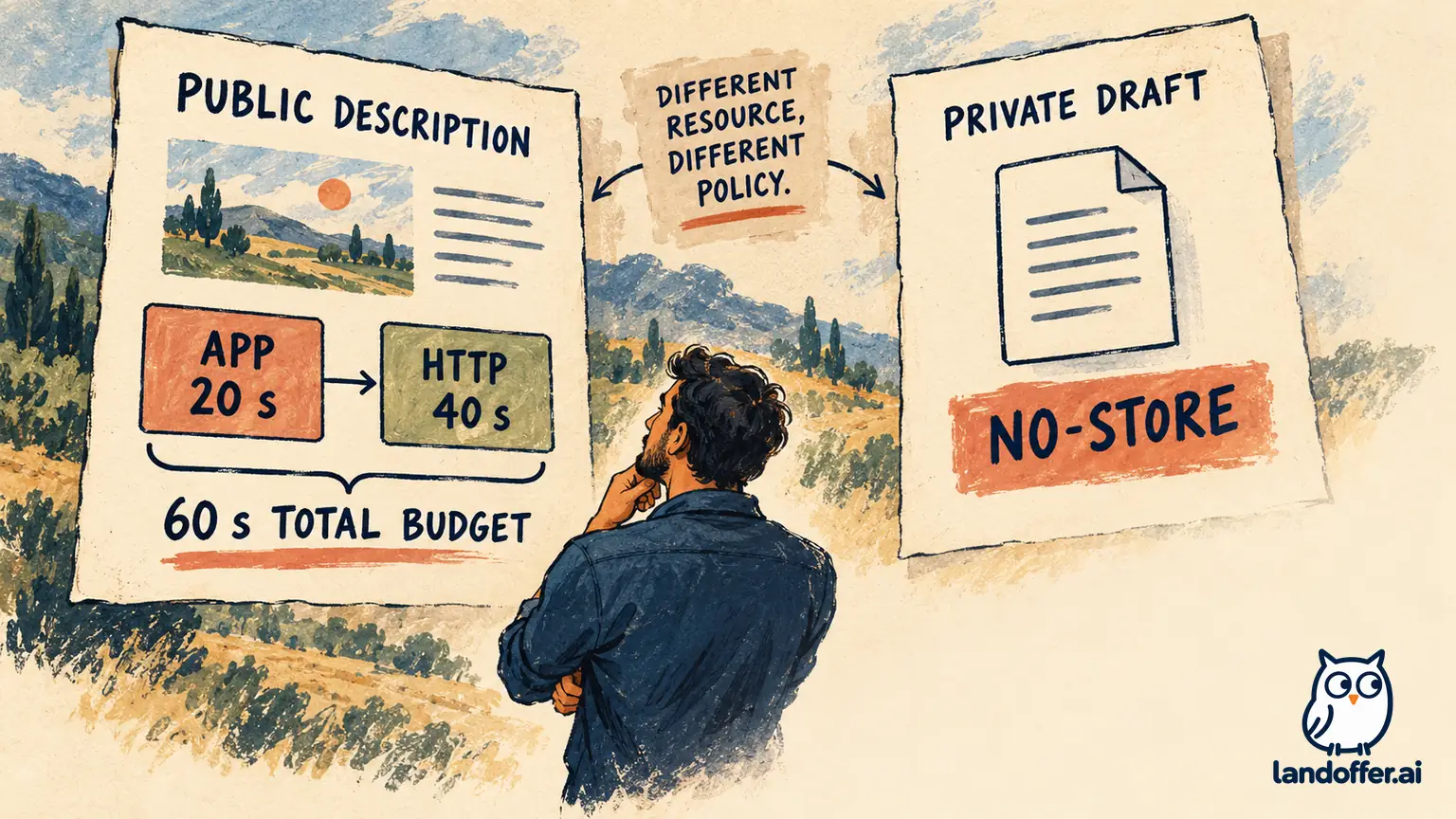
In the fictional GalleryLane site, editor Mara accepts up to 60 seconds of update lag for public exhibition-description text returned on a new request. That permission excludes closures, admission availability, transactions, and safety notices. It is an authored requirement for this example, not a claim about what real visitors or every content owner would tolerate.
Developer Niko finds two relevant layers: an application snapshot that can lag the source, followed by an HTTP response cache. Giving both layers a 60-second lifetime could exceed Mara’s total allowance. Start with the entire freshness budget, then allocate it rather than treating each layer’s default as independently acceptable.
Amazon’s Memcached caching-strategy documentation explains that time-to-live refreshes do not guarantee a value is never stale. An application cache can keep old data after the database changes. HTTP freshness adds another decision about when an already generated response may be reused; it cannot repair an out-of-date source representation by itself.
Record the update owner, resource, allowed lag, layers, outage behavior, and validation evidence together. If an owner cannot accept any bounded delay for a particular operation, choose a different retrieval or decision path rather than inventing a convenient TTL to satisfy a performance goal.
Complete a policy for each resource
The first completed asset is GalleryLane’s resource-policy record. Its public description contains no account-specific fields and has the same representation for every visitor in this fixture. The private resource contains an editor’s synthetic draft. Neither route represents live customer data.
| Resource | Required behavior | Proposed response policy | Important boundary |
|---|---|---|---|
| Public exhibition description | New requests may receive text delayed by at most the example’s 60-second total budget | Cache-Control: public, max-age=40, must-revalidate and a representation-specific ETag |
Application snapshot gets a separate 20-second allowance; no stale grace period is planned |
| Personalized editor draft | Do not store the response in HTTP caches | Cache-Control: no-store |
Real access checks, app state, logs, and previously stored responses require separate handling |
The public header is appropriate only for the explicitly nonpersonalized representation in this case. Do not add public to a response containing account details simply to improve shared-cache hits. If a representation varies by language or another request field, its cache key and response metadata need to reflect that variation; this single-language fixture does not verify that configuration.
RFC 9111 compares a response’s current age with its freshness lifetime. Once the response is stale, the example’s must-revalidate directive requires successful validation before reuse. The stricter outage choice is deliberate: GalleryLane would rather surface unavailability than silently extend the stated freshness budget. This does not force validation while the response remains fresh.
Keep no-cache, no-store, and private distinct. MDN’s HTTP caching guide describes no-cache as requiring validation before reuse, while storage may still occur. private limits storage to a private cache rather than a shared one. no-store prohibits storage by compliant HTTP caches. The right combination follows the resource’s needs; none of these words is a complete privacy or authorization system.
For another personalized resource whose client-side storage is acceptable but reuse must be validated, a private, no-cache policy may be worth evaluating. That is a different requirement from the draft policy above. Do not replace an explicit no-storage decision with it without consulting the owner.
Trace the source update through both layers
The local server begins with public description V1 in both the source and application snapshot. The snapshot refreshes synchronously when accessed at an age of 20 seconds or more. The small HTTP cache permits reuse while its modeled resident age is less than 40 seconds. Network delay, clock skew, and stale-serving extensions are absent from this model.
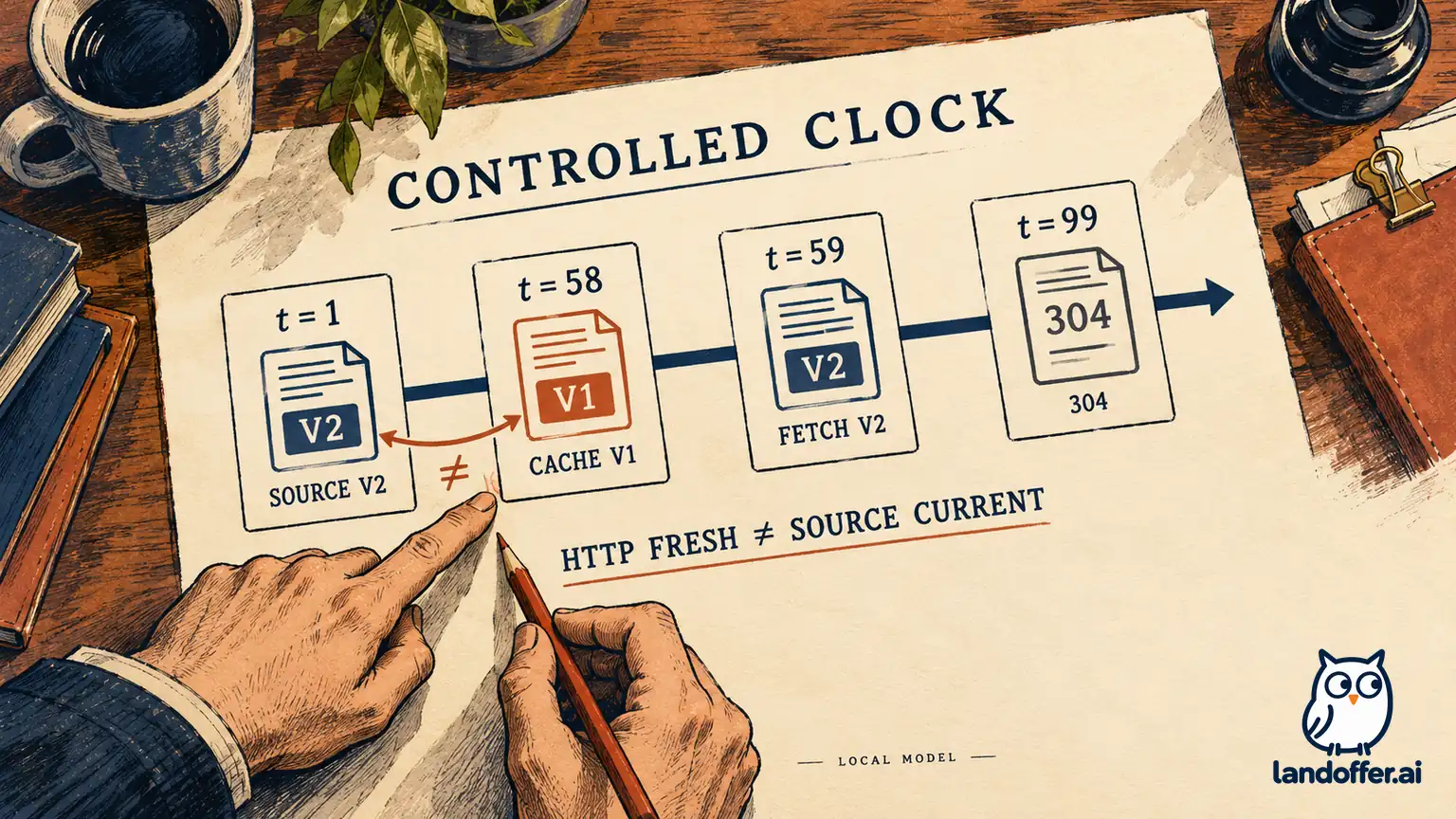
At time 1, the underlying source changes to V2. The HTTP cache first requests the resource at time 19, just before the old application snapshot expires. The server therefore returns V1 in a newly generated HTTP response. That response is fresh to the HTTP cache even though it does not contain the latest source value.
This is the second completed asset: a retained request-and-response trace connected to an explicit content timeline.
| Injected time | Source and application state | Actual fixture observation | Interpretation |
|---|---|---|---|
| 0 seconds | Source V1; snapshot V1 created | Initial server state | Starting reference, not an HTTP-cache validation |
| 1 second | Source changes to V2; snapshot remains V1 | Controlled source update | The business freshness clock starts here |
| 19 seconds | Snapshot is still V1 | HTTP 200 supplies V1 with the public policy and V1 validator | HTTP freshness does not establish source freshness |
| 58 seconds | Cached HTTP response has modeled age 39 | Cache reuses V1 without contacting the server | Request receives the old value despite source V2 |
| 59 seconds | HTTP response reaches age 40 | Conditional request reaches server; snapshot refreshes to V2; HTTP 200 supplies V2 | Changed content becomes visible on this request |
| 99 seconds | V2 response reaches age 40; source unchanged | Conditional request receives HTTP 304; stored V2 body is reused | Validation can refresh reuse without another response body |
The change becomes visible 58 seconds after the source update in this schedule: 59 minus 1. The conservative layer allocation is 20 plus 40, totaling 60 seconds under the model’s assumptions. This is not a general proof that two configured TTLs enforce a real-world freshness guarantee. Additional replication lag, response transit, asynchronous refresh, or stale-serving rules would consume more of the budget.
The validator is computed from the body the server actually represents. A validator derived from an unrelated timestamp, or a conditional handler that answers without checking the current representation, can make the validation result misleading. The fixture checks changed content with a 200 response and unchanged content with a 304 response separately.
An ETag is not a push notification. Before the cache asks the server again, it has no knowledge of the source change. Purging a managed cache, versioning a resource, or updating application state may address different update paths, but each needs its own propagation and failure evidence.
Test expiry, outage, and private storage separately
Eighteen executed checks verify the trace and the following boundaries. The test uses Python 3.12.14’s standard-library HTTP server and client over loopback. The timestamps are controlled test inputs; the HTTP statuses are observed over loopback, not measured CDN latency or deployed-cache behavior.
| Boundary check | Executed local result | What remains outside the evidence |
|---|---|---|
| Just before expiry | At modeled age 39, cached V1 is reused | Full HTTP Date/Age calculation across real intermediaries |
| At expiry | At age 40, the cache validates instead of using the freshness shortcut | Browser and CDN configuration compatibility |
| Unchanged validation | Actual 304 response reuses the existing V2 body and resets the model’s validation time | Full handling of every header update or validator type |
| Origin unavailable while response is fresh | At time 100, fresh V2 is reused without an origin request | A freshness policy is not continuous origin polling |
| Origin unavailable after expiry | At time 139, origin returns 503 and the cache surfaces failure instead of serving stale content | Every real outage, retry, or stale-extension path |
| Two synthetic draft callers | Each receives its own fixture label; no-store leaves the cache empty | Real authentication, authorization, browser history, and application-state isolation |
The private test uses a demo request header solely to select synthetic labels. It does not authenticate anyone. These two no-store responses leave the model cache empty; that result does not establish real cross-account access protection.
Changing a response header also does not reach backwards into every copy already stored. MDN specifically notes that returning no-store does not delete an existing cached response for that URL. Review the previous policy and migration plan when moving a resource from public caching to personalized content. Do not assume a new header instantly removes old copies.
An open page has another boundary. The fixture retains the V1 string that was previously displayed; advancing the clock and updating the source does not change that variable. A cache lifetime governs a later reuse decision, not a timer that redraws the page. If the requirement concerns what a person sees after leaving a page open, define polling, refresh, subscription, or action-time validation separately.
The handwritten cache deliberately implements only the decisions needed for these scenarios. It is not a reusable HTTP-cache library. Its age model assumes zero transit delay and does not implement all RFC directives, request variants, eviction rules, or intermediary behavior. Keep this model out of the production path and verify the selected cache implementation’s actual semantics.
Agree on a rollout condition beyond the hit rate
The fictional review records: “Accept the 20-second application and 40-second HTTP allocation as the test proposal for public description text only. The local schedule demonstrates a 58-second update delay, validation at expiry, and no stale reuse after the modeled outage. Keep the real rollout pending until the platform owner verifies actual cache layers, age accounting, update propagation, and failure configuration.” This is an authored review note, not a deployed policy.
Mara owns the tolerance and exclusions. Niko owns the real response and validator implementation. The platform owner must inspect shared-cache keys, override rules, and any stale-serving features before enabling the proposal. The draft route’s no-storage and access boundaries need their own review; they are not covered by the public timeline’s success.
Measure update visibility as well as hit rate when validating the real path. Retain the source-change time, representation version, request time, relevant headers, and returned body version. Include an unchanged case so a successful 304 is distinguishable from a server that incorrectly validates an old representation. Keep the test synthetic or explicitly authorized.
For your next cached resource, name its allowed update lag and one action that must not depend on old content. Allocate that budget across layers, then test just before expiry, at expiry, and during failure. More practical engineering guides are available from LandOffer.ai.