LandOffer
Career Growth
AWS Certification Renewal: Choose a Valid Route Before Your Credential Expires
Two completed fictional credential-combination plans distinguish three-year renewal, one-year Skill Builder maintenance, and routes that leave another credential uncovered. A dated action and contingency record keeps exam results, completion dates, public USD prices, and actual credential confirmation separate, while preserving differing official page wording.
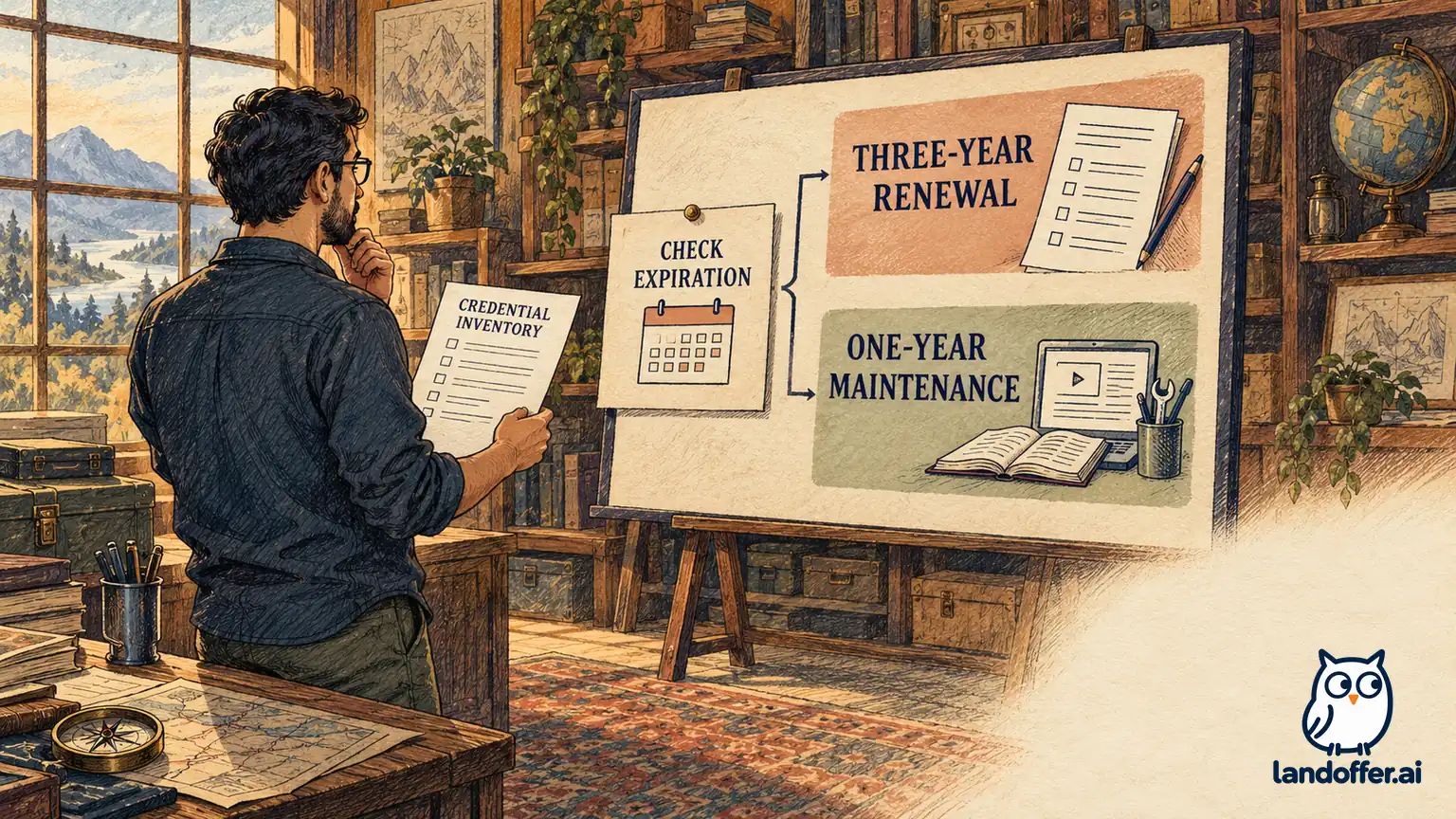
Start AWS renewal planning with the exact credential, its active status, and its expiration date. Then match it to the current certification-specific route: three-year renewal and one-year maintenance are different choices. Check the route for each credential; a course, reservation, or higher-level pass does not establish renewal of every certification you hold.
This LandOffer.ai guide compares two fictional credential combinations and completes a dated renewal plan. Public AWS pages were checked on October 27, 2026. No certification account was accessed, exam booked, subscription purchased, learning activity completed, or credential renewed. The examples are planning records, not personal eligibility confirmations.
Distinguish the current routes from older general wording
AWS's general recertification policy says certification is valid for three years and describes exam-based renewal. It still says other methods are not accepted. However, the main recertification page now lists additional routes, including one-year maintenance through AWS Skill Builder for specified certifications and a separate Cloud Practitioner option.
The difference changes which actions a holder may be able to use before expiry. AWS's June 23, 2026 announcement independently describes the new maintenance experience, launched in open beta. It uses curated training and practical activities rather than an exam retake. Do not interpret the general page's older exam-only wording as proof that these named routes do not exist.
Equally, do not turn the new offering into “any training renews AWS certifications.” The announcement ties completion to a selected certification path and its requirements. For its Associate-level launch paths, it describes 500 points including a practical activity; the current path and account eligibility still need checking. A course completion badge is not interchangeable with recertification.
The main page requires an active credential for renewal or maintenance. Its maintenance FAQ specifies an active Skill Builder subscription and a credential within 90 days of expiry. It distinguishes a one-year maintenance extension from three-year renewal. Use the exact current credential row and your account's offered path, particularly while program details are changing.
List each credential before choosing a route
Create one row per certification, not one line saying “AWS certified until December.” Record the complete name, expiration shown in the certification account, chosen route, required action, and resulting status you will need to verify. Give voucher expiration, subscription term, and credential expiration separate fields so one date cannot stand in for another.
Two credentials earned on different dates can have different deadlines. A renamed credential or newly available exam also needs an exact mapping. For example, the main table distinguishes CloudOps Engineer – Associate and the older SysOps Administrator – Associate naming. Similar names are a reason to inspect the row, not to assume every learning plan or exam is equivalent.
Keep a source link and check date beside each mapping. If your study plan says “take a Professional exam,” replace that with the exact exam name and a separate coverage answer for each existing credential. Add a column for what would prove completion: a passing result for an exam route or the recognized completion of the selected maintenance path. That makes a gap visible before it becomes a deadline problem.
For each proposed route, ask what it covers and what it leaves untouched. If passing one exam can renew another active credential, record that relationship explicitly. If a pairing is absent from the official table, do not invent it because the new exam seems more advanced.
The comparisons below use active credentials and dates entirely invented for the examples. They are not a comprehensive map of every AWS certification. A real holder should also check current exam versions, any retirement announcements, the offered maintenance path, and account-specific eligibility before committing time or money.
Compare two completed credential-combination plans
Combination A: Nina holds Cloud Practitioner and Solutions Architect – Associate. Her fictional expiration dates are January 20, 2027, and December 18, 2026, respectively. She wants to keep both active and is already preparing at the Associate level. She has not established readiness for a Professional exam.
| Candidate route | What the current public mapping supports | Nina's completed planning decision |
|---|---|---|
| Pass the current Solutions Architect – Associate exam while both remain active. | A same-credential renewal route for the Associate certification; an Associate exam is also listed for Cloud Practitioner renewal. | Preferred exam route, subject to readiness, actual eligibility, and available appointments. Verify both updated records after completion. |
| Pass Solutions Architect – Professional. | Listed as a renewal route for Solutions Architect – Associate; Professional exams are also listed for Cloud Practitioner. | Not selected merely to cover two credentials. The larger exam is outside her present preparation plan. |
| Complete Cloud Quest: Recertify Cloud Practitioner. | A specific Cloud Practitioner three-year route, with its stated six-month eligibility window. | Could address Cloud Practitioner separately; does not resolve her Associate deadline. |
| Use the listed Skill Builder maintenance path for Solutions Architect – Associate. | A one-year option with subscription and eligibility requirements. | Possible alternative if actually available; do not assume it gives both credentials three years. Check any applicable related-credential effect separately. |
Combination B: Eli holds AI Practitioner and Developer – Associate. Both are active in this fictional record, with the same January 20 and December 18 expiration dates. Eli initially assumes that any Professional pass renews both.
| Candidate route | Coverage that must be checked separately | Eli's completed planning decision |
|---|---|---|
| Pass DevOps Engineer – Professional. | Listed for Developer – Associate; it is not the AI Practitioner row's named higher-level route. | Do not treat AI Practitioner as renewed by this plan. |
| Pass Machine Learning Engineer – Associate or Generative AI Developer – Professional. | Named higher-level routes in the current AI Practitioner row; neither is listed as Developer – Associate's renewal route. | Do not assume Developer coverage from the AI credential's mapping. |
| Retake the current AI Practitioner and Developer – Associate exams. | Two separate same-credential exam routes. | A clear candidate plan if each exam fits readiness and timing; two actions and two result checks remain. |
| Maintain Developer – Associate through its listed Skill Builder option. | One-year Developer maintenance; the AI Practitioner row does not list that same maintenance choice. | Evaluate Developer separately and choose a valid AI Practitioner route. |
These comparisons expose a planning gap before commitment: a higher-level exam may leave another credential without a listed renewal route. They do not establish that a named person can pass, afford, schedule, or access any route.
Put completion dates into the plan
Nina sets October 27, 2026, as the comparison date. December 18 is 52 calendar days away; January 20 is 85 days away. The retained date calculations count calendar days only; they do not establish the account's precise expiration cutoff. Her assumed Associate credential is within the public 90-day maintenance window, but eligibility has not been observed in an account.
She records the following completed plan instead of writing “renew before expiry.” Dates are proposed internal targets, and no appointment or learning-path access has been confirmed.
| Target date | Action and evidence sought | Condition or unresolved item |
|---|---|---|
| October 27 | Capture the two actual certification records and compare the current route table. | The article supplies only a fictional inventory; Nina must check her own records. |
| October 30 | Review preparation against the current Associate exam guide and available assessment evidence. | No mock score, readiness decision, or passing prediction is invented. |
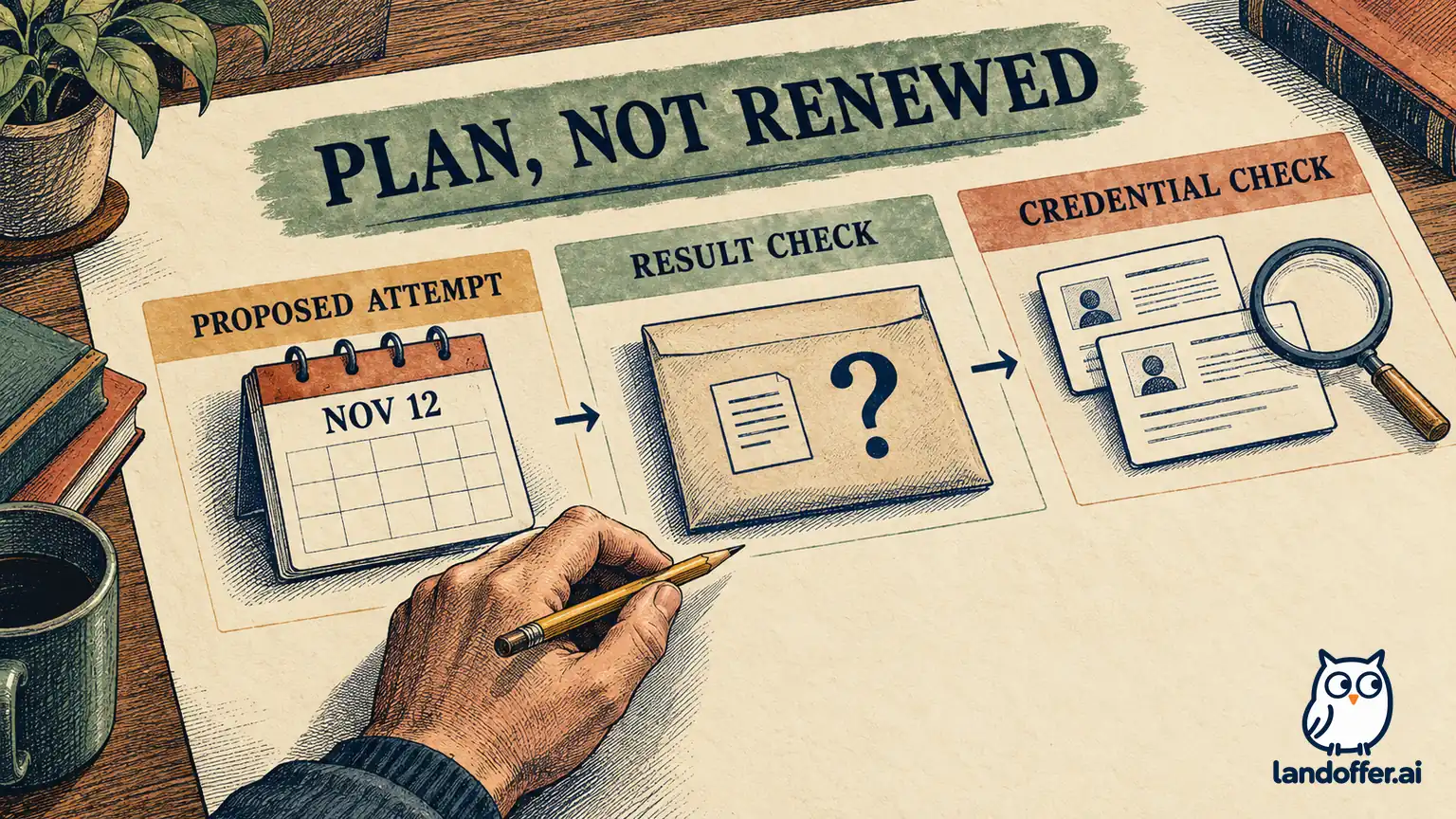
| November 12 | Proposed first Associate exam attempt, if ready and an appointment is available. | Booking is not completion, and taking an exam is not passing it. |
| After results | Check Exam History and each relevant certification's updated expiration. | Retain the result and credential records rather than assuming cascade from an email. |
| If unsuccessful | Reassess the route, available time, and the retake rules before another booking. | No automatic retake slot or deadline extension is assumed. |
| Before December 18 | Resolve any missing result or unchanged credential record with AWS support. | An unresolved case is not proof that active status continues after expiry. |
AWS's after-testing policy says final results are posted within five business days, with exceptions for security or technical review. It also requires a 14-calendar-day wait after a failed exam before a retake. Nina therefore does not put a second attempt on November 13 or treat the first proposed date as guaranteed renewal.
For illustration only, November 12 plus 14 calendar days is November 26. That leaves 22 days before the assumed December 18 expiry, but says nothing about appointment availability, applicable time boundaries, result review, or whether Nina would be prepared. November 26 is an arithmetic contingency date; no eligible appointment or second attempt has been confirmed.
Calculate the extension from the right date
The main recertification FAQ says the extension is based on completion of the recertification action. It does not simply add time to whatever expiration you previously had. In Nina's hypothetical example, successful three-year renewal completed November 12, 2026, points to November 12, 2029; one-year maintenance completed that day points to November 12, 2027.
Those illustrations do not predict the actual account update. They show why the two choices are not equivalent, and why completing early can produce a different anniversary from December 18. Verify the resulting date on the credential record.
The June announcement also describes related lower-level extensions when maintaining a higher-level credential, including conditions on active status and the lower-level credential's remaining validity. Do not apply that example to every combination or confuse its matching-date effect with a separate three-year renewal for each credential. Nina's plan deliberately leaves any such effect for explicit verification.
For costs, AWS's before-testing table currently lists US$150 for an Associate attempt and US$100 for a Foundational attempt, before applicable taxes. Nina's single Associate attempt has a US$150 base price; Eli's two same-level retakes total US$250 before tax. These are public USD planning figures, not a checkout quote or an account-specific offer.
The general policy describes a 50% exam benefit voucher in the certification account. If an applicable voucher is actually available for Nina's attempt, half of US$150 is US$75 before tax. Do not assume the benefit is present, reusable for multiple attempts, or interchangeable with a Skill Builder subscription. No purchase or voucher redemption was tested here.
Finish with verified status, not preparation evidence
Nina's closeout remains a plan: “Preferred route: current Associate exam, subject to readiness and availability. Alternative: investigate the specific one-year maintenance path. Both credential updates must be checked; no renewal completed.” Eli's closeout preserves two separate coverage decisions instead of claiming one higher-level exam solves everything.
For your own renewal, keep a route-to-credential table, an actual expiration inventory, and evidence of the completed action and resulting account status. If pages conflict or your offered path differs, retain the dated source and ask AWS to resolve the specific case before relying on it. A practice course, an exam reservation, or a support request does not by itself extend a credential.
If a record remains unchanged after the expected action, collect the exact credential name, completion date, relevant result or completion record, and old and displayed expiration dates for the support inquiry. Keep sensitive identifiers out of public forums. If the credential has already expired, do not assume an active-credential maintenance option can restore it; ask which route applies to that actual status instead of marking a planning spreadsheet renewed.
Recheck the current options before starting, especially for a changing maintenance offering. LandOffer.ai publishes this credential-maintenance guide; AWS determines eligible routes and certification status. This article demonstrates planning and comparison, not successful recertification or access to a real certification account.