LandOffer
Job search
AsanaUP Apprenticeship vs. Internship: Choose the Route That Matches Your Background
Choose an Asana early-career route using your current enrollment, career transition and graduation stage, while keeping program descriptions separate from open roles.
Start with your current background: an enrolled student should investigate internships, a nontraditional entrant should investigate apprenticeships, and a recent graduate should also consider graduate hiring. Asana's current page puts all three under AsanaUP. When checked on October 13, 2026, its early-career vacancy section showed no open roles. This comparison helps you choose what to monitor and prepare; it does not identify an application you can submit today.
LandOffer publishes this article and offers recent tech-job discovery. We reviewed Asana's official program overview, public vacancy section and dated employer-hosted participant stories. We did not apply, join its talent network, contact recruiting or assess anyone's eligibility. Devon, Inez, Ezra and Mei below are fictional teaching cases.
An overlapping background does not need to be forced into one label. Preserve your actual education and experience while comparing the routes. You can identify a promising route without pretending that an overview contains the complete selection rules. Keep the route you want to investigate separate from a verified opening, and keep both separate from an offer.

AsanaUP includes three different starting points
The Emerging Talent Programs page describes internships lasting twelve to sixteen weeks for current college or university students in Engineering, Data Science and Product Design. Apprenticeships address people entering technology from nontraditional, diverse backgrounds. Its graduate route names Engineering and Data Science, with mentoring and technical bootcamps. These descriptions identify routes to investigate; they do not establish that a particular reader qualifies.
Use the distinction to select the first posting to read and the education facts to keep beside it. Someone currently studying has an enrollment fact to compare with an internship posting. Someone changing careers has a transition to explain and relevant starting skills to demonstrate. If you have graduated, check the particular role's permitted graduation dates and enrollment conditions. The overview alone does not settle whether an internship could still accept your record.
| Route named on the overview | Starting point to investigate | Missing information that could change your choice |
|---|---|---|
| Internship | Current college or university study | Accepted graduation dates, subject, term and location |
| Apprenticeship | Nontraditional entry into technology | Exact track, education rules, experience boundary and duration |
| New Graduates | Graduate entry | Accepted graduation window, degree requirements and available discipline |
The table is a preparation guide, not three eligibility certificates. Do not transfer Airbnb Connect's particular degree or experience limits into Asana's program. Similar names do not establish identical requirements. A detail absent from this overview remains unanswered until you find a current authoritative posting or receive a relevant clarification.
The apprenticeship label does not establish that the role teaches every prerequisite from zero. Identify the actual technical starting point required by a future role. The useful comparison is between your evidence and that requirement, rather than between an appealing program name and your desire to join the company.
Four fictional readers make different choices
Devon is in the third year of a Computer Science degree and expects to graduate in May 2028. He has a college group project and wants to work in software engineering. His first route to investigate is an internship. Before preparing for an actual opening, he would need to match its accepted graduation range and available dates to his record.
Inez has worked in logistics, completed a coding bootcamp and continued learning independently. She is not currently enrolled at a college or university. She chooses to monitor engineering apprenticeships and other entry roles accepting her demonstrated skills. Describing herself as a student merely because she is still learning would not accurately explain her enrollment.
Ezra completed a Computer Science degree in June 2026. His first preparation list includes graduate hiring and suitable ordinary entry roles. He does not assume the label new graduate includes every past graduation date. The date window in a future posting could include him, exclude him or require a clarification.
Mei is currently studying humanities and building programming projects outside her coursework. Her record combines current university enrollment with a nontraditional technical path. That combination makes a forced either-or answer premature. She should inspect both kinds of actual posting, retaining her real degree subject and enrollment rather than choosing the most convenient description.
| Fictional reader | Completed decision now | Condition still unresolved |
|---|---|---|
| Devon | Monitor engineering internships; keep May 2028 graduation visible | Whether a particular opening accepts that date and availability |
| Inez | Monitor apprenticeships and suitable entry engineering roles | Whether her bootcamp and present skills meet the actual track's conditions |
| Ezra | Investigate graduate hiring and other appropriate entry roles | Whether June 2026 falls in the role's graduate window |
| Mei | Compare actual student and nontraditional-entry postings | How the particular role treats her subject, enrollment and technical background |
These decisions are different even though none produces an application today. Devon's next useful document is his term and graduation record. Inez's is evidence of learning and technical contribution. Ezra needs an accurate completion date. Mei needs a clear account of both current study and technical preparation, plus the exact requirement that needs interpretation.
Changing the facts would change the decision. If Inez later enrolls in a degree, her student status would need reassessment against an internship's own conditions. If Devon graduates before a later intake, he should revisit the route rather than reuse an old student label. A saved classification needs updating when the underlying record changes.
What the historical stories actually add
Asana's February 2020 AsanaUP feature shares accounts from Christi Ginger, Patrick Miner and Luis Alvarez. They describe earlier work outside conventional engineering paths, contribution on engineering teams and support from mentors. These employer-selected accounts make the intended learning environment more concrete. They do not establish today's admission rules or a conversion rate.
The value to investigate is work alongside people who can give useful feedback. A reader who already learns well independently may still want guidance on a larger codebase, collaboration and judgment. Conversely, someone seeking a predictable classroom syllabus should find out how the actual role structures learning before assuming apprenticeship supplies that format.
The September 2021 engineering internship account, written by Jordan Hunt, describes returning to school after a sixteen-week San Francisco experience, Engineering Bootcamp and work on a product team. It illustrates one student's experience in that period. Its location, technology stack and personal schedule are not verified terms for a future opening.
A February 2021 Marcy Lab School announcement also describes workshops, mentorship and interviews through a partnership. That historical relationship does not make attendance at that school a universal prerequisite or a promise of placement. Do not enroll in a separate program merely because an old employer story mentions it.
Read these accounts for the kind of work and support to ask about. Keep your own unanswered questions beside them. A positive participant story can explain why a route is attractive without answering whether it is currently available to you.
Worked preparation: Inez records how feedback changed her design
Inez's completed teaching example is a small personal task-list demonstration using invented records. It is not an Asana integration, employer assessment or live customer application. The point is to show how she can explain a decision, understand a review question and revise her approach.
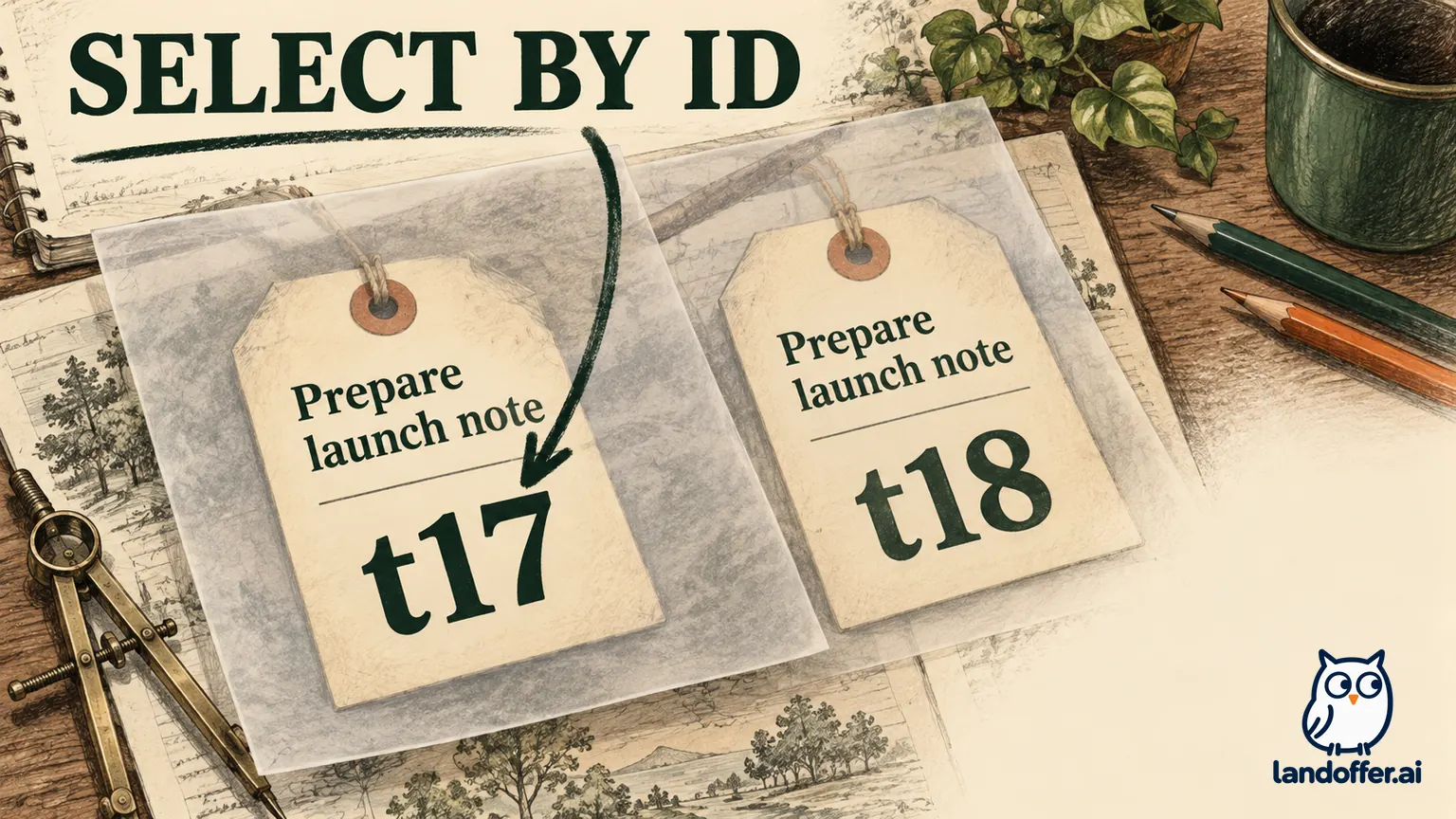
Her two sample records have identifiers t17 and t18. Both display the title “Prepare launch note,” but they represent different tasks. In the first design, a completion action finds records by their displayed title. That design would affect both records when the intended action concerns only t17.
In this fictional exercise, a peer asks, “What happens if two tasks have the same title?” Inez writes down the problem rather than treating the question as a request to make all titles unique. A title can be edited or legitimately duplicated. It is a poor choice for identifying the one record the user selected.
Her revised design carries the selected record's stable identifier into the completion action. The display title remains a label: selecting t17 must leave t18 unchanged even when both show “Prepare launch note.” She records the following expected behavior before deciding how to demonstrate the change. These are expected results in a teaching case; we did not execute this project.
| Exercise action | Expected state after the revised design | What the check explains |
|---|---|---|
| Complete t17 when both titles match | t17 complete; t18 unchanged | Selection follows identity rather than displayed text |
| Rename t17, then complete t17 | Renamed t17 complete; t18 unchanged | Editing a label does not change record identity |
| Complete an unknown identifier | No existing task changes; report the missing target | An invalid selection should not choose a convenient substitute |
| Repeat completion of t17 | t17 remains complete; t18 unchanged | Repeating the action does not affect another record |
Her finished feedback note has a specific sequence: initial title-based choice, peer's duplicate-title question, stable-identifier revision and expected checks. She can explain the difference between the user-facing label and the selected record. That is more useful learning evidence than a list of technologies without a decision to discuss.
The note also preserves limits. This local demonstration does not establish persistence across sessions, permission controls or concurrent edits by several people. A future reviewer could ask how those would change the design. Inez can say what she has not implemented and explain what she would need to investigate next.
Adapt the evidence to the route you actually pursue
Inez's feedback record gives her a concrete way to discuss learning through review. She keeps her logistics employment separate from the personal software exercise. Her work experience may explain collaboration or responsibility, while the project shows her present technical reasoning. Neither has to be relabeled to make the transition coherent.
Devon can use a group project differently. He should identify his own change, the team's review and the result he can substantiate. If another teammate wrote the underlying component, he should not claim it as his own. A clear contribution can be small and still support a useful discussion about working with others.
Ezra can prepare a capstone or another relevant example alongside his actual graduation record. Mei can explain which learning came from university and which came from independent work. The format of the evidence should follow the actual application instructions; this article does not establish that any route requires a public repository.
Track selection matters too. Evidence of a software change is not automatically the right portfolio for Product Design. A design applicant would need to select material relevant to the advertised work and explain their contribution and choices. Sharing the AsanaUP umbrella does not make the disciplines interchangeable.
For someone with mixed enrollment and work history, the useful clarification is narrow. Mei could ask whether a particular advertised internship accepts her current degree subject and expected graduation date. That is answerable in relation to a named requisition. Asking whether she generally belongs in technology is not the missing selection fact.
A program page, a network and an opening are different next steps
We followed the official overview's See open positions link to its vacancy section and observed the no-open-roles message. The separate all-company positions page contained other vacancies. The early-career observation therefore should not become a claim that Asana was hiring nobody.
The overview also links to a talent network. Treat that as a separate information route if you decide to use it. Joining a network does not itself establish that you applied to an apprenticeship, were screened or have a reserved place. We inspected the link and did not join or test its notification behavior.
When a relevant opening appears, save the actual title, discipline, location, cohort or start date and requirements together. Check compensation, duration, schedule and any work-authorization terms before making a commitment. The current overview and historical stories do not supply a complete future offer.
Keep other suitable applications moving while this program has no listed early-career role. Use recent roles on LandOffer alongside employer sources, then choose one opportunity whose published conditions match your record. For Asana, write the route you will monitor, your actual enrollment and graduation dates, and one contribution or feedback example you can explain. Record any missing requirement as a question, rather than marking yourself eligible. Revisit the official vacancy section when there is new information.
Sources and Further Reading
- Asana Emerging Talent Programs: current three-route overview and early-career vacancy section, observed October 13, 2026; not a current application offer.
- Asana all open positions: separate company-wide vacancy list, inspected October 13, 2026.
- How I advanced my career through AsanaUP: employer-hosted participant accounts published February 20, 2020; historical and selected.
- My internship on Asana's Engineering team: Jordan Hunt's employer-hosted account published September 24, 2021.
- Asana and The Marcy Lab School: historical partnership announcement published February 12, 2021; no current universal prerequisite inferred.