LandOffer
Job search
AlgoExpert Review: Annual Bundle Access, Practice Tools, and Topic Coverage
Match the current annual bundle to your actual coding, system design or specialist interview needs before buying access.
AlgoExpert is a plausible purchase if you want a finite coding syllabus, video explanations and practice tools in one place. Its current public offer bundles seven products for one year. The important choice is which parts address your actual interview gaps. Access to frontend, machine learning, infrastructure, iOS and blockchain material does not create a reason to study all of them.
On October 14, 2026, we observed All Access at $119 for one year. The purchasing FAQ explicitly says access does not renew automatically: you must repurchase to regain access after expiry. It also states a no-refund policy and points to free content for evaluation. We inspected public pages and a free workspace, without buying, signing in or submitting code. This review does not measure paid learning outcomes.
LandOffer publishes this review. You can browse recent roles on LandOffer.ai to identify the work your target roles require, then choose preparation topics around the interview information you actually have.

What the current annual offer includes
The purchase page displayed a single All Access offer at $119, alongside a crossed-out $693 amount and a flash-sale countdown. Its card listed one year of access to AlgoExpert, SystemsExpert, FrontendExpert, MLExpert, InfraExpert, iOSExpert and BlockchainExpert. We did not verify a final checkout charge, the crossed-out amount as a usual selling price or how long that displayed offer would remain available.
That observation is more useful for a current budget than assuming older standalone or multi-product prices still apply. We did not establish a cheaper current standalone option. Nor did the seven-product card list ProgrammingExpert. Keep the named contents and the access term together when comparing an offer you see later.
The purchasing FAQ distinguishes access expiry from recurring billing. It says AlgoExpert does not automatically renew access or charge again. To return after expiry, you purchase access again. The FAQ says a small loyalty discount appears when you are logged into the relevant account. We did not verify its amount, so a particular renewal percentage should not be part of your budget.
The same FAQ says four AlgoExpert coding questions are free and that the products contain free content to help you evaluate fit. That is a preview route, not a refundable paid trial. The terms also describe purchases as final and non-refundable. Try the relevant public content before deciding whether the explanation style and workflow justify a non-refundable purchase.
Match the seven products to one interview loop
The bundle covers several distinct preparation needs. The coding module lists 200 questions, while SystemsExpert lists 13 system-design questions and FrontendExpert lists 50 frontend questions. Those counts describe different kinds of exercises. Adding them together would not produce a meaningful measure of readiness.
Leon is a fictional Go API engineer with four years of experience. For this example, his target process includes coding and service-architecture discussions. He has allocated 36 hours to his next preparation cycle. These are his own constraints, not a claim about an employer's process or the time needed to finish AlgoExpert.
He completes this selection against the bundle's documented contents:
| Product | Documented focus | Leon's decision |
|---|---|---|
| AlgoExpert | Coding questions, explanations, complexity analysis and timed assessments | Use for algorithms he can solve but struggle to explain or analyze |
| SystemsExpert | System-design course, questions, diagrams, written walkthroughs and quiz | Use for service-design trade-offs and a structured design discussion |
| FrontendExpert | Frontend questions and HTML, CSS and JavaScript courses | Defer; his specified loop does not include building UI features |
| MLExpert | Machine-learning coding, design and course material | Defer; his target does not require model-development preparation |
| InfraExpert | Infrastructure course, coding and design questions | Defer; infrastructure ownership is outside this example's immediate gap |
| iOSExpert | Layout, unit testing, concurrency and iOS/Swift material | Defer; he is not preparing for an iOS interview |
| BlockchainExpert | Blockchain curriculum, Solidity workspace and projects | Defer; Solidity is not part of his target work |
Leon allocates 20 hours to coding attempts and reconstruction, 12 to system design and four to timed work and reviewing errors. The total is 36 hours. This does not imply he can finish either module in that time. It gives him a way to protect practice and review time from unrelated course browsing.
His provisional choice is to consider the bundle for the first two products if their free previews and the current total fit his needs. He does not justify the purchase by dividing $119 by seven; five products currently contribute nothing to his plan. If resources he already owns address both gaps effectively, keeping those resources is reasonable.
The deferred modules can matter for a different candidate. A frontend engineer asked to build an interactive component should inspect FrontendExpert's exercises. Someone preparing to discuss model deployment should examine whether MLExpert or InfraExpert covers the actual responsibility in the role. Compare the listed exercises with the responsibility you expect to discuss.
Python videos and nine written-solution languages
The content FAQ lists JavaScript, TypeScript, Python, Swift, Kotlin, C++, Java, C# and Go for both written coding solutions and the coding workspace. It separately states that the implementation walkthroughs in videos use Python. Nine solution languages therefore do not mean nine versions of every video. Leave time to implement and explain the approach in the language you will use.
For Leon, that distinction affects how he studies. He can use the conceptual explanation to understand an approach, then examine the Go solution for language-specific details and reconstruct it himself. Watching a Python implementation does not establish that he can produce a correct Go version under interview conditions.
The product page describes two-part explanations: a conceptual overview followed by implementation. It also documents hints, test execution, complexity analysis, four curated timed assessments and a data-structures course. The FAQ describes that introductory course as 13 modules totaling nearly five hours. Treat it as a refresher to inspect, rather than proof that every candidate needs to watch it from the beginning.
Grouping questions by topic can help when a particular data structure is weak. Mixed or difficulty-based practice serves a different purpose. The FAQ offers those choices; it does not establish a personalized curriculum that diagnoses Leon's gaps for him.
What we observed in the free workspace
We followed the product page's link to the public Validate Subsequence workspace. It exposed a prompt, hints, tests, a JavaScript starter, language choices and run/submit controls without our signing in. We did not enter or execute code, watch the full paid library, test saved progress or inspect every language runtime.
That observation supports a limited conclusion: there is a concrete public practice screen to inspect before buying. It does not establish performance, accessibility across every control or the reliability of paid features. Use the preview to assess whether you can read the prompt comfortably, understand the explanations and work in your intended language.
The product also describes mock coding interviews with other users in a shared workspace. That is peer practice. We did not verify a matching wait, partner availability, feedback quality or access to a professional interviewer. A timed assessment and a peer conversation test different parts of preparation; neither should be mistaken for a hiring prediction.
A worked example of evidence beyond watching a solution
Here is an original editorial exercise about ordered deployment checkpoints. It uses our own string inputs and implementation, not AlgoExpert's prompt, solution or test cases. We executed the example locally in Python; the results are not AlgoExpert run or submission results.
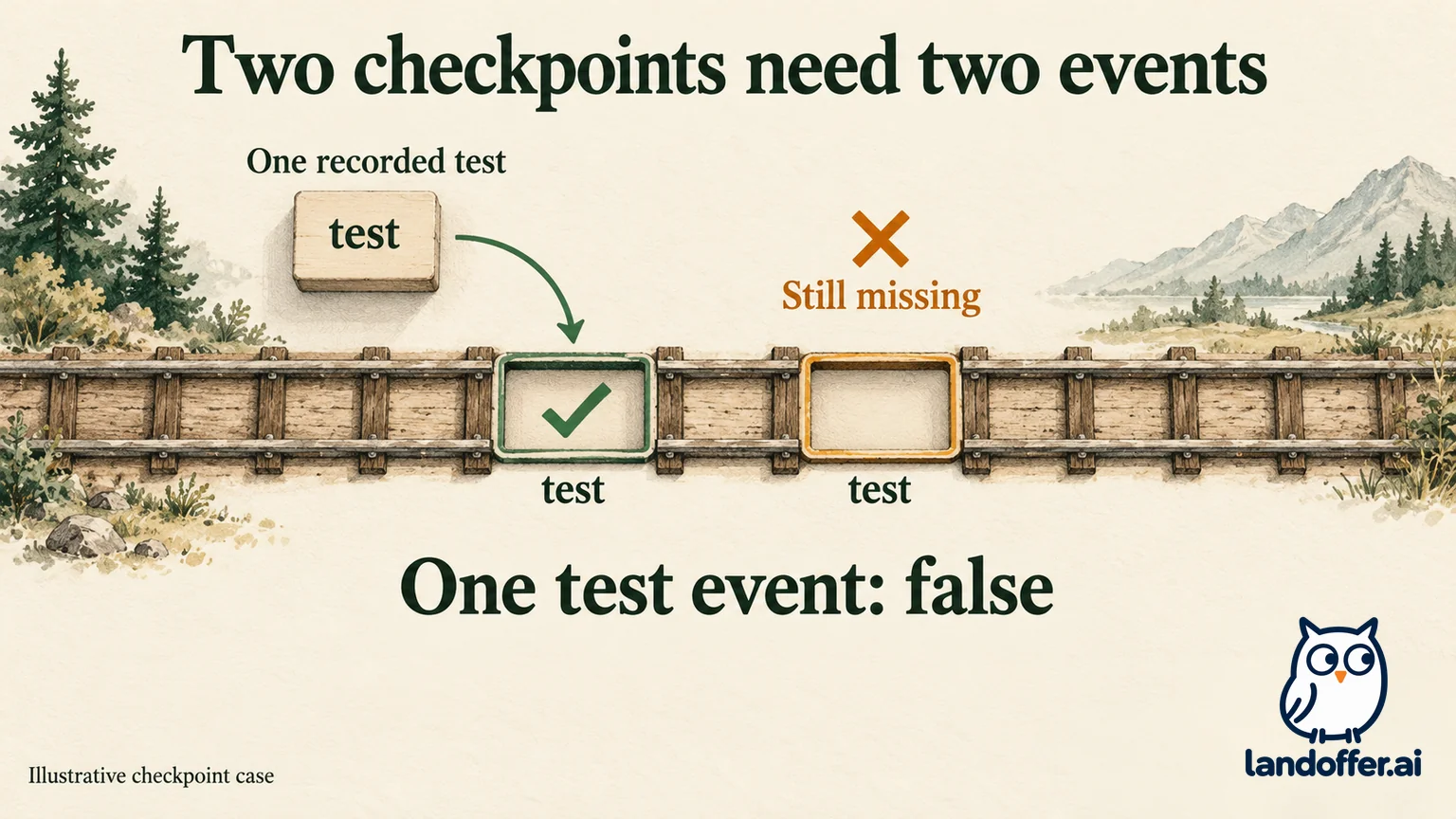
Suppose the recorded events are build, test, test, deploy. The requested checkpoints are test, test, deploy. The question for this example is whether distinct events satisfy those checkpoints in order. Extra events may occur between checkpoints, but a single event cannot satisfy two requested occurrences.
| Event examined | Next checkpoint before the event | Action | Checkpoints consumed afterward |
|---|---|---|---|
| build | first test | Skip unrelated event | 0 |
| first test | first test | Consume this checkpoint | 1 |
| second test | second test | Consume this checkpoint | 2 |
| deploy | deploy | Consume this checkpoint | 3 |
The result is true because all three checkpoints have distinct matching events. Now remove one test event: build, test, deploy, requesting test, test. The result becomes false. Checking only whether each requested value appears in a set would incorrectly accept that second case: membership loses the number of required occurrences and their order.
The position has a precise meaning: every checkpoint before it has already been matched to a distinct earlier event. A mismatch leaves that position unchanged. A match advances it once, so the same event cannot be reused for the next test. This is the invariant Leon should explain, rather than saying that a loop seems to work.
This short implementation keeps the position of the next checkpoint:
def ordered_checkpoints(
    events, required
):
    pos = 0
    for event in events:
        if pos == len(required):
            break
        if event == required[pos]:
            pos += 1
    return pos == len(required)
For our exercise, an empty checkpoint list is satisfied. That is an explicit choice in this example's specification. Other specifications may require non-empty inputs; do not silently change a platform prompt to match your preferred implementation.
Our local checks cover the valid repeated-test sequence, a missing second test, reversed order, empty inputs, an empty event list with a required test and a non-empty event list with no required checkpoints. All six produce the specified results. The implementation scans at most the event list once: O(n) time and O(1) auxiliary space, excluding the supplied inputs.
If Leon's answer fails the missing-test case, he has a concrete multiplicity error to investigate. If it fails reversed order, he has an ordering error. Those different diagnoses give him something specific to look for in an explanation and something specific to verify on his next attempt.
Leon can now explain why the position advances only after a match and why it never moves backward. He can also produce a counterexample to the set-based shortcut. That explanation is better evidence of understanding than recognizing a familiar video. To connect this to his own interview language, he would reconstruct the logic in Go and test it; we did not execute a Go implementation here.
Use the documented workspace, hints and explanations to support that kind of attempt-and-review process. Record whether the failed assumption concerned order, repeated values or an input boundary before opening a solution. Then return to the problem without the explanation visible. Passing the checked cases is useful. Explaining why each event can advance the checkpoint position only once helps Leon defend the solution when someone asks a follow-up.
Who should buy, and who should keep another resource
Consider AlgoExpert if you value a curated coding collection, conceptual videos and written implementations, and if the current bundle covers a preparation gap you will actually work on during the access year. Its public no-auto-renewal description makes the billing model clearer, but expiry still means losing access unless you repurchase.
Keep an existing resource when it already provides useful explanations and sufficient practice. Look for something more specific if your main need is employer-specific question targeting, live expert critique or a framework-heavy UI task that you have not confirmed in the relevant module. Certificates and referral descriptions do not establish an interview invitation or job outcome.
Identify one target loop, choose the relevant modules and try their public content before paying. Confirm the access term and total on the offer you intend to buy. Use LandOffer.ai to find roles worth preparing for, then judge the course by the work it helps you explain and reproduce.
Sources and Further Reading
- AlgoExpert purchase page: current All Access offer and included products
- Purchasing FAQ: free content, refunds, expiry and manual repurchase
- Content FAQ: workspace languages, Python videos and course structure
- AlgoExpert product description: coding, videos, assessments and peer practice
- Public Validate Subsequence workspace inspected for this review
- AlgoExpert terms and conditions
- AlgoExpert privacy policy