LandOffer
Job search
Aced vs. interviewing.io: Peer Mocks, Professional Interviewers, and Feedback Control
Choose reciprocal practice or a professional technical mock by your round, calendar, and feedback requirements.
Aced's reciprocal peer mocks fit repeated practice when you can spend time interviewing another candidate. Interviewing.io's professional technical mocks fit a focused need for outside assessment, subject to the round, quote, and available interviewer. Choose the specific route: Aced also offers separate human coaching, and interviewing.io also advertises free AI practice. Neither price nor anonymous presentation establishes the quality or confidentiality of a session.
This comparison uses current public descriptions and logged-out observations on October 14, 2026. We inspected Aced's monthly and annual pricing selections, expanded practice FAQs, and interviewing.io's FAQ and privacy page. We did not book, attend, record, or purchase a session. LandOffer publishes this comparison; browse recent roles on LandOffer.ai to identify the coding, design, or other round you need to practice before selecting access.

Start with the session you are comparing
The central difference is the relationship with the person across from you. In Aced Practice, you and another candidate take turns interviewing each other. On interviewing.io's professional route, the interviewer is selected through its described experience and trial-interview screening process. That difference changes what you owe the session and what you can reasonably request from it.
It does not create a clean human-versus-AI divide. Aced's practice page describes optional member AI feedback alongside peer feedback, and its pricing distinguishes an Expert AI suite. Interviewing.io's FAQ points to a free AI interviewer for coding and system design. A comparison that calls one brand “peer only” and the other “human only” would miss those separate offers.
| Criterion | Aced reciprocal peer route | Interviewing.io professional route |
|---|---|---|
| Person interviewing you | Another candidate matched for practice | A professional interviewer under the platform's screening description |
| Your session obligation | Prepare to interview the other person as well | Bring your attempted work and the requested technical focus |
| Matching question | Can the peer format and schedule support repeated practice? | Does the offered subject, interviewer, and quote fit the requested review? |
| Feedback to evaluate | A listener's reactions and supported comments on the attempt | Technical critique tied to the actual problem and your reasoning |
| Control to inspect | Display name, audio/video choice, AI feedback settings | Anonymous presentation and the separate policy for information disclosed |
Use the matrix to identify the session that addresses your current gap. A prepared peer can give a useful account of where your explanation became hard to follow. Ask a professional reviewer to connect the critique to a requirement, an input, or a moment in your explanation. You must connect either person's comment to the work you performed.
Aced: budget for both halves of practice
Aced describes a typical reciprocal session as approximately 30 minutes in each role, about an hour overall. Matching considers availability, current role, experience, and practice history. We read the matching explanation; we did not test whether a suitable partner would be available at a particular time. A displayed practice opportunity is not proof that your desired match will occur.
The interviewer half makes a difference to your calendar. Preparing a question and listening to another candidate can help you notice requirements you overlook in your own work. It also takes time. If you plan six one-hour reciprocal sessions, do not label all six hours “being interviewed.” Approximately three hours would be your candidate turns under the described format, with the other three spent interviewing.
Before joining, decide what feedback your partner can usefully supply. Ask them to note where you failed to state the output requirement or where they needed clarification. If they make a correctness claim, ask for the input that demonstrates it. Their experience level may differ from yours, so a specific example carries more value than an unsupported overall rating.
You also owe the same care in return. Read the assigned problem and understand its contract before interviewing someone else. For this interval exercise, prepare the adjacent and nested cases before your interviewer turn. You can then explain a failure with an input your partner can inspect.
Interviewing.io: match the review to the round
The current FAQ describes technical interviews covering fundamentals, algorithms, and system design, with a backend or full-stack emphasis. It says company-specific interviewer requests are possible and that human interviews start at $179, with price varying by subject and company preference. Those are public descriptions, not a final quote or a confirmed appointment.
A company preference and a feedback need are different requirements. You may want someone familiar with a company's style, but still need to specify the round, expected level, and weakness you want examined. “Review whether I clarify interval boundaries before choosing an algorithm” is more actionable than “make this feel like a famous employer.” An interviewer cannot examine a concern you never make visible in your attempt.
Its described screening process is useful context for why someone might pay for the professional route. It does not prove that every reviewer will be equally helpful for your chosen problem. Inspect the session offer, ask how the subject and level are matched, and evaluate the returned critique against what happened in the mock.
We did not establish a universal session duration or a guaranteed scheduling lead time from the inspected FAQ. If you only have one free afternoon, confirm that the appointment and debrief fit it. Do not build a deadline plan around an assumed instant match.
Read Aced's billing selection correctly
On the current Aced pricing page, Basic displayed $0 and five peer mocks per month. Selecting Monthly displayed Pro at $79 and Expert at $99 per month. Pro advertised course access and unlimited peer mocks; Expert advertised the fuller AI suite. The default annual selection displayed lower monthly equivalents, $12 and $20. We did not complete checkout or verify the exact annual charge.
The annual equivalent is not a monthly subscription you can purchase at that displayed amount. Choose the billing period deliberately. Aced’s pricing page directs buyers to add coaching separately; the inspected membership cards do not include a human session. Aced's support page describes normal coaching as a separate purchase; particular programs can have their own expressly stated inclusions.
Choose membership for an access gap you actually have. If five free peer credits and the available material cover your plan, a paid tier is not required merely because you prefer a polished dashboard. If you need more reciprocal sessions in the same monthly cycle and specific course access, Pro may address those constraints. Human expert critique remains a separate decision.
Feedback controls and anonymity answer different questions
Aced's practice FAQ says your partner sees your public display name and that audio-only practice is an option. It describes member AI transcripts and feedback for named interview types, with an opt-out in account settings. We read those controls but did not change an account setting. Opting out of AI feedback should not be assumed to erase every recording or all platform data.
Interviewing.io's FAQ describes voice without video and limited interviewer access to your personal information. Its privacy policy, labeled effective April 25, 2024 and still accessible during our inspection, separately warns that interview disclosures are not confidential and that participant sharing cannot be guaranteed against. Anonymous presentation therefore does not make a proprietary incident or private code safe to disclose.
For either service, use a synthetic problem when the details of your work are sensitive. Removing an employer name may still leave a recognizable architecture, incident, or customer record. You can practice stating assumptions and defending a solution without supplying private logs. Your feedback request should identify the skill, not reveal the system that taught you it.
For the interval task, save the half-open contract, the adjacent-window input, the reviewer’s comment, and the revised merge condition. That gives you something to retest even if a transcript is unavailable. It also avoids assuming that an alias, a feedback toggle, and recording retention are the same control.
Worked choice: six repetitions or one outside review
Morgan is a fictional candidate who wants six reciprocal coding mocks plus some course study over four weeks. Morgan has eight full hours available and a $90 budget. All six planned mocks fall within one monthly credit cycle for this example. Basic's advertised five credits leave one planned session uncovered; we do not assume that a new cycle will arrive in time.
One monthly Pro offer at the displayed $79 fits Morgan's stated budget and advertised access needs, leaving $11 unallocated. Six reciprocal sessions consume six hours, approximately three as candidate and three as interviewer. Two hours remain for the targeted course work. This is a completed planning allocation, not a schedule we booked or proof that six suitable peers will be available.
Morgan's reason for the paid tier is the sixth repetition plus course access. One interviewing.io human interview at the advertised starting price would already exceed the $90 budget and would not replace six practice turns. Morgan can instead revise the plan to five free sessions if the sixth is optional. An annual membership is not necessary to resolve this four-week example.
Jae, another fictional candidate, has a $230 budget, one free afternoon, and an attempted backend coding round. Jae wants a reviewer to assess how assumptions are established before the algorithm, and does not want an obligation to interview a peer during that appointment. The professional route is a candidate choice if the actual subject, available time, and final quote fit those constraints.
At the $179 starting price, $51 would remain from the budget, but a company-specific or subject-specific quote could change that calculation. Jae should request the actual offer rather than treating the starting amount as a reservation. Aced's separate human coaching could also fit if a suitable coach and quote are available; buying its peer membership would not by itself supply the requested professional review.
Morgan and Jae are choosing different work. A higher budget does not invalidate Morgan's repetition plan, and access to many peer sessions does not solve Jae's need for a specified outside assessment. The useful comparison is the gap each session will examine.
Worked brief: make an interval assumption visible
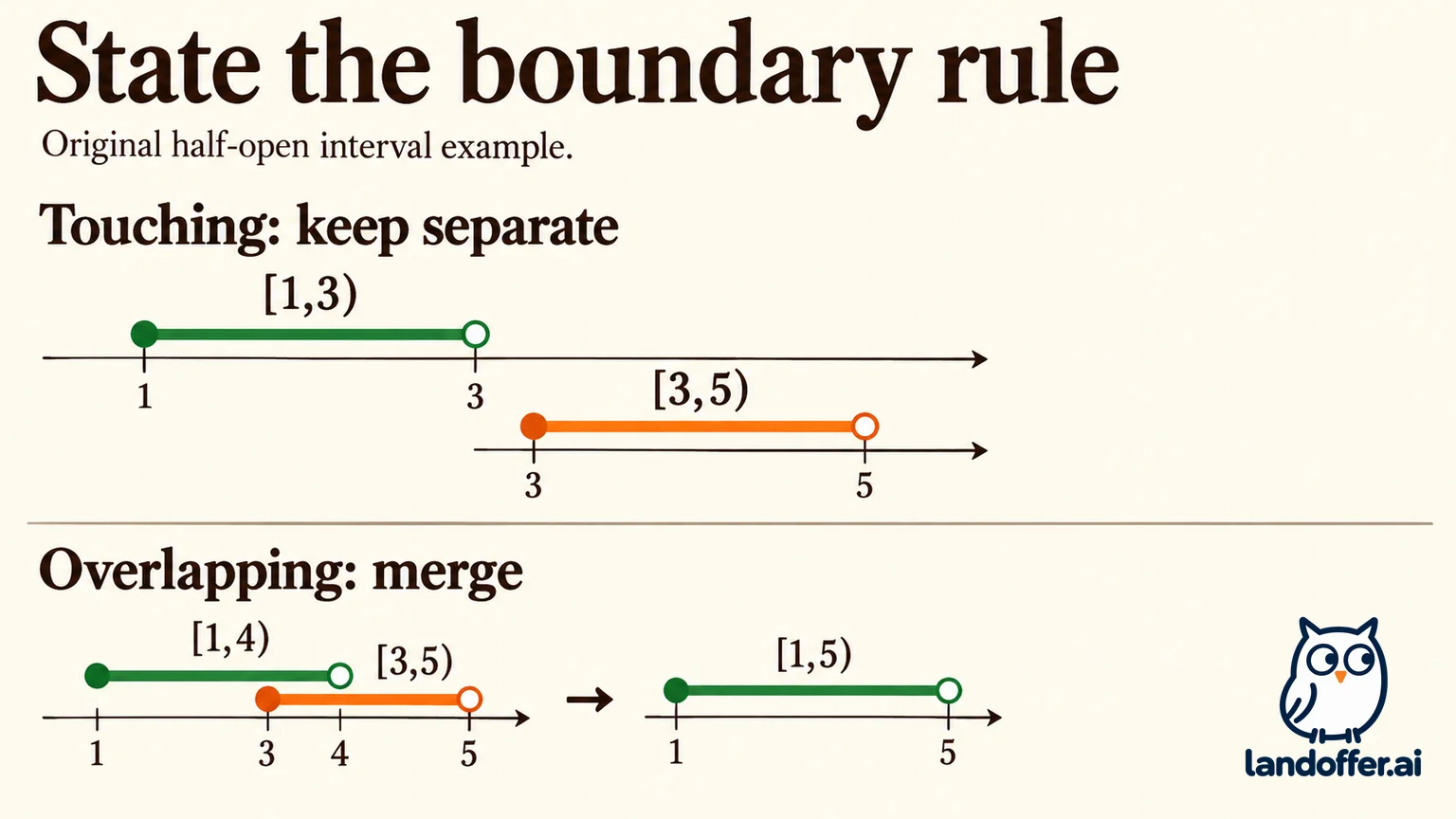
Here is an original synthetic exercise, not a paid question or a vendor session transcript. The task is to merge overlapping maintenance windows represented as half-open intervals. In this exercise, adjacent windows stay separate, and an interval whose end is not greater than its start is invalid. Stating those rules is part of the attempt.
For input 1 ≤ t < 3 and 3 ≤ t < 5, the expected result is two windows. They touch at three but share no included point. For 1 ≤ t < 4 and 3 ≤ t < 5, the expected result is 1 ≤ t < 5: those windows overlap. A candidate who merges whenever the next start is less than or equal to the previous end silently changes the adjacency rule.
The correction is to merge only when the next start is strictly less than the current end, after sorting valid intervals by start. A nested input, 1 ≤ t < 6 and 2 ≤ t < 3, should still return 1 ≤ t < 6. The end must stay at the greater value rather than shrink to the later interval's end. Our local checks verify these examples and rejection of 2 ≤ t < 2; they are checks of our teaching example, not platform execution.
For a peer mock, the finished feedback request is: “Note whether I state the adjacency rule before coding. If my result violates it, identify the smallest input that shows the problem.” That request lets a peer report an observed omission and demonstrate it with a concrete case.
For a professional review, the finished brief adds: “Assess how I discover an ambiguous boundary rule, explain its effect on the merge condition, and defend the nested-window case. Keep the debrief tied to the attempt rather than substituting a different problem.” The request defines expert judgment you can evaluate afterward.
Both briefs use synthetic windows and contain no employer, production schedule, or private code. After feedback, redo the problem with a different adjacency policy. If adjacent windows should now merge, the condition changes. That retest shows whether you understand the contract, rather than merely memorizing a particular comparison operator.
Choose the route before choosing more access
Write the target round, one attempted problem, and the feedback you need in a short session brief. Then check the appointment format, candidate time, access allowance, and data controls for that specific service. If reciprocal practice already supplies the repetitions and useful reactions you need, keep it. If a defined technical judgment remains unresolved, consider a matched professional session with a confirmed quote.
Use recent roles on LandOffer.ai to choose the responsibility behind that brief, then preserve one concrete correction after the mock. Job discovery helps define the target. The attempted work and the redo establish what your practice actually changed.