LandOffer
Job search
Explain a Move from Academia to Industry in a Recruiter Conversation
Connect an existing industry resume to a truthful explanation of your target work, research contribution, continuing interests and unresolved commitments.
Explain an academic-to-industry move through the work you want to do next, one relevant contribution you can substantiate, and the responsibilities you are prepared to accept. You do not need a story about disliking academia. Give the recruiter enough context to connect your research experience to this particular role.
This guide assumes you already have an industry resume. Keep it nearby, choose a real target posting, and prepare the spoken explanation that connects them. You can browse recent roles on LandOffer.ai to identify work worth discussing, without assuming that a research background satisfies every engineering requirement.

Give the recruiter a reason to continue the conversation
A useful opening answers three questions: what kind of work are you pursuing, why does it interest you, and what have you done that is relevant? Your dissertation subject can supply context, but the opening need not explain the entire field before reaching your contribution.
Harvard MCS's interviewing guidance identifies reasons for applying, potential contributions and transferable skills among the things interviewers assess. It also recommends concrete examples that explain your own actions and connect them to the position. This is general career guidance, not evidence of a particular recruiter's scoring rubric.
Choose a positive reason that is true. You might want to maintain tools used by others, work with a specific class of system, or spend more time translating analysis into an operational decision. Those are different motivations. Avoid saying that industry always offers immediate impact, better collaboration or less uncertainty; the actual team may not match that expectation.
Finish the opening with a contribution the recruiter can explore. A short account of a data-validation decision lets the recruiter ask who wrote the code, how it was checked and where your experience stops. An inventory of every instrument and publication can leave the next question unclear.
LandOffer.ai publishes this guide. We reviewed three public Harvard career-communication resources on October 21, 2026. The worked conversations below are original fictional teaching examples, not real calls, recruiter feedback or measured hiring outcomes. Their wording should never substitute for your own experience.
Translate the contribution without changing its meaning
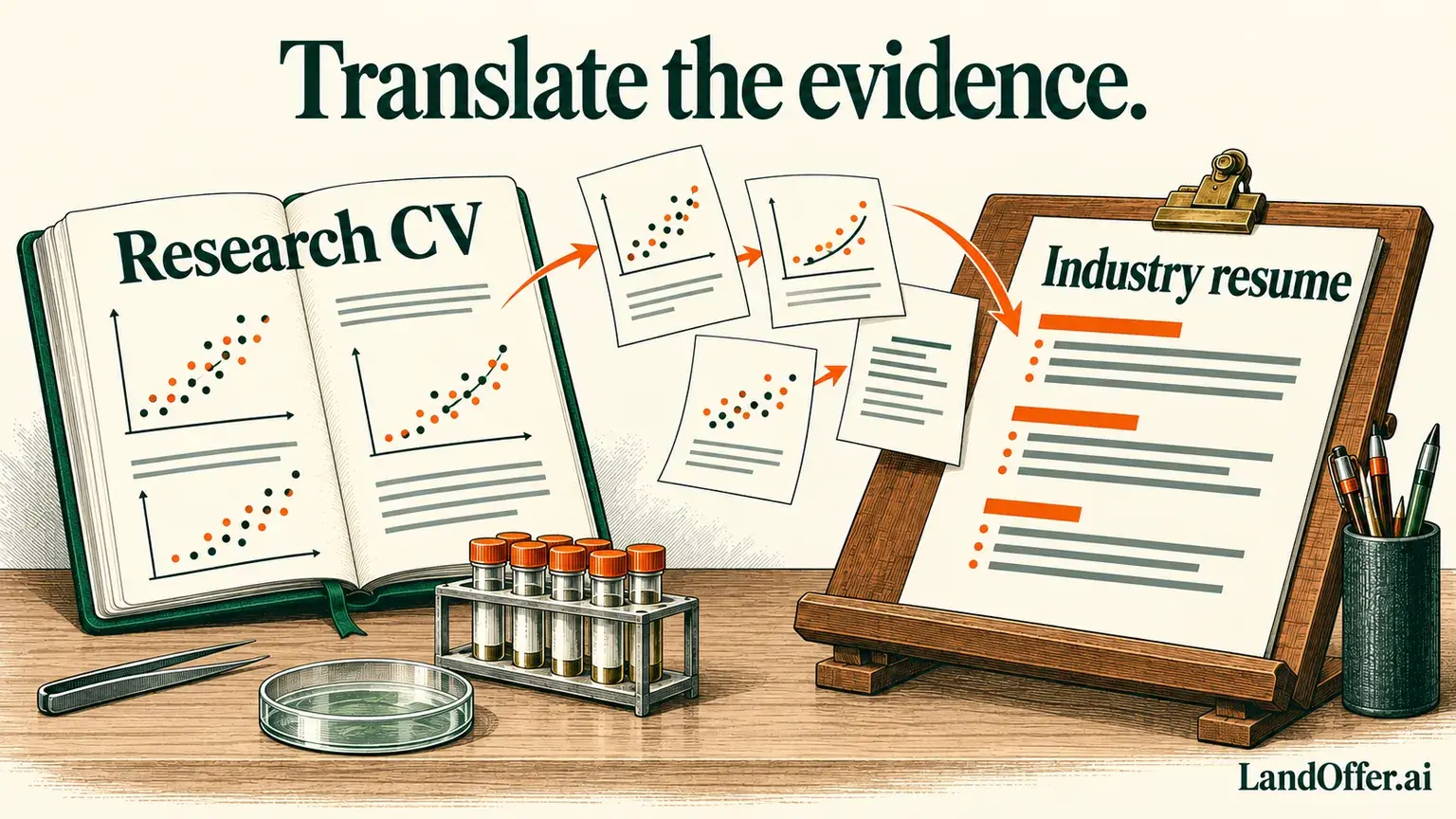
Start with one item already on your industry resume. Write down the problem, your action, the observable output and the limit of your responsibility. Translate specialist language only as far as accuracy permits. A pipeline used by a lab remains a lab pipeline; it does not become a customer-facing production platform because that sounds more commercial.
The September 15, 2026 Harvard MCS graduate-industry resume discussion emphasizes explaining contributions and being ready to discuss anything listed on the resume. It reports panel guidance, rather than establishing a universal industry hiring rule. Here, its practical implication is to keep your spoken account consistent with the resume you already submitted.
Distinguish your work from shared outcomes. You can describe writing validation rules, investigating a discrepancy or documenting a handoff without claiming to have led the entire study. If another researcher chose the method, say so when that distinction matters. If you never measured time saved, use the output you can verify instead of inventing an efficiency percentage.
Then connect the evidence to a responsibility in the posting. “I wrote a reproducible import check” can support a conversation about data quality. It does not establish experience operating a distributed service, responding to production incidents or managing a commercial roadmap. Acknowledging the gap gives the recruiter an accurate question to take to the hiring team.
Worked opening: explain a move toward data engineering
Fictional case: Leena is finishing a research appointment and has already prepared an industry resume. Her invented target posting asks for Python, SQL, data-quality checks and collaboration with analysts. It also mentions cloud orchestration, which she has not used professionally. This is a hypothetical role brief, not an open vacancy or eligibility finding.
Her original opening is vague: “I have a strong research background and want to move to industry to have more impact.” She replaces it using this completed evidence map:
| Recruiter question | Leena's fictional evidence | Wording decision |
|---|---|---|
| What work do you want? | The target brief emphasizes reliable data inputs and analyst collaboration. | Name data engineering and those responsibilities. |
| Why this move? | She most enjoyed making a recurring lab process understandable to its next operator. | Explain the work preference, without criticizing research. |
| What did you personally do? | Wrote Python checks for missing sample identifiers and documented the review process. | Use “I” for those actions, not for the whole research project. |
| What changed? | A review list identified ambiguous rows before the next analysis; no time-saving study occurred. | Describe the output, not an invented business metric. |
| What remains a gap? | Local scripts and SQL practice, but no professional cloud-orchestration ownership. | Keep the gap visible and ask about the team's expectations. |
Her complete revised introduction reads:
I'm looking for data engineering work where I can help make recurring data processes reliable and understandable to the people using them. During my research appointment, I particularly enjoyed the engineering part of our workflow. I wrote Python checks for missing sample identifiers and a guide explaining how to review ambiguous rows before analysis. Another researcher owned the scientific method; my contribution was the input checks and handoff documentation. Your description of data-quality work with analysts is why this role caught my attention. My experience has been with local research workflows, so I would like to understand how much prior cloud-orchestration ownership you need in this position.
The revised answer gives a direction, a personal action, a bounded output and a role-specific question. It does not claim that Leena built the team's whole pipeline, ran a commercial service or already meets the cloud requirement. The recruiter can explore whether the gap is trainable or essential for this opening.
If asked for more detail, her next answer is ready: “The check separated rows with absent identifiers from rows needing manual clarification. I wrote the checks and documented the review steps. I did not decide the scientific inclusion criteria.” That follow-up adds technical ownership without turning the opening into a dissertation defense.
Leena's completed preparation decision is to keep the revised introduction and investigate the cloud requirement. The revised wording identifies the facts Leena is prepared to discuss. No recruiter heard this fictional answer, so it provides no evidence of persuasion, qualification or interview success.
Answer why now without inventing dissatisfaction
The transition date and the motivation are related but different. You may be completing a degree, reaching the end of an appointment, or making a considered change while employed. State the circumstance accurately, then explain the work you are seeking. An end date alone does not explain why this role fits; a motivation alone does not establish when you can begin.
You can value academic research and still prefer a different mix of responsibilities. Avoid turning a complicated experience into an accusation because you think a recruiter expects a dramatic reason for leaving. If there was a genuine difficulty, describe only what you are comfortable sharing and move toward what you learned and want next.
Do not claim that you have abandoned research if you intend to keep pursuing it. Industry includes research roles, applied-science work, engineering roles that support researchers, and jobs with little research responsibility. Ask how this team's work is divided before promising that its balance suits you.
Harvard Catalyst's pre-interview guidance recommends connecting your story and skills to the institution's priorities and preparing questions about the work. Its scientific-communication context is useful here, but it supplies no guarantee that a particular employer will accommodate a publication or outside commitment.
Worked follow-up: clarify research expectations and remaining work
Separate fictional case: Tomas is seeking an applied software role after a research position. He remains interested in research. He also has an unfinished manuscript from his current appointment. He has not agreed a handoff date or established what any future employer would permit. No real employer, supervisor or candidate is represented.
He prepares three complete answers rather than an unconditional promise:
“Do you want to keep doing research?”
Yes. I enjoy testing an idea carefully, and I want to use that habit in software work. What attracts me to this role is the opportunity to build and maintain the tools that support analysis. I am not assuming that publishing papers is part of the job. Could you explain how the team divides time between exploratory work, implementation and ongoing maintenance?
“Would you be happy maintaining something after the experiment?”
That is part of what I want to do. In my previous research project, I wrote a setup guide and revised an import check after another user found an unclear error message. That was a small internal workflow, not an on-call production service. I would like to learn what maintenance and incident responsibilities this role actually carries before representing that I have already done the same work.
“Can you start next month with no other commitments?”
I cannot confirm that yet. I have a manuscript and project handoff to resolve with my current group. I can explain the remaining tasks, but the completion date has not been agreed. What start-date range does the team need? I would confirm my availability only after clarifying those responsibilities and the applicable expectations for any continuing work.

He completes this private follow-up record immediately after preparing the answers:
| Item | What is established in the fictional case | What remains unresolved |
|---|---|---|
| Desired work | Build and maintain tools supporting analysis. | Actual balance of exploration and maintenance. |
| Relevant contribution | Wrote setup guidance and improved an import error message. | Whether the team needs prior production ownership. |
| Research interest | Still values inquiry and would welcome relevant work. | Whether publication is expected, permitted or absent from the role. |
| Current obligations | Manuscript and project handoff remain. | Agreed scope, dates and any continuing involvement. |
| Availability | No unconditional start date has been given. | Candidate's confirmed date and employer's acceptable range. |
Tomas's completed choice is to continue the conversation while leaving availability unconfirmed. His answers reveal a potential fit and several open questions. They do not convert an unfinished commitment into spare-time work that a new employer has already approved.
The distinction matters even when everyone seems supportive. A recruiter may be able to clarify the role while lacking authority to settle authorship, confidentiality, outside-work rules or the current supervisor's handoff expectations. Get the relevant facts from the people responsible before making a commitment; this article does not interpret an employment agreement or decide whether ongoing work is permitted.
Rehearse for accuracy and useful follow-ups
Read the introduction aloud, then remove any phrase you cannot explain with a concrete example. Check whether a listener can identify the target work, your action and one relevant limitation. You can ask a practice partner to repeat what they understood, but their response is feedback on that rehearsal, not evidence of how an employer will evaluate you.
Keep the opening focused on target work and one contribution; reserve the input checks, review steps and ownership details for follow-up questions. Do not memorize an answer so tightly that you miss the actual question. If the recruiter asks about availability, answer that first; if they ask about motivation, explain the preference before adding technical detail. No universal speaking-time limit follows from these examples.
After the conversation, separate what you said from what was confirmed. Record the role requirements the recruiter actually described and any follow-up you agreed. Leave unanswered questions open instead of upgrading a friendly response into an offer or a resolved qualification gap.
Choose one posting and use a contribution already on your resume to prepare the opening. Write down the unanswered requirement or commitment that you need the recruiter to clarify. Browse recent roles on LandOffer.ai, then connect your existing resume to the actual work rather than rehearsing a generic explanation for leaving academia.